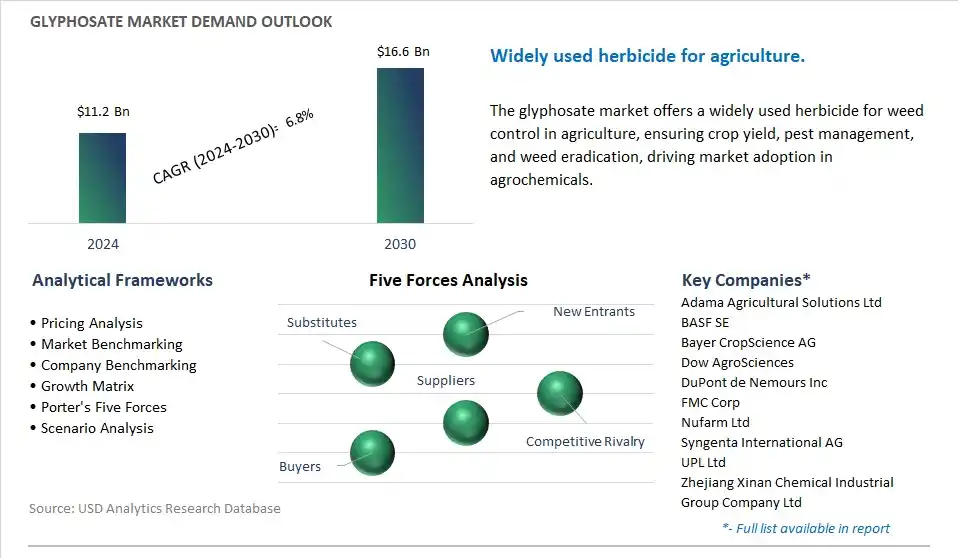
The global Glyphosate Market is poised to register a 6.8% CAGR from $11.2 Billion in 2024 to $16.6 Billion in 2030.
The global Glyphosate Market Study analyzes and forecasts the market size across 6 regions and 24 countries for diverse segments -By Type (GM Crops, Non-GM Crops), By Application (Grains and Cereals, Pulses and Oilseeds, Fruits and Vegetables, Commercial Crops, Others).
An Introduction to Global Glyphosate Market in 2024
The future of the glyphosate market is influenced by trends such as agriculture modernization, weed resistance management, and environmental sustainability driving innovation in herbicide formulations, application techniques, and regulatory compliance. Glyphosate, a broad-spectrum herbicide widely used in agriculture for weed control, is facing increasing scrutiny due to concerns about its potential environmental and health impacts. Key trends shaping this market include advancements in glyphosate formulations such as glyphosate-based herbicides with adjuvants, surfactants, and tank-mix partners to enhance efficacy, reduce off-target drift, and mitigate weed resistance issues, the development of precision application technologies such as GPS-guided sprayers, drone-based spraying systems, and sensor-enabled equipment to optimize herbicide use, minimize environmental impact, and improve crop yields in precision agriculture practices, and the adoption of integrated weed management strategies such as crop rotation, cover cropping, and alternative herbicides to reduce reliance on glyphosate and mitigate the development of herbicide-resistant weeds. As agriculture stakeholders seek sustainable, effective solutions for weed management while addressing regulatory restrictions and consumer concerns, the demand for glyphosate products that offer efficacy, safety, and environmental compatibility is expected to drive market growth and stimulate further innovation in herbicide technology and practices.
Glyphosate Market Competitive Landscape
The market report analyses the leading companies in the industry including Adama Agricultural Solutions Ltd, BASF SE, Bayer CropScience AG, Dow AgroSciences, DuPont de Nemours Inc, FMC Corp, Nufarm Ltd, Syngenta International AG, UPL Ltd, Zhejiang Xinan Chemical Industrial Group Company Ltd.
Glyphosate Market Dynamics
Glyphosate Market Trend: Increasing Adoption of Herbicide-resistant Genetically Modified Crops
A significant trend in the glyphosate market is the increasing adoption of herbicide-resistant genetically modified (GM) crops, particularly in major agricultural regions worldwide. Glyphosate, a broad-spectrum herbicide, is widely used in conjunction with GM crops engineered to tolerate its application, such as glyphosate-resistant soybeans, corn, and cotton. The adoption of herbicide-resistant GM crops allows farmers to effectively control weeds while minimizing crop damage, reducing labor costs, and enhancing crop yields. With the growing need for sustainable agriculture practices, coupled with the challenge of weed resistance to traditional herbicides, there is a continued shift towards the cultivation of herbicide-tolerant crops and the use of glyphosate-based weed management systems. The trend drives market demand for glyphosate as a key component in modern agricultural practices, fostering opportunities for market growth and expansion in the agrochemical industry.
Glyphosate Market Driver: Rising Global Demand for Crop Protection Solutions
The primary driver for the glyphosate market is the rising global demand for crop protection solutions to address weed control challenges and optimize agricultural productivity. Weeds compete with crops for essential resources such as nutrients, water, and sunlight, leading to yield losses and reduced farm profitability. Glyphosate, with its systemic mode of action and broad spectrum of weed control, offers an effective and cost-efficient solution for weed management in various crops, including row crops, cereals, and specialty crops. As global population growth, changing dietary preferences, and climate variability exert pressure on agricultural systems to produce more food with fewer resources, there is an increasing need for sustainable and efficient crop protection technologies to safeguard crop yields and ensure food security. Glyphosate plays a critical role in integrated weed management strategies, enabling farmers to adopt conservation tillage practices, reduce soil erosion, and preserve natural habitats while maintaining weed-free fields and maximizing crop productivity. The rising demand for crop protection solutions drives market growth for glyphosate, as farmers seek effective tools to combat weed infestations and optimize agricultural output, creating opportunities for market expansion and innovation in the agrochemical sector.
Glyphosate Market Opportunity: Expansion into Non-agricultural Applications
An opportunity exists for companies operating in the glyphosate market to expand into non-agricultural applications, such as vegetation management, industrial weed control, and urban landscaping. While glyphosate is primarily known for its use in agriculture, it also finds applications in non-crop areas for controlling unwanted vegetation, invasive species, and nuisance weeds. Glyphosate-based herbicides are commonly used by municipalities, transportation departments, utility companies, and property managers for maintaining rights-of-way, roadsides, industrial sites, and recreational areas. Additionally, glyphosate products are utilized in forestry operations, turf management, and residential weed control applications. By diversifying their product offerings and targeting non-agricultural markets, companies can capitalize on the versatility and effectiveness of glyphosate formulations in managing vegetation and controlling weeds in various settings outside of traditional agricultural fields. Expanding into non-agricultural applications presents opportunities for market growth and revenue diversification, allowing companies to leverage their expertise in herbicide technology and expand their customer base beyond the agricultural sector.
Glyphosate Market Ecosystem
The glyphosate Market Ecosystem begins with raw material production, where chemical manufacturers including BASF SE and Lanxess AG produce N-Phosphonomethyl glycine (NPMG) and methylamine, key ingredients for glyphosate synthesis. Glyphosate manufacturing follows, with companies including Bayer CropScience AG, Corteva, and Sinochem Corporation producing glyphosate technical, the active ingredient.
Chinese manufacturers including Lier Chemical Co., Ltd. have gained significant market share recently. Producers further formulate glyphosate into various formulations, either independently or through integrated capabilities.
Distribution channels play a crucial role, with direct sales by large agrochemical companies, distribution through agricultural retailers, and emerging online retail channels, ensuring glyphosate products reach farmers efficiently. Farmers, the primary end users, utilize glyphosate to control weeds in crops including corn, soybeans, and cotton, improving yields and farm efficiency.
Glyphosate Market Share Analysis: GM Crops held the dominant revenue share in 2024
The largest segment in the Glyphosate Market is the GM Crops segment. This dominance can be attributed to diverse factors. Glyphosate is widely known as a broad-spectrum herbicide that effectively controls a broad range of weeds and grasses. Genetically modified (GM) crops, also known as glyphosate-tolerant crops, have been genetically engineered to withstand glyphosate application, allowing farmers to apply the herbicide directly to the crops without causing harm. This trait offers significant advantages to farmers, including simplified weed management, increased crop yields, and reduced labor and production costs. As a result, glyphosate-tolerant GM crops, such as soybeans, corn, cotton, and canola, have seen widespread adoption in major agricultural regions worldwide. Additionally, the availability of glyphosate-tolerant crop varieties from leading seed companies further contributes to the dominance of the GM Crops segment in the Glyphosate Market. Further, the continuous expansion of GM crop cultivation, driven by the desire for higher yields, improved efficiency, and weed management convenience, sustains the demand for glyphosate herbicides in GM crop production systems. As a result, the GM Crops segment holds the largest share in the Glyphosate Market due to its widespread adoption and inherent compatibility with glyphosate-based herbicides.
Glyphosate Market Share Analysis: Pulses and Oilseeds is the fastest growing market segment over the forecast period to 2030
The fastest-growing segment in the Glyphosate Market is the Pulses and Oilseeds segment. This growth is driven by pulses and oilseeds, such as soybeans, canola, and pulses like lentils and chickpeas, are major crops cultivated globally for their high protein and oil content, making them essential components of human and animal diets. Glyphosate is commonly used in pulses and oilseeds cultivation to control weeds effectively, ensuring higher crop yields and quality. Additionally, the adoption of conservation tillage practices, which involve minimal soil disturbance and the use of herbicides for weed control, has increased in pulses and oilseeds production systems. Glyphosate plays a crucial role in conservation tillage by enabling farmers to manage weeds efficiently while preserving soil health and moisture, reducing erosion, and enhancing soil structure. In addition, the increasing demand for vegetable oils, protein-rich foods, and plant-based products has led to expanded acreage and production of oilseeds and pulses globally, driving the demand for glyphosate herbicides in these crops. Further, advancements in agricultural technologies, seed genetics, and farming practices continue to support the growth of the Pulses and Oilseeds segment in the Glyphosate Market. As farmers seek to optimize crop production and meet the rising demand for food and feed, the use of glyphosate in pulses and oilseeds cultivation is expected to continue its rapid growth trajectory.
Glyphosate Market Report Scope-
By Type
GM Crops
Non-GM Crops
By Application
Grains and Cereals
Pulses and Oilseeds
Fruits and Vegetables
Commercial Crops
Others
Glyphosate Market Companies Profiled
Adama Agricultural Solutions Ltd
BASF SE
Bayer CropScience AG
Dow AgroSciences
DuPont de Nemours Inc
FMC Corp
Nufarm Ltd
Syngenta International AG
UPL Ltd
Zhejiang Xinan Chemical Industrial Group Company Ltd
*- List Not Exhaustive
TABLE OF CONTENTS
1 Introduction to 2024 Glyphosate Market
1.1 Market Overview
1.2 Quick Facts
1.3 Scope/Objective of the Study
1.4 Market Definition
1.5 Countries and Regions Covered
1.6 Units, Currency, and Conversions
1.7 Industry Value Chain
2 Research Methodology
2.1 Market Size Estimation
2.2 Sources and Research Methodology
2.3 Data Triangulation
2.4 Assumptions and Limitations
3 Executive Summary
3.1 Global Glyphosate Market Size Outlook, $ Million, 2021 to 2030
3.2 Glyphosate Market Outlook by Type, $ Million, 2021 to 2030
3.3 Glyphosate Market Outlook by Product, $ Million, 2021 to 2030
3.4 Glyphosate Market Outlook by Application, $ Million, 2021 to 2030
3.5 Glyphosate Market Outlook by Key Countries, $ Million, 2021 to 2030
4 Market Dynamics
4.1 Key Driving Forces of Glyphosate Industry
4.2 Key Market Trends in Glyphosate Industry
4.3 Potential Opportunities in Glyphosate Industry
4.4 Key Challenges in Glyphosate Industry
5 Market Factor Analysis
5.1 Value Chain Analysis
5.2 Competitive Landscape
5.2.1 Global Glyphosate Market Share by Company (%), 2023
5.2.2 Product Offerings by Company
5.3 Porter’s Five Forces Analysis
5.4 Pricing Analysis and Outlook
6 Growth Outlook Across Scenarios
6.1 Growth Analysis-Case Scenario Definitions
6.2 Low Growth Scenario Forecasts
6.3 Reference Growth Scenario Forecasts
6.4 High Growth Scenario Forecasts
7 Global Glyphosate Market Outlook by Segments
7.1 Glyphosate Market Outlook by Segments, $ Million, 2021- 2030
By Type
GM Crops
Non-GM Crops
By Application
Grains and Cereals
Pulses and Oilseeds
Fruits and Vegetables
Commercial Crops
Others
8 North America Glyphosate Market Analysis and Outlook To 2030
8.1 Introduction to North America Glyphosate Markets in 2024
8.2 North America Glyphosate Market Size Outlook by Country, 2021-2030
8.2.1 United States
8.2.2 Canada
8.2.3 Mexico
8.3 North America Glyphosate Market size Outlook by Segments, 2021-2030
By Type
GM Crops
Non-GM Crops
By Application
Grains and Cereals
Pulses and Oilseeds
Fruits and Vegetables
Commercial Crops
Others
9 Europe Glyphosate Market Analysis and Outlook To 2030
9.1 Introduction to Europe Glyphosate Markets in 2024
9.2 Europe Glyphosate Market Size Outlook by Country, 2021-2030
9.2.1 Germany
9.2.2 France
9.2.3 Spain
9.2.4 United Kingdom
9.2.4 Italy
9.2.5 Russia
9.2.6 Norway
9.2.7 Rest of Europe
9.3 Europe Glyphosate Market Size Outlook by Segments, 2021-2030
By Type
GM Crops
Non-GM Crops
By Application
Grains and Cereals
Pulses and Oilseeds
Fruits and Vegetables
Commercial Crops
Others
10 Asia Pacific Glyphosate Market Analysis and Outlook To 2030
10.1 Introduction to Asia Pacific Glyphosate Markets in 2024
10.2 Asia Pacific Glyphosate Market Size Outlook by Country, 2021-2030
10.2.1 China
10.2.2 India
10.2.3 Japan
10.2.4 South Korea
10.2.5 Indonesia
10.2.6 Malaysia
10.2.7 Australia
10.2.8 Rest of Asia Pacific
10.3 Asia Pacific Glyphosate Market size Outlook by Segments, 2021-2030
By Type
GM Crops
Non-GM Crops
By Application
Grains and Cereals
Pulses and Oilseeds
Fruits and Vegetables
Commercial Crops
Others
11 South America Glyphosate Market Analysis and Outlook To 2030
11.1 Introduction to South America Glyphosate Markets in 2024
11.2 South America Glyphosate Market Size Outlook by Country, 2021-2030
11.2.1 Brazil
11.2.2 Argentina
11.2.3 Rest of South America
11.3 South America Glyphosate Market size Outlook by Segments, 2021-2030
By Type
GM Crops
Non-GM Crops
By Application
Grains and Cereals
Pulses and Oilseeds
Fruits and Vegetables
Commercial Crops
Others
12 Middle East and Africa Glyphosate Market Analysis and Outlook To 2030
12.1 Introduction to Middle East and Africa Glyphosate Markets in 2024
12.2 Middle East and Africa Glyphosate Market Size Outlook by Country, 2021-2030
12.2.1 Saudi Arabia
12.2.2 UAE
12.2.3 Oman
12.2.4 Rest of Middle East
12.2.5 Egypt
12.2.6 Nigeria
12.2.7 South Africa
12.2.8 Rest of Africa
12.3 Middle East and Africa Glyphosate Market size Outlook by Segments, 2021-2030
By Type
GM Crops
Non-GM Crops
By Application
Grains and Cereals
Pulses and Oilseeds
Fruits and Vegetables
Commercial Crops
Others
13 Company Profiles
13.1 Company Snapshot
13.2 SWOT Profiles
13.3 Products and Services
13.4 Recent Developments
13.5 Financial Profile
Adama Agricultural Solutions Ltd
BASF SE
Bayer CropScience AG
Dow AgroSciences
DuPont de Nemours Inc
FMC Corp
Nufarm Ltd
Syngenta International AG
UPL Ltd
Zhejiang Xinan Chemical Industrial Group Company Ltd
14 Appendix
14.1 Customization Offerings
14.2 Subscription Services
14.3 Related Reports
14.4 Publisher Expertise
By Type
GM Crops
Non-GM Crops
By Application
Grains and Cereals
Pulses and Oilseeds
Fruits and Vegetables
Commercial Crops
Others
Countries Analyzed
North America (US, Canada, Mexico)
Europe (Germany, UK, France, Spain, Italy, Russia, Rest of Europe)
Asia Pacific (China, India, Japan, South Korea, Australia, South East Asia, Rest of Asia)
South America (Brazil, Argentina, Rest of South America)
Middle East and Africa (Saudi Arabia, UAE, Rest of Middle East, South Africa, Egypt, Rest of Africa)
