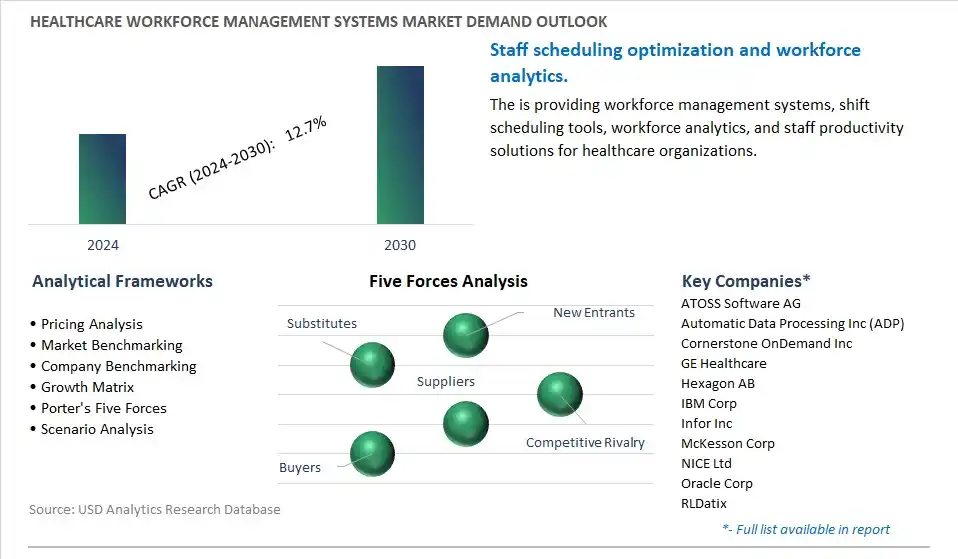
Healthcare Workforce Management Systems Market is estimated to increase at a Compounded Annual Growth Rate of 12.7% CAGR over the forecast period from 2024 to 2030
The Healthcare Workforce Management Systems Market study analyzes and forecasts the market size across 6 regions and 24 countries for diverse segments- By Solution (Software, Services), By Delivery Mode (Web & Cloud Based, On-Premise), By End-User (Hospitals, Long-term Care Centers, Nursing Homes, Others).
An Introduction to Healthcare Workforce Management Systems Market in 2024
Healthcare workforce management systems are comprehensive software solutions designed to optimize staffing levels, streamline scheduling processes, track employee productivity, and manage labor costs within healthcare organizations. In 2024, these systems are instrumental in helping hospitals, clinics, and long-term care facilities efficiently manage their workforce amid evolving patient needs, regulatory requirements, and staffing challenges. Healthcare workforce management systems offer features such as shift scheduling, time and attendance tracking, skill-based staffing, and compliance monitoring to ensure adequate staffing levels while minimizing overtime and labor expenses. By leveraging predictive analytics and demand forecasting algorithms, these systems enable healthcare administrators to anticipate staffing needs, address staffing gaps, and maintain high-quality patient care standards. Moreover, workforce management systems support workforce engagement initiatives, promote staff satisfaction, and facilitate communication and collaboration among healthcare teams. As healthcare delivery models continue to evolve and organizations strive to enhance operational efficiency and patient outcomes, healthcare workforce management systems play a critical role in optimizing staffing resources, improving workforce productivity, and ensuring the delivery of high-quality, patient-centered care.
Market Trend: Shift towards Digital Workforce Management Solutions
A prominent trend in the healthcare workforce management systems market is the shift toward digital workforce management solutions. With the increasing complexity of healthcare operations and the need for efficient staff scheduling, resource allocation, and compliance management, healthcare organizations are adopting digital workforce management systems to streamline their workforce processes. This trend reflects the growing demand for integrated solutions that automate workforce planning, scheduling, timekeeping, and labor analytics, enabling healthcare providers to optimize staffing levels, improve productivity, and ensure regulatory compliance amidst evolving healthcare delivery models and workforce dynamics.
Market Driver: Focus on Staffing Efficiency and Cost Containment
A primary driver fueling the growth of the healthcare workforce management systems market is the focus on staffing efficiency and cost containment. Healthcare organizations face pressure to reduce labor costs, optimize staffing levels, and improve workforce productivity while maintaining high-quality patient care. Workforce management systems offer advanced features such as predictive analytics, demand forecasting, and labor optimization algorithms to help healthcare providers align staffing levels with patient demand, reduce overtime expenses, and minimize staffing gaps. Additionally, workforce management solutions enable organizations to automate compliance with labor laws, union agreements, and regulatory requirements, driving operational efficiency and cost savings in workforce management processes.
Market Opportunity: Integration of Artificial Intelligence for Predictive Staffing
An enticing opportunity within the healthcare workforce management systems market lies in the integration of artificial intelligence (AI) for predictive staffing. AI-powered workforce management solutions can analyze historical data, patient volumes, and staffing patterns to predict future staffing needs accurately. By leveraging machine learning algorithms, these solutions can forecast patient demand, anticipate staffing shortages or surpluses, and recommend optimal staffing schedules to meet patient care requirements while controlling labor costs. Furthermore, AI-enabled workforce management systems can adapt staffing plans in real-time based on emerging trends, unexpected events, and dynamic patient needs, improving workforce agility and responsiveness. The integration of AI for predictive staffing presents opportunities for market differentiation and innovation in healthcare workforce management systems, enabling organizations to achieve higher levels of efficiency, productivity, and quality in workforce planning and management.
Healthcare Workforce Management Systems Market Share Analysis: Web & Cloud Based Solutions is the fastest growing segment over the forecast period to 2030
In the Healthcare Workforce Management Systems Market, the segment experiencing the most rapid growth is Web & Cloud Based Solutions. This growth is driven by several key factors. Firstly, web and cloud-based solutions offer greater flexibility and accessibility compared to traditional on-premise systems. Healthcare organizations, including hospitals, long-term care centers, and nursing homes, are increasingly adopting cloud-based workforce management solutions to support remote work, decentralized teams, and mobile workforce management. With web and cloud-based solutions, healthcare providers can access workforce management tools and data from any location with internet connectivity, enabling real-time collaboration, communication, and decision-making across distributed teams and facilities. Secondly, the COVID-19 pandemic has accelerated the adoption of remote work and telecommuting arrangements in healthcare, driving the need for cloud-based workforce management solutions that can support virtual collaboration, shift scheduling, and staff allocation in response to dynamic healthcare demands. Cloud-based solutions offer scalability and agility to healthcare organizations to rapidly adapt to changing staffing requirements, surge capacity needs, and regulatory compliance mandates. Thirdly, web and cloud-based workforce management solutions enable healthcare providers to leverage advanced analytics, artificial intelligence (AI), and machine learning (ML) capabilities to optimize workforce productivity, forecast staffing needs, and automate labor-intensive tasks such as scheduling, time and attendance tracking, and compliance monitoring. Moreover, cloud-based solutions offer cost-effectiveness through subscription-based pricing models, eliminating the need for upfront capital investments in hardware, software licenses, and IT infrastructure. As a result, Web & Cloud Based Solutions emerge as the fastest growing segment in the Healthcare Workforce Management Systems Market, offering healthcare organizations the flexibility, scalability, and efficiency needed to effectively manage their workforce in today's rapidly evolving healthcare landscape.
Healthcare Workforce Management Systems Competitive Analysis
The market research study provides in-depth insights into leading companies including the SWOT analyses, product profile, financial details, and recent developments acrossATOSS Software AG, Automatic Data Processing Inc (ADP), Cornerstone OnDemand Inc, GE Healthcare, Hexagon AB, IBM Corp, Infor Inc, McKesson Corp, NICE Ltd, Oracle Corp, RLDatix, SAP SE, Strata Decision Technology LLC, Ultimate Kronos Group LLC, Workday Inc
Healthcare Workforce Management Systems Market Segmentation
By Solution
Software
-Standalone Software
-Integrated Software
Services
By Delivery Mode
Web & Cloud Based
On-Premise
By End-User
Hospitals
Long-term Care Centers
Nursing Homes
Others
Geographical Analysis
North America (United States, Canada, Mexico)
Europe (Germany, France, United Kingdom, Spain, Italy, Rest of Europe)
Asia Pacific (China, India, Japan, South Korea, Rest of Asia Pacific)
South America (Brazil, Argentina, Rest of South America)
Middle East and Africa (Saudi Arabia, UAE, Rest of Middle East, South Africa, Egypt, Rest of Africa)
Healthcare Workforce Management Systems Market Companies
ATOSS Software AG
Automatic Data Processing Inc (ADP)
Cornerstone OnDemand Inc
GE Healthcare
Hexagon AB
IBM Corp
Infor Inc
McKesson Corp
NICE Ltd
Oracle Corp
RLDatix
SAP SE
Strata Decision Technology LLC
Ultimate Kronos Group LLC
Workday Inc
Reasons to Buy the Healthcare Workforce Management Systems Market Study
• Deepen your industry insights and navigate uncertainties for strategy formulation, CAPEX, and Operational decisions
• Gain access to detailed insights on the Healthcare Workforce Management Systems Market, encompassing current market size, growth trends, and forecasts till 2030.
• Access detailed competitor analysis, enabling competitive advantage through a thorough understanding of market players, strategies, and potential differentiation opportunities
• Stay ahead of the curve with insights on technological advancements, innovations, and upcoming trends
• Identify lucrative investment avenues and expansion opportunities within the Healthcare Workforce Management Systems Market industry, guided by robust, data-backed analysis.
• Understand regional and global markets through country-wise analysis, regional market potential, regulatory nuances, and dynamics
• Execute strategies with confidence and speed through information, analytics, and insights on the industry value chain
• Corporate leaders, strategists, financial experts, shareholders, asset managers, and governmental representatives can make long-term planning scenarios and build an integrated and timely understanding of market dynamics
• Benefit from tailored solutions and expert consultation based on report insights, providing personalized strategies aligned with specific business needs.
TABLE OF CONTENTS
1 Introduction to 2024 Healthcare Workforce Management Systems Market
1.1 Market Overview
1.2 Quick Facts
1.3 Scope/Objective of the Study
1.4 Market Definition
1.5 Countries and Regions Covered
1.6 Units, Currency, and Conversions
1.7 Industry Value Chain
2 Research Methodology
2.1 Market Size Estimation
2.2 Sources and Research Methodology
2.3 Data Triangulation
2.4 Assumptions and Limitations
3 Executive Summary
3.1 Global Healthcare Workforce Management Systems Market Size Outlook, $ Million, 2021 to 2030
3.2 Healthcare Workforce Management Systems Market Outlook by Type, $ Million, 2021 to 2030
3.3 Healthcare Workforce Management Systems Market Outlook by Product, $ Million, 2021 to 2030
3.4 Healthcare Workforce Management Systems Market Outlook by Application, $ Million, 2021 to 2030
3.5 Healthcare Workforce Management Systems Market Outlook by Key Countries, $ Million, 2021 to 2030
4 Market Dynamics
4.1 Key Driving Forces of Healthcare Workforce Management Systems Industry
4.2 Key Market Trends in Healthcare Workforce Management Systems Industry
4.3 Potential Opportunities in Healthcare Workforce Management Systems Industry
4.4 Key Challenges in Healthcare Workforce Management Systems Industry
5 Market Factor Analysis
5.1 Value Chain Analysis
5.2 Competitive Landscape
5.2.1 Global Healthcare Workforce Management Systems Market Share by Company (%), 2023
5.2.2 Product Offerings by Company
5.3 Porter’s Five Forces Analysis
5.4 Pricing Analysis and Outlook
6 Growth Outlook Across Scenarios
6.1 Growth Analysis-Case Scenario Definitions
6.2 Low Growth Scenario Forecasts
6.3 Reference Growth Scenario Forecasts
6.4 High Growth Scenario Forecasts
7 Global Healthcare Workforce Management Systems Market Outlook by Segments
7.1 Healthcare Workforce Management Systems Market Outlook by Segments, $ Million, 2021- 2030
By Solution
Software
-Standalone Software
-Integrated Software
Services
By Delivery Mode
Web & Cloud Based
On-Premise
By End-User
Hospitals
Long-term Care Centers
Nursing Homes
Others
8 North America Healthcare Workforce Management Systems Market Analysis and Outlook To 2030
8.1 Introduction to North America Healthcare Workforce Management Systems Markets in 2024
8.2 North America Healthcare Workforce Management Systems Market Size Outlook by Country, 2021-2030
8.2.1 United States
8.2.2 Canada
8.2.3 Mexico
8.3 North America Healthcare Workforce Management Systems Market size Outlook by Segments, 2021-2030
By Solution
Software
-Standalone Software
-Integrated Software
Services
By Delivery Mode
Web & Cloud Based
On-Premise
By End-User
Hospitals
Long-term Care Centers
Nursing Homes
Others
9 Europe Healthcare Workforce Management Systems Market Analysis and Outlook To 2030
9.1 Introduction to Europe Healthcare Workforce Management Systems Markets in 2024
9.2 Europe Healthcare Workforce Management Systems Market Size Outlook by Country, 2021-2030
9.2.1 Germany
9.2.2 France
9.2.3 Spain
9.2.4 United Kingdom
9.2.4 Italy
9.2.5 Russia
9.2.6 Norway
9.2.7 Rest of Europe
9.3 Europe Healthcare Workforce Management Systems Market Size Outlook by Segments, 2021-2030
By Solution
Software
-Standalone Software
-Integrated Software
Services
By Delivery Mode
Web & Cloud Based
On-Premise
By End-User
Hospitals
Long-term Care Centers
Nursing Homes
Others
10 Asia Pacific Healthcare Workforce Management Systems Market Analysis and Outlook To 2030
10.1 Introduction to Asia Pacific Healthcare Workforce Management Systems Markets in 2024
10.2 Asia Pacific Healthcare Workforce Management Systems Market Size Outlook by Country, 2021-2030
10.2.1 China
10.2.2 India
10.2.3 Japan
10.2.4 South Korea
10.2.5 Indonesia
10.2.6 Malaysia
10.2.7 Australia
10.2.8 Rest of Asia Pacific
10.3 Asia Pacific Healthcare Workforce Management Systems Market size Outlook by Segments, 2021-2030
By Solution
Software
-Standalone Software
-Integrated Software
Services
By Delivery Mode
Web & Cloud Based
On-Premise
By End-User
Hospitals
Long-term Care Centers
Nursing Homes
Others
11 South America Healthcare Workforce Management Systems Market Analysis and Outlook To 2030
11.1 Introduction to South America Healthcare Workforce Management Systems Markets in 2024
11.2 South America Healthcare Workforce Management Systems Market Size Outlook by Country, 2021-2030
11.2.1 Brazil
11.2.2 Argentina
11.2.3 Rest of South America
11.3 South America Healthcare Workforce Management Systems Market size Outlook by Segments, 2021-2030
By Solution
Software
-Standalone Software
-Integrated Software
Services
By Delivery Mode
Web & Cloud Based
On-Premise
By End-User
Hospitals
Long-term Care Centers
Nursing Homes
Others
12 Middle East and Africa Healthcare Workforce Management Systems Market Analysis and Outlook To 2030
12.1 Introduction to Middle East and Africa Healthcare Workforce Management Systems Markets in 2024
12.2 Middle East and Africa Healthcare Workforce Management Systems Market Size Outlook by Country, 2021-2030
12.2.1 Saudi Arabia
12.2.2 UAE
12.2.3 Oman
12.2.4 Rest of Middle East
12.2.5 Egypt
12.2.6 Nigeria
12.2.7 South Africa
12.2.8 Rest of Africa
12.3 Middle East and Africa Healthcare Workforce Management Systems Market size Outlook by Segments, 2021-2030
By Solution
Software
-Standalone Software
-Integrated Software
Services
By Delivery Mode
Web & Cloud Based
On-Premise
By End-User
Hospitals
Long-term Care Centers
Nursing Homes
Others
13 Company Profiles
13.1 Company Snapshot
13.2 SWOT Profiles
13.3 Products and Services
13.4 Recent Developments
13.5 Financial Profile
List of Companies
ATOSS Software AG
Automatic Data Processing Inc (ADP)
Cornerstone OnDemand Inc
GE Healthcare
Hexagon AB
IBM Corp
Infor Inc
McKesson Corp
NICE Ltd
Oracle Corp
RLDatix
SAP SE
Strata Decision Technology LLC
Ultimate Kronos Group LLC
Workday Inc
14 Appendix
14.1 Customization Offerings
14.2 Subscription Services
14.3 Related Reports
14.4 Publisher Expertise
By Solution
Software
-Standalone Software
-Integrated Software
Services
By Delivery Mode
Web & Cloud Based
On-Premise
By End-User
Hospitals
Long-term Care Centers
Nursing Homes
Others
Countries Analyzed
North America (United States, Canada, Mexico)
Europe (Germany, France, United Kingdom, Spain, Italy, Rest of Europe)
Asia Pacific (China, India, Japan, South Korea, Rest of Asia Pacific)
South America (Brazil, Argentina, Rest of South America)
Middle East and Africa (Saudi Arabia, UAE, Rest of Middle East, South Africa, Egypt, Rest of Africa)
