The global Heat Pump Market is poised to register a 9.2% CAGR from $82.4 Billion in 2024 to $139.7 Billion in 2030.
The global Heat Pump Market Study analyzes and forecasts the market size across 6 regions and 24 countries for diverse segments -By Technology (Air-To-Air Heat Pumps, Air-To-Water Heat Pumps, Water Source Heat Pumps, Ground-Source (Geothermal) Heat Pumps, Hybrid Heat Pumps, Photovoltaic-Thermal (PVT) Heat Pumps), By Type (Reversible Heat Pumps, Non-Reversible Heat Pumps), By Refrigerant (R410A, R407C, R744, R290, R717, Others), By Rated Capacity (Up to 10 Kw, 10 to 20 Kw, 20 to 30 Kw, Above 30 Kw), By End-User (Residential, Commercial, Industrial).
An Introduction to Global Heat Pump Market in 2024
The heat pump market is undergoing rapid growth propelled by the increasing focus on energy efficiency and the transition towards renewable energy sources. Key trends shaping the future of the industry include advancements in heat pump technology, such as the integration of smart controls and variable-speed compressors to enhance efficiency and performance. Additionally, rising concerns about climate change and government initiatives to reduce carbon emissions are driving the adoption of heat pumps for heating and cooling applications in residential, commercial, and industrial sectors. Moreover, innovations in geothermal heat pump systems and air-to-water heat pumps are expanding the market reach by providing efficient heating and cooling solutions across diverse geographical regions.
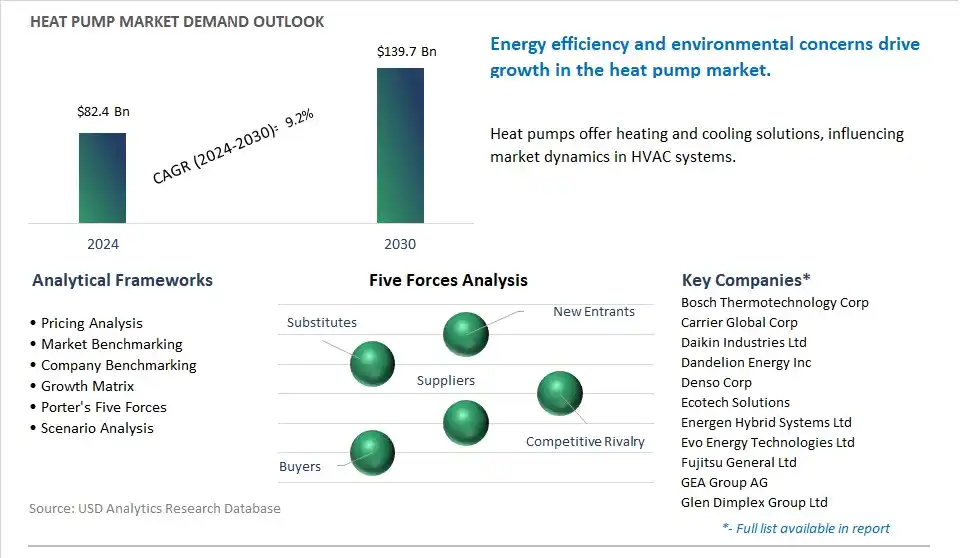
Heat Pump Market Competitive Landscape
The market report analyses the leading companies in the industry including Bosch Thermotechnology Corp, Carrier Global Corp, Daikin Industries Ltd, Dandelion Energy Inc, Denso Corp, Ecotech Solutions, Energen Hybrid Systems Ltd, Evo Energy Technologies Ltd, Fujitsu General Ltd, GEA Group AG, Glen Dimplex Group Ltd, Guangzhou Sprsun New Energy Technology Development Co. Ltd, Johnson Controls International plc, Lennox International Inc, LG Electronics Inc, Midea Group Co. Ltd, Mitsubishi Electric Corp, Namma Swadeshi, NIBE Industrier AB, Panasonic Corp, Rheem Manufacturing Company, Samsung Electronics Co. Ltd, Thermax Ltd, Trane Technologies plc, Zealux Electric Ltd.
Heat Pump Market Dynamics
Heat Pump Market Trend: Transition Towards Energy-Efficient Heating and Cooling Solutions
A significant trend in the heat pump market is the transition towards energy-efficient heating and cooling solutions driven by environmental concerns, energy conservation efforts, and regulatory mandates. Heat pumps, which provide both heating and cooling functions by transferring heat between indoor and outdoor environments, are gaining popularity as sustainable alternatives to traditional heating, ventilation, and air conditioning (HVAC) systems. With increasing awareness of climate change and the need to reduce greenhouse gas emissions, there is a growing demand for energy-efficient HVAC technologies that offer improved performance, lower operating costs, and reduced environmental impact. Heat pumps, characterized by their high efficiency, versatility, and ability to utilize renewable energy sources such as air, water, and ground heat, are positioned to capitalize on this trend as key components in sustainable building designs and green construction projects.
Heat Pump Market Driver: Government Incentives and Renewable Energy Policies
A key driver propelling the heat pump market is the support from government incentives, renewable energy policies, and building codes promoting the adoption of energy-efficient heating and cooling technologies. Governments worldwide are implementing measures such as tax credits, rebates, and subsidies to encourage the installation of heat pump systems as part of energy efficiency programs and climate action initiatives. Additionally, renewable energy policies and regulations promoting the use of clean energy sources such as solar, geothermal, and air-source heat pumps contribute to market growth by incentivizing the deployment of renewable heating and cooling solutions. As policymakers prioritize decarbonization and sustainable development goals, there is a favorable regulatory environment driving market demand for heat pumps as environmentally friendly alternatives to conventional HVAC systems, stimulating investment and innovation in the heat pump industry.
Heat Pump Market Opportunity: Integration of Heat Pumps with Smart Building Technologies
An opportunity for market expansion lies in the integration of heat pumps with smart building technologies to enhance energy management, optimize system performance, and improve occupant comfort in residential, commercial, and industrial buildings. Smart building solutions such as building automation systems (BAS), Internet of Things (IoT) devices, and energy management software enable real-time monitoring, control, and optimization of HVAC systems, including heat pumps. By integrating heat pumps with smart building platforms, building owners and facility managers can achieve energy savings, peak demand reduction, and predictive maintenance through data-driven insights and automated control strategies. Additionally, the integration of heat pumps with renewable energy sources such as solar panels and energy storage systems offers opportunities for grid flexibility, demand response, and distributed energy management. By leveraging the capabilities of smart building technologies, heat pump manufacturers can differentiate their products, provide added value to customers, and capture opportunities in the growing market for energy-efficient and intelligent HVAC solutions, driving growth and innovation in the heat pump market.
Heat Pump Market Share Analysis: Air-To-Air Heat Pumps segment generated the highest revenue in the industry
The air-to-air heat pumps segment is the largest segment in the heat pump market, primarily due to its wide applicability and popularity in residential and commercial heating and cooling systems. Air-to-air heat pumps extract heat from the outdoor air during the heating season and transfer it indoors to provide space heating. Conversely, during the cooling season, they remove heat from indoor air and transfer it outdoors to provide air conditioning. These systems are highly efficient, cost-effective, and easy to install, making them the preferred choice for both new construction and retrofit projects. Additionally, air-to-air heat pumps offer versatility in terms of system design, capacity, and configuration, allowing for customization to meet the specific heating and cooling requirements of different buildings and applications. Further, advancements in technology, such as variable-speed compressors and smart controls, have further enhanced the efficiency and performance of air-to-air heat pump systems, driving their widespread adoption. Over the forecast period, the combination of efficiency, versatility, and ease of installation positions air-to-air heat pumps as the largest segment in the heat pump market.
Heat Pump Market Share Analysis: Reversible Heat Pumps Segment is poised to register the fastest growth rate (CAGR) over the forecast period to 2030
The reversible heat pumps segment is the fastest-growing segment in the heat pump market, driven by diverse key factors. The reversible heat pumps, also known as heat pump systems with a reversible cycle, offer the ability to provide both heating and cooling functions using the same equipment. These systems are highly versatile and can effectively transfer heat in both directions, allowing for year-round comfort control in residential, commercial, and industrial buildings. As energy efficiency and sustainability become increasingly important considerations in building design and operation, reversible heat pumps offer a compelling solution by leveraging the principles of heat transfer to provide heating in the winter and cooling in the summer using a single system. Secondly, the growing emphasis on energy efficiency and carbon reduction goals is driving the adoption of reversible heat pumps as efficient alternatives to traditional heating and cooling systems. Reversible heat pumps can achieve high coefficients of performance (COPs) by utilizing renewable energy sources such as air, water, or ground as heat sources or sinks, thereby reducing energy consumption and greenhouse gas emissions compared to conventional heating and cooling equipment. Additionally, reversible heat pumps can integrate with renewable energy technologies such as solar photovoltaics and geothermal systems, further enhancing their sustainability credentials. Further, advancements in heat pump technology, such as the development of inverter-driven compressors and smart controls, have improved the efficiency, reliability, and performance of reversible heat pump systems, making them increasingly attractive to consumers and building owners. Over the forecast period, the versatility, energy efficiency, and environmental benefits of reversible heat pumps position them as the fastest-growing segment in the heat pump market.
Heat Pump Market Share Analysis: R290 (Propane) Segment is poised to register the fastest growth rate (CAGR) over the forecast period to 2030
The R290 (propane) segment is the fastest-growing segment in the heat pump market, driven by diverse key factors. The R290 is a natural refrigerant with low global warming potential (GWP) and zero ozone depletion potential (ODP), making it an environmentally friendly alternative to synthetic refrigerants such as R410A and R407C, which have high GWPs and contribute to climate change. As environmental regulations become more stringent and consumers demand greener and more sustainable solutions, there is a growing trend towards the adoption of natural refrigerants like R290 in heat pump systems. Secondly, R290 offers excellent thermodynamic properties, including high energy efficiency and heat transfer capabilities, making it well-suited for use in heat pump applications. R290-based heat pump systems can achieve high coefficients of performance (COPs) and provide efficient heating and cooling solutions for residential, commercial, and industrial buildings. Additionally, R290 is readily available, cost-effective, and compatible with existing heat pump technology, facilitating its adoption by manufacturers and HVAC contractors. Further, advancements in refrigeration technology and system design have improved the safety and reliability of R290-based heat pump systems, addressing concerns about flammability and ensuring compliance with safety standards and regulations. Over the forecast period, the combination of environmental benefits, energy efficiency, and technological advancements positions R290 as the fastest-growing segment in the heat pump market.
Heat Pump Market Report Segmentation
By Technology
Air-To-Air Heat Pumps
Air-To-Water Heat Pumps
Water Source Heat Pumps
Ground-Source (Geothermal) Heat Pumps
Hybrid Heat Pumps
Photovoltaic-Thermal (PVT) Heat Pumps
By Type
Reversible Heat Pumps
Non-Reversible Heat Pumps
By Refrigerant
R410A
R407C
R744
R290
R717
Others
By Rated Capacity
Up to 10 Kw
10-20 Kw
20-30 Kw
Above 30 Kw
By End-User
Residential
Commercial
Industrial
Regions Included
North America (US, Canada, Mexico)
Europe (Germany, UK, France, Spain, Italy, Russia, Rest of Europe)
Asia Pacific (China, India, Japan, South Korea, Australia, South East Asia, Rest of Asia)
South America (Brazil, Argentina, Rest of South America)
Middle East and Africa (Saudi Arabia, UAE, Rest of Middle East, South Africa, Egypt, Rest of Africa)
Heat Pump Companies Profiled in the Market Study
Bosch Thermotechnology Corp
Carrier Global Corp
Daikin Industries Ltd
Dandelion Energy Inc
Denso Corp
Ecotech Solutions
Energen Hybrid Systems Ltd
Evo Energy Technologies Ltd
Fujitsu General Ltd
GEA Group AG
Glen Dimplex Group Ltd
Guangzhou Sprsun New Energy Technology Development Co. Ltd
Johnson Controls International plc
Lennox International Inc
LG Electronics Inc
Midea Group Co. Ltd
Mitsubishi Electric Corp
Namma Swadeshi
NIBE Industrier AB
Panasonic Corp
Rheem Manufacturing Company
Samsung Electronics Co. Ltd
Thermax Ltd
Trane Technologies plc
Zealux Electric Ltd
*- List Not Exhaustive
TABLE OF CONTENTS
1 Introduction to 2024 Heat Pump Market
1.1 Market Overview
1.2 Quick Facts
1.3 Scope/Objective of the Study
1.4 Market Definition
1.5 Countries and Regions Covered
1.6 Units, Currency, and Conversions
1.7 Industry Value Chain
2 Research Methodology
2.1 Market Size Estimation
2.2 Sources and Research Methodology
2.3 Data Triangulation
2.4 Assumptions and Limitations
3 Executive Summary
3.1 Global Heat Pump Market Size Outlook, $ Million, 2021 to 2030
3.2 Heat Pump Market Outlook by Type, $ Million, 2021 to 2030
3.3 Heat Pump Market Outlook by Product, $ Million, 2021 to 2030
3.4 Heat Pump Market Outlook by Application, $ Million, 2021 to 2030
3.5 Heat Pump Market Outlook by Key Countries, $ Million, 2021 to 2030
4 Market Dynamics
4.1 Key Driving Forces of Heat Pump Industry
4.2 Key Market Trends in Heat Pump Industry
4.3 Potential Opportunities in Heat Pump Industry
4.4 Key Challenges in Heat Pump Industry
5 Market Factor Analysis
5.1 Value Chain Analysis
5.2 Competitive Landscape
5.2.1 Global Heat Pump Market Share by Company (%), 2023
5.2.2 Product Offerings by Company
5.3 Porter’s Five Forces Analysis
5.4 Pricing Analysis and Outlook
6 Growth Outlook Across Scenarios
6.1 Growth Analysis-Case Scenario Definitions
6.2 Low Growth Scenario Forecasts
6.3 Reference Growth Scenario Forecasts
6.4 High Growth Scenario Forecasts
7 Global Heat Pump Market Outlook by Segments
7.1 Heat Pump Market Outlook by Segments, $ Million, 2021- 2030
By Technology
Air-To-Air Heat Pumps
Air-To-Water Heat Pumps
Water Source Heat Pumps
Ground-Source (Geothermal) Heat Pumps
Hybrid Heat Pumps
Photovoltaic-Thermal (PVT) Heat Pumps
By Type
Reversible Heat Pumps
Non-Reversible Heat Pumps
By Refrigerant
R410A
R407C
R744
R290
R717
Others
By Rated Capacity
Up to 10 Kw
10-20 Kw
20-30 Kw
Above 30 Kw
By End-User
Residential
Commercial
Industrial
8 North America Heat Pump Market Analysis and Outlook To 2030
8.1 Introduction to North America Heat Pump Markets in 2024
8.2 North America Heat Pump Market Size Outlook by Country, 2021-2030
8.2.1 United States
8.2.2 Canada
8.2.3 Mexico
8.3 North America Heat Pump Market size Outlook by Segments, 2021-2030
By Technology
Air-To-Air Heat Pumps
Air-To-Water Heat Pumps
Water Source Heat Pumps
Ground-Source (Geothermal) Heat Pumps
Hybrid Heat Pumps
Photovoltaic-Thermal (PVT) Heat Pumps
By Type
Reversible Heat Pumps
Non-Reversible Heat Pumps
By Refrigerant
R410A
R407C
R744
R290
R717
Others
By Rated Capacity
Up to 10 Kw
10-20 Kw
20-30 Kw
Above 30 Kw
By End-User
Residential
Commercial
Industrial
9 Europe Heat Pump Market Analysis and Outlook To 2030
9.1 Introduction to Europe Heat Pump Markets in 2024
9.2 Europe Heat Pump Market Size Outlook by Country, 2021-2030
9.2.1 Germany
9.2.2 France
9.2.3 Spain
9.2.4 United Kingdom
9.2.4 Italy
9.2.5 Russia
9.2.6 Norway
9.2.7 Rest of Europe
9.3 Europe Heat Pump Market Size Outlook by Segments, 2021-2030
By Technology
Air-To-Air Heat Pumps
Air-To-Water Heat Pumps
Water Source Heat Pumps
Ground-Source (Geothermal) Heat Pumps
Hybrid Heat Pumps
Photovoltaic-Thermal (PVT) Heat Pumps
By Type
Reversible Heat Pumps
Non-Reversible Heat Pumps
By Refrigerant
R410A
R407C
R744
R290
R717
Others
By Rated Capacity
Up to 10 Kw
10-20 Kw
20-30 Kw
Above 30 Kw
By End-User
Residential
Commercial
Industrial
10 Asia Pacific Heat Pump Market Analysis and Outlook To 2030
10.1 Introduction to Asia Pacific Heat Pump Markets in 2024
10.2 Asia Pacific Heat Pump Market Size Outlook by Country, 2021-2030
10.2.1 China
10.2.2 India
10.2.3 Japan
10.2.4 South Korea
10.2.5 Indonesia
10.2.6 Malaysia
10.2.7 Australia
10.2.8 Rest of Asia Pacific
10.3 Asia Pacific Heat Pump Market size Outlook by Segments, 2021-2030
By Technology
Air-To-Air Heat Pumps
Air-To-Water Heat Pumps
Water Source Heat Pumps
Ground-Source (Geothermal) Heat Pumps
Hybrid Heat Pumps
Photovoltaic-Thermal (PVT) Heat Pumps
By Type
Reversible Heat Pumps
Non-Reversible Heat Pumps
By Refrigerant
R410A
R407C
R744
R290
R717
Others
By Rated Capacity
Up to 10 Kw
10-20 Kw
20-30 Kw
Above 30 Kw
By End-User
Residential
Commercial
Industrial
11 South America Heat Pump Market Analysis and Outlook To 2030
11.1 Introduction to South America Heat Pump Markets in 2024
11.2 South America Heat Pump Market Size Outlook by Country, 2021-2030
11.2.1 Brazil
11.2.2 Argentina
11.2.3 Rest of South America
11.3 South America Heat Pump Market size Outlook by Segments, 2021-2030
By Technology
Air-To-Air Heat Pumps
Air-To-Water Heat Pumps
Water Source Heat Pumps
Ground-Source (Geothermal) Heat Pumps
Hybrid Heat Pumps
Photovoltaic-Thermal (PVT) Heat Pumps
By Type
Reversible Heat Pumps
Non-Reversible Heat Pumps
By Refrigerant
R410A
R407C
R744
R290
R717
Others
By Rated Capacity
Up to 10 Kw
10-20 Kw
20-30 Kw
Above 30 Kw
By End-User
Residential
Commercial
Industrial
12 Middle East and Africa Heat Pump Market Analysis and Outlook To 2030
12.1 Introduction to Middle East and Africa Heat Pump Markets in 2024
12.2 Middle East and Africa Heat Pump Market Size Outlook by Country, 2021-2030
12.2.1 Saudi Arabia
12.2.2 UAE
12.2.3 Oman
12.2.4 Rest of Middle East
12.2.5 Egypt
12.2.6 Nigeria
12.2.7 South Africa
12.2.8 Rest of Africa
12.3 Middle East and Africa Heat Pump Market size Outlook by Segments, 2021-2030
By Technology
Air-To-Air Heat Pumps
Air-To-Water Heat Pumps
Water Source Heat Pumps
Ground-Source (Geothermal) Heat Pumps
Hybrid Heat Pumps
Photovoltaic-Thermal (PVT) Heat Pumps
By Type
Reversible Heat Pumps
Non-Reversible Heat Pumps
By Refrigerant
R410A
R407C
R744
R290
R717
Others
By Rated Capacity
Up to 10 Kw
10-20 Kw
20-30 Kw
Above 30 Kw
By End-User
Residential
Commercial
Industrial
13 Company Profiles
13.1 Company Snapshot
13.2 SWOT Profiles
13.3 Products and Services
13.4 Recent Developments
13.5 Financial Profile
Bosch Thermotechnology Corp
Carrier Global Corp
Daikin Industries Ltd
Dandelion Energy Inc
Denso Corp
Ecotech Solutions
Energen Hybrid Systems Ltd
Evo Energy Technologies Ltd
Fujitsu General Ltd
GEA Group AG
Glen Dimplex Group Ltd
Guangzhou Sprsun New Energy Technology Development Co. Ltd
Johnson Controls International plc
Lennox International Inc
LG Electronics Inc
Midea Group Co. Ltd
Mitsubishi Electric Corp
Namma Swadeshi
NIBE Industrier AB
Panasonic Corp
Rheem Manufacturing Company
Samsung Electronics Co. Ltd
Thermax Ltd
Trane Technologies plc
Zealux Electric Ltd
14 Appendix
14.1 Customization Offerings
14.2 Subscription Services
14.3 Related Reports
14.4 Publisher Expertise
By Technology
Air-To-Air Heat Pumps
Air-To-Water Heat Pumps
Water Source Heat Pumps
Ground-Source (Geothermal) Heat Pumps
Hybrid Heat Pumps
Photovoltaic-Thermal (PVT) Heat Pumps
By Type
Reversible Heat Pumps
Non-Reversible Heat Pumps
By Refrigerant
R410A
R407C
R744
R290
R717
Others
By Rated Capacity
Up to 10 Kw
10-20 Kw
20-30 Kw
Above 30 Kw
By End-User
Residential
Commercial
Industrial
Countries Analyzed
North America (US, Canada, Mexico)
Europe (Germany, UK, France, Spain, Italy, Russia, Rest of Europe)
Asia Pacific (China, India, Japan, South Korea, Australia, South East Asia, Rest of Asia)
South America (Brazil, Argentina, Rest of South America)
Middle East and Africa (Saudi Arabia, UAE, Rest of Middle East, South Africa, Egypt, Rest of Africa)
