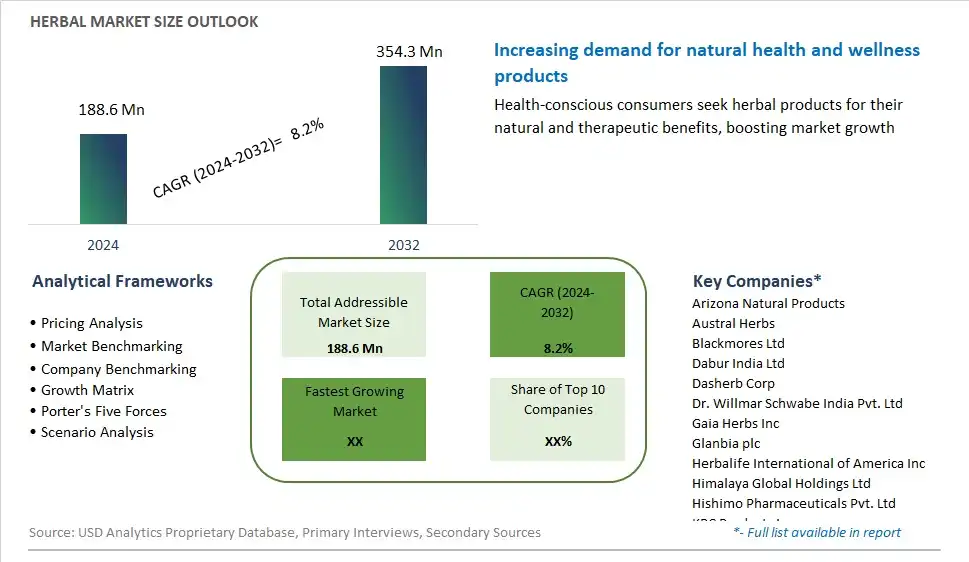
Global Herbal Market Size is valued at $188.6 Million in 2024 and is forecast to register a growth rate (CAGR) of 8.2% to reach $354.3 Million by 2032.
The global Herbal Market Comprehensive Study analyzes and forecasts the market size across 6 regions and 24 countries for diverse segments -By Delivery (Over the counter, Prescription), By Product (Herbal supplements and remedies, Herbal medicine, Herbal cosmetics)
An Introduction to Herbal Market
In 2024, the herbal products market continues to flourish as consumers embrace natural remedies and holistic approaches to health and wellness. Herbal products, derived from medicinal plants and botanical extracts, have been used for centuries in traditional medicine systems such as Ayurveda, Traditional Chinese Medicine (TCM), and Western herbalism for their therapeutic properties. Today, herbal products encompass a wide range of formulations, including dietary supplements, teas, tinctures, essential oils, and topical preparations, catering to diverse health concerns and lifestyle needs. With growing consumer awareness of the potential side effects associated with synthetic medications and the desire for more natural alternatives, the demand for herbal products has surged across various demographics and geographies. Moreover, scientific research and clinical studies validating the efficacy and safety of herbal remedies have further bolstered consumer confidence in their use for preventive health, symptom management, and overall well-being. As consumers prioritize self-care, preventive health measures, and sustainable living, the herbal products market is poised for continued growth and innovation, offering opportunities for product diversification, market expansion, and collaboration between traditional and modern healthcare systems.
Herbal Competitive Landscape
The market report analyses the leading companies in the industry including Arizona Natural Products, Austral Herbs, Blackmores Ltd, Dabur India Ltd, Dasherb Corp, Dr. Willmar Schwabe India Pvt. Ltd, Gaia Herbs Inc, Glanbia plc, Herbalife International of America Inc, Himalaya Global Holdings Ltd, Hishimo Pharmaceuticals Pvt. Ltd, KPC Products Inc, Patanjali Ayurved Ltd, Schaper and Brummer GmbH and Co. KG, SP Pharmaceuticals, Tsumura and Co., ZeinPharma Germany GmbH, and Others.
Herbal Market Dynamics
Herbal Market Trend: Increasing Consumer Preference for Natural Remedies
The herbal market is witnessing a significant trend towards natural remedies, driven by a growing awareness of health and wellness. Consumers are increasingly seeking alternatives to conventional pharmaceuticals, preferring herbal supplements, teas, and remedies derived from plants and herbs. This trend is fueled by a desire for holistic approaches to health, as well as concerns about the side effects and long-term impacts of synthetic medications. As a result, the herbal market is experiencing rapid growth, with a plethora of products catering to various health needs and preferences.
Market Driver: Rising Demand for Functional Foods and Nutraceuticals
A key driver propelling the herbal market is the increasing demand for functional foods and nutraceuticals fortified with herbal ingredients. As consumers become more proactive about managing their health, they are turning to foods and beverages that offer additional health benefits beyond basic nutrition. Herbal extracts and botanicals are valued for their potential to promote wellness, boost immunity, and address specific health concerns such as stress, inflammation, and digestive issues. This demand is driving innovation in the food and beverage industry, leading to the development of a wide range of herbal-infused products, including energy drinks, protein bars, and functional snacks.
Market Opportunity: Integration of Herbal Ingredients in Beauty and Personal Care
An exciting opportunity lies in the integration of herbal ingredients into the beauty and personal care industry. With consumers increasingly prioritizing natural and organic products for skincare, haircare, and cosmetics, there is a growing demand for herbal formulations that offer both efficacy and safety. Herbal extracts renowned for their skincare benefits, such as aloe vera, green tea, and lavender, are being incorporated into a variety of beauty products, including moisturizers, serums, shampoos, and soaps. This presents an opportunity for manufacturers to capitalize on the trend towards clean beauty by formulating products with botanical ingredients known for their nourishing, soothing, and anti-aging properties. Additionally, leveraging the rich cultural heritage and traditional knowledge of herbal remedies from different regions can add a unique selling proposition to herbal beauty brands, appealing to consumers seeking authenticity and connection to nature.
Herbal Market Share Analysis: Over the Counter held the dominant market share in 2024
In the Herbal Market, the over-the-counter (OTC) segment is the largest, driven by the accessibility, convenience, and consumer preference for self-care and natural remedies. Over-the-counter herbal products, readily available without a prescription, cater to a wide range of health and wellness needs, from dietary supplements to herbal teas to topical treatments. The OTC segment benefits from the growing consumer awareness of the potential health benefits of herbal remedies, coupled with the desire for holistic and natural approaches to wellness. Further, the ease of access to OTC herbal products through pharmacies, supermarkets, health food stores, and online retailers enhances their market reach and consumer adoption. Additionally, the stringent regulations governing the safety, efficacy, and labeling of OTC herbal products instill confidence in consumers and promote trust in the quality and reliability of these products. As individuals increasingly seek natural and alternative healthcare solutions, the OTC segment in the Herbal Market continues to expand, solidifying its position as the largest segment and driving the market forward.
Herbal Market Share Analysis: Herbal Cosmetics market is poised to register the fastest growth rae over the forecast period to 2032
In the Herbal Market, the herbal cosmetics segment is the fastest-growing, driven by the increasing consumer preference for natural, sustainable, and skin-friendly beauty products. Herbal cosmetics harness the power of botanical extracts, herbs, and plant-based ingredients known for their nourishing, healing, and rejuvenating properties, offering a holistic approach to skincare and beauty. With rising awareness of the potential adverse effects of synthetic chemicals in conventional cosmetics, consumers are increasingly gravitating towards herbal alternatives that prioritize skin health and wellness. Further, the growing demand for clean, green, and eco-friendly beauty solutions further accelerates the growth of this segment. Additionally, the allure of herbal cosmetics lies in their ability to address a wide range of skincare concerns, including acne, aging, dryness, and sensitivity, catering to diverse consumer needs and preferences. As the herbal cosmetics segment continues to innovate and expand its product offerings, fueled by consumer demand for natural beauty solutions, it is the fastest-growing segment in the Herbal Market, poised to reshape the beauty industry landscape.
Herbal Market Segmentation
By Delivery
Over the counter
Prescription
By Product
Herbal supplements and remedies
Herbal medicine
Herbal cosmetics
Countries Analyzed
North America (US, Canada, Mexico)
Europe (Germany, UK, France, Spain, Italy, Russia, Rest of Europe)
Asia Pacific (China, India, Japan, South Korea, Australia, South East Asia, Rest of Asia)
South America (Brazil, Argentina, Rest of South America)
Middle East and Africa (Saudi Arabia, UAE, Rest of Middle East, South Africa, Egypt, Rest of Africa)
Herbal Companies Profiled in the Study
Arizona Natural Products
Austral Herbs
Blackmores Ltd
Dabur India Ltd
Dasherb Corp
Dr. Willmar Schwabe India Pvt. Ltd
Gaia Herbs Inc
Glanbia plc
Herbalife International of America Inc
Himalaya Global Holdings Ltd
Hishimo Pharmaceuticals Pvt. Ltd
KPC Products Inc
Patanjali Ayurved Ltd
Schaper and Brummer GmbH and Co. KG
SP Pharmaceuticals
Tsumura and Co.
ZeinPharma Germany GmbH
*- List Not Exhaustive
Chapter 1. TABLE OF CONTENTS
Chapter 2. Introduction to Herbal Market
2.1. Market Overview
2.2. Key Statistics and Report Highlights
2.3. Scope of the Comprehensive Study
2.3.1. Market Definition
2.3.2 Countries and Regions Covered
2.3.3 Research Objective
2.3.4 Units, Currency, and Conversions
2.3.5 Industry Value Chain
2.4. Key Market Segments
2.5. Key Companies
2.6. Study Period
Chapter 3. Strategic Analysis Review
3.1. Herbal Pricing Analysis and Forecast
3.2. Porter’s Five Forces
3.3. Market Ecosystem
3.4. SWOT Analysis
3.5. Regulatory Scenario
3.3. Effects of Inflation, Russia-Ukraine War, moderating economic growth, and other macroeconomic factors
Chapter 4. Competitive Landscape
4.1. Market Share Analysis
4.1.1. Global Herbal Market Share by Company, 2023
4.1.2. Product Offerings of Leading Herbal Companies
4.2. Market Entropy
4.2.1. New Product Launches in the Industry
4.2.2. Mergers, Acquisitions, Joint ventures, and Partnerships
4.3. Key Strategies and Best Practices
Chapter 5. Global Market Projections: Best, Reference, and Low Case Scenarios
5.1. Growth Analysis- Case Scenario Definitions
5.2. Low Growth Case Scenario Forecasts
5.3. Reference Growth Case Scenario Forecasts
5.4. High Growth Case Scenario Forecasts
Chapter 6. Market Dynamics
6.1. Herbal Market Drivers
6.2. Herbal Market Challenges
6.6. Herbal Market Opportunities
6.4. Herbal Market Trends
Chapter 7. Global Herbal Market Outlook Trends
7.1. Global Herbal Revenue (USD Million) and CAGR (%) by Type (2021-2032)
7.2. Global Herbal Revenue (USD Million) and CAGR (%) by Application (2021-2032)
7.3. Global Herbal Revenue (USD Million) and CAGR (%) by Product (2021-2032)
By Delivery
Over the counter
Prescription
By Product
Herbal supplements and remedies
Herbal medicine
Herbal cosmetics
Chapter 8. Global Herbal Regional Analysis and Outlook
8.1. Global Herbal Revenue (USD Million) By Regions (2021- 2032)
8.2. North America Herbal Revenue (USD Million) by Country (2021-2032)
8.2.1. United States Herbal Regional Analysis and Outlook
8.2.2. Canada Herbal Regional Analysis and Outlook
8.2.3. Mexico Herbal Regional Analysis and Outlook
8.3. Europe Herbal Revenue (USD Million), by Country (2021-2032)
8.3.1. Germany Herbal Regional Analysis and Outlook
8.3.2. France Herbal Regional Analysis and Outlook
8.3.3. United Kingdom Herbal Regional Analysis and Outlook
8.3.4. Spain Herbal Regional Analysis and Outlook
8.3.5. Italy Herbal Regional Analysis and Outlook
8.3.6. Russia Herbal Regional Analysis and Outlook
8.3.7. Rest of Europe Herbal Regional Analysis and Outlook
8.4. Asia Pacific Herbal Revenue (USD Million) by Country (2021-2032)
8.4.1. China Herbal Regional Analysis and Outlook
8.4.2. Japan Herbal Regional Analysis and Outlook
8.4.3. India Herbal Regional Analysis and Outlook
8.4.4. South Korea Herbal Regional Analysis and Outlook
8.4.5. Australia Herbal Regional Analysis and Outlook
8.4.6. South East Asia Herbal Regional Analysis and Outlook
8.4.7. Rest of Asia Pacific Herbal Regional Analysis and Outlook
8.5. South America Herbal Revenue (USD Million), by Country (2021-2032)
8.5.1. Brazil Herbal Regional Analysis and Outlook
8.5.2. Argentina Herbal Regional Analysis and Outlook
8.5.3. Rest of South America Herbal Regional Analysis and Outlook
8.6. Middle East and Africa Herbal Revenue (USD Million) by Country (2021-2032)
8.6.1. Middle East Herbal Regional Analysis and Outlook
8.6.2. Africa Herbal Regional Analysis and Outlook
Chapter 9. North America Herbal Analysis and Outlook
9.1. North America Herbal Revenue (USD Million) by Segments (2021-2032)
9.1.1. North America Herbal Revenue (USD Million) by Type (2021-2032)
9.1.2. North America Herbal Revenue (USD Million) by Application (2021-2032)
9.1.3. North America Herbal Revenue (USD Million) by Product (2021-2032)
By Delivery
Over the counter
Prescription
By Product
Herbal supplements and remedies
Herbal medicine
Herbal cosmetics
Chapter 10. Europe Herbal Analysis and Outlook
10.1. Europe Herbal Revenue (USD Million), by Segments (USD Million) (2021-2032)
10.1.1. Europe Herbal Revenue (USD Million) by Type (2021-2032)
10.1.2. Europe Herbal Revenue (USD Million) by Application (2021-2032)
10.1.3. Europe Herbal Revenue (USD Million) by Product (2021-2032)
By Delivery
Over the counter
Prescription
By Product
Herbal supplements and remedies
Herbal medicine
Herbal cosmetics
Chapter 11. Asia Pacific Herbal Analysis and Outlook
11.1. Asia Pacific Herbal Revenue (USD Million), and Revenue (USD Million) by Segments (2021-2032)
11.1.1. Asia Pacific Herbal Revenue (USD Million) by Type (2021-2032)
11.1.2. Asia Pacific Herbal Revenue (USD Million) by Application (2021-2032)
11.1.3. Asia Pacific Herbal Revenue (USD Million) by Product (2021-2032)
By Delivery
Over the counter
Prescription
By Product
Herbal supplements and remedies
Herbal medicine
Herbal cosmetics
Chapter 12. South America Herbal Analysis and Outlook
12.1. South America Herbal Revenue (USD Million), by Segments (2021-2032)
12.1.1. South America Herbal Revenue (USD Million) by Type (2021-2032)
12.1.2. South America Herbal Revenue (USD Million) by Application (2021-2032)
12.1.3. South America Herbal Revenue (USD Million) by Product (2021-2032)
By Delivery
Over the counter
Prescription
By Product
Herbal supplements and remedies
Herbal medicine
Herbal cosmetics
Chapter 13. Middle East and Africa Herbal Analysis and Outlook
13.1. Middle East and Africa Herbal Revenue (USD Million), by Segments (2021-2032)
13.1.1. Middle East and Africa Herbal Revenue (USD Million) by Type (2021-2032)
13.1.2. Middle East and Africa Herbal Revenue (USD Million) by Application (2021-2032)
13.1.3. Middle East and Africa Herbal Revenue (USD Million) by Product (2021-2032)
By Delivery
Over the counter
Prescription
By Product
Herbal supplements and remedies
Herbal medicine
Herbal cosmetics
Chapter 14. Herbal Company Profiles
14.1 Business Overview
14.2 Product Profiles
14.3 SWOT Profiles
14.5 Recent Developments
14.6 Financial Profile
List of Companies
Arizona Natural Products
Austral Herbs
Blackmores Ltd
Dabur India Ltd
Dasherb Corp
Dr. Willmar Schwabe India Pvt. Ltd
Gaia Herbs Inc
Glanbia plc
Herbalife International of America Inc
Himalaya Global Holdings Ltd
Hishimo Pharmaceuticals Pvt. Ltd
KPC Products Inc
Patanjali Ayurved Ltd
Schaper and Brummer GmbH and Co. KG
SP Pharmaceuticals
Tsumura and Co.
ZeinPharma Germany GmbH
15. Methodology and Data Sources
15.1 Customization Offerings
15.2 Subscription Services
15.3 Related Reports
15.4 Publisher Expertise
LIST OF TABLES
Table 1 Market Segmentation Analysis
Table 2 Global Herbal Market Share of Leading Companies, 2023
Table 3 Product Offerings of Leading Companies
Table 4 Low Growth Scenario Forecasts
Table 5 Reference Case Growth Scenario
Table 6 High Growth Case Scenario
Table 7 Global Herbal Revenue (USD Million) And CAGR (%) By Type (2021-2032)
Table 8 Global Herbal Revenue (USD Million) And CAGR (%) By Application (2021-2032)
Table 9 Global Herbal Revenue (USD Million) And CAGR (%) By Product (2021-2032)
Table 10 Global Herbal Market Revenue (USD Million) By Regions (2021-2032)
Table 11 Global Herbal Market Share (%) By Regions (2021-2032)
Table 12 North America Herbal Revenue (USD Million) By Country (2021-2032)
Table 13 Europe Herbal Revenue (USD Million) By Country (2021-2032)
Table 14 Asia Pacific Herbal Revenue (USD Million) By Country (2021-2032)
Table 15 South America Herbal Revenue (USD Million) By Country (2021-2032)
Table 16 Middle East and Africa Herbal Revenue (USD Million) By Region (2021-2032)
Table 17 North America Herbal Revenue (USD Million) By Type (2021-2032)
Table 18 North America Herbal Revenue (USD Million) By Application (2021-2032)
Table 19 North America Herbal Revenue (USD Million) By Product (2021-2032)
Table 20 Europe Herbal Revenue (USD Million) By Type (2021-2032)
Table 21 Europe Herbal Revenue (USD Million) By Application (2021-2032)
Table 22 Europe Herbal Revenue (USD Million) By Product (2021-2032)
Table 23 Asia Pacific Herbal Revenue (USD Million) By Type (2021-2032)
Table 24 Asia Pacific Herbal Revenue (USD Million) By Application (2021-2032)
Table 25 Asia Pacific Herbal Revenue (USD Million) By Product (2021-2032)
Table 26 South America Herbal Revenue (USD Million) By Type (2021-2032)
Table 27 South America Herbal Revenue (USD Million) By Application (2021-2032)
Table 28 South America Herbal Revenue (USD Million) By Product (2021-2032)
Table 29 Middle East and Africa Herbal Revenue (USD Million) By Type (2021-2032)
Table 30 Middle East and Africa Herbal Revenue (USD Million) By Application (2021-2032)
Table 31 Middle East and Africa Herbal Revenue (USD Million) By Product (2021-2032)
LIST OF FIGURES
Figure 1. Market Scope
Figure 2. Pricing Forecasts Per Unit, 2023- 2032
Figure 3. Porter’s Five Forces
Figure 4. Global Herbal Market Revenue (USD Million) By Regions (2021-2032)
Figure 5. Global Herbal Market Share (%) By Regions (2023)
Figure 6. North America Herbal Revenue (USD Million) By Country (2021-2032)
Figure 7. United States Herbal Revenue (USD Million) By Country (2021-2032)
Figure 8. Canada Herbal Revenue (USD Million) By Country (2021-2032)
Figure 9. Mexico Herbal Revenue (USD Million) By Country (2021-2032)
Figure 10. Europe Herbal Revenue (USD Million) By Country (2021-2032)
Figure 11. Germany Herbal Revenue (USD Million) By Country (2021-2032)
Figure 12. France Herbal Revenue (USD Million) By Country (2021-2032)
Figure 13. United Kingdom Herbal Revenue (USD Million) By Country (2021-2032)
Figure 14. Spain Herbal Revenue (USD Million) By Country (2021-2032)
Figure 15. Italy Herbal Revenue (USD Million) By Country (2021-2032)
Figure 16. Russia Herbal Revenue (USD Million) By Country (2021-2032)
Figure 17. Rest of Europe Herbal Revenue (USD Million) By Country (2021-2032)
Figure 11. Asia Pacific Herbal Revenue (USD Million) By Country (2021-2032)
Figure 12. China Herbal Revenue (USD Million) By Country (2021-2032)
Figure 13. Japan Herbal Revenue (USD Million) By Country (2021-2032)
Figure 14. India Herbal Revenue (USD Million) By Country (2021-2032)
Figure 15. South Korea Herbal Revenue (USD Million) By Country (2021-2032)
Figure 16. Australia Herbal Revenue (USD Million) By Country (2021-2032)
Figure 17. South East Asia Herbal Revenue (USD Million) By Country (2021-2032)
Figure 18. South America Herbal Revenue (USD Million) By Country (2021-2032)
Figure 19. Brazil Herbal Revenue (USD Million) By Country (2021-2032)
Figure 20. Argentina Herbal Revenue (USD Million) By Country (2021-2032)
Figure 21. Rest of Asia Pacific Herbal Revenue (USD Million) By Country (2021-2032)
Figure 22. Middle East and Africa Herbal Revenue (USD Million) By Region (2021-2032)
Figure 23. Saudi Arabia Herbal Revenue (USD Million) By Region (2021-2032)
Figure 24. The UAE Herbal Revenue (USD Million) By Region (2021-2032)
Figure 25. Rest of Middle East Herbal Revenue (USD Million) By Region (2021-2032)
Figure 26. South Africa Herbal Revenue (USD Million) By Region (2021-2032)
Figure 27. Africa Herbal Revenue (USD Million) By Region (2021-2032)
Figure 28. North America Herbal Revenue (USD Million) By Type (2021-2032)
Figure 29. North America Herbal Revenue (USD Million) By Application (2021-2032)
Figure 30. North America Herbal Revenue (USD Million) By Product (2021-2032)
Figure 31. Europe Herbal Revenue (USD Million) By Type (2021-2032)
Figure 32. Europe Herbal Revenue (USD Million) By Application (2021-2032)
Figure 33. Europe Herbal Revenue (USD Million) By Product (2021-2032)
Figure 34. Asia Pacific Herbal Revenue (USD Million) By Type (2021-2032)
Figure 35. Asia Pacific Herbal Revenue (USD Million) By Application (2021-2032)
Figure 36. Asia Pacific Herbal Revenue (USD Million) By Product (2021-2032)
Figure 37. South America Herbal Revenue (USD Million) By Type (2021-2032)
Figure 38. South America Herbal Revenue (USD Million) By Application (2021-2032)
Figure 39. South America Herbal Revenue (USD Million) By Product (2021-2032)
Figure 40. Middle East and Africa Herbal Revenue (USD Million) By Type (2021-2032)
Figure 41. Middle East and Africa Herbal Revenue (USD Million) By Application (2021-2032)
Figure 42. Middle East and Africa Herbal Revenue (USD Million) By Product (2021-2032)
By Delivery
Over the counter
Prescription
By Product
Herbal supplements and remedies
Herbal medicine
Herbal cosmetics
Countries Analyzed
North America (US, Canada, Mexico)
Europe (Germany, UK, France, Spain, Italy, Russia, Rest of Europe)
Asia Pacific (China, India, Japan, South Korea, Australia, South East Asia, Rest of Asia)
South America (Brazil, Argentina, Rest of South America)
Middle East and Africa (Saudi Arabia, UAE, Rest of Middle East, South Africa, Egypt, Rest of Africa)
