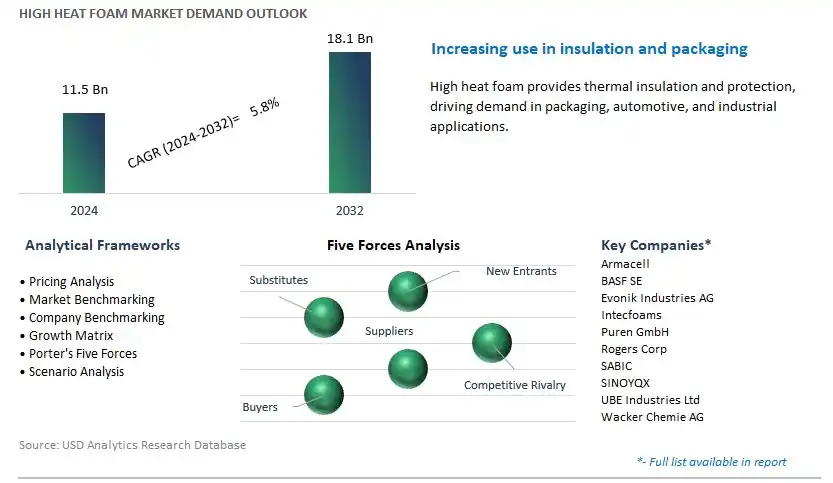
Global High Heat Foam Market Size is valued at $11.5 Billion in 2024 and is forecast to register a growth rate (CAGR) of 5.8% to reach $18.1 Billion by 2032.
The global High Heat Foam Market Study analyzes and forecasts the market size across 6 regions and 24 countries for diverse segments -By Type (Silicone, Polyimide, Melamine, Polyethylene, Others), By Application (Automotive, Railway, Industrial, Aerospace, Others).
An Introduction to High Heat Foam Market in 2024
In 2024, the market for high heat foam s to witness significant growth driven by a surge in demand across various industries such as aerospace, automotive, and electronics. High heat foam materials are engineered to withstand extreme temperatures, making them ideal for applications requiring thermal insulation, fire resistance, and thermal stability. Industries are increasingly adopting high heat foam for insulation in high-temperature environments, as well as for thermal management in electronic devices and automotive components. Additionally, the aerospace sector utilizes high heat foam for lightweight structural components that can withstand the demanding conditions of space exploration and aviation. With ongoing advancements in material science and manufacturing technologies, the high heat foam market is poised for further expansion, catering to the evolving needs of industries seeking enhanced performance and reliability in extreme thermal environments.
High Heat Foam Market Competitive Landscape
The market report analyses the leading companies in the industry including Armacell, BASF SE, Evonik Industries AG, Intecfoams, Puren GmbH, Rogers Corp, SABIC, SINOYQX, UBE Industries Ltd, Wacker Chemie AG, and others.
High Heat Foam Market Dynamics
Market Trend: Increased Demand for Lightweight and Insulating Materials in Automotive and Aerospace Industries
The market for high heat foam is experiencing a prominent trend driven by the increased demand for lightweight and insulating materials in the automotive and aerospace industries. As automotive manufacturers strive to improve fuel efficiency and reduce emissions, and aerospace companies focus on enhancing aircraft performance and fuel economy, there's a growing need for materials that can provide thermal insulation while minimizing weight. High heat foam, known for its low density, excellent thermal insulation properties, and resistance to high temperatures, is being increasingly adopted for applications such as automotive engine compartments, aircraft interiors, and thermal insulation panels in spacecraft. This trend towards the use of high heat foam for lightweighting and thermal management purposes is expected to continue as industries prioritize material solutions that offer a combination of performance, durability, and weight savings.
Market Driver: Stringent Regulatory Standards and Energy Efficiency Requirements
A significant driver propelling the market for high heat foam is the enforcement of stringent regulatory standards and energy efficiency requirements in various industries. With increasing emphasis on environmental sustainability, energy conservation, and greenhouse gas emissions reduction, governments and regulatory bodies are imposing strict regulations and standards on vehicle emissions, building energy efficiency, and aerospace emissions. This drives the demand for materials that can help meet regulatory requirements while enhancing energy efficiency and thermal performance. High heat foam, with its ability to provide effective thermal insulation, reduce heat transfer, and improve energy efficiency, emerges as a preferred solution for compliance with regulatory mandates in automotive, building construction, and aerospace applications. The need to adhere to regulatory standards and achieve energy efficiency targets acts as a key driver stimulating the adoption of high heat foam in these industries.
Market Opportunity: Expansion into Renewable Energy and Industrial Insulation
An opportunity for market expansion lies in the penetration of high heat foam into renewable energy and industrial insulation applications. With the increasing focus on renewable energy sources such as solar and wind power, there's a growing demand for thermal insulation materials to enhance the efficiency and performance of renewable energy systems. High heat foam can be utilized for thermal insulation in solar panels, concentrated solar power (CSP) systems, and wind turbine components, helping to reduce heat loss, improve energy capture, and enhance overall system efficiency. Additionally, in industrial applications such as petrochemical, oil and gas, and manufacturing plants, there's a need for thermal insulation materials to minimize heat transfer and maintain process temperatures. High heat foam offers opportunities for insulation in equipment, piping, and storage tanks, helping industries optimize energy usage, reduce operational costs, and improve safety. By targeting these emerging markets and applications, manufacturers of high heat foam can diversify their product offerings, expand their customer base, and capitalize on new growth opportunities in renewable energy and industrial insulation sectors.
High Heat Foam Market Share Analysis: Polyimide segment generated the highest revenue in 2024
The largest segment in the High Heat Foam Market is the Polyimide segment. The large revenue share can be attributed to the exceptional thermal stability, mechanical strength, and flame resistance properties offered by polyimide foam. Polyimide foam is widely used in high-temperature applications such as aerospace, automotive, electronics, and industrial insulation due to its ability to withstand extreme temperatures without significant degradation. It maintains its structural integrity and insulation properties even at temperatures exceeding 300°C, making it ideal for use in environments where traditional foam materials would fail. Additionally, polyimide foam exhibits excellent chemical resistance, low outgassing, and high dielectric strength, further enhancing its suitability for demanding applications. As industries increasingly prioritize lightweight, durable, and high-temperature-resistant materials, the Polyimide segment is the largest in the High Heat Foam Market due to the extensive use of polyimide foam across various sectors.
High Heat Foam Market Share Analysis: Aerospace is poised to register the fastest CAGR over the forecast period
Among the segments within the High Heat Foam Market categorized by application, the Aerospace segment is the fastest-growing. This surge is primarily fuelled by the increasing demand for lightweight materials with exceptional thermal insulation properties in the aerospace industry. High heat foam materials play a crucial role in aircraft construction, providing insulation against high temperatures generated during flight, as well as thermal and acoustic insulation within the aircraft structure. Additionally, the aerospace sector is witnessing rapid technological advancements and innovations aimed at enhancing fuel efficiency, reducing emissions, and improving overall performance. As a result, there is a growing need for lightweight materials that can withstand extreme operating conditions while meeting stringent safety and regulatory standards. High heat foam materials, particularly those based on advanced polymers and ceramics, are increasingly being adopted by aerospace manufacturers for applications such as aircraft interiors, engine components, thermal protection systems, and insulation blankets. With the aerospace industry projected to experience sustained growth in the coming years, driven by increasing air travel demand and the expansion of commercial and defense aviation programs, the Aerospace segment in the High Heat Foam Market is poised for rapid expansion.
High Heat Foam Market
By Type
Silicone
Polyimide
Melamine
Polyethylene
Others
By Application
Automotive
Railway
Industrial
Aerospace
Others
Countries Analyzed
North America (US, Canada, Mexico)
Europe (Germany, UK, France, Spain, Italy, Russia, Rest of Europe)
Asia Pacific (China, India, Japan, South Korea, Australia, South East Asia, Rest of Asia)
South America (Brazil, Argentina, Rest of South America)
Middle East and Africa (Saudi Arabia, UAE, Rest of Middle East, South Africa, Egypt, Rest of Africa)
High Heat Foam Companies Profiled in the Study
Armacell
BASF SE
Evonik Industries AG
Intecfoams
Puren GmbH
Rogers Corp
SABIC
SINOYQX
UBE Industries Ltd
Wacker Chemie AG
*- List Not Exhaustive
TABLE OF CONTENTS
1 Introduction to 2024 High Heat Foam Market
1.1 Market Overview
1.2 Quick Facts
1.3 Scope/Objective of the Study
1.4 Market Definition
1.5 Countries and Regions Covered
1.6 Units, Currency, and Conversions
1.7 Industry Value Chain
2 Research Methodology
2.1 Market Size Estimation
2.2 Sources and Research Methodology
2.3 Data Triangulation
2.4 Assumptions and Limitations
3 Executive Summary
3.1 Global High Heat Foam Market Size Outlook, $ Million, 2021 to 2032
3.2 High Heat Foam Market Outlook by Type, $ Million, 2021 to 2032
3.3 High Heat Foam Market Outlook by Product, $ Million, 2021 to 2032
3.4 High Heat Foam Market Outlook by Application, $ Million, 2021 to 2032
3.5 High Heat Foam Market Outlook by Key Countries, $ Million, 2021 to 2032
4 Market Dynamics
4.1 Key Driving Forces of High Heat Foam Industry
4.2 Key Market Trends in High Heat Foam Industry
4.3 Potential Opportunities in High Heat Foam Industry
4.4 Key Challenges in High Heat Foam Industry
5 Market Factor Analysis
5.1 Value Chain Analysis
5.2 Competitive Landscape
5.2.1 Global High Heat Foam Market Share by Company (%), 2023
5.2.2 Product Offerings by Company
5.3 Porter’s Five Forces Analysis
5.4 Pricing Analysis and Outlook
6 Growth Outlook Across Scenarios
6.1 Growth Analysis-Case Scenario Definitions
6.2 Low Growth Scenario Forecasts
6.3 Reference Growth Scenario Forecasts
6.4 High Growth Scenario Forecasts
7 Global High Heat Foam Market Outlook by Segments
7.1 High Heat Foam Market Outlook by Segments, $ Million, 2021- 2032
By Type
Silicone
Polyimide
Melamine
Polyethylene
Others
By Application
Automotive
Railway
Industrial
Aerospace
Others
8 North America High Heat Foam Market Analysis and Outlook To 2032
8.1 Introduction to North America High Heat Foam Markets in 2024
8.2 North America High Heat Foam Market Size Outlook by Country, 2021-2032
8.2.1 United States
8.2.2 Canada
8.2.3 Mexico
8.3 North America High Heat Foam Market size Outlook by Segments, 2021-2032
By Type
Silicone
Polyimide
Melamine
Polyethylene
Others
By Application
Automotive
Railway
Industrial
Aerospace
Others
9 Europe High Heat Foam Market Analysis and Outlook To 2032
9.1 Introduction to Europe High Heat Foam Markets in 2024
9.2 Europe High Heat Foam Market Size Outlook by Country, 2021-2032
9.2.1 Germany
9.2.2 France
9.2.3 Spain
9.2.4 United Kingdom
9.2.4 Italy
9.2.5 Russia
9.2.6 Norway
9.2.7 Rest of Europe
9.3 Europe High Heat Foam Market Size Outlook by Segments, 2021-2032
By Type
Silicone
Polyimide
Melamine
Polyethylene
Others
By Application
Automotive
Railway
Industrial
Aerospace
Others
10 Asia Pacific High Heat Foam Market Analysis and Outlook To 2032
10.1 Introduction to Asia Pacific High Heat Foam Markets in 2024
10.2 Asia Pacific High Heat Foam Market Size Outlook by Country, 2021-2032
10.2.1 China
10.2.2 India
10.2.3 Japan
10.2.4 South Korea
10.2.5 Indonesia
10.2.6 Malaysia
10.2.7 Australia
10.2.8 Rest of Asia Pacific
10.3 Asia Pacific High Heat Foam Market size Outlook by Segments, 2021-2032
By Type
Silicone
Polyimide
Melamine
Polyethylene
Others
By Application
Automotive
Railway
Industrial
Aerospace
Others
11 South America High Heat Foam Market Analysis and Outlook To 2032
11.1 Introduction to South America High Heat Foam Markets in 2024
11.2 South America High Heat Foam Market Size Outlook by Country, 2021-2032
11.2.1 Brazil
11.2.2 Argentina
11.2.3 Rest of South America
11.3 South America High Heat Foam Market size Outlook by Segments, 2021-2032
By Type
Silicone
Polyimide
Melamine
Polyethylene
Others
By Application
Automotive
Railway
Industrial
Aerospace
Others
12 Middle East and Africa High Heat Foam Market Analysis and Outlook To 2032
12.1 Introduction to Middle East and Africa High Heat Foam Markets in 2024
12.2 Middle East and Africa High Heat Foam Market Size Outlook by Country, 2021-2032
12.2.1 Saudi Arabia
12.2.2 UAE
12.2.3 Oman
12.2.4 Rest of Middle East
12.2.5 Egypt
12.2.6 Nigeria
12.2.7 South Africa
12.2.8 Rest of Africa
12.3 Middle East and Africa High Heat Foam Market size Outlook by Segments, 2021-2032
By Type
Silicone
Polyimide
Melamine
Polyethylene
Others
By Application
Automotive
Railway
Industrial
Aerospace
Others
13 Company Profiles
13.1 Company Snapshot
13.2 SWOT Profiles
13.3 Products and Services
13.4 Recent Developments
13.5 Financial Profile
Armacell
BASF SE
Evonik Industries AG
Intecfoams
Puren GmbH
Rogers Corp
SABIC
SINOYQX
UBE Industries Ltd
Wacker Chemie AG
14 Appendix
14.1 Customization Offerings
14.2 Subscription Services
14.3 Related Reports
14.4 Publisher Expertise
By Type
Silicone
Polyimide
Melamine
Polyethylene
Others
By Application
Automotive
Railway
Industrial
Aerospace
Others
Countries Analyzed
North America (US, Canada, Mexico)
Europe (Germany, UK, France, Spain, Italy, Russia, Rest of Europe)
Asia Pacific (China, India, Japan, South Korea, Australia, South East Asia, Rest of Asia)
South America (Brazil, Argentina, Rest of South America)
Middle East and Africa (Saudi Arabia, UAE, Rest of Middle East, South Africa, Egypt, Rest of Africa)
