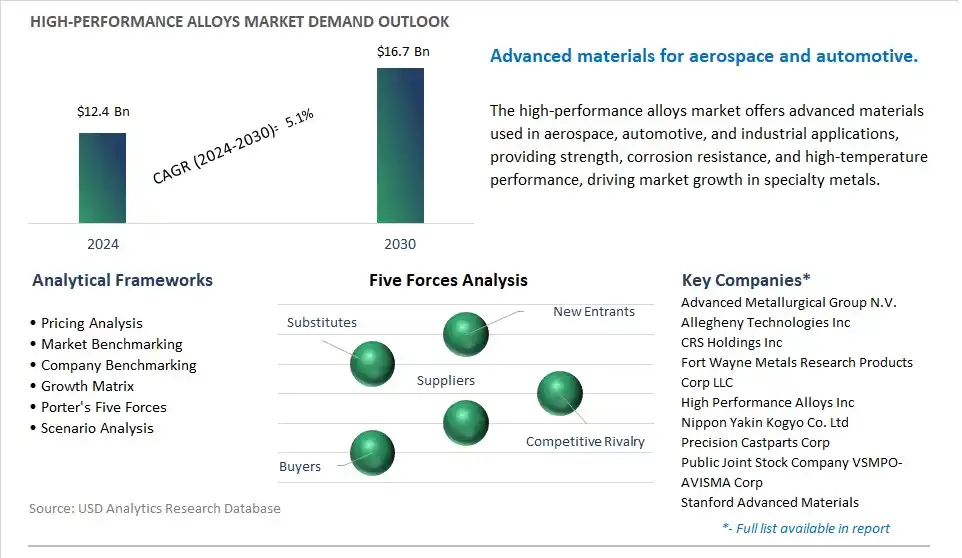
The global High-Performance Alloys Market is poised to register a 5.1% CAGR from $12.4 Billion in 2024 to $16.7 Billion in 2030.
The global High-Performance Alloys Market Study analyzes and forecasts the market size across 6 regions and 24 countries for diverse segments -By Metal (Aluminum, Nickel, Steel, Magnesium, Titanium, Others), By Product (Heat Resistant Alloys, Corrosion Resistant Alloys, Wear Resistant Alloys, Others), By End-User (Aerospace, Power, Oil and Gas, Automotive, Others).
An Introduction to Global High Performance Alloys Market in 2024
High-performance alloys, including nickel-based superalloys, titanium alloys, and high-strength steels, are essential materials in aerospace, automotive, energy, and medical industries, providing superior mechanical properties, corrosion resistance, and thermal stability in demanding applications. One key trend shaping the future of high-performance alloys is the development of advanced alloy compositions and processing techniques to enhance performance, processability, and sustainability while reducing material cost and environmental footprint. Researchers and manufacturers are exploring new alloying elements, microstructures, and heat treatment methods to optimize mechanical strength, fatigue resistance, and creep behavior, enabling lightweight and durable components for aerospace engines, automotive powertrains, and industrial machinery. Additionally, advancements in additive manufacturing (AM) technologies such as selective laser melting (SLM) and electron beam melting (EBM) are revolutionizing alloy design and production, enabling complex geometries, rapid prototyping, and on-demand manufacturing of high-performance alloy parts with reduced material waste and lead times. Moreover, the integration of digital twins, simulation software, and machine learning algorithms is accelerating alloy development and optimization, enabling predictive modeling of alloy properties, process performance, and component behavior, reducing time-to-market and R&D costs while maximizing performance and reliability. As industries push the boundaries of material performance and sustainability, the high-performance alloy industry is poised for innovation and growth, with opportunities for collaboration, technology transfer, and market expansion to meet the evolving needs of customers and regulatory requirements.
High-Performance Alloys Market Competitive Landscape
The market report analyses the leading companies in the industry including Advanced Metallurgical Group N.V., Allegheny Technologies Inc, CRS Holdings Inc, Fort Wayne Metals Research Products Corp LLC, High Performance Alloys Inc, Nippon Yakin Kogyo Co. Ltd, Precision Castparts Corp, Public Joint Stock Company VSMPO-AVISMA Corp, Stanford Advanced Materials.
High-Performance Alloys Market Dynamics
High Performance Alloys Market Trend: Increasing Demand for Lightweight and High-Strength Materials
A prominent trend in the market for High Performance Alloys is the increasing demand for lightweight and high-strength materials across various industries. As industries such as aerospace, automotive, energy, and medical devices continue to pursue improvements in performance, efficiency, and sustainability, there is a growing need for high performance alloys that offer superior strength-to-weight ratios, corrosion resistance, and temperature stability. High performance alloys, including nickel-based, titanium-based, and stainless steel alloys, are favored for their exceptional mechanical properties and reliability in demanding applications. This is driven by advancements in engineering design, manufacturing processes, and material science, leading to increased adoption of high performance alloys in critical components and structures where lightweight and high-strength materials are essential for achieving performance objectives.
High Performance Alloys Market Driver: Technological Advancements and Innovation in Alloy Development
The market for High Performance Alloys is being driven by technological advancements and innovation in alloy development and manufacturing processes. Researchers and manufacturers are continuously exploring new alloy compositions, processing techniques, and surface treatments to enhance the mechanical, thermal, and corrosion-resistant properties of high performance alloys. Factors such as the demand for higher operating temperatures, the need for improved fuel efficiency, and the need for longer service life drive the development of alloys with superior performance characteristics. This driver is further fueled by investments in research and development, collaboration between academia and industry, and partnerships with end-users to address specific application requirements and challenges, driving market growth and differentiation in the high performance alloys industry.
High Performance Alloys Market Opportunity: Expansion into Emerging Applications and Industries
An exciting opportunity within the market for High Performance Alloys lies in the expansion into emerging applications and industries that demand advanced materials with unique properties and performance characteristics. Companies can explore opportunities to provide high performance alloys for emerging technologies such as additive manufacturing, electric vehicles, renewable energy, and medical implants, where lightweight, corrosion-resistant, and biocompatible materials are essential for achieving performance and regulatory compliance requirements. Additionally, there is potential to develop customized alloys for niche applications such as aerospace components, chemical processing equipment, and marine structures, where extreme operating conditions and harsh environments require materials with exceptional durability and reliability. By leveraging their expertise in alloy design, manufacturing capabilities, and industry partnerships, companies can capitalize on the growing demand for high performance alloys and position themselves as leaders in the development of advanced materials solutions for emerging applications and industries.
High-Performance Alloys Market Share Analysis: Steel held the dominant revenue share in 2024
The largest segment in the High Performance Alloys Market is the "Steel" segment. This is primarily due to diverse key factors. Firstly, steel is one of the most widely used metals globally, with extensive applications across various industries, including automotive, aerospace, construction, energy, and manufacturing. Steel alloys offer exceptional strength, durability, and versatility, making them ideal for demanding applications where high performance and reliability are crucial. Additionally, steel alloys can be engineered to exhibit specific properties, such as corrosion resistance, high-temperature resistance, wear resistance, and impact resistance, through alloying elements and heat treatment processes, making them suitable for a wide range of industrial applications. In addition, the relatively lower cost of steel compared to other high-performance alloys, such as titanium and nickel-based alloys, makes it a preferred choice for many applications where cost-effectiveness is a key consideration. Further, advancements in steel manufacturing technologies, such as vacuum melting, powder metallurgy, and additive manufacturing, enable the production of high-performance steel alloys with improved mechanical properties, microstructures, and performance characteristics, meeting the evolving needs of industries for lightweight, durable, and cost-efficient materials. Additionally, the widespread availability of steel raw materials and established supply chains further support its dominance in the high-performance alloys market. As a result of these factors, the Steel segment is the largest in the High Performance Alloys Market due to its extensive applications, superior properties, cost-effectiveness, and technological advancements in steel alloy development and manufacturing processes.
High-Performance Alloys Market Share Analysis: Wear Resistant Alloys is the fastest growing market segment over the forecast period to 2030
The fastest-growing segment in the High Performance Alloys Market is the "Wear Resistant Alloys" segment. This growth can be attributed to diverse key factors. Firstly, wear-resistant alloys are in high demand across various industries, including automotive, aerospace, mining, oil and gas, and manufacturing, where components are subjected to abrasive wear, erosion, friction, and mechanical stresses during operation. Wear-resistant alloys offer exceptional hardness, toughness, and abrasion resistance, making them ideal for applications such as cutting tools, drill bits, bearings, gears, valves, and wear plates, where extended service life and reduced maintenance downtime are critical. Additionally, the increasing demand for high-performance alloys in harsh operating environments, such as mining, construction, and heavy machinery, drives the adoption of wear-resistant alloys to enhance equipment durability, reliability, and performance under extreme conditions. In addition, advancements in alloy design, metallurgy, and manufacturing processes enable the development of wear-resistant alloys with tailored microstructures, alloy compositions, and surface treatments to optimize wear resistance, hardness, and toughness properties, meeting the specific requirements of end-users for wear protection solutions. Further, the growing emphasis on sustainability, energy efficiency, and cost optimization in industrial operations fosters the adoption of wear-resistant alloys to prolong equipment lifespan, minimize material loss, and reduce overall operating costs over the equipment lifecycle. Additionally, the expansion of key end-use industries, such as mining, construction, and transportation, in emerging markets and developing economies further drives the demand for wear-resistant alloys to meet the growing needs for infrastructure development, urbanization, and industrialization. As a result of these factors, the Wear Resistant Alloys segment is expected to experience rapid growth in the High Performance Alloys Market due to increasing demand for wear protection solutions and enhanced performance materials in critical applications across various industries.
High-Performance Alloys Market Share Analysis: Aerospace is the fastest growing market segment over the forecast period to 2030
The fastest-growing segment in the High Performance Alloys Market is the "Aerospace" segment. Diverse factors contribute to this growth. Firstly, the aerospace industry demands high-performance alloys with exceptional strength, durability, and resistance to extreme temperatures, corrosion, and fatigue for critical aerospace components such as aircraft engines, airframes, landing gear, and structural components. High-performance alloys play a crucial role in enhancing aircraft performance, fuel efficiency, safety, and reliability, meeting stringent regulatory standards and performance requirements in the aerospace sector. Additionally, the aerospace industry is experiencing rapid technological advancements, such as the development of next-generation aircraft, including commercial airliners, military aircraft, unmanned aerial vehicles (UAVs), and space launch vehicles, which require advanced materials with superior properties to meet the demands of modern aviation and space exploration missions. Further, the growing demand for air travel, expansion of commercial aviation fleets, and increasing investments in defense and space exploration programs worldwide drive the demand for high-performance alloys in the aerospace industry. In addition, collaborations between aerospace OEMs (Original Equipment Manufacturers), materials suppliers, and research institutions facilitate innovation in alloy development, processing technologies, and performance testing, leading to the introduction of new and improved high-performance alloys tailored for aerospace applications. Additionally, the aerospace industry's focus on lightweight materials, fuel efficiency, and environmental sustainability accelerates the adoption of high-performance alloys with high strength-to-weight ratios, enhanced fatigue resistance, and recyclability, contributing to the segment's growth. As a result of these factors, the Aerospace segment in the High Performance Alloys Market is expected to experience rapid growth due to increasing demand for advanced materials to support the evolving needs of the aerospace industry for lightweight, durable, and high-performance alloys in aircraft and spacecraft manufacturing.
High-Performance Alloys Market Report Scope-
By Metal
Aluminum
Nickel
Steel
Magnesium
Titanium
Others
By Product
Heat Resistant Alloys
Corrosion Resistant Alloys
Wear Resistant Alloys
Others
By End-User
Aerospace
Power
Oil and Gas
Automotive
Others
High-Performance Alloys Market Companies Profiled
Advanced Metallurgical Group N.V.
Allegheny Technologies Inc
CRS Holdings Inc
Fort Wayne Metals Research Products Corp LLC
High Performance Alloys Inc
Nippon Yakin Kogyo Co. Ltd
Precision Castparts Corp
Public Joint Stock Company VSMPO-AVISMA Corp
Stanford Advanced Materials
*- List Not Exhaustive
TABLE OF CONTENTS
1 Introduction to 2024 High-Performance Alloys Market
1.1 Market Overview
1.2 Quick Facts
1.3 Scope/Objective of the Study
1.4 Market Definition
1.5 Countries and Regions Covered
1.6 Units, Currency, and Conversions
1.7 Industry Value Chain
2 Research Methodology
2.1 Market Size Estimation
2.2 Sources and Research Methodology
2.3 Data Triangulation
2.4 Assumptions and Limitations
3 Executive Summary
3.1 Global High-Performance Alloys Market Size Outlook, $ Million, 2021 to 2030
3.2 High-Performance Alloys Market Outlook by Type, $ Million, 2021 to 2030
3.3 High-Performance Alloys Market Outlook by Product, $ Million, 2021 to 2030
3.4 High-Performance Alloys Market Outlook by Application, $ Million, 2021 to 2030
3.5 High-Performance Alloys Market Outlook by Key Countries, $ Million, 2021 to 2030
4 Market Dynamics
4.1 Key Driving Forces of High-Performance Alloys Industry
4.2 Key Market Trends in High-Performance Alloys Industry
4.3 Potential Opportunities in High-Performance Alloys Industry
4.4 Key Challenges in High-Performance Alloys Industry
5 Market Factor Analysis
5.1 Value Chain Analysis
5.2 Competitive Landscape
5.2.1 Global High-Performance Alloys Market Share by Company (%), 2023
5.2.2 Product Offerings by Company
5.3 Porter’s Five Forces Analysis
5.4 Pricing Analysis and Outlook
6 Growth Outlook Across Scenarios
6.1 Growth Analysis-Case Scenario Definitions
6.2 Low Growth Scenario Forecasts
6.3 Reference Growth Scenario Forecasts
6.4 High Growth Scenario Forecasts
7 Global High-Performance Alloys Market Outlook by Segments
7.1 High-Performance Alloys Market Outlook by Segments, $ Million, 2021- 2030
By Metal
Aluminum
Nickel
Steel
Magnesium
Titanium
Others
By Product
Heat Resistant Alloys
Corrosion Resistant Alloys
Wear Resistant Alloys
Others
By End-User
Aerospace
Power
Oil and Gas
Automotive
Others
8 North America High-Performance Alloys Market Analysis and Outlook To 2030
8.1 Introduction to North America High-Performance Alloys Markets in 2024
8.2 North America High-Performance Alloys Market Size Outlook by Country, 2021-2030
8.2.1 United States
8.2.2 Canada
8.2.3 Mexico
8.3 North America High-Performance Alloys Market size Outlook by Segments, 2021-2030
By Metal
Aluminum
Nickel
Steel
Magnesium
Titanium
Others
By Product
Heat Resistant Alloys
Corrosion Resistant Alloys
Wear Resistant Alloys
Others
By End-User
Aerospace
Power
Oil and Gas
Automotive
Others
9 Europe High-Performance Alloys Market Analysis and Outlook To 2030
9.1 Introduction to Europe High-Performance Alloys Markets in 2024
9.2 Europe High-Performance Alloys Market Size Outlook by Country, 2021-2030
9.2.1 Germany
9.2.2 France
9.2.3 Spain
9.2.4 United Kingdom
9.2.4 Italy
9.2.5 Russia
9.2.6 Norway
9.2.7 Rest of Europe
9.3 Europe High-Performance Alloys Market Size Outlook by Segments, 2021-2030
By Metal
Aluminum
Nickel
Steel
Magnesium
Titanium
Others
By Product
Heat Resistant Alloys
Corrosion Resistant Alloys
Wear Resistant Alloys
Others
By End-User
Aerospace
Power
Oil and Gas
Automotive
Others
10 Asia Pacific High-Performance Alloys Market Analysis and Outlook To 2030
10.1 Introduction to Asia Pacific High-Performance Alloys Markets in 2024
10.2 Asia Pacific High-Performance Alloys Market Size Outlook by Country, 2021-2030
10.2.1 China
10.2.2 India
10.2.3 Japan
10.2.4 South Korea
10.2.5 Indonesia
10.2.6 Malaysia
10.2.7 Australia
10.2.8 Rest of Asia Pacific
10.3 Asia Pacific High-Performance Alloys Market size Outlook by Segments, 2021-2030
By Metal
Aluminum
Nickel
Steel
Magnesium
Titanium
Others
By Product
Heat Resistant Alloys
Corrosion Resistant Alloys
Wear Resistant Alloys
Others
By End-User
Aerospace
Power
Oil and Gas
Automotive
Others
11 South America High-Performance Alloys Market Analysis and Outlook To 2030
11.1 Introduction to South America High-Performance Alloys Markets in 2024
11.2 South America High-Performance Alloys Market Size Outlook by Country, 2021-2030
11.2.1 Brazil
11.2.2 Argentina
11.2.3 Rest of South America
11.3 South America High-Performance Alloys Market size Outlook by Segments, 2021-2030
By Metal
Aluminum
Nickel
Steel
Magnesium
Titanium
Others
By Product
Heat Resistant Alloys
Corrosion Resistant Alloys
Wear Resistant Alloys
Others
By End-User
Aerospace
Power
Oil and Gas
Automotive
Others
12 Middle East and Africa High-Performance Alloys Market Analysis and Outlook To 2030
12.1 Introduction to Middle East and Africa High-Performance Alloys Markets in 2024
12.2 Middle East and Africa High-Performance Alloys Market Size Outlook by Country, 2021-2030
12.2.1 Saudi Arabia
12.2.2 UAE
12.2.3 Oman
12.2.4 Rest of Middle East
12.2.5 Egypt
12.2.6 Nigeria
12.2.7 South Africa
12.2.8 Rest of Africa
12.3 Middle East and Africa High-Performance Alloys Market size Outlook by Segments, 2021-2030
By Metal
Aluminum
Nickel
Steel
Magnesium
Titanium
Others
By Product
Heat Resistant Alloys
Corrosion Resistant Alloys
Wear Resistant Alloys
Others
By End-User
Aerospace
Power
Oil and Gas
Automotive
Others
13 Company Profiles
13.1 Company Snapshot
13.2 SWOT Profiles
13.3 Products and Services
13.4 Recent Developments
13.5 Financial Profile
Advanced Metallurgical Group N.V.
Allegheny Technologies Inc
CRS Holdings Inc
Fort Wayne Metals Research Products Corp LLC
High Performance Alloys Inc
Nippon Yakin Kogyo Co. Ltd
Precision Castparts Corp
Public Joint Stock Company VSMPO-AVISMA Corp
Stanford Advanced Materials
14 Appendix
14.1 Customization Offerings
14.2 Subscription Services
14.3 Related Reports
14.4 Publisher Expertise
