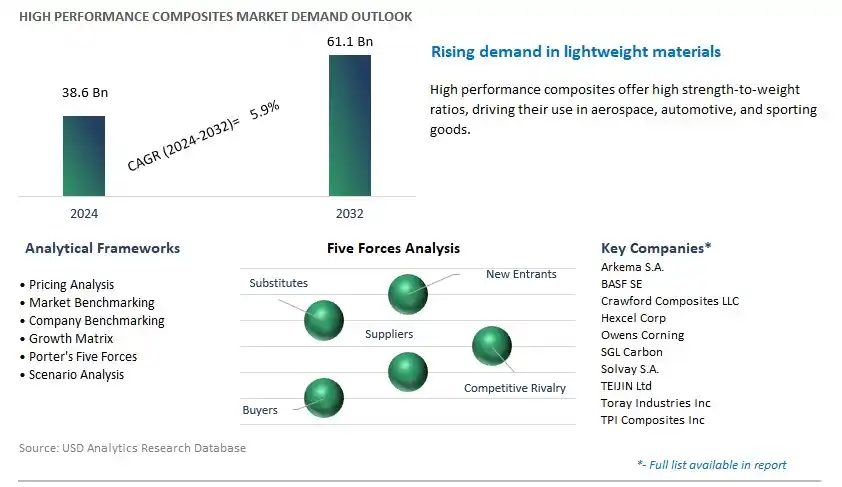
Global High Performance Composites Market Size is valued at $38.6 Billion in 2024 and is forecast to register a growth rate (CAGR) of 5.9% to reach $61.1 Billion by 2032.
The global High Performance Composites Market Study analyzes and forecasts the market size across 6 regions and 24 countries for diverse segments -By Resin (Thermoset Resins, Thermoplastic Resins), By Fiber (Carbon Fiber Composites, S-glass Composites, Aramid Fiber Composites, Others), By Application (Aerospace & Defense, Automotive, Pressure Vessel, Wind Turbine, Medical, Construction, Others).
An Introduction to High Performance Composites Market in 2024
In 2024, the high performance composites market experiences steady growth driven by increasing demand from sectors such as aerospace, automotive, wind energy, and sporting goods. High performance composites are engineered materials composed of two or more constituent materials with significantly different physical or chemical properties, resulting in a combination that exhibits superior performance characteristics such as high strength-to-weight ratio, corrosion resistance, and thermal stability. These composites find extensive applications in aerospace structures, automotive components, wind turbine blades, and high-performance sporting equipment due to their lightweight nature and exceptional mechanical properties. Additionally, the construction industry is increasingly adopting high performance composites for infrastructure projects requiring durable and corrosion-resistant materials. With advancements in composite manufacturing processes, such as automated layup techniques and resin infusion technologies, the market is witnessing the development of innovative composite structures that offer enhanced performance, reduced production costs, and improved sustainability. As industries to prioritize lightweighting, durability, and efficiency, the high performance composites market is poised for further expansion, driven by the continuous pursuit of advanced materials and manufacturing techniques.
High Performance Composites Market Competitive Landscape
The market report analyses the leading companies in the industry including Arkema S.A., BASF SE, Crawford Composites LLC, Hexcel Corp, Owens Corning, SGL Carbon, Solvay S.A., TEIJIN Ltd, Toray Industries Inc, TPI Composites Inc, and others.
High Performance Composites Market Dynamics
Market Trend: Increased Adoption of Lightweight and High-Strength Materials Across Industries
The market for high-performance composites is witnessing a prominent trend driven by the increased adoption of lightweight and high-strength materials across various industries. As industries such as aerospace, automotive, renewable energy, and construction strive to improve efficiency, reduce fuel consumption, and enhance performance, there's a growing demand for advanced materials that offer superior mechanical properties while being lightweight and durable. High-performance composites, such as carbon fiber-reinforced polymers (CFRP) and glass fiber-reinforced polymers (GFRP), are increasingly being utilized to replace traditional materials like metals and alloys in structural applications. This trend towards the adoption of high-performance composites is expected to continue as industries seek to achieve weight reduction, fuel efficiency, and sustainability goals while maintaining or improving product performance and reliability.
Market Driver: Technological Advancements in Composite Manufacturing and Design
A significant driver propelling the market for high-performance composites is the continuous technological advancements in composite manufacturing processes and design methodologies. Through innovations in resin formulations, fiber reinforcements, and composite processing techniques such as automated fiber placement (AFP), resin transfer molding (RTM), and additive manufacturing (3D printing), manufacturers are able to produce composites with enhanced mechanical properties, tailored performance characteristics, and complex geometries. These advancements enable the development of high-performance composites that meet the stringent requirements of demanding applications in aerospace, automotive, marine, and sporting goods industries. Additionally, advancements in simulation and modeling tools allow for more accurate prediction of composite behavior and optimization of composite structures, driving further adoption of high-performance composites in diverse applications.
Market Opportunity: Expansion into Emerging Markets and Customized Solutions
An opportunity for market expansion lies in the penetration of high-performance composites into emerging markets and the development of customized solutions tailored to specific application requirements. Emerging sectors such as renewable energy, electric vehicles, and medical devices present untapped opportunities for the utilization of high-performance composites in lightweight structures, energy-efficient components, and advanced prosthetics. For instance, in the renewable energy sector, high-performance composites can be used in wind turbine blades, solar panels, and energy storage systems to improve efficiency and durability, contributing to the growth of sustainable energy sources. Moreover, by offering customized solutions such as hybrid composites, functionalized surfaces, and composite-metal hybrids, manufacturers can address the unique needs of different industries and applications, thereby expanding their market reach and driving growth in the high-performance composites market.
High Performance Composites Market Share Analysis: Thermoset Resins segment generated the highest revenue in 2024
Within the High Performance Composites Market categorized by resin type, thermoset Resins segment is the largest. The large revenue share is primarily attributed to the superior performance characteristics and durability offered by thermoset resin-based composites across various industries and applications. Thermoset resins, such as epoxy, polyester, and vinyl ester, undergo irreversible chemical reactions during curing, resulting in a highly cross-linked polymer structure that exhibits excellent mechanical properties, chemical resistance, and thermal stability. These attributes make thermoset resin-based composites ideal for demanding applications in aerospace, automotive, marine, wind energy, and construction sectors. Moreover, thermoset resin-based composites can be tailored to meet specific performance requirements, including high strength-to-weight ratios, corrosion resistance, and flame retardancy, making them preferred materials for critical components and structural applications. As industries increasingly seek lightweight, durable, and high-performance materials, thermoset Resins segment remains the largest in the High Performance Composites Market.
High Performance Composites Market Share Analysis: fiber type is poised to register the fastest CAGR over the forecast period
Among the segments within the High Performance Composites Market categorized by fiber type, the fastest-growing segment is the Carbon Fiber Composites segment. This surge is primarily driven by the increasing demand for lightweight and high-strength materials across various industries such as aerospace, automotive, wind energy, and sporting goods. Carbon fiber composites offer exceptional mechanical properties, including high tensile strength, stiffness, and fatigue resistance, making them ideal for applications where weight reduction and performance enhancement are critical. In the aerospace industry, for example, carbon fiber composites are used in aircraft components to reduce fuel consumption and improve overall efficiency. Additionally, the automotive sector is increasingly adopting carbon fiber composites to manufacture lightweight vehicles, thereby enhancing fuel efficiency and reducing emissions. Moreover, advancements in carbon fiber manufacturing technologies and the growing availability of cost-effective precursors are further driving the adoption of carbon fiber composites in various applications, positioning them as the fastest-growing segment in the High Performance Composites Market.
High Performance Composites Market Share Analysis: Aerospace & Defense segment generated the highest revenue in 2024
The largest segment in the High Performance Composites Market is the Aerospace & Defense segment. The large revenue share can be attributed to the extensive use of high-performance composites in the aerospace and defense industries for manufacturing lightweight and durable aircraft, spacecraft, missiles, and defense systems. High-performance composites offer exceptional properties such as high strength-to-weight ratio, corrosion resistance, and fatigue resistance, making them ideal for critical applications where reliability and performance are paramount. In the aerospace sector, composites are used in structural components, interior panels, engine components, and aircraft interiors to reduce weight, improve fuel efficiency, and enhance overall performance. Similarly, in the defense industry, composites are utilized in military vehicles, armor systems, and unmanned aerial vehicles (UAVs) to enhance mobility, survivability, and mission capability. The stringent safety and performance requirements in the aerospace and defense sectors drive the demand for high-performance composites, positioning the Aerospace & Defense segment as the largest in the High Performance Composites Market.
High Performance Composites Market
By Resin
Thermoset Resins
Thermoplastic Resins
By Fiber
Carbon Fiber Composites
S-glass Composites
Aramid Fiber Composites
Others
By Application
Aerospace & Defense
Automotive
Pressure Vessel
Wind Turbine
Medical
Construction
Others
Countries Analyzed
North America (US, Canada, Mexico)
Europe (Germany, UK, France, Spain, Italy, Russia, Rest of Europe)
Asia Pacific (China, India, Japan, South Korea, Australia, South East Asia, Rest of Asia)
South America (Brazil, Argentina, Rest of South America)
Middle East and Africa (Saudi Arabia, UAE, Rest of Middle East, South Africa, Egypt, Rest of Africa)
High Performance Composites Companies Profiled in the Study
Arkema S.A.
BASF SE
Crawford Composites LLC
Hexcel Corp
Owens Corning
SGL Carbon
Solvay S.A.
TEIJIN Ltd
Toray Industries Inc
TPI Composites Inc
*- List Not Exhaustive
TABLE OF CONTENTS
1 Introduction to 2024 High Performance Composites Market
1.1 Market Overview
1.2 Quick Facts
1.3 Scope/Objective of the Study
1.4 Market Definition
1.5 Countries and Regions Covered
1.6 Units, Currency, and Conversions
1.7 Industry Value Chain
2 Research Methodology
2.1 Market Size Estimation
2.2 Sources and Research Methodology
2.3 Data Triangulation
2.4 Assumptions and Limitations
3 Executive Summary
3.1 Global High Performance Composites Market Size Outlook, $ Million, 2021 to 2032
3.2 High Performance Composites Market Outlook by Type, $ Million, 2021 to 2032
3.3 High Performance Composites Market Outlook by Product, $ Million, 2021 to 2032
3.4 High Performance Composites Market Outlook by Application, $ Million, 2021 to 2032
3.5 High Performance Composites Market Outlook by Key Countries, $ Million, 2021 to 2032
4 Market Dynamics
4.1 Key Driving Forces of High Performance Composites Industry
4.2 Key Market Trends in High Performance Composites Industry
4.3 Potential Opportunities in High Performance Composites Industry
4.4 Key Challenges in High Performance Composites Industry
5 Market Factor Analysis
5.1 Value Chain Analysis
5.2 Competitive Landscape
5.2.1 Global High Performance Composites Market Share by Company (%), 2023
5.2.2 Product Offerings by Company
5.3 Porter’s Five Forces Analysis
5.4 Pricing Analysis and Outlook
6 Growth Outlook Across Scenarios
6.1 Growth Analysis-Case Scenario Definitions
6.2 Low Growth Scenario Forecasts
6.3 Reference Growth Scenario Forecasts
6.4 High Growth Scenario Forecasts
7 Global High Performance Composites Market Outlook by Segments
7.1 High Performance Composites Market Outlook by Segments, $ Million, 2021- 2032
By Resin
Thermoset Resins
Thermoplastic Resins
By Fiber
Carbon Fiber Composites
S-glass Composites
Aramid Fiber Composites
Others
By Application
Aerospace & Defense
Automotive
Pressure Vessel
Wind Turbine
Medical
Construction
Others
8 North America High Performance Composites Market Analysis and Outlook To 2032
8.1 Introduction to North America High Performance Composites Markets in 2024
8.2 North America High Performance Composites Market Size Outlook by Country, 2021-2032
8.2.1 United States
8.2.2 Canada
8.2.3 Mexico
8.3 North America High Performance Composites Market size Outlook by Segments, 2021-2032
By Resin
Thermoset Resins
Thermoplastic Resins
By Fiber
Carbon Fiber Composites
S-glass Composites
Aramid Fiber Composites
Others
By Application
Aerospace & Defense
Automotive
Pressure Vessel
Wind Turbine
Medical
Construction
Others
9 Europe High Performance Composites Market Analysis and Outlook To 2032
9.1 Introduction to Europe High Performance Composites Markets in 2024
9.2 Europe High Performance Composites Market Size Outlook by Country, 2021-2032
9.2.1 Germany
9.2.2 France
9.2.3 Spain
9.2.4 United Kingdom
9.2.4 Italy
9.2.5 Russia
9.2.6 Norway
9.2.7 Rest of Europe
9.3 Europe High Performance Composites Market Size Outlook by Segments, 2021-2032
By Resin
Thermoset Resins
Thermoplastic Resins
By Fiber
Carbon Fiber Composites
S-glass Composites
Aramid Fiber Composites
Others
By Application
Aerospace & Defense
Automotive
Pressure Vessel
Wind Turbine
Medical
Construction
Others
10 Asia Pacific High Performance Composites Market Analysis and Outlook To 2032
10.1 Introduction to Asia Pacific High Performance Composites Markets in 2024
10.2 Asia Pacific High Performance Composites Market Size Outlook by Country, 2021-2032
10.2.1 China
10.2.2 India
10.2.3 Japan
10.2.4 South Korea
10.2.5 Indonesia
10.2.6 Malaysia
10.2.7 Australia
10.2.8 Rest of Asia Pacific
10.3 Asia Pacific High Performance Composites Market size Outlook by Segments, 2021-2032
By Resin
Thermoset Resins
Thermoplastic Resins
By Fiber
Carbon Fiber Composites
S-glass Composites
Aramid Fiber Composites
Others
By Application
Aerospace & Defense
Automotive
Pressure Vessel
Wind Turbine
Medical
Construction
Others
11 South America High Performance Composites Market Analysis and Outlook To 2032
11.1 Introduction to South America High Performance Composites Markets in 2024
11.2 South America High Performance Composites Market Size Outlook by Country, 2021-2032
11.2.1 Brazil
11.2.2 Argentina
11.2.3 Rest of South America
11.3 South America High Performance Composites Market size Outlook by Segments, 2021-2032
By Resin
Thermoset Resins
Thermoplastic Resins
By Fiber
Carbon Fiber Composites
S-glass Composites
Aramid Fiber Composites
Others
By Application
Aerospace & Defense
Automotive
Pressure Vessel
Wind Turbine
Medical
Construction
Others
12 Middle East and Africa High Performance Composites Market Analysis and Outlook To 2032
12.1 Introduction to Middle East and Africa High Performance Composites Markets in 2024
12.2 Middle East and Africa High Performance Composites Market Size Outlook by Country, 2021-2032
12.2.1 Saudi Arabia
12.2.2 UAE
12.2.3 Oman
12.2.4 Rest of Middle East
12.2.5 Egypt
12.2.6 Nigeria
12.2.7 South Africa
12.2.8 Rest of Africa
12.3 Middle East and Africa High Performance Composites Market size Outlook by Segments, 2021-2032
By Resin
Thermoset Resins
Thermoplastic Resins
By Fiber
Carbon Fiber Composites
S-glass Composites
Aramid Fiber Composites
Others
By Application
Aerospace & Defense
Automotive
Pressure Vessel
Wind Turbine
Medical
Construction
Others
13 Company Profiles
13.1 Company Snapshot
13.2 SWOT Profiles
13.3 Products and Services
13.4 Recent Developments
13.5 Financial Profile
Arkema S.A.
BASF SE
Crawford Composites LLC
Hexcel Corp
Owens Corning
SGL Carbon
Solvay S.A.
TEIJIN Ltd
Toray Industries Inc
TPI Composites Inc
14 Appendix
14.1 Customization Offerings
14.2 Subscription Services
14.3 Related Reports
14.4 Publisher Expertise
By Resin
Thermoset Resins
Thermoplastic Resins
By Fiber
Carbon Fiber Composites
S-glass Composites
Aramid Fiber Composites
Others
By Application
Aerospace & Defense
Automotive
Pressure Vessel
Wind Turbine
Medical
Construction
Others
Countries Analyzed
North America (US, Canada, Mexico)
Europe (Germany, UK, France, Spain, Italy, Russia, Rest of Europe)
Asia Pacific (China, India, Japan, South Korea, Australia, South East Asia, Rest of Asia)
South America (Brazil, Argentina, Rest of South America)
Middle East and Africa (Saudi Arabia, UAE, Rest of Middle East, South Africa, Egypt, Rest of Africa)
