High Voltage Power Transformers Market Overview: Transmission Grid Expansion, AI Data Center Demand and Power Infrastructure Modernization Drive Growth
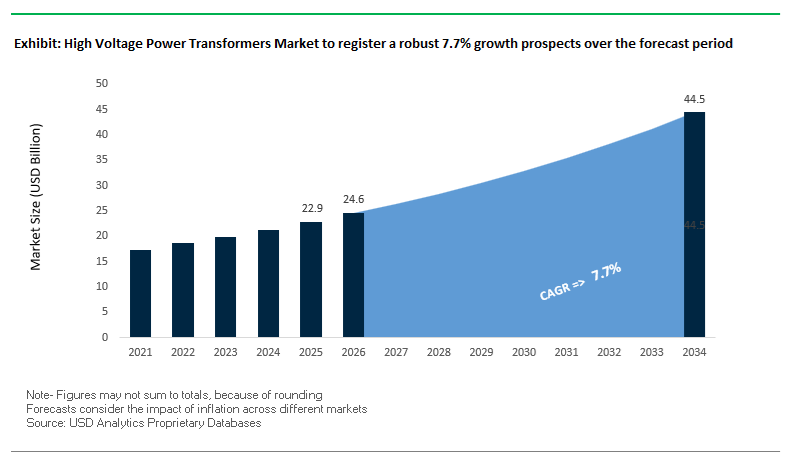
The global High Voltage Power Transformers Market was valued at USD 24,643.3 million in 2026 and is projected to reach USD 44,534.6 million by 2034, registering a CAGR of 7.7% during 2026–2034. Market expansion is supported by high-voltage transmission grid development, renewable energy integration, aging power infrastructure replacement and increasing electricity requirements from hyperscale data centers and energy-intensive industrial facilities. High-voltage power transformers, including multi-winding transformers, autotransformers, generator step-up transformers and HVDC converter transformers, are critical components in bulk electricity transmission, voltage transformation and interregional grid interconnections. According to the International Energy Agency's Electricity 2026 assessment, more than 2,500 GW of renewable generation, large-load and storage projects are stalled in grid connection queues globally, while annual grid expenditure would need to increase by approximately 50% from USD 400 billion by 2030 to meet electricity demand requirements. Transmission capacity expansion and high-voltage substation development are consequently generating equipment demand across utility networks, renewable energy corridors and industrial power infrastructure.
The commercial structure of the High Voltage Power Transformers Industry is shaped by manufacturing capacity constraints, specialized engineering requirements, raw material availability and transformer lifecycle economics. Large power transformer procurement involves voltage-class specifications, MVA ratings, winding configurations, impedance requirements, dielectric insulation performance, factory acceptance testing and complex transportation arrangements. The International Energy Agency reports procurement lead times of up to four years for large power transformers, reflecting elevated equipment demand and limitations in specialized manufacturing capacity. Grain-oriented electrical steel (GOES), copper conductors, high-voltage bushings and on-load tap changers remain significant cost and supply-chain inputs. Transformer pricing and procurement economics also reflect no-load and load losses, cooling-system efficiency, maintenance requirements, outage exposure and long-term asset reliability. Multiyear equipment supply agreements, regional transformer manufacturing expansion and localized component sourcing are becoming increasingly prominent within utility procurement and transmission infrastructure contracts.
Technology differentiation in the High Voltage Power Transformers Market is increasingly associated with extra-high-voltage transmission equipment, HVDC converter transformers, digital condition monitoring and high-efficiency transformer designs. Expansion of 400 kV, 500 kV, 765 kV and ultra-high-voltage transmission networks is supporting demand for specialized insulation engineering, high-capacity autotransformers and converter-specific transformer configurations. Online dissolved gas analysis (DGA), bushing monitoring, winding temperature assessment and predictive maintenance systems are strengthening the role of transformer asset diagnostics in lifecycle service contracts. Mineral oil-immersed transformers retain a leading position in large transmission applications, while natural and synthetic ester insulation technologies address specific fire-safety and environmental requirements. Major manufacturers, including Hitachi Energy, Siemens Energy, GE Vernova, Mitsubishi Electric, TBEA and Hyosung Heavy Industries, compete through high-voltage manufacturing capabilities, production capacity, technical qualification, utility project references and aftermarket service coverage.
Key Insights
- Transmission Infrastructure Demand: More than 2,500 GW of generation, large-load and storage projects face grid connection bottlenecks globally, according to the IEA's 2026 assessment.
- Manufacturing and Supply Constraints: Large power transformer procurement lead times can reach four years, reflecting specialized production capacity and supply-chain limitations.
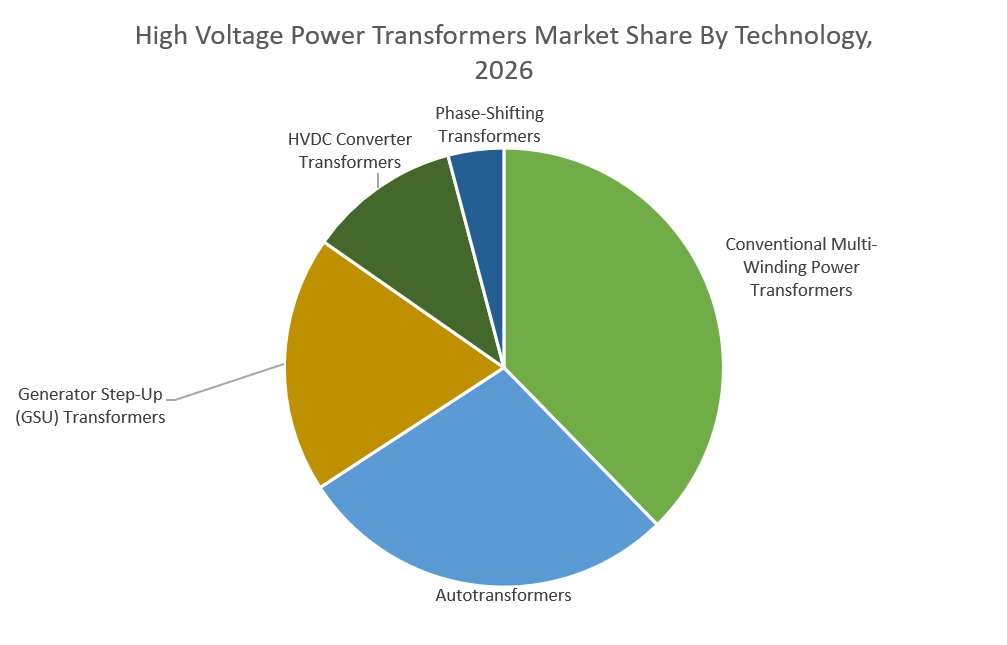
- Technology Market Leadership: Conventional multi-winding transformers account for an estimated 37.7% of 2026 revenue, followed by autotransformers at 28.1%.
- Insulation Medium Dominance: Mineral oil-immersed transformers represent an estimated 81.4% of 2026 market revenue, supported by established high-voltage applications.
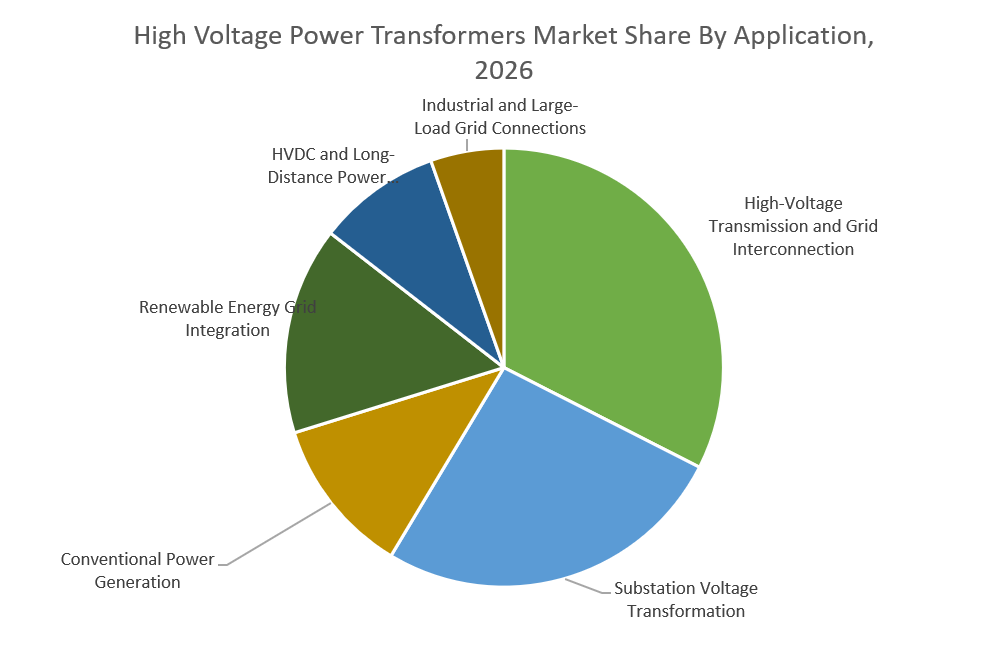
- Leading Application: High-voltage transmission and grid interconnection account for an estimated 32.5% of 2026 revenue, followed by substation voltage transformation at 26.1%.
Recent Developments in the High Voltage Power Transformer Market: Manufacturing Expansion, 765 kV Transmission Equipment and Supply-Chain Localization
Recent developments in the High Voltage Power Transformer Market reflect increasing demand for large power transformers, extra-high-voltage transmission equipment and domestic manufacturing capacity as electricity networks expand to support renewable generation, industrial electrification and AI data centers. The International Energy Agency reported in 2025 that procurement lead times for large power transformers had extended to as much as four years, while transformer prices had risen approximately 75% since 2019. Manufacturing constraints involving grain-oriented electrical steel (GOES), continuously transposed copper conductors, electrical insulation materials and factory testing capacity remain important commercial factors. In October 2026, Hitachi Energy announced a CAD 479 million transformer insulation factory in London, Ontario, designed to establish Canada's first electrical insulation pressboard production line. The Hitachi Energy manufacturing announcement identifies a planned 21,000-square-meter facility, scheduled for completion in 2028, supplying pressboard and laminates used in power transformer manufacturing.
Regional manufacturing expansion has accelerated across North America, Asia and established transformer production centers. In September 2026, Hitachi Energy announced a USD 528 million transformer factory in Gallman, Mississippi, with production scheduled to begin in 2029 and planned manufacturing capacity exceeding twice that of its existing Crystal Springs operation. This followed the company's June 2026 groundbreaking for a USD 457 million large power transformer manufacturing expansion in South Boston, Virginia, and an August announcement of USD 300 million in additional transformer and component manufacturing capacity in Hefei, China. In India, Hitachi Energy separately committed approximately INR 2,000 crore to a new large power transformer facility in Vadodara, targeted for completion in FY2028. Toshiba Energy Systems & Solutions announced JPY 55 billion of planned transmission and distribution equipment manufacturing expenditure through FY2027, with combined production capacity at its principal Japanese and Indian facilities expected to more than double by FY2030 relative to FY2024.
Industry consolidation is reshaping competition among high voltage power transformer manufacturers, HVDC transformer suppliers and transmission equipment providers. On February 2, 2026, GE Vernova completed its USD 5.275 billion acquisition of the remaining 50% ownership interest in Prolec GE, bringing the transformer manufacturer's seven production facilities across the Americas under GE Vernova's Electrification business. The completed GE Vernova–Prolec GE acquisition expanded its manufacturing and service capabilities across power generation, transmission and distribution transformers. In March 2026, GE Vernova announced a further USD 200 million manufacturing project in Hai Phong, Vietnam, primarily targeting large power transformers for high-voltage direct current (HVDC) transmission applications, with full operations expected in 2028. The company also disclosed a USD 30 million expansion of its Italian transformer bushing manufacturing facility, addressing a specialized component category used in high-voltage equipment.
Recent transmission contracts demonstrate growing demand for 345 kV, 765 kV and ultra-high-voltage power transformers across utility transmission systems and large electricity-consuming facilities. In September 2026, Hyosung Heavy Industries secured approximately USD 287 million in transformer supply contracts from two major U.S. technology companies, comprising approximately USD 163 million for 765 kV equipment and USD 124 million for 345 kV transformers associated with planned AI data centers. The Hyosung high-voltage transformer contract announcement follows a February 2026 agreement valued at approximately KRW 787 billion for ultra-high-voltage transformers, reactors and associated transmission equipment in the United States. In India, GE Vernova secured a 2025 POWERGRID contract covering more than 70 units of 765 kV-class transformers and shunt reactors for renewable electricity transmission corridors, with equipment deliveries scheduled across 2026–2027. Transformer manufacturing capability, type-testing requirements, delivery schedules and local service infrastructure remain significant elements of these contracts.
Technology development is also extending into high-efficiency transformer designs, biodegradable insulating fluids, grid asset monitoring and transformer lifecycle services. In May 2025, Hitachi Energy successfully tested a 765/400 kV, 250 MVA single-phase natural ester-filled power transformer, demonstrating the technical application of biodegradable insulating fluids at extra-high-voltage ratings. The equipment was tested as part of its TrafoStar technology platform; the announcement did not establish a completed commercial installation. Siemens Energy has also expanded its transformer and grid equipment activities through manufacturing capacity development and digital asset management. In June 2026, the company announced an agreement to acquire Camlin Group, a specialist in electricity network monitoring, analytics and asset digitalization, with completion subject to regulatory approvals at the time of the announcement. Transformer condition assessment, insulation monitoring, predictive maintenance and refurbishment services are becoming increasingly relevant to transmission utilities operating aging high-voltage equipment with extended replacement lead times.
High Voltage Power Transformer Market Regulatory Framework: IEC 60076, IEEE C57, Transformer Efficiency and Grid Reliability Standards
The High Voltage Power Transformer Market is governed by technical standards covering electrical insulation, temperature rise, dielectric withstand performance, short-circuit strength and factory acceptance testing. IEC 60076-1 establishes general requirements for power transformers, while IEC 60076-3 addresses insulation levels and dielectric tests. The updated IEC 60076-4:2026 transformer impulse testing standard, published in July 2026, specifies procedures for lightning and switching impulse tests, including test circuits, measurement techniques and failure detection. In North America, IEEE C57.12.90-2026, approved in September 2026, updates test methods for liquid-immersed power transformers, covering winding resistance, load losses, impedance, dielectric performance, temperature rise and audible sound measurements.
Transformer energy efficiency requirements differ across regulatory jurisdictions. The European Union's Commission Regulation (EU) No 548/2014, amended by Regulation (EU) 2019/1783, establishes ecodesign requirements for medium and large power transformers, including minimum Peak Efficiency Index (PEI) values and applicable load-loss requirements. Tier 2 requirements have applied since July 2021, subject to specified technical and installation-related exceptions. IEC TS 60076-20 provides additional methods for evaluating transformer energy performance. In the United States, the Department of Energy's 2024 amended efficiency standards for distribution transformers have a compliance date of April 23, 2029; their statutory product scope does not extend generally to large high-voltage transmission transformers.
Environmental and operational standards also influence oil-immersed high voltage transformer design, insulating fluid selection and transmission asset lifecycle management. IEC 62770:2024 specifies properties and testing requirements for unused natural ester insulating fluids, including application conditions involving sealed transformer systems. IEC 60296:2020 addresses mineral insulating oils, while IEC 60076 testing requirements support equipment qualification. U.S. transmission reliability requirements, including NERC CIP-014-3, address physical security at designated high-impact transmission substations rather than imposing universal product certification requirements. Compliance considerations extend to transformer transport, fire protection, insulating-fluid handling, dielectric testing and site-specific grid connection requirements.
High Voltage Power Transformers Market Trends
Extended Power Transformer Lead Times and Manufacturing Capacity Constraints Reshape Supply Agreements
The global High Voltage Power Transformers Market is experiencing sustained manufacturing capacity constraints as transmission grid expansion, large-scale electrification and replacement demand compete for limited production slots. Large power transformers require customized electromagnetic designs, specialized core and winding manufacturing, high-voltage testing and complex transportation arrangements. According to the International Energy Agency's Building the Future Transmission Grid, procurement lead times for large power transformers can reach four years, while average transformer lead times have nearly doubled since 2021. These constraints are increasing the commercial significance of manufacturing-slot allocations, multiyear framework agreements and delivery-linked contractual provisions.
Supply availability remains particularly sensitive to grain-oriented electrical steel (GOES), high-voltage bushings, insulation components and specialized manufacturing capacity. Hitachi Energy announced a USD 195 million expansion of its Varennes, Quebec, large power transformer facility in September 2025, targeting nearly threefold production capacity following completion. The expansion reflects the scale of additional manufacturing capacity required to meet demand for high-voltage transmission transformers, HVDC equipment and large industrial power applications.
Digital Power Transformer Monitoring and Predictive Maintenance Gain Importance in High-Voltage Grid Assets
Digital monitoring is becoming an increasingly important differentiator in the High Voltage Power Transformers Market as transmission utilities seek greater visibility into transformer insulation condition, thermal loading and operational reliability. Online dissolved gas analysis (DGA), winding hot-spot temperature monitoring, bushing condition assessment and on-load tap changer diagnostics provide asset-level information beyond periodic inspection cycles. These technologies support condition-based maintenance, particularly for high-capacity transmission transformers where equipment failures can involve extended outages, specialist repair work and substantial replacement costs.
Hitachi Energy's CoreSense M10 monitoring system illustrates the increasing technical scope of transformer diagnostics, providing continuous monitoring of nine dissolved gases and moisture in insulating fluids. Integration with transformer asset management platforms enables operators to correlate diagnostic measurements with loading history, temperature exposure and developing insulation faults. Commercial differentiation is extending beyond transformer hardware to monitoring software, diagnostic subscriptions, sensor replacement and lifecycle maintenance contracts, particularly within aging extra-high-voltage transmission networks.
High Voltage Power Transformers Market Drivers
Transmission Grid Expansion, Renewable Energy Integration and AI Data Center Growth Accelerate High-Voltage Transformer Demand
Expansion of high-voltage transmission networks is a principal demand driver for large power transformers, supported by renewable energy interconnection, cross-regional electricity transfers and rising electricity requirements from hyperscale data centers. The International Energy Agency's Energy and AI report projects global data center electricity consumption to reach approximately 945 TWh by 2030 in its base case, more than double the 2024 level. Concentrated data center load growth is adding demand for high-capacity grid connections, transmission substations and associated power transformation equipment, although transformer requirements vary with local grid topology, connection voltage and available network capacity.
Renewable generation additions are simultaneously increasing requirements for generator step-up transformers, grid interconnection transformers and extra-high-voltage substations. The growing geographical separation between renewable energy resources and industrial load centers is increasing the importance of 400 kV, 500 kV and 765 kV transmission infrastructure in applicable regional networks. High-voltage transformer order pipelines are consequently linked to grid connection approvals, transmission network construction schedules, substation equipment packages and the commissioning dates of major electricity-consuming facilities.
Aging Transformer Fleets and Grid Reliability Requirements Accelerate Replacement and Modernization Demand
Aging transmission infrastructure represents a sustained source of replacement and refurbishment demand in the High Voltage Power Transformers Market. The U.S. Department of Energy's 2024 Large Power Transformer Resilience Report identifies a typical large power transformer design life of approximately 40 years, while recognizing that actual service life varies with operating temperature, insulation condition, electrical stress and maintenance history. Deterioration of winding insulation, bushings, cooling systems and tap changers creates refurbishment requirements even where transformer cores and major structural components remain serviceable.
Grid reliability requirements are adding further commercial significance to replacement schedules, spare transformer availability and contingency capacity. Transmission operators face operational exposure when large custom-built units fail because transformer transportation, installation and commissioning involve significant logistical constraints. Extreme weather, prolonged thermal loading and changes in system power flows also affect equipment aging and failure probabilities. Replacement demand therefore includes complete transformer units, transformer rewinding, bushing upgrades, cooling-system refurbishment and life-extension services, with expenditure influenced by equipment condition, substation configuration and the feasibility of extended outages.
High Voltage Power Transformers Market Opportunities
HVDC Converter Transformers and Extra-High-Voltage Transmission Projects Expand Specialized Equipment Demand
Expansion of high-voltage direct current (HVDC) transmission and extra-high-voltage alternating current networks is broadening the addressable market for specialized transformer manufacturers. HVDC converter transformers require insulation systems and winding designs suited to combined AC and DC electrical stresses, converter-related harmonics and demanding thermal operating conditions. These technical requirements differentiate HVDC transformer manufacturing from conventional grid transformer production and increase the importance of specialized engineering, factory testing and project-specific equipment qualification.
In April 2025, Hitachi Energy and Bharat Heavy Electricals Limited secured a contract for India's 950 km Bhadla–Fatehpur HVDC transmission project, designed to transfer 6 GW of renewable electricity through a ±800 kV bipolar system. The scope includes converter transformers and connections to 765 kV and 400 kV AC grids. Separately, GE Vernova T&D India reported orders for 765 kV power transformers from Power Grid Corporation of India and a private transmission developer during the quarter ended December 2025. Such projects generate demand for high-capacity transformer manufacturing, converter-specific insulation, high-voltage bushings and specialized testing infrastructure.
High-Efficiency and Ester-Filled Power Transformers Create Lifecycle Cost and Fire-Safety Differentiation
Energy efficiency and dielectric insulation performance are increasingly important commercial differentiators in large power transformer specifications, particularly for continuously energized transmission assets. Transformer operating economics incorporate no-load core losses, load-dependent winding losses, cooling-system consumption and maintenance expenditure over extended service periods. The European Union's Ecodesign Regulation (EU) No. 548/2014, as amended, establishes minimum Peak Efficiency Index requirements for large power transformers. The Tier 2 threshold effective from July 2021 reaches 99.797% for liquid-immersed units rated at 200 MVA or above. These requirements give transformer core design, electrical steel selection and loss evaluation a direct role in equipment compliance and lifecycle cost comparisons.
Natural and synthetic ester dielectric fluids provide additional product differentiation through higher fire points and different environmental characteristics compared with conventional mineral oil. Their use is relevant to applications involving constrained installation footprints, elevated fire-risk exposure and sensitive environmental locations. However, ester-filled transformer configurations have distinct thermal, viscosity and cooling-system requirements that can affect tank sizing and operating design. The U.S. Department of Energy identifies both the fire-safety benefits and cooling-related design considerations of ester-insulated large power transformers.
Regional Transformer Manufacturing Expansion and Lifecycle Services Create New Supplier Revenue Opportunities
Regional manufacturing expansion is changing the competitive structure of the High Voltage Power Transformers Market as major equipment manufacturers increase domestic production capacity and strengthen localized component supply chains. Manufacturing location influences import exposure, transportation complexity, delivery schedules and qualification requirements for large power transformers. In September 2026, Hitachi Energy announced a USD 528 million transformer manufacturing facility in Gallman, Mississippi, intended to double its local production capacity and create more than 700 jobs. In June 2026, the company also announced approximately INR 2,000 crore for a new large power transformer factory in Vadodara, India, with completion scheduled for fiscal 2028.
Manufacturing localization is accompanied by growing commercial activity across transformer components and aftermarket services. High-voltage bushings, on-load tap changers, insulating materials, field installation, oil processing, transformer testing and refurbishment represent specialized revenue segments alongside original equipment supply. Long operational lifetimes and complex asset replacement requirements create recurring demand for diagnostic services, spare components and maintenance contracts. Manufacturer capabilities in high-voltage testing, field service coverage and equipment refurbishment increasingly influence competitive differentiation across utility transmission, power generation and industrial transformer applications.
High Voltage Power Transformers Market Share Analysis, 2026
High Voltage Power Transformers Market Share by Technology: Conventional Multi-Winding Transformers Lead
Conventional multi-winding power transformers dominate the global High Voltage Power Transformers Market in 2026, accounting for 37.7% of total revenue, supported by extensive deployment across transmission substations, grid interconnection infrastructure and industrial power networks. Their established role in voltage transformation, electrical isolation and multi-voltage grid integration sustains demand across transmission expansion and aging infrastructure replacement programs. Autotransformers hold a 28.1% market share, reflecting their importance in high-capacity transmission networks requiring efficient voltage transformation between interconnected grid levels. Generator step-up (GSU) transformers maintain substantial demand from conventional power generation and utility-scale renewable installations, while HVDC converter transformers benefit from long-distance power transmission, offshore wind connections and cross-border interconnector projects. Phase-shifting transformers serve specialized grid applications involving active-power flow control, transmission congestion management and network stability.
High Voltage Power Transformers Market Share by Insulation Medium: Mineral Oil-Immersed Transformers Dominate
Mineral oil-immersed transformers account for 81.4% of global High Voltage Power Transformers Market revenue in 2026, maintaining market leadership through established dielectric performance, thermal management efficiency and extensive operating experience across high-voltage and extra-high-voltage transmission networks. Mature manufacturing processes, established maintenance infrastructure and compatibility with large MVA transformer designs support their widespread adoption across utility substations and power generation facilities. Natural ester-insulated transformers represent 9.8% of the market, reflecting increasing demand for biodegradable dielectric fluids, higher fire-point insulation systems and environmentally sensitive installations. Synthetic ester-insulated transformers address specialized fire-safety and insulation requirements, while other insulation technologies serve selected applications involving space constraints, environmental specifications and distinct operating conditions. Insulation-medium competition increasingly reflects lifecycle costs, fire-safety performance, dielectric fluid characteristics and regulatory compliance.
High Voltage Power Transformers Market Share by Application: Transmission and Grid Interconnection Lead
High-voltage transmission and grid interconnection represent the largest application segment, accounting for 32.5% of global High Voltage Power Transformers Market revenue in 2026, driven by transmission grid expansion, renewable energy interconnection and increasing electricity transfers between generation centers and major consumption hubs. Demand includes high-capacity transmission transformers, extra-high-voltage equipment and grid reinforcement projects associated with utility infrastructure development. Substation voltage transformation follows with a 26.1% market share, supported by capacity uprating, network modernization and replacement of aging transformer assets. Renewable energy grid integration contributes through utility-scale solar and wind developments, while conventional power generation sustains generator step-up transformer demand. HVDC transmission projects generate specialized converter transformer requirements, and industrial grid connections, including hyperscale data centers, steel manufacturing and petrochemical facilities, support demand for dedicated high-voltage substations and large-capacity power transformation equipment.
High Voltage Power Transformers Market Competitive Landscape
The global High Voltage Power Transformers Market features a competitive mix of multinational electrical equipment manufacturers, specialized transformer OEMs and regional transmission equipment suppliers. Hitachi Energy, Siemens Energy and GE Vernova maintain extensive high-voltage transformer portfolios, supported by international manufacturing networks, advanced testing capabilities and established relationships with transmission system operators. Mitsubishi Electric, Toshiba, Hyosung Heavy Industries, HD Hyundai Electric and TBEA compete across large power transformers, generator step-up transformers, autotransformers and specialized transmission applications. Competition is influenced by voltage-class expertise, manufacturing capacity, technical qualification, delivery schedules and installed equipment references.
Manufacturing capacity and regional production capabilities are becoming increasingly important competitive differentiators as large power transformer lead times remain elevated. In 2026, Hitachi Energy announced a new large power transformer manufacturing facility in Vadodara, India, scheduled for completion in fiscal 2028, while Siemens Energy India approved an expansion of approximately 30,000 MVA in large power transformer manufacturing capacity. GE Vernova strengthened its North American transformer operations through the completed acquisition of Prolec GE in February 2026. These developments reflect increasing competition for utility supply agreements, grid modernization contracts and large-capacity transformer orders associated with transmission expansion.
Technology differentiation is particularly significant in extra-high-voltage (EHV), ultra-high-voltage (UHV) and high-voltage direct current (HVDC) transformer applications. Manufacturers compete through 400 kV, 500 kV, 765 kV and higher-voltage equipment capabilities, alongside specialized converter transformers, phase-shifting transformers and high-capacity generator step-up units. TBEA and China XD maintain established product capabilities in 1,000 kV-class AC and ultra-high-voltage DC transmission equipment, while Hyosung Heavy Industries and HD Hyundai Electric offer large-capacity transformers for international transmission networks. Competitive positioning in these segments reflects dielectric engineering, short-circuit withstand performance, thermal design, factory acceptance testing and project-specific manufacturing requirements.
Aftermarket services and transformer lifecycle performance also influence competitive differentiation across utility and industrial applications. Online dissolved gas analysis, bushing monitoring, on-load tap changer diagnostics, insulation assessment and transformer refurbishment extend manufacturer participation beyond original equipment sales. High-efficiency transformer designs and natural or synthetic ester insulation provide additional differentiation in applications with stringent loss, fire-safety and environmental requirements. Established manufacturers and specialized regional suppliers compete through technical service coverage, spare-part availability, equipment reliability, warranty provisions and compliance with IEC and IEEE transformer standards.
High Voltage Power Transformers Market Country Analysis
United States High Voltage Power Transformers Market: Grid Modernization, AI Data Centers and Domestic Manufacturing Expansion
The United States represents a major market for high-voltage power transformers, supported by aging transmission infrastructure, hyperscale data center electricity demand and expansion of high-capacity grid connections. Demand encompasses generator step-up transformers, 345 kV and 500 kV transmission equipment, 765 kV extra-high-voltage transformers and large substation autotransformers. Domestic manufacturing capacity is expanding in response to elevated equipment lead times and growing utility procurement requirements. In June 2026, Hitachi Energy commenced construction of a USD 457 million large power transformer manufacturing facility in South Boston, Virginia, followed by the announcement of a USD 528 million transformer factory in Mississippi in September 2026. GE Vernova, Siemens Energy and Hyosung Heavy Industries maintain significant positions in the American power equipment supply chain. Transformer procurement remains closely associated with transmission network reinforcement, grid reliability expenditure, manufacturing capacity availability and the commissioning schedules of large electricity-consuming facilities.
China High Voltage Power Transformers Market: Ultra-High-Voltage Transmission and Renewable Power Corridors
China maintains an extensive high-voltage power transformer manufacturing and deployment base, driven by ultra-high-voltage transmission networks, regional electricity transfers and large-scale renewable energy integration. State Grid's west-to-east transmission infrastructure creates substantial demand for 1,000 kV UHVAC transformers, ±800 kV HVDC converter transformers, high-capacity autotransformers and specialized substation equipment. In June 2025, the 2,260 km Hami–Chongqing ±800 kV HVDC transmission project entered operation, with an expected annual electricity transfer exceeding 36 billion kWh. The Ningxia–Hunan ±800 kV project, spanning approximately 1,616 km with a designed transmission capacity of 8 GW, also reached full-capacity operation in 2025. Domestic manufacturers, including TBEA and China XD, maintain established capabilities across ultra-high-voltage AC and DC equipment. China's transformer market is distinguished by large project-specific equipment requirements, domestic manufacturing scale, converter transformer engineering and integration with long-distance renewable electricity transmission.
India High Voltage Power Transformers Market: 765 kV Grid Expansion and Renewable Energy Interconnection
India's High Voltage Power Transformers Market is supported by rapid transmission infrastructure expansion, renewable energy evacuation corridors, interstate electricity transfers and growing industrial power requirements. The Ministry of Power's National Electricity Plan projects an increase in national transformation capacity from 1,478 GVA in June 2026 to 2,345 GVA by 2032, alongside transmission network expansion from approximately 509,000 circuit-km to 648,000 circuit-km. The development of 400 kV and 765 kV substations, high-capacity autotransformers and ±800 kV HVDC links is creating demand across government transmission utilities and private transmission developers. In June 2026, Hitachi Energy announced approximately INR 2,000 crore for a new large power transformer facility in Vadodara, scheduled for completion in fiscal 2028. BHEL, CG Power, Transformers and Rectifiers (India) and Siemens Energy India also participate in the domestic transformer manufacturing and supply ecosystem. Equipment demand is closely linked to renewable energy grid integration, transmission capacity additions, domestic manufacturing capabilities and large-scale substation development.
Germany High Voltage Power Transformers Market: HVDC Transmission Corridors and Offshore Wind Grid Integration
Germany represents an important European market for high-voltage power transformers, characterized by extra-high-voltage grid modernization, offshore wind interconnection and long-distance HVDC transmission infrastructure. The Federal Network Agency reported approvals covering approximately 2,000 km of electricity transmission lines during 2025, around 45% above the previous year, including progress on major north-to-south transmission corridors. The SuedLink project is designed to transfer up to 4 GW of electricity across approximately 700 km, with Siemens Energy supplying HVDC converter technology and transformers for designated project sections. Germany also maintains specialized transformer manufacturing capabilities through Siemens Energy's Nuremberg facility, where a €220 million expansion announced in September 2025 is expected to increase production capacity by approximately 50% by 2028. Demand is associated with converter transformers, large power transformers, offshore transmission infrastructure and substation modernization. Equipment competition reflects high-voltage engineering expertise, European grid specifications, manufacturing lead times and technical qualification requirements.
Brazil High Voltage Power Transformers Market: Transmission Auctions and Regional Transformer Manufacturing
Brazil's High Voltage Power Transformers Market is driven by long-distance electricity transmission, renewable generation integration and expansion of the National Interconnected System. Transmission concession auctions organized by ANEEL provide an important source of project demand for high-capacity power transformers, autotransformers and substation equipment. Brazil's October 2026 transmission auction is scheduled to offer 1,866 km of new transmission lines and 12,694 MVA of transformation capacity, across eight concession lots. Domestic manufacturing is also expanding, with Hitachi Energy announcing an additional USD 70 million for transformer facilities in Guarulhos and Pindamonhangaba in March 2026, supplementing its previously announced USD 200 million manufacturing program. The expansion includes a planned 50% increase in production capacity at Pindamonhangaba, supporting domestic supply and transformer exports. WEG and other regional electrical equipment suppliers contribute to the competitive landscape. Market activity encompasses high-voltage substations, renewable power corridors, large-capacity transformer manufacturing and transmission network reinforcement.
South Korea High Voltage Power Transformers Market: EHV Transformer Manufacturing and HVDC Technology Development
South Korea holds a significant position in the international High Voltage Power Transformers Market through advanced manufacturing capabilities, specialized extra-high-voltage equipment and established export relationships with major transmission utilities. Hyosung Heavy Industries and HD Hyundai Electric manufacture large power transformers for domestic and overseas applications, including 345 kV, 400 kV and 765 kV transmission systems. In January 2026, Hyosung Heavy Industries reported that cumulative extra-high-voltage transformer production at its Changwon facility had exceeded KRW 10 trillion, with annual orders surpassing KRW 1 trillion for three consecutive years since 2023. The company subsequently announced a KRW 787 billion U.S. power equipment contract in February 2026, including 765 kV transformers and reactors. Domestic technology development is also expanding into 500 kV HVDC converter transformers, associated with Korea's long-distance transmission modernization. Manufacturing competition is influenced by export order backlogs, high-voltage testing capabilities, specialized transformer engineering and production capacity for international utility contracts.
High Voltage Power Transformers Market Report Scope
High Voltage Power Transformers Market Report Scope, Segmentation, Competitive Landscape and Regional Coverage (2026–2034)
|
Parameter
|
Details
|
|
Market Size (2026)
|
USD 24,643.3 Million
|
|
Market Size (2034)
|
USD 44,534.6 Million
|
|
Market Growth Rate
|
7.7% CAGR (2026–2034)
|
|
Segments
|
By Technology: Conventional Multi-Winding Power Transformers, Autotransformers, Generator Step-Up (GSU) Transformers, HVDC Converter Transformers, Phase-Shifting Transformers. By Insulation Medium: Mineral Oil-Immersed Transformers, Natural Ester-Insulated Transformers, Synthetic Ester-Insulated Transformers, Other Insulation Technologies. By Application: High-Voltage Transmission and Grid Interconnection, Substation Voltage Transformation, Conventional Power Generation, Renewable Energy Grid Integration, HVDC and Long-Distance Power Transmission, Industrial and Large-Load Grid Connections.
|
|
Study Period
|
Historical: 2020–2025; Forecast: 2026–2034
|
|
Units
|
Revenue (USD Million and USD Billion)
|
|
Technology Coverage
|
High-Voltage and Extra-High-Voltage Power Transformers, Multi-Winding Transformers, High-Capacity Autotransformers, Generator Step-Up Transformers, HVDC Converter Transformers, Phase-Shifting Transformers, Digital Transformer Monitoring, Online Dissolved Gas Analysis (DGA), High-Efficiency Transformers, Natural and Synthetic Ester Insulation
|
|
Qualitative Analysis
|
Porter's Five Forces, SWOT Analysis, Market Share Analysis, Competitive Landscape, Market Dynamics, Value Chain Analysis, Manufacturing Capacity Assessment, Supply-Chain Analysis, Transformer Lifecycle Economics, Industry Benchmarking, Regulatory Assessment and Regional Market Outlook
|
|
Regulatory and Standards Coverage
|
IEC 60076 Power Transformer Standards, IEEE C57 Series, EU Ecodesign Regulation (EU) No. 548/2014 (as amended), Transformer Efficiency Requirements, Dielectric Insulation Standards, High-Voltage Testing and Electrical Safety Requirements
|
|
Leading Companies
|
Hitachi Energy Ltd., Siemens Energy AG, GE Vernova Inc., Mitsubishi Electric Corporation, Toshiba Energy Systems & Solutions Corporation, Hyosung Heavy Industries Corporation, HD Hyundai Electric Co., Ltd., TBEA Co., Ltd., China XD Electric / China XD Group, Bharat Heavy Electricals Limited (BHEL), CG Power and Industrial Solutions Limited, WEG S.A., SGB-SMIT Group, Virginia Transformer Corporation, Transformers and Rectifiers (India) Limited
|
|
Countries and Markets Covered
|
United States, Canada, Mexico, Germany, France, Spain, Italy, United Kingdom, Russia, China, India, Japan, South Korea, Australia, Southeast Asia, Brazil, Argentina, Middle East, Africa
|
High Voltage Power Transformers Market Segmentation
By Technology
- Conventional Multi-Winding Power Transformers
- Autotransformers
- Generator Step-Up (GSU) Transformers
- HVDC Converter Transformers
- Phase-Shifting Transformers
By Voltage Rating
- High Voltage (HV)
- Extra High Voltage (EHV)
- Ultra-High Voltage (UHV)
By Power Capacity
- Up to 100 MVA
- Above 100–300 MVA
- Above 300–600 MVA
- Above 600 MVA
By Insulation Medium
- Mineral Oil-Immersed Transformers
- Natural Ester-Insulated Transformers
- Synthetic Ester-Insulated Transformers
- Other Insulation Technologies
By Application
- High-Voltage Transmission and Grid Interconnection
- Substation Voltage Transformation
- Conventional Power Generation
- Renewable Energy Grid Integration
- HVDC and Long-Distance Power Transmission
- Industrial and Large-Load Grid Connections
By End-User
- Electric Utilities and Transmission System Operators
- Power Generation Companies
- Renewable Energy Developers
- Industrial Facilities
- Data Centers and Large Commercial Power Users
Countries Analyzed
- North America (US, Canada, Mexico)
- Europe (Germany, UK, France, Spain, Italy, Russia, Rest of Europe)
- Asia Pacific (China, India, Japan, South Korea, Australia, South East Asia, Rest of Asia)
- South America (Brazil, Argentina, Rest of South America)
- Middle East and Africa (Saudi Arabia, UAE, Rest of Middle East, South Africa, Egypt, Rest of Africa)
Leading High Voltage Power Transformer Manufacturers and Key Market Players
- Hitachi Energy Ltd.
- Siemens Energy AG
- GE Vernova Inc.
- Mitsubishi Electric Corporation
- Toshiba Energy Systems & Solutions Corporation
- Hyosung Heavy Industries Corporation
- HD Hyundai Electric Co., Ltd.
- TBEA Co., Ltd.
- China XD Electric / China XD Group
- Bharat Heavy Electricals Limited (BHEL)
- CG Power and Industrial Solutions Limited
- WEG S.A.
- SGB-SMIT Group
- Virginia Transformer Corporation
- Transformers and Rectifiers (India) Limited (TARIL)
*List not Exhaustive
High Voltage Power Transformers Market Research Methodology
The High Voltage Power Transformers Market assessment draws on secondary research covering power transmission infrastructure, transformer manufacturing, equipment specifications, regulatory requirements and industry developments. Principal information sources include manufacturer annual reports, investor disclosures, official press releases, government electricity infrastructure programs, transmission system operator publications, regulatory agencies and recognized technical standards organizations. Industry evidence is evaluated across transformer voltage ratings, MVA capacity, technology configurations, insulation systems, application requirements and geographical markets, with attention to equipment manufacturing activity, utility procurement and large-scale transmission project pipelines.
The market segmentation framework covers technology, insulation medium and application, with revenue allocation defined by the primary equipment category and end-use application to limit double counting. Competitive analysis considers high-voltage manufacturing capabilities, transformer product portfolios, regional production facilities, project contracts and lifecycle service operations. Market interpretation incorporates transmission capacity additions, transformer replacement demand, supply-chain conditions and transformer lifecycle economics. The supplied 2026 segment-share estimates are treated as modeled market allocations rather than independently verified manufacturer revenue disclosures.

 )
 )
 to
 )