Hotel Energy Management System Market Outlook: Sustainability, Cost Efficiency, and Smart Building Integration
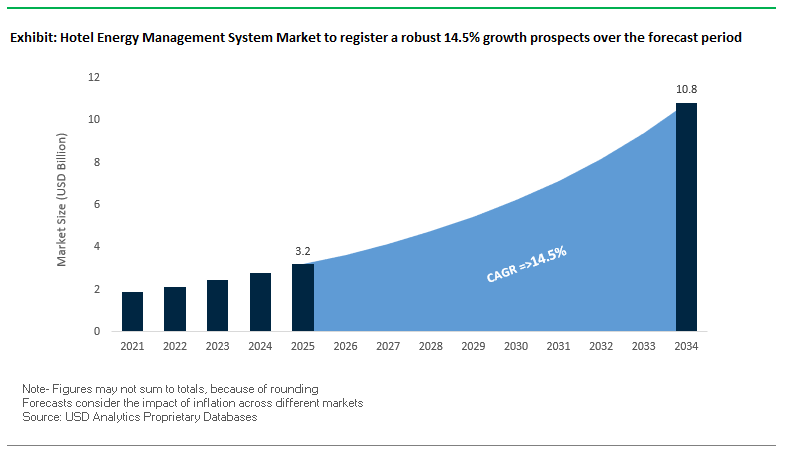
The global hotel energy management system (HEMS) market is projected to grow from $3.2 billion in 2025 to $10.8 billion by 2034, at a CAGR of 14.5%. The sector has a transformative effect on the hospitality industry, enabling hotels to optimize operational efficiency, sustainability, and guest comfort through emerging technology. With rising energy costs and green regulations, the use of HEMS is on the upswing globally as hoteliers seek data-driven technology that easily integrates with modern building systems.
Industry experts know that hotels are one of the largest consumers of energy in commercial property with a peak of over 400 kWh/m²/year. Clever, integrated HEMS platforms reduce costs, meet regulatory demands, and improve brand reputation. With sustainability as a brand-defining characteristic, global initiatives like the World Sustainable Hospitality Alliance's Hotel Carbon Measurement Initiative (HCMI) and Hotel Water Measurement Initiative (HWMI) adopted by over 30,000 hotels globally are setting new standards in energy and water reporting.
Key Insights for Industry Decision-Makers:
- Global Sustainability Push: Standardized measurement frameworks driving widespread HEMS adoption.
- Energy Cost Pressures: Rising electricity prices make energy efficiency a profitability necessity.
- Guest-Centric Technology: Occupancy-based controls and personalized room environments enhance the customer experience.
- Smart Building Convergence: Integration of HVAC, lighting, and sensors into unified platforms is becoming the hospitality norm.
- IoT and AI Influence: Predictive analytics and real-time energy data boost operational agility.
Recent Developments and Strategic Moves in Hotel Energy Management System Industry
Recent shifts in the global HEMS market witnessed aggressive innovation and targeted growth, an indication of industry momentum. In July 2025, ABB launched its Smart EMS platform that facilitates seamless integration with third-party devices from over 300 manufacturers critical to hotels with heterogeneous legacy and modern systems. In February 2025, Schneider Electric launched its SpaceLogic Touchscreen Room Controller that optimizes room control with intelligent interfaces that weigh guest comfort and energy efficiency.
IoT and AI are the new drivers of transformation in HEMS. In November 2024, Honeywell launched AI-driven building solutions to enhance operational productivity and efficiency, the gateway to autonomous plant operation that is hotel-friendly. SensorFlow collaborated with Truntum Hotel Kuta Bali in November and with Oakwood Premier Phnom Penh in October 2024, highlighting the fast pace of Southeast Asia's energy-saving hotel technology uptake.
The Competitive Landscape is also driven by product diversification and innovation in the cloud. September 2024 witnessed the launch by Eaton of its AbleEdge HEMS, designed for resilience and flexibility, and August 2024 witnessed Telkonet marketing its IoT-based occupancy system for real-time guest room condition optimization. By April 2025, a top HEMS vendor had upgraded its cloud-based remote monitoring capabilities, enabling hoteliers to track energy consumption and optimization areas from a central location. These launches indicate where the market is moving from discrete systems to comprehensive, cloud-based platforms with the capability to undertake predictive energy optimization.
Trends and Opportunities Reshaping the Hotel Energy Management System Market
AI-Powered HVAC Load Balancing Reduces Costs and Enhances Comfort
AI-driven HVAC optimization is one of the most effective technologies in the hotel energy management system (HEMS) category. With the use of real-time IoT-based occupancy, temperature, and humidity sensor data, these systems dynamically optimize HVAC loads to actual demand. Luxury and mid-scale hotels can achieve 20%–50% in energy savings using this technology, with reported instances saving up to 28% in per-room energy usage at 80% occupancy without compromising guest comfort. Predictive maintenance functionality further optimizes HVAC equipment life and reduces downtime, lowering repair costs by up to 35%. PMS integration does away with the manual switching of energy modes when guests check out and pre-conditions rooms for incoming guests. The result is a double benefit significant cost savings for operations and a consistently comfortable, tailored guest environment.
Blockchain-Enabled Carbon Credit Trading Unlocks New Revenue Streams
The application of blockchain technology in HEMS platforms is transforming ESG reporting and monetization tactics for hotels. Tracking energy use and carbon savings on decentralized records, operators make environmental and transparent ESG reporting a top requirement for green-conscious investors. Emissions savings may be tokenized as digital carbon credits and traded in decentralized markets, opening a new green revenue stream. Hotels that adopt this strategy not only meet regulatory needs but also increase access to sustainable finance funds, enabling investment in further retrofits and renewable energy initiatives. This nexus between energy management, blockchain transparency, and financial innovation sets innovative hotels at the forefront of hospitality sustainability.
Middle East Luxury Hotel Energy Retrofits for Extreme Climate Efficiency
The Middle East luxury hospitality market boom, combined with ultra-cooling demands, offers a high-margin retrofit opportunity for HEMS providers. Across the UAE and Saudi Arabia, HVAC represents a disproportionate percentage of hotel energy, offering an attractive ROI for energy upgrade. Upgrades fit national sustainability strategies like Saudi Arabia's Vision 2030, which encourages smart building investment. Regional luxury operators are looking for solutions that address sustainability without compromising premium guest comfort, and this offers the opportunity to AI-optimise cooling, high-performance glazing systems, and integrated smart controls. This opportunity is underscored by government-supported financing initiatives and market acceptance of cutting-edge ESG-compliant technologies.
Energy-as-a-Service (EaaS) Models for Independent Hotel Adoption
The EaaS model is lowering barriers to independent hotels and small chains embracing HEMS with minimal initial capital. Under the model, providers install, manage, and maintain the system for a recurring fee based on a percentage of actual verified energy savings. The pay-for-performance model aligns provider incentives with hotel performance and frees up capital for other operating needs. EaaS contracts often bundle full lifecycle service, including monitoring, software updates, and proactive maintenance, freeing up operating burdens from hotel personnel. As independent hotels represent a large percentage of the hospitality market, EaaS represents a scalable path to broad HEMS adoption, propelling the industry toward energy efficiency.
Hotel Energy Management System Market Share and Segmentation Insights
Application Segment Performance: HVAC Control Dominates, Lighting Control Expands
HVAC control (35% market share) is the largest application segment because of its disproportionate contribution to energy use typically up to 50% of the total utility bill of a hotel. AI-driven HVAC systems coupled with occupancy-based automation yield the maximum savings. Lighting control (25%) is racing ahead with the help of LED retrofit, daylight harvesting, and circadian lighting solutions boosting guest comfort. Energy monitoring and reporting software are now minimum requirements for meeting international sustainability standards, and providing actionable data for continuous improvement. Room automation such as smart thermostats and in-room control panels is progressing most rapidly in luxury hotels, and water management integration is flying high in water-scarce destinations enabling end-to-end resource optimization.
 Market Share by Application (2025).png)
Hotel Type Performance: Luxury Hotels Lead, Budget Hotels Gain Ground
Luxury hotels (40% market share) are the adopters of HEMS, who are spending heavily on integrated platforms fusing energy efficiency and high-end guest customization. Luxury hotels are embracing full-suite solutions, from AI HVAC optimization to environmental control in-guest rooms, in line with ESG principles while still maintaining brand cachet. Budget hotels (12%) and motels are implementing cost-focused HEMS solutions, particularly for HVAC and lighting control, to protect margins in price-sensitive marketplaces. Boutique hotels apply HEMS as a component of sustainable branding, appealing to eco-aware travelers by promoting energy efficiency programs. Across all segments, the ROI potential of next-generation HEMS solutions is driving adoption, with performance-related and EaaS models driving adoption in price-sensitive segments.
Competitive Landscape – Key Innovators Driving Hotel Energy Management System Adoption
The global HEMS market is led by technology giants and specialized providers that combine building automation, sustainability solutions, and hospitality-focused innovations. These companies are shaping the competitive field with integrated platforms, IoT capabilities, and customer-centric service models. Key players included are Schneider Electric SE, Siemens AG, Honeywell International Inc., Johnson Controls International plc, ABB Ltd., INNCOM (a division of Honeywell), Telkonet, Inc. (now VDA Telkonet), Enkoa S.A., Verdant Environmental Solutions, SensorFlow Pte. Ltd., Entech Controls LLC, EcoSmart, Lutron Electronics Co., Inc., Betterspace GmbH, VDA Telkonet, Others.
Schneider Electric – Digital Transformation Leader in Hospitality Energy Management
Schneider Electric utilizes its energy optimization and automation expertise to deliver end-to-end hotel solutions like room controllers, BMS platforms, and analytics software. The company's focus on sustainability through minimizing CO₂ emissions is reflected through alignment with all worldwide sustainability objectives. In February 2025, it launched the SpaceLogic Touchscreen Room Controller, a guest-centric interface for enhanced comfort and operational efficiency.
Siemens AG – Integrated Smart Building Innovator
Siemens offers integrated building automation solutions that combine HVAC, lighting, safety, and security management. Its Building Services offerings, which are sold through the Siemens Xcelerator marketplace, assist hotels in saving money and complying with environmental regulations. Siemens' flexibility and emphasis on sustainable building technology make it a hospitality energy management leader.
Honeywell International Inc. – AI-Driven Building Technology Provider
Honeywell’s strength lies in its Tridium building automation systems, which unify multiple hotel systems into one cohesive platform. Its November 2024 AI solutions are designed to increase system productivity and efficiency and are feature-optimized for self-sustaining building operations. Honeywell's operational intelligence focus allows hotels to deliver cost savings and improved guest experience.
ABB Ltd. – Flexible and Future-Ready Energy Optimization Solutions
ABB's Smart EMS, launched in July 2025, optimizes energy flows while ensuring wide third-party compatibility with best-fit devices for upgrading hotels' infrastructure. ABB's emphasis on integrated systems that are easy to use enables hotels to optimize energy consumption without the hassle of overhauls, which is appealing to large chains and independent owners.
Telkonet Inc. – Occupancy-Based Energy Efficiency Specialist
Telkonet is completely committed to energy management that is hospitality-centric, its Rhapsody platform integrating smart thermostats and IoT sensors to deliver room-level control of energy. Its wireless, retrofit sensors make installation quick with little disruption to hotel operations. The company's emphasis on guest comfort and measurable cost savings makes it an appealing option for both mid-scale and upscale hotels.
United States: AI-Driven HEMS Deployment and Large-Scale Chain Integration
The United States remains one of the most advanced markets for hotel energy management systems, supported by robust government initiatives such as the Better Buildings Challenge and Better Plants Program, which encourage the hospitality sector to cut energy consumption without compromising guest experience. Major hotel groups like Marriott International are committing to climate risk evaluations across thousands of properties, further reinforcing market adoption. U.S. technology providers are pushing the boundaries of AI-driven HEMS capable of predictive maintenance, real-time occupancy-based adjustments, and weather-adaptive HVAC control. These systems integrate with in-room guest interfaces, allowing for personalized lighting and climate settings while ensuring automated efficiency when spaces are unoccupied.
Large-scale hotel chains in the U.S. present fertile ground for mass HEMS deployment, with brands investing in multi-property rollouts to achieve measurable cost savings and sustainability targets. Companies like Telkonet are forming strategic partnerships to equip thousands of rooms with advanced monitoring and automation tools. The focus on balancing comfort and efficiency remains a competitive differentiator, with next-generation systems providing actionable analytics for property managers. This synergy between policy, technology, and large corporate adoption cements the U.S. as a leading innovator in the global HEMS market.
Germany: Regulation-Driven Efficiency and Precision-Engineered HEMS Solutions
Germany’s HEMS market is shaped by strict compliance with the EU Energy Performance of Buildings Directive (EPBD), compelling hotels to adopt sophisticated monitoring and energy control systems. German engineering giants such as Siemens and Betterspace deliver highly reliable HEMS platforms that emphasize durability, long-term ROI, and seamless integration with building automation. The country’s strong culture of precision engineering ensures these systems meet both energy reduction targets and operational continuity.
Artificial intelligence is playing a critical role in Germany’s hotel energy strategy, with solutions like BRAIAN demonstrating the impact of predictive analytics on climate control optimization. By integrating environmental sensors, occupancy tracking, and HVAC data, German hotels are achieving significant reductions in energy demand. The combination of policy-driven adoption, engineering excellence, and AI-powered innovation positions Germany as a model market for scalable, regulation-compliant HEMS deployments across Europe.
India: Government-Led Efficiency Programs and Sustainability-Driven Adoption
India’s hotel energy management system market is expanding rapidly due to strong government support and the rising cost of electricity in commercial buildings. Initiatives such as the Guidebook for Managing Energy Use in Your Hotel are educating hoteliers on achieving 20–30% energy savings without compromising guest satisfaction. With commercial electricity costs climbing, HEMS adoption is increasingly seen as a necessity for operational cost control and brand differentiation in a competitive hospitality market.
The push for sustainability is also transforming India’s hospitality sector, with eco-conscious travelers preferring hotels that commit to measurable environmental impact reduction. Emerging solutions in India are leveraging IoT-enabled sensors and cloud-based analytics to provide real-time monitoring, enabling hotel managers to adjust energy consumption patterns dynamically. This blend of policy, market economics, and technological innovation is making HEMS a core element of India’s green hospitality movement.
China: Smart Hotel Growth and AI-Powered HEMS Integration
China’s booming tourism industry and rapid urban hotel development are fueling large-scale opportunities for HEMS deployment. As the government enforces stricter environmental compliance, hotels are under increasing pressure to adopt energy-efficient technologies. Chinese tech leaders are leveraging IoT ecosystems and AI optimization algorithms to develop comprehensive energy management platforms that integrate with property management and guest service systems, delivering both efficiency and an enhanced guest experience.
High-tech integration is a defining feature of China’s HEMS market. Systems are capable of analyzing real-time consumption patterns across HVAC, lighting, and other building services, automatically adjusting parameters to reduce waste. With global e-commerce platforms also promoting Chinese-made HEMS technology, manufacturers are finding export opportunities in addition to domestic growth. The combination of government-driven regulation, technology leadership, and hospitality sector expansion ensures China’s continued influence on global HEMS innovation.
United Kingdom: Sustainability Goals and Smart Building Synergy
The United Kingdom’s hotel energy management system market is evolving under the influence of sustainability targets, rising energy costs, and post-pandemic operational priorities. While no longer bound by EU regulations, UK hotels remain aligned with European efficiency standards to appeal to eco-conscious travelers. Adoption rates are growing for IoT-based HEMS solutions capable of monitoring energy use across entire properties and optimizing performance through AI-powered analytics.
UK hotels are also integrating guest-centric energy controls, enabling visitors to personalize room climate and lighting settings while maintaining backend automation for efficiency. With energy cost reduction a major driver, ROI-focused hoteliers are embracing HEMS as a dual-purpose investment that lowers operational expenses and enhances brand positioning. The synergy between smart building integration, sustainability branding, and operational savings continues to make the UK a competitive and innovation-focused HEMS market.
Japan: High-Tech Hospitality Efficiency and Integrated Operations
Japan’s HEMS market reflects the country’s broader reputation for precision engineering, automation, and environmental responsibility. Government policies actively encourage energy efficiency in commercial buildings, fostering adoption in hotels that value compliance, cost savings, and guest satisfaction. Japanese HEMS solutions are highly data-driven, providing granular energy usage reports that allow operators to fine-tune consumption patterns and reduce waste without affecting comfort.
Integration is a key trend, with hotel HEMS platforms increasingly linked to property management systems (PMS), enabling a holistic approach to operations that synchronizes energy management with housekeeping schedules, maintenance planning, and guest services. With a high standard for quality and reliability, Japan’s HEMS market is uniquely positioned to cater to both domestic luxury hospitality and international hotel chains seeking best-in-class energy management solutions.
Hotel Energy Management System Market Report Scope
Hotel Energy Management System Market
|
Parameter
|
Details
|
|
Market Size (2025)
|
$3.2 Billion
|
|
Market Size (2034)
|
$10.8 Billion
|
|
Market Growth Rate
|
14.5%
|
|
Segments
|
By Component (Hardware (Sensors, Controllers, Actuators), Software (Energy Management Platforms, Data Analytics), Services (Installation, Maintenance, Consulting)), By Application (HVAC Control, Lighting Control, Energy Monitoring & Reporting, Room Automation, Water Management), By Deployment (On-Premise, Cloud-Based), By Hotel Type (Luxury Hotels, Budget Hotels, Boutique Hotels, Resorts, Motels), By Technology (IoT-based, AI & Machine Learning, Predictive Analytics)
|
|
Study Period
|
2019- 2024 and 2025-2034
|
|
Units
|
Revenue (USD)
|
|
Qualitative Analysis
|
Porter’s Five Forces, SWOT Profile, Market Share, Scenario Forecasts, Market Ecosystem, Company Ranking, Market Dynamics, Industry Benchmarking
|
|
Companies
|
Schneider Electric SE, Siemens AG, Honeywell International Inc., Johnson Controls International plc, ABB Ltd., INNCOM (a division of Honeywell), Telkonet, Inc. (now VDA Telkonet), Enkoa S.A., Verdant Environmental Solutions, SensorFlow Pte. Ltd., Entech Controls LLC, EcoSmart, Lutron Electronics Co., Inc., Betterspace GmbH, VDA Telkonet, Others.
|
|
Countries
|
US, Canada, Mexico, Germany, France, Spain, Italy, UK, Russia, China, India, Japan, South Korea, Australia, South East Asia, Brazil, Argentina, Middle East, Africa
|
Hotel Energy Management System Market Segmentation
By Component
- Hardware
- Sensors
- Controllers
- Actuators
- Software
- Energy Management Platforms
- Data Analytics
- Services
- Installation
- Maintenance
- Consulting
By Application
- HVAC Control
- Lighting Control
- Energy Monitoring & Reporting
- Room Automation
- Water Management
By Deployment
By Hotel Type
- Luxury Hotels
- Budget Hotels
- Boutique Hotels
- Resorts
- Motels
By Technology
- IoT-based
- AI & Machine Learning
- Predictive Analytics
Countries Analyzed
- North America (US, Canada, Mexico)
- Europe (Germany, UK, France, Spain, Italy, Russia, Rest of Europe)
- Asia Pacific (China, India, Japan, South Korea, Australia, South East Asia, Rest of Asia)
- South America (Brazil, Argentina, Rest of South America)
- Middle East and Africa (Saudi Arabia, UAE, Rest of Middle East, South Africa, Egypt, Rest of Africa)
Top Companies in Hotel Energy Management System Market
- Schneider Electric SE
- Siemens AG
- Honeywell International Inc.
- Johnson Controls International plc
- ABB Ltd.
- INNCOM, a division of Honeywell
- Telkonet Inc. (now VDA Telkonet)
- Enkoa S.A.
- Verdant Environmental Solutions
- SensorFlow Pte. Ltd.
- Entech Controls LLC
- EcoSmart
- Lutron Electronics Co. Inc.
- Betterspace GmbH
- VDA Telkonet
* List Not Exhaustive
Research Coverage
This report from USDAnalytics investigates the global Hotel Energy Management System (HEMS) market, offering an in-depth analysis that combines sustainability imperatives, operational cost efficiency, and smart building integration. It reviews breakthroughs in AI-driven HVAC optimization, blockchain-enabled carbon credit monetization, and EaaS adoption, making this report an essential resource for industry professionals. With detailed coverage of market drivers, application segment performance, regional adoption trends, and competitive landscapes, the study highlights strategic opportunities across luxury, budget, and boutique hotel categories. This comprehensive research integrates historical data (2021–202with forward-looking projections (2025–2034), delivering actionable intelligence for decision-makers seeking to align energy efficiency with guest satisfaction, regulatory compliance, and brand value. Profiles and competitive benchmarking of 15+ leading companies—including Schneider Electric, Siemens AG, Honeywell International Inc., and ABB Ltd.—offer granular insights into innovation pipelines, market positioning, and partnership strategies, equipping stakeholders with the tools to navigate a rapidly evolving hospitality energy landscape. Scope includes-
- Segmentation: By Component (Hardware, Software, Services), By Application (HVAC Control, Lighting Control, Energy Monitoring & Reporting, Room Automation, Water Management), By Deployment (On-Premise, Cloud-Based), By Hotel Type (Luxury, Budget, Boutique, Resorts, Motels), By Technology (IoT-based, AI & Machine Learning, Predictive Analytics)
- Geographic Scope: Analysis spans 25+ countries across North America, Europe, Asia Pacific, Latin America, and the Middle East & Africa
- Historical Coverage: 2021–2024 data with forecasts for 2025–2034
- Companies: Detailed analysis and profiling of 15+ companies shaping the HEMS industry
Methodology
The research methodology combines primary and secondary data sources to ensure accuracy and depth. Primary research involved interviews with hotel operators, technology providers, sustainability consultants, and policymakers to validate market size estimates, adoption trends, and technology benchmarks. Secondary research incorporated company reports, regulatory frameworks, sustainability alliance publications, and technology deployment case studies. Market modeling applied top-down and bottom-up approaches, with macroeconomic indicators, energy cost trends, and hotel industry expansion rates factored into growth projections. Competitive positioning was derived from a blend of market share analysis, product benchmarking, and innovation scoring, enabling a robust view of both established and emerging players. The forecast period accounts for policy shifts, ESG mandates, climate targets, and technological evolution in IoT, AI, and blockchain, ensuring that the projections reflect realistic and actionable market opportunities.
Deliverables:
- Comprehensive Market Research Report (PDF and Excel) with detailed tables, charts, and interactive visualizations.
- Country-Specific Forecasts & Analysis.
- Segment-Wise Revenue Forecasts (2025–2034).
- Competitive Analysis, Benchmarking, and SWOT Profiles.
- Recent Developments & Innovation Tracker.
- Executive Summary & Analyst Commentary.
- Post-Purchase Analyst Support for Client-Specific Questions and Custom Data Requirements.
