Hotels Reverse Osmosis System Market Outlook: Driving Hospitality Sustainability and Water Quality Excellence
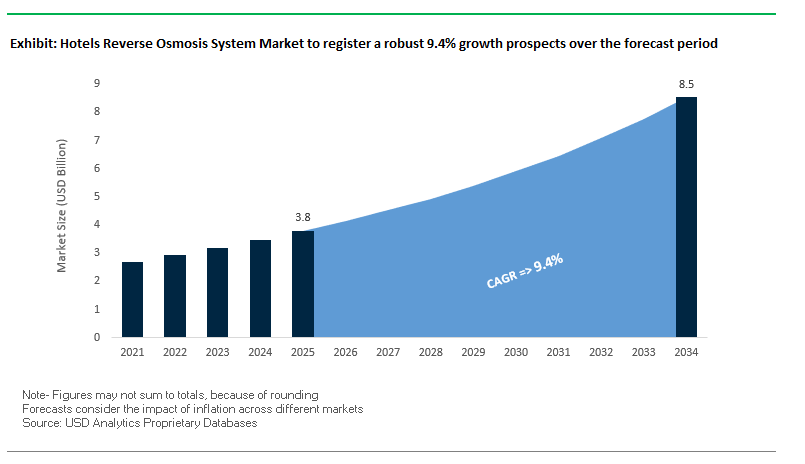
The global hotel reverse osmosis (RO) system market is becoming the most significant segment of the hospitality water treatment market, with a market value expected to be $3.8 billion in 2025 and growing to $8.5 billion by 2034 at a CAGR of 9.4%. This is driven by the convergence of regulatory requirements, guest health expectations, water scarcity issues, and rapid technological advancements. In a day and age where guest satisfaction is not only about the quality of service but also about sustainability of the environment, hotels are increasingly investing in RO systems that provide safe, high-quality water with low operational and environmental costs.
Demand is particularly strong in luxury resorts, business hotels, and health-oriented hospitality chains that want to differentiate on the basis of high-quality drinking water, culinary water, spa treatment water, and recreational water facilities. Governments and regulatory bodies, including the World Health Organization (WHO) and the European Union Drinking Water Directive, are setting stringent water standards, which are compelling hoteliers to equip state-of-the-art treatment technologies. Drivers of sustainability are equally strong because the hospitality industry is a high-consumption water industry, and the integration of RO with water reuse and recycling facilities is becoming a competitive necessity.
Key Insights for Industry Professionals:
- Regulatory Compliance: Rising enforcement of microplastics and PFAS monitoring standards in hospitality water systems.
- Sustainability Priority: Increasing adoption of RO for greywater reuse in irrigation, cooling, and sanitation.
- Technology-Driven Efficiency: IoT- and AI-enabled RO systems improving water use efficiency by up to 35%.
- Regional Growth Hotspots: Strongest demand projected in Asia-Pacific and North America.
Hotels Reverse Osmosis System Market Analysis: Strategic Shifts and Technological Breakthroughs
The last year has seen an increase in innovation and strategic penetration in the hotels RO system industry due to the shift toward integrated water management solutions. A global market report during June 2025 confirmed that RO systems dominate the point-of-entry (POE) application wherein hotels implement water treatment mainly in North America and Asia-Pacific as the most rapidly growing regions.
Hospitality-focused solutions are gaining traction. August 2024 witnessed Fluence Corporation's launch of its "Water 360" solution combining desalination and wastewater treatment into one on-site solution highly suitable for resorts in water-short locations. Similarly, September 2024 witnessed DuPont promoting its FilmTec™ RO membranes, which deliver up to three times better quality water than standard membranes a new benchmark in performance and efficiency.
Sustainability is now non-negotiable. Nexteel's review of India's hospitality industry in November 2024 emphasized rainwater collection and greywater treatment, with RO units being the final purification step. At the same time, industry giants are upscaling August 2025 witnessed Pentair extending its commercial RO product range to meet high-flow hotel applications, which continues to follow the international trend toward centralized water purification facilities in hospitality complexes.
Hotels are also embracing digital technologies. Artificial intelligence-based water optimization, seen in a 2025 industry trend, is enabling up to 35% gains in efficiency, and commercial RO systems were being marketed in July 2025 on B2B websites like Alibaba.com, signalling a more direct procurement approach by hoteliers.
Trends and Opportunities in the Hotels Reverse Osmosis (RO) System Market
Smart IoT-Enabled RO Systems Enhancing Water Conservation and Operational Efficiency
The global hotels reverse osmosis system market is observing increasing adoption of AI-driven, IoT-enabled water treatment systems that provide high-quality water as well as quantifiable sustainability benefits. These systems utilize sophisticated sensors and real-time analytics to monitor water purity, monitor usage, and detect inefficiencies in water usage across multiple hotel properties. Predictive maintenance software can detect early indications of membrane fouling or pressure loss, allowing proactive maintenance to avoid expensive downtime. Integrated leak detection provides quick response to anomalies, which eliminates waste and operational cost. By automating flow registration based on occupancy levels and peak usage periods, IoT-enabled RO systems also lower energy usage. For hotels competing in an environment of environmentally conscious hospitality, these technologies enhance ESG compliance while solidifying brand positioning as a sustainable, guest-centric operator.
Modular and Compact RO Solutions Optimized for Boutique and Urban Hotels
Urban boutique hotels increasingly look to compact, modular RO systems that deliver maximum purification capacity in minimal space. The systems integrate high-performance membranes and automated controls into plug-and-play systems that can be fitted into tight plant rooms or even concealed in cabinetry without compromising on design. Apart from saving space, modular RO systems offer flexibility to scale capacity as needed by adding capacity based on guest demand without having to bear heavy capital. The technology's flexibility also extends to specialty applications such as under-counter glass washers, combination steamers, and point-of-use culinary stations. Their low-maintenance design, coupled with consistent water purity, makes them ideal for smaller hotels lacking resident engineering staff but still require high-quality water for operational and guest-facing applications.
Regulatory-Driven Growth in Water-Scarce Tourism Hubs
In dry regions like Southeast Asia and the Middle East, regulatory needs for hotel water treatment are fueling demand for reverse osmosis systems. Governments are becoming more assertive in demanding rigorous water treatment requirements of the hospitality sector, and compliance becomes a necessary expense. With increasing tourism in those markets, hotels must be able to supply consistent, high-quality water for drinking, culinary, laundry, and recreational uses, even where brackish or seawater supplies are used. That regulatory environment not only creates consistent demand but also places RO system suppliers in the position of necessary infrastructure partners. Suppliers that provide solutions to high-salinity regions with energy-efficient recovery systems will be best positioned to capture market share in those high-growth markets.
Premium Mineral-Infused RO Water as a Differentiated Guest Experience
Luxury and upscale hotels are leveraging remineralization technology to convert RO-purified water into a premium, branded amenity. Adding balanced levels of calcium, magnesium, and other healthy minerals, hotels enhance flavor, improve the quality of hydration, and establish a wellness-based value proposition. The approach provides a variety of guest touchpoints from in-room bottled water through fine dining beverage service and offers opportunities for signature branding. The health-conscious traveler segment is extremely responsive to such upgrades, associating mineral-balanced water with superior quality and lifestyle attributes. Balanced pH also prevents corrosion and scaling of plumbing, coffee makers, and dishwashers, reducing maintenance costs and equipment longevity.
Market Share Insights in the Hotels Reverse Osmosis System Market
Market Share by System Type: Point-of-Use Systems Leading with Targeted Filtration
Point-of-Use (POU) systems hold 65% market share, dominating applications where localized purification is critical such as guest room dispensers, on-premises restaurants, and conference centers. Their compact size, simplicity of installation, and direct supply of drinking-quality water make them highly sought after by hotels requiring localized quality control. Point-of-Entry (POE) systems, although initially more costly, are a requirement in centralized purification, treating all incoming water for all laundry facilities, swimming pools, spas, and kitchens. Applications of high-recovery membranes in POE installations are reducing water wastage and operating costs, making them ever more appealing to large resorts and high-occupancy hotels.
Market Share by Application: Drinking Water Leading, Swimming Pools & Spas Emerging as Key Growth Segment
Drinking water applications take the largest share at 40%, which is a reflection of the hospitality industry's focus on delivering safe, great-tasting water for guests and culinary purposes. Remineralized RO water is now a signature feature in luxury hotels, which is an aid to brand differentiation. Swimming pools & spas, which represent 12% of the market, represent a new growth area as hotels install RO systems to provide water clarity, reduce chemical usage, and deliver a more comfortable guest experience. RO-treated pool and spa water without TDS and impurities requires fewer chemical adjustments, which saves money on maintenance and provides better sustainability practices. Culinary applications include ice making, coffee brewing, and food preparation, which demand consistent, high-purity water to avoid scaling on equipment and deliver better flavor profiles. Laundry applications have softer, mineral-free water that extends linen life and improves fabric quality. Boilers and cooling towers rely on RO treatment to prevent scaling and corrosion, which delivers maximum energy efficiency and extends equipment life.
 System Market Share by Application (2025).png)
Competitive Landscape – Leading Players Shaping the Hotels RO System Market
The hotels RO system market features a blend of multinational corporations and specialized engineering firms, each competing on technological leadership, global reach, and tailored solutions. Key players included are SUEZ SA, Pentair plc, Evoqua Water Technologies LLC, Veolia Environnement SA, DuPont de Nemours, Inc., Toray Industries, Inc., Vontron Technology Co., Ltd., WaterCare (European WaterCare), Pure Aqua, Inc., ProMinent GmbH, Kinetico Incorporated, Grundfos Holding A/S, LG Water Solutions, Aquatec International, Inc., Shubham RO System, Others.
Pentair plc – Comprehensive Water Solutions for Hospitality
Pentair's extensive range of high-capacity point-of-use and point-of-entry RO systems is a hotelier's go-to for reliability and energy efficiency. Pentair incorporates smart monitoring within its systems to control water quality in real time. Pentair is positioning itself as a one-stop-shop answer for design, installation, and maintenance. With an estimated 19% global RO market share as of 2025, Pentair is going on the offensive targeting the hospitality segment with custom high-volume systems.
Evoqua Water Technologies (Xylem Inc.) – Industrial-Grade Purification for Large Hotels
A Xylem business, Evoqua is a high-value membrane technology and sustainable system design leader. Its RO system is high-volume based, making it ideal for chain hotels and resorts. Its emphasis is on combining purification with energy-saving processes, consistent with international green hotel certifications. Evoqua systems are an Asia and North America preferred choice for water reuse applications, a testament to both its quality and sustainability leadership.
Culligan International Company – Local Service, Global Reach
Culligan's brand recognition, supported by its extensive network of dealers, allows it to offer hotels local service as well as tailored water treatment solutions. Its commercial RO solutions range from restaurant-sized systems to multi-hotel-wide installations. Culligan's green and smart water solutions are designed to help hotels meet guest needs as well as environmental goals, and it is the partner of choice for mid-scale and upscale hotels worldwide.
DuPont de Nemours, Inc. – Membrane Technology Leader
Under its FilmTec™ brand, DuPont is still a major upstream component supplier to RO system manufacturers worldwide. Its membranes are noted for high rejection rates, high durability, and high water production efficiency. Although DuPont does not sell complete systems to hotels, its membrane technology leadership directly influences the performance of hospitality RO applications in the marketplace.
Pure Aqua, Inc. – Custom-Engineered RO for Remote and Luxury Resorts
Pure Aqua designs and manufactures specialty RO and desalination systems for challenging environments and is a top supplier to upscale resorts throughout the Caribbean, Middle East, and Pacific islands. Its turnkey systems are engineered to meet complex water quality issues, including high salinity or contamination, to allow for uninterrupted operation to water-starved properties in remote locations.
United States: Premium Guest Experience and Advanced Water Technology Integration
The United States remains one of the most influential markets for hotels reverse osmosis systems, driven by a strong emphasis on delivering premium guest experiences and adhering to high water quality standards. Leading hotel chains such as Marriott, Hilton, and Sheraton are deploying RO systems not only for safe drinking water but also for spas, pools, and culinary applications, directly enhancing guest satisfaction. The demand is further fueled by the country’s hospitality sector focus on sustainability and operational efficiency, with systems helping reduce scale buildup, prolonging the life of appliances, and lowering maintenance costs. The integration of customized RO solutions, from compact models for boutique hotels to large-scale systems for resorts, demonstrates the adaptability of U.S. suppliers to diverse operational needs.
Technological innovation is at the forefront, with companies like Pure Aqua introducing energy-efficient RO units and Kinetico offering smart monitoring features that track water usage and optimize system performance. The shift towards data-driven water management allows hotels to better forecast consumption, reduce operational expenses, and comply with environmental regulations. E-commerce and direct procurement channels have also expanded accessibility, enabling hotels across different states to adopt advanced filtration systems quickly. With growing awareness of sustainable hospitality practices, the U.S. is expected to remain a hub for both adoption and innovation in hotel RO technologies.
China: Tourism Growth and Smart Water Treatment Integration
China’s hotels reverse osmosis system market is expanding rapidly, driven by the country’s booming tourism industry and the government’s strategic focus on water quality improvement. The luxury hotel segment, catering to both domestic and international tourists, is particularly active in adopting RO systems for enhanced water safety and guest experience. Government policies under the 14th Five-Year Plan are encouraging water conservation and sustainable infrastructure, making RO adoption a natural choice for hotels seeking compliance and competitive advantage. In coastal areas, seawater desalination technology integrated with RO plays a critical role in meeting the high water demands of hospitality facilities.
Chinese manufacturers are leading in smart RO technology, incorporating IoT-enabled sensors for real-time monitoring, automated maintenance alerts, and predictive performance analytics. This innovation reduces operational disruptions and ensures consistent water quality. Tech giants like Tencent and Alibaba are also investing in water treatment ventures, fostering advancements that merge hospitality needs with digital technology ecosystems. E-commerce platforms further accelerate adoption by connecting hotels with a broad range of suppliers, from domestic producers to international brands. The combination of rapid tourism expansion, policy support, and technological integration positions China as one of the fastest-growing RO system markets in the hospitality sector.
Germany: Sustainable Engineering and High-Efficiency RO Solutions
Germany’s hotels reverse osmosis system market is shaped by its engineering excellence and strong environmental regulations. German manufacturers are developing high-efficiency RO units like ProMinent’s DULCOSMOSE BW, which use low-pressure membranes to deliver high water output while reducing energy consumption. This design focus aligns with the country’s strict sustainability targets and helps hotels lower both operating costs and carbon footprint. German-made RO systems are also recognized for their consistency in water purity, ensuring compliance with rigorous health standards and enhancing the guest experience.
Innovation in brine management is another competitive strength, with some German technologies capable of producing 40% less brine discharge compared to traditional systems and even recovering salt as a byproduct. This reduces environmental impact and creates potential new revenue streams for hotels. Government support for renewable-powered desalination technologies further promotes adoption in remote resorts and eco-focused hospitality projects. The combination of precise engineering, eco-conscious design, and policy-driven sustainability goals keeps Germany at the forefront of advanced RO system solutions for the hospitality industry.
Middle East: Water Security and Tourism Infrastructure Expansion
The Middle East, particularly Saudi Arabia, is a global leader in seawater desalination, making RO systems essential for the region’s hospitality sector. Large-scale infrastructure projects under Vision 2030 aim to expand tourism while ensuring sustainable water supply, with hotels directly benefiting from new desalination plants like the one in Shuaibah that uses Toray’s RO membranes. Such facilities provide a reliable water source for luxury resorts and urban hotels, reducing dependence on imported water and enhancing operational stability.
Local manufacturing is also gaining momentum, with the opening of the largest RO membrane plant in the Middle East in Dammam, a collaboration between Saudi authorities and Toray. This facility supports the localization of strategic industries and ensures supply security for the growing hospitality sector. As mega-tourism projects like NEOM progress, demand for robust, high-capacity RO systems will surge, especially in regions with limited freshwater availability. With water scarcity concerns intertwined with tourism development, the Middle East will remain a major market for cutting-edge RO technology adoption.
Japan: High-Tech, Sustainable, and Space-Efficient Water Solutions
Japan’s hotels reverse osmosis system market is driven by technological sophistication and a national commitment to sustainability. Companies like Toray Industries are producing long-life RO membranes capable of desalinating seawater, treating river water, and enabling wastewater reuse an attractive proposition for hotels in both coastal and urban environments. These innovations support Japan’s broader goals of water conservation and disaster preparedness, ensuring uninterrupted operations for hospitality businesses.
The adoption of IoT-ready RO systems is on the rise, enabling real-time performance tracking, remote troubleshooting, and predictive maintenance. Such capabilities are particularly valuable in Japan’s densely populated cities, where space is limited and system downtime is costly. Urbanization and heightened awareness of water safety are prompting hotels to integrate RO solutions not just for drinking water, but also for kitchens, spas, and wellness facilities. Combined with government-backed water safety campaigns, these factors ensure that Japan continues to lead in both adoption rates and technological advancement in hotel water treatment.
Australia: Off-Grid Hospitality and Renewable-Powered RO Systems
Australia’s hotels reverse osmosis system market is characterized by custom water solutions designed for both urban luxury hotels and remote, off-grid resorts. Companies like Moerk Water specialize in systems that can process seawater, bore water, and other unconventional sources to ensure water security in challenging environments. This is particularly crucial for hotels in the Outback or coastal eco-resorts, where reliable freshwater supply is limited.
The growing emphasis on eco-friendly, chemical-free RO systems powered by renewable energy aligns with Australia’s sustainability-focused tourism sector. Urban hotels are also investing in modular, skid-mounted RO units that fit within existing building layouts while meeting strict water discharge regulations. A notable example is a luxury Melbourne hotel’s installation of an automated RO plant for groundwater treatment to comply with environmental standards. By combining innovation, environmental responsibility, and adaptability to varied hospitality settings, Australia remains a model for sustainable RO implementation in the global hotel industry.
Hotels Reverse Osmosis System Market Report Scope
Hotels Reverse Osmosis System Market
|
Parameter
|
Details
|
|
Market Size (2025)
|
$3.8 Billion
|
|
Market Size (2034)
|
$8.5 Billion
|
|
Market Growth Rate
|
9.4%
|
|
Segments
|
By System Type (Point-of-Use Systems, Point-of-Entry Systems), By Technology (Reverse Osmosis (RO), Ultrafiltration (UF), Nanofiltration (NF), Microfiltration (MF)), By Application (Drinking Water, Culinary Use, Laundry, Swimming Pools & Spas, Boilers & Cooling Towers), By Capacity (Low Capacity (Less than 1000 GPD), Medium Capacity (1000-5000 GPD), High Capacity (More than 5000 GPD)), By End-User (Business Hotels, Resorts, Boutique Hotels, Budget Hotels), By Component (Membranes, Pumps, Filters, Storage Tanks, Dosing Systems)
|
|
Study Period
|
2019- 2024 and 2025-2034
|
|
Units
|
Revenue (USD)
|
|
Qualitative Analysis
|
Porter’s Five Forces, SWOT Profile, Market Share, Scenario Forecasts, Market Ecosystem, Company Ranking, Market Dynamics, Industry Benchmarking
|
|
Companies
|
SUEZ SA, Pentair plc, Evoqua Water Technologies LLC, Veolia Environnement SA, DuPont de Nemours, Inc., Toray Industries, Inc., Vontron Technology Co., Ltd., WaterCare (European WaterCare), Pure Aqua, Inc., ProMinent GmbH, Kinetico Incorporated, Grundfos Holding A/S, LG Water Solutions, Aquatec International, Inc., Shubham RO System, Others.
|
|
Countries
|
US, Canada, Mexico, Germany, France, Spain, Italy, UK, Russia, China, India, Japan, South Korea, Australia, South East Asia, Brazil, Argentina, Middle East, Africa
|
Hotels Reverse Osmosis System Market Segmentation
By System Type
- Point-of-Use Systems
- Point-of-Entry Systems
By Technology
- Reverse Osmosis (RO)
- Ultrafiltration (UF)
- Nanofiltration (NF)
- Microfiltration (MF)
By Application
- Drinking Water
- Culinary Use
- Laundry
- Swimming Pools & Spas
- Boilers & Cooling Towers
By Capacity
- Low Capacity (Less than 1000 GPD0
- Medium Capacity (1000-5000 GPD)
- High Capacity (More than 5000 GPD)
By End-User
- Business Hotels
- Resorts
- Boutique Hotels
- Budget Hotels
By Component
- Membranes
- Pumps
- Filters
- Storage Tanks
- Dosing Systems
Countries Analyzed
- North America (US, Canada, Mexico)
- Europe (Germany, UK, France, Spain, Italy, Russia, Rest of Europe)
- Asia Pacific (China, India, Japan, South Korea, Australia, South East Asia, Rest of Asia)
- South America (Brazil, Argentina, Rest of South America)
- Middle East and Africa (Saudi Arabia, UAE, Rest of Middle East, South Africa, Egypt, Rest of Africa)
Top Companies in Hotels Reverse Osmosis System Market
- SUEZ SA
- Pentair plc
- Evoqua Water Technologies LLC
- Veolia Environnement SA
- DuPont de Nemours Inc.
- Toray Industries Inc.
- Vontron Technology Co. Ltd.
- WaterCare (European WaterCare)
- Pure Aqua Inc.
- ProMinent GmbH
- Kinetico Incorporated
- Grundfos Holding A/S
- LG Water Solutions
- Aquatec International Inc.
- Shubham RO System
* List Not Exhaustive
Research Coverage
This report investigates the Hotels Reverse Osmosis System Market, delivering executive-grade intelligence on demand drivers, technology breakthroughs, policy catalysts, buyer behavior, and supplier strategies across the hospitality value chain. USDAnalytics’ analysis reviews end-use priorities (drinking water, culinary, pools/spas, utilities), evaluates ROI levers (water recovery, energy intensity, membrane life), and benchmarks leaders on innovation, service models, and digital readiness. The study highlights how IoT telemetry, PFAS/microplastics compliance, and remineralized guest water programs are reshaping specifications and procurement. With deep dives into capacity classes, components, and hotel archetypes, this report is an essential resource for chain operators, engineering consultants, OEMs, and investors seeking actionable insights, risk mapping, and growth playbooks through 2034. Scope includes-
- Segmentation:
- By System Type: Point-of-Use Systems; Point-of-Entry Systems
- By Technology: Reverse Osmosis (RO); Ultrafiltration (UF); Nanofiltration (NF); Microfiltration (MF)
- By Application: Drinking Water; Culinary Use; Laundry; Swimming Pools & Spas; Boilers & Cooling Towers
- By Capacity: Low (<1,000 GPD); Medium (1,000–5,000 GPD); High (>5,000 GPD)
- By End-User: Business Hotels; Resorts; Boutique Hotels; Budget Hotels
- By Component: Membranes; Pumps; Filters; Storage Tanks; Dosing Systems
- Geographic Scope: Analysis spans 25+ countries across North America, Europe, Asia Pacific, Latin America, and the Middle East & Africa.
- Timeframe: Historic data 2021–2024 and forecasts 2025–2034 with scenario sensitivities.
- Companies: Competitive analysis and profiles of 15+ leading vendors and membrane suppliers.
Methodology
USDAnalytics applies a mixed-methods approach that triangulates primary interviews (hotel engineering heads, EPCs, water-treatment OEMs, distributors, and membrane technologists) with secondary intelligence (regulatory bulletins, WHO/EU directives, ESG disclosures, project databases, and tender archives). Market sizing uses bottom-up installation counts by hotel class and capacity band, reconciled with top-down spend from capex/opex budgets and import/export flows of membranes and pumps. Pricing corridors, utilization, recovery ratios, and energy kWh/m³ inform TCO models; Monte Carlo stress tests quantify sensitivities to occupancy, feedwater salinity, and tariff swings. Vendor benchmarking evaluates technology readiness (high-recovery RO, anti-fouling chemistries, AI/IoT stacks), service depth, and regional serviceability. The result is a transparent, auditable forecast with clearly stated assumptions and confidence ranges.
Deliverables:
- Comprehensive Market Research Report (PDF and Excel) with detailed tables, charts, and interactive visualizations.
- Country-Specific Forecasts & Analysis.
- Segment-Wise Revenue Forecasts (2025–2034).
- Competitive Analysis, Benchmarking, and SWOT Profiles.
- Recent Developments & Innovation Tracker.
- Executive Summary & Analyst Commentary.
- Post-Purchase Analyst Support for Client-Specific Questions and Custom Data Requirements.
