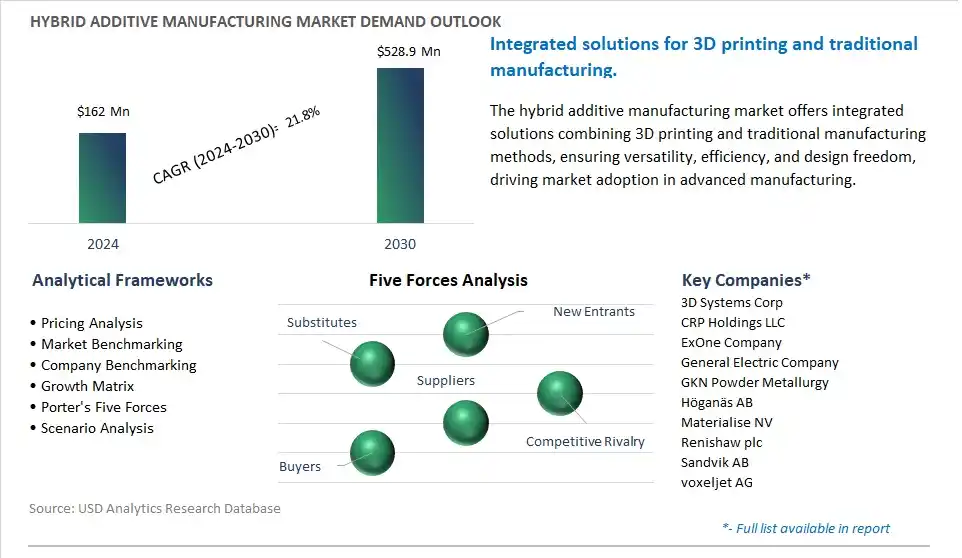
The global Hybrid Additive Manufacturing Market is poised to register a 21.8% CAGR from $162 Million in 2024 to $528.9 Million in 2030.
The global Hybrid Additive Manufacturing Market Study analyzes and forecasts the market size across 6 regions and 24 countries for diverse segments -By Material (Titanium, Aluminum, Steel, Nickel, Others), By End-User (Aerospace, Tooling and Mold, Medical, Others).
An Introduction to Global Hybrid Additive Manufacturing Market in 2024
Hybrid additive manufacturing (AM), also known as hybrid manufacturing or integrated AM, combines additive and subtractive manufacturing processes in a single machine or production line, enabling the fabrication of complex parts with improved accuracy, surface finish, and material properties. One key trend shaping the future of hybrid AM is the integration of multiple AM and machining technologies, such as laser powder bed fusion (LPBF), directed energy deposition (DED), and computer numerical control (CNC) machining, to achieve hybrid manufacturing systems capable of producing parts with intricate geometries, fine features, and high mechanical performance. Manufacturers are developing hybrid AM platforms with advanced process monitoring, closed-loop control, and in-situ inspection capabilities to ensure quality and consistency throughout the production process, reducing scrap and rework while increasing productivity and yield. Additionally, advancements in hybrid toolpath optimization, multi-material deposition, and post-processing techniques are expanding the range of materials and applications feasible with hybrid AM, enabling the production of multi-functional parts with tailored material properties and functionalities for aerospace, automotive, and medical industries. Moreover, the integration of digital design tools, generative algorithms, and simulation software is enabling design optimization and part consolidation, reducing material waste and lead times while enhancing product performance and innovation. As industries seek advanced manufacturing solutions for complex components and customized products, the hybrid AM industry is poised for innovation and growth, with opportunities for collaboration, technology integration, and market expansion to meet the evolving needs of manufacturers and end-users.
Hybrid Additive Manufacturing Market Competitive Landscape
The market report analyses the leading companies in the industry including 3D Systems Corp, CRP Holdings LLC, ExOne Company, General Electric Company, GKN Powder Metallurgy, Höganäs AB, Materialise NV, Renishaw plc, Sandvik AB, voxeljet AG.
Hybrid Additive Manufacturing Market Dynamics
Hybrid Additive Manufacturing Market Trend: Integration of Hybrid Additive Manufacturing Processes
A prominent trend in the market for Hybrid Additive Manufacturing is the integration of multiple additive manufacturing processes into hybrid systems. As industries seek to overcome the limitations of individual additive manufacturing techniques, there is a growing trend towards combining different additive manufacturing technologies such as powder bed fusion, directed energy deposition, and material extrusion to leverage their respective strengths and capabilities. Hybrid additive manufacturing systems enable the production of complex parts with improved surface finish, mechanical properties, and build speed by selectively using different processes within the same build volume. This is driven by the demand for multifunctional and customizable manufacturing solutions, advancements in hybrid machine design and control software, and the need to address challenges such as part distortion, material waste, and process scalability in additive manufacturing, leading to increased adoption of hybrid additive manufacturing technologies across various industries.
Hybrid Additive Manufacturing Market Driver: Demand for Enhanced Part Performance and Production Efficiency
The market for Hybrid Additive Manufacturing is being driven by the demand for enhanced part performance and production efficiency in manufacturing processes. As industries adopt additive manufacturing for end-use production applications, there is a need for solutions that can deliver parts with superior mechanical properties, dimensional accuracy, and production throughput compared to traditional manufacturing methods. Hybrid additive manufacturing offers the flexibility to optimize part geometry, material properties, and production workflow by combining additive and subtractive processes within a single machine platform. Factors such as the need for lightweight and high-strength components, the need for rapid prototyping and on-demand manufacturing, and the drive for cost-effective production solutions drive investments in hybrid additive manufacturing technologies, driving market growth and adoption in aerospace, automotive, medical, and other industrial sectors.
Hybrid Additive Manufacturing Market Opportunity: Customized Manufacturing Solutions for Complex Applications
An exciting opportunity within the market for Hybrid Additive Manufacturing lies in providing customized manufacturing solutions for complex applications that require a combination of additive and subtractive processes. Companies can explore opportunities to develop hybrid additive manufacturing systems tailored for specific industry needs such as aerospace engine components, mold and die tooling, and medical implants, where traditional manufacturing methods are limited by design complexity, material properties, or production scalability. Additionally, there is potential to offer hybrid manufacturing services for repair, refurbishment, and customization of existing parts, enabling cost-effective and sustainable solutions for extending the lifecycle of critical components. By leveraging their expertise in additive manufacturing, machining, and process integration, companies can capitalize on the growing demand for customized manufacturing solutions and position themselves as leaders in providing innovative hybrid additive manufacturing technologies and services, driving growth and differentiation in the hybrid additive manufacturing market.
Hybrid Additive Manufacturing Market Ecosystem
The hybrid additive manufacturing market operates through a multifaceted Market Ecosystem involving diverse key stages and players. Machine development and manufacturing form the foundational stage, with companies including SLM Solutions and EOS GmbH leading the production of machines for traditional laser powder bed fusion or metal binder jetting. Further, hybrid system developers including TRUMPF and DMG MORI play a crucial role by integrating additive and subtractive manufacturing technologies into hybrid systems, enhancing versatility and functionality.
Material suppliers including Höganäs AB and AP Powder provide the necessary metal powders for additive manufacturing processes, while wire manufacturers including Sandvik Materials Technology cater to wire arc additive manufacturing applications. In the realm of software and controls, additive manufacturing software providers including Materialise and Siemens NX develop sophisticated software for design, simulation, and process control, while control system providers including Siemens and Fanuc offer specialized control systems tailored for hybrid additive manufacturing machines.
Service providers, including engineering service providers including Exa Corporation, and contract manufacturing services including Proto Labs, offer essential support by providing design optimization, process development, and application engineering services for hybrid additive manufacturing, thus completing the Market Ecosystem.
The end users of hybrid additive manufacturing technology span various industries, each leveraging its capabilities for different applications. In the aerospace and defense sector, hybrid AM finds utility in producing complex, lightweight components vital for aircraft and weapon systems. Similarly, the automotive industry employs hybrid AM for prototyping and low-volume production of customized parts, as well as for creating lightweight components to enhance vehicle performance. In the medical and dental fields, hybrid AM is instrumental in manufacturing custom implants, prosthetics, and surgical tools, offering personalized solutions to patients. Additionally, the energy sector harnesses hybrid AM technology to develop intricate components for turbines, reactors, and other energy generation equipment, reflecting the diverse range of applications and industries benefitting from hybrid additive manufacturing.
Hybrid Additive Manufacturing Market Share Analysis: Titanium held the dominant revenue share in 2024
is the fastest growing market segment over the forecast period to 2030The largest segment in the Hybrid Additive Manufacturing Market is the Titanium material segment. This dominance is primarily due to diverse key factors. Titanium is widely recognized for its exceptional strength-to-weight ratio, corrosion resistance, and biocompatibility, making it a preferred material for various industries, including aerospace, automotive, medical, and defense. Additionally, titanium's unique properties make it well-suited for additive manufacturing processes, where complex geometries and lightweight designs are desired. Hybrid additive manufacturing, which combines additive and subtractive manufacturing processes in a single machine, offers significant advantages for processing titanium components. The combination of additive and subtractive techniques allows for the fabrication of intricate titanium parts with high precision, dimensional accuracy, and surface finish. In addition, titanium's compatibility with various additive manufacturing technologies, such as selective laser melting (SLM) and electron beam melting (EBM), further enhances its attractiveness in the hybrid additive manufacturing market. Further, the increasing demand for lightweight and high-performance components in industries such as aerospace and medical devices drives the adoption of titanium-based hybrid additive manufacturing solutions. Overall, the Titanium material segment holds the largest share in the Hybrid Additive Manufacturing Market due to titanium's superior properties, compatibility with additive manufacturing processes, and its extensive use in critical applications across multiple industries.
Hybrid Additive Manufacturing Market Share Analysis: Medical is the fastest growing market segment over the forecast period to 2030
The fastest-growing segment in the Hybrid Additive Manufacturing Market is the Medical end-user segment. This growth is primarily due to diverse key factors. Firstly, the medical industry is increasingly adopting additive manufacturing technologies to produce patient-specific implants, surgical instruments, and medical devices with complex geometries and enhanced functionalities. Hybrid additive manufacturing, which combines additive and subtractive processes, offers unique advantages for manufacturing medical components with high precision, accuracy, and surface finish. Additionally, the medical sector benefits from the customization capabilities of hybrid additive manufacturing, allowing for the fabrication of personalized implants tailored to individual patient anatomy. In addition, the growing demand for orthopedic implants, dental prosthetics, and other medical devices drives the adoption of hybrid additive manufacturing solutions in the medical field. Further, regulatory approvals and standards supporting the use of additive manufacturing in the medical industry, along with advancements in materials and technology, further accelerate the growth of the Medical end-user segment in the Hybrid Additive Manufacturing Market. Overall, the Medical end-user segment is experiencing rapid growth due to the increasing demand for personalized healthcare solutions, regulatory support, and technological advancements in additive manufacturing for medical applications.
Hybrid Additive Manufacturing Market Report Scope-
By Material
Titanium
Aluminum
Steel
Nickel
Others
By End-User
Aerospace
Tooling and Mold
Medical
Others
Hybrid Additive Manufacturing Market Companies Profiled
3D Systems Corp
CRP Holdings LLC
ExOne Company
General Electric Company
GKN Powder Metallurgy
Höganäs AB
Materialise NV
Renishaw plc
Sandvik AB
voxeljet AG
*- List Not Exhaustive
TABLE OF CONTENTS
1 Introduction to 2024 Hybrid Additive Manufacturing Market
1.1 Market Overview
1.2 Quick Facts
1.3 Scope/Objective of the Study
1.4 Market Definition
1.5 Countries and Regions Covered
1.6 Units, Currency, and Conversions
1.7 Industry Value Chain
2 Research Methodology
2.1 Market Size Estimation
2.2 Sources and Research Methodology
2.3 Data Triangulation
2.4 Assumptions and Limitations
3 Executive Summary
3.1 Global Hybrid Additive Manufacturing Market Size Outlook, $ Million, 2021 to 2030
3.2 Hybrid Additive Manufacturing Market Outlook by Type, $ Million, 2021 to 2030
3.3 Hybrid Additive Manufacturing Market Outlook by Product, $ Million, 2021 to 2030
3.4 Hybrid Additive Manufacturing Market Outlook by Application, $ Million, 2021 to 2030
3.5 Hybrid Additive Manufacturing Market Outlook by Key Countries, $ Million, 2021 to 2030
4 Market Dynamics
4.1 Key Driving Forces of Hybrid Additive Manufacturing Industry
4.2 Key Market Trends in Hybrid Additive Manufacturing Industry
4.3 Potential Opportunities in Hybrid Additive Manufacturing Industry
4.4 Key Challenges in Hybrid Additive Manufacturing Industry
5 Market Factor Analysis
5.1 Value Chain Analysis
5.2 Competitive Landscape
5.2.1 Global Hybrid Additive Manufacturing Market Share by Company (%), 2023
5.2.2 Product Offerings by Company
5.3 Porter’s Five Forces Analysis
5.4 Pricing Analysis and Outlook
6 Growth Outlook Across Scenarios
6.1 Growth Analysis-Case Scenario Definitions
6.2 Low Growth Scenario Forecasts
6.3 Reference Growth Scenario Forecasts
6.4 High Growth Scenario Forecasts
7 Global Hybrid Additive Manufacturing Market Outlook by Segments
7.1 Hybrid Additive Manufacturing Market Outlook by Segments, $ Million, 2021- 2030
By Material
Titanium
Aluminum
Steel
Nickel
Others
By End-User
Aerospace
Tooling and Mold
Medical
Others
8 North America Hybrid Additive Manufacturing Market Analysis and Outlook To 2030
8.1 Introduction to North America Hybrid Additive Manufacturing Markets in 2024
8.2 North America Hybrid Additive Manufacturing Market Size Outlook by Country, 2021-2030
8.2.1 United States
8.2.2 Canada
8.2.3 Mexico
8.3 North America Hybrid Additive Manufacturing Market size Outlook by Segments, 2021-2030
By Material
Titanium
Aluminum
Steel
Nickel
Others
By End-User
Aerospace
Tooling and Mold
Medical
Others
9 Europe Hybrid Additive Manufacturing Market Analysis and Outlook To 2030
9.1 Introduction to Europe Hybrid Additive Manufacturing Markets in 2024
9.2 Europe Hybrid Additive Manufacturing Market Size Outlook by Country, 2021-2030
9.2.1 Germany
9.2.2 France
9.2.3 Spain
9.2.4 United Kingdom
9.2.4 Italy
9.2.5 Russia
9.2.6 Norway
9.2.7 Rest of Europe
9.3 Europe Hybrid Additive Manufacturing Market Size Outlook by Segments, 2021-2030
By Material
Titanium
Aluminum
Steel
Nickel
Others
By End-User
Aerospace
Tooling and Mold
Medical
Others
10 Asia Pacific Hybrid Additive Manufacturing Market Analysis and Outlook To 2030
10.1 Introduction to Asia Pacific Hybrid Additive Manufacturing Markets in 2024
10.2 Asia Pacific Hybrid Additive Manufacturing Market Size Outlook by Country, 2021-2030
10.2.1 China
10.2.2 India
10.2.3 Japan
10.2.4 South Korea
10.2.5 Indonesia
10.2.6 Malaysia
10.2.7 Australia
10.2.8 Rest of Asia Pacific
10.3 Asia Pacific Hybrid Additive Manufacturing Market size Outlook by Segments, 2021-2030
By Material
Titanium
Aluminum
Steel
Nickel
Others
By End-User
Aerospace
Tooling and Mold
Medical
Others
11 South America Hybrid Additive Manufacturing Market Analysis and Outlook To 2030
11.1 Introduction to South America Hybrid Additive Manufacturing Markets in 2024
11.2 South America Hybrid Additive Manufacturing Market Size Outlook by Country, 2021-2030
11.2.1 Brazil
11.2.2 Argentina
11.2.3 Rest of South America
11.3 South America Hybrid Additive Manufacturing Market size Outlook by Segments, 2021-2030
By Material
Titanium
Aluminum
Steel
Nickel
Others
By End-User
Aerospace
Tooling and Mold
Medical
Others
12 Middle East and Africa Hybrid Additive Manufacturing Market Analysis and Outlook To 2030
12.1 Introduction to Middle East and Africa Hybrid Additive Manufacturing Markets in 2024
12.2 Middle East and Africa Hybrid Additive Manufacturing Market Size Outlook by Country, 2021-2030
12.2.1 Saudi Arabia
12.2.2 UAE
12.2.3 Oman
12.2.4 Rest of Middle East
12.2.5 Egypt
12.2.6 Nigeria
12.2.7 South Africa
12.2.8 Rest of Africa
12.3 Middle East and Africa Hybrid Additive Manufacturing Market size Outlook by Segments, 2021-2030
By Material
Titanium
Aluminum
Steel
Nickel
Others
By End-User
Aerospace
Tooling and Mold
Medical
Others
13 Company Profiles
13.1 Company Snapshot
13.2 SWOT Profiles
13.3 Products and Services
13.4 Recent Developments
13.5 Financial Profile
3D Systems Corp
CRP Holdings LLC
ExOne Company
General Electric Company
GKN Powder Metallurgy
Höganäs AB
Materialise NV
Renishaw plc
Sandvik AB
voxeljet AG
14 Appendix
14.1 Customization Offerings
14.2 Subscription Services
14.3 Related Reports
14.4 Publisher Expertise
By Material
Titanium
Aluminum
Steel
Nickel
Others
By End-User
Aerospace
Tooling and Mold
Medical
Others
Countries Analyzed
North America (US, Canada, Mexico)
Europe (Germany, UK, France, Spain, Italy, Russia, Rest of Europe)
Asia Pacific (China, India, Japan, South Korea, Australia, South East Asia, Rest of Asia)
South America (Brazil, Argentina, Rest of South America)
Middle East and Africa (Saudi Arabia, UAE, Rest of Middle East, South Africa, Egypt, Rest of Africa)
