Industrial Coating Equipment Market Size, Automation Adoption, and Precision Coating Technologies Outlook
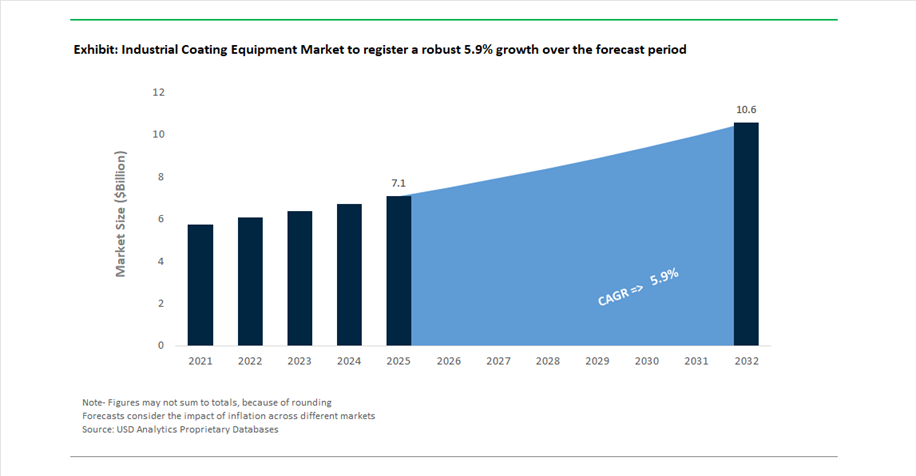
The global industrial coating equipment market was valued at $7.1 billion in 2025 and is projected to reach $10.6 billion by 2032, expanding at a CAGR of 5.9%. This growth is being driven by rising demand for automated coating systems, spray equipment, powder coating machinery, fluid dispensing systems, and precision coating technologies across industries such as automotive, aerospace, electronics, medical devices, and heavy industrial manufacturing. As manufacturers prioritize process efficiency, coating uniformity, and material optimization, the adoption of advanced coating equipment is accelerating.
A key market driver is the increasing shift toward Industry 4.0-enabled coating processes, where IoT-integrated equipment, real-time monitoring systems, and automated fluid management technologies are improving operational efficiency and reducing downtime. The need for high-precision coating application in sectors such as semiconductors, medical devices, and advanced electronics is further driving demand for robotic dispensing systems and multi-axis automation platforms. Additionally, stringent environmental regulations are encouraging the use of low-waste, solvent-efficient, and energy-efficient coating equipment, including electrostatic spray systems and high-transfer-efficiency applicators.
The market is also benefiting from the expansion of global manufacturing hubs and infrastructure projects, particularly in Asia-Pacific, the Middle East, and Latin America, where demand for high-performance coatings is rising in tandem with industrial growth. Meanwhile, North America and Europe continue to lead in technological innovation, automation integration, and high-end coating equipment development, supported by strong R&D investments and advanced manufacturing ecosystems.
Smart Coating Equipment, Strategic M&A, and Automation-Focused Innovation Reshaping Industry Dynamics
The industrial coating equipment industry is rapidly evolving, with a strong emphasis on automation, digitalization, and portfolio expansion through mergers and acquisitions. In March 2026, Graco Inc. introduced the industry’s first wirelessly connected automated fluid management system, leveraging IoT sensors to track material consumption and provide real-time diagnostics. This innovation directly addresses key operational challenges such as equipment downtime, material wastage, and predictive maintenance, reinforcing the shift toward smart coating equipment ecosystems.
Strategic consolidation is playing a significant role in strengthening technological capabilities. In December 2025, Dürr Systems merged its Italian subsidiaries to form Dürr Systems Italy S.p.A., consolidating expertise in turnkey assembly lines and advanced automotive painting systems. Similarly, Graco’s July 2025 acquisition of Color Service s.r.l. for €63 million expands its presence in automated precision dosing systems for both powder and liquid coatings, enhancing its ability to serve high-performance industrial applications. Carlisle Fluid Technologies also strengthened its portfolio through the December 2024 acquisition of Reinhardt Technik, adding advanced metering and mixing systems for multi-component coating materials.
Product innovation is increasingly focused on precision, repeatability, and application efficiency. In October 2025, Nordson EFD launched its 3-axis automated fluid dispensing systems, designed for high-precision coating applications in electronics and medical device manufacturing, where micron-level accuracy is critical. SATA GmbH further advanced spray technology with the January 2025 launch of the SATA jet X premium spray gun, featuring a Labyrinth System nozzle that ensures turbulence-free airflow and ultra-fine atomization, significantly improving surface finish quality in industrial and automotive coatings.
Operational optimization and sustainability are also key focus areas. In September 2024, SATA introduced its Liner Cup System (LCS), which reduces cleaning solvent consumption and improves ergonomics in paint shops. Pushing this trend further, PPG Industries demonstrated the effectiveness of electrostatic coating application technologies, reducing overspray and enhancing transfer efficiency, which is increasingly being integrated into industrial coating equipment systems.
Companies are also realigning strategies to focus on core automation technologies and high-growth regions. In June 2025, Dürr Group divested its environmental technology business to concentrate on production automation and coating technologies, while Wagner Group announced its 2026 international expansion strategy, including new technology centers in the Middle East to support infrastructure and energy coating projects. Nordson EFD’s March 2024 expansion into Latin America, through a dedicated technology center, further highlights the importance of regional application support and customer training in driving adoption.
AI-Enabled Closed-Loop Electrostatic Spray Systems Enhancing Precision and Efficiency
The industrial coating equipment industry is entering a new phase of automation with the adoption of AI-enabled closed-loop electrostatic spray systems, particularly in high-volume automotive and industrial manufacturing environments. These systems integrate real-time sensor feedback with machine learning algorithms to dynamically adjust spray parameters such as atomization pressure, fluid flow, and electrostatic charge. This enables ultra-precise control of coating deposition, achieving film thickness tolerances within ±1 micron even on complex geometries. Compared to conventional programmable logic controller systems, this results in over 40% reduction in film build variability, significantly improving product quality consistency. Transfer efficiency is also substantially enhanced, with AI-optimized systems achieving rates above 85%, leading to a 15% to 20% reduction in paint consumption per unit. Additionally, real-time environmental monitoring allows systems to instantly compensate for changes in humidity and temperature, reducing common surface defects such as orange peel and runs by approximately 30%. Predictive maintenance capabilities further improve operational efficiency, extending component lifespan by around 25% and minimizing unplanned downtime. These advancements are positioning AI-integrated spray equipment as a critical technology for precision coating applications and cost optimization in advanced manufacturing.
Triboelectric Powder Coating Systems Addressing Faraday Cage Limitations
The powder coating equipment segment is witnessing a growing shift toward triboelectric charging systems, particularly for applications involving complex geometries where traditional corona charging methods face limitations. Triboelectric systems generate charge through friction rather than high-voltage ionization, enabling superior penetration into recessed areas and internal cavities. This results in effective coating coverage of up to 95% in regions typically affected by the Faraday cage effect. Surface finish quality is also improved, as the absence of high-voltage fields eliminates defects such as back-ionization and surface irregularities, leading to approximately 20% improvement in first-pass yield. Additionally, triboelectric systems produce a more uniform powder cloud, reducing over-application on flat surfaces by around 15% while maintaining adequate coverage in corners and edges. Modern coating lines are increasingly adopting hybrid configurations that combine corona and triboelectric systems to balance speed and precision, achieving overall line efficiencies exceeding 90% in mixed-product manufacturing environments. These developments are driving the adoption of advanced powder coating equipment capable of delivering higher quality and efficiency across diverse industrial applications.
US EPA NESHAP Regulations Driving Upgrade Cycle for High-Efficiency Coating Equipment
The United States Environmental Protection Agency’s National Emission Standards for Hazardous Air Pollutants are creating a significant replacement market for high-efficiency coating equipment across metal and plastic parts manufacturing sectors. Updated regulations require the use of application technologies such as high-volume low-pressure spray guns or electrostatic systems with minimum transfer efficiency thresholds of 65%, effectively phasing out low-efficiency air spray equipment. These requirements are driving investments in advanced spray technologies that reduce hazardous air pollutant emissions while improving material utilization. The regulatory push also encourages the adoption of plural-component mixing systems, which minimize solvent waste associated with cleaning and purging processes. Compliance measures, including mandatory operator training and certification, are contributing to a 10% to 12% reduction in material waste through improved application techniques. Enhanced enforcement mechanisms, including electronic reporting systems, are increasing regulatory scrutiny and accelerating equipment upgrades. These dynamics are positioning high-efficiency coating equipment as a critical solution for compliance and operational optimization in regulated industrial environments.
China VOC Phase 3 Policy Driving Adoption of Automated and High-Efficiency Coating Systems
China’s Volatile Organic Compounds Phase 3 Action Plan is creating a strong growth opportunity for advanced coating equipment by mandating the transition from low-efficiency application methods to automated, high-efficiency systems. The regulation effectively prohibits traditional high-pressure air spray techniques in key industrial regions, requiring manufacturers to adopt technologies such as electrostatic rotary bell atomizers and robotic spray systems. In addition to application efficiency, the policy emphasizes emission control through the integration of enclosed spray booths with high-efficiency collection systems and downstream treatment technologies such as regenerative thermal oxidizers. Manufacturers are also required to achieve collection efficiencies of up to 90%, driving demand for turnkey coating systems that combine application and abatement capabilities. Government incentives, including subsidies of 10% to 15% for green equipment adoption, are accelerating the transition to waterborne-compatible and low-emission coating lines. Furthermore, strict emission caps are encouraging the implementation of fast color-change systems that reduce material waste during production transitions by up to 60%. These regulatory and economic drivers are positioning China as a key market for next-generation industrial coating equipment solutions.
Industrial Coating Equipment Market Share 2025: Semi-Automation and Direct Sales Drive Efficiency
Automation Level Insights: Semi-Automatic Systems Lead with Flexibility and Cost Efficiency
The semi-automatic systems segment dominates the industrial coating equipment market with a 48% market share in 2025, driven by its optimal balance between production efficiency and operational flexibility. These systems, including automated spray guns, reciprocators, and digitally controlled spray booths, deliver higher throughput than manual equipment while allowing quick changeovers for batch production and customized coating requirements. This makes them particularly suitable for mid-sized manufacturers in automotive, general industrial, and metal fabrication sectors. A key growth driver is the strong retrofit market, where small and medium enterprises upgrade existing manual coating setups with semi-automated components such as pressure regulators, pattern controllers, and robotic arms, improving consistency and reducing material waste without the high capital investment of fully automated lines. As manufacturers seek cost-effective ways to enhance productivity and coating quality, semi-automatic systems will continue to lead the industrial coating equipment market.
Distribution Channel Insights: Direct Sales Dominate with System Integration and Lifecycle Support
The direct sales segment holds the largest 45% share in the industrial coating equipment market in 2025, reflecting the complexity of customized coating system integration and engineering requirements. Advanced coating setups, including robotic spray systems, conveyorized production lines, curing ovens, and paint circulation units, require close collaboration between equipment manufacturers and end-users for layout design, programming, and seamless integration with existing production infrastructure. Direct engagement ensures that systems meet specific performance and operational requirements across industries such as automotive, aerospace, and heavy manufacturing. Additionally, direct sales channels enable manufacturers to offer long-term service contracts, including maintenance, calibration, spare parts supply, and operator training, creating ongoing value beyond initial equipment installation. As industrial coating processes become more sophisticated and automation-driven, direct sales will remain the preferred channel supporting growth in the global industrial coating equipment market.
Industrial Coating Equipment Market Competitive Landscape: Automation, Precision Spray Technologies, and Digital Integration Driving Market Leadership
The industrial coating equipment market is highly competitive, driven by automation, IoT-enabled systems, and high-efficiency spray technologies. Key players are focusing on robotic coating systems, powder coating optimization, and digital process control to enhance transfer efficiency, reduce waste, and support advanced manufacturing across automotive, electronics, and construction sectors.
Nordson drives precision coating efficiency with dense-phase powder systems and high-margin IPS strategy
Nordson Corporation is a leading player in industrial coating equipment, driven by its Industrial Precision Solutions (IPS) segment and strong financial outlook of $2.83–$2.95 billion in 2026 sales. The company achieved $900 million in EBITDA with 55% gross margins under its Ascend Strategy, demonstrating resilience in a volatile tariff environment. Its Encore® HD powder coating platform utilizes dense-phase technology to deliver superior thickness control while reducing powder consumption by 15–20%. Nordson’s NBS Next framework emphasizes close-to-customer support and advanced fluid management systems for electronics and automotive applications. The company’s strong backlog of $600 million supports sustained growth in high-performance coating systems. This focus on efficiency, precision, and customer integration strengthens its market leadership.
Dürr dominates turnkey paint shop automation with overspray-free technology and AI-driven robotics
Dürr Group is a global leader in industrial coating equipment, particularly in automotive paint shop automation. With $4.7 billion in trailing revenue and a strong patent portfolio of 5,679 patents, the company leads in high-end turnkey coating systems. Its EcoPaintjet Pro enables overspray-free two-tone painting, eliminating masking processes and reducing material waste. The acquisition of Kallesoe Machinery expands its capabilities in wood and engineered timber coatings, aligning with sustainable construction trends. Dürr’s DXQ digital platform provides AI-driven predictive maintenance for robotic spray systems, reducing downtime by 22%. This integration of automation, innovation, and digital intelligence reinforces its dominance in advanced coating equipment.
Graco advances high-efficiency spray systems and surface preparation technologies for industrial applications
Graco Inc. is strengthening its position in the industrial coating equipment market through high-efficiency spray systems and advanced surface preparation solutions. Its ProXpc™ electrostatic spray technology achieves transfer efficiencies exceeding 95%, reducing material waste and improving coating quality. The company’s EcoQuip® 2 vapor abrasive blasting system reduces dust by 92%, addressing environmental and safety concerns in surface preparation. Graco operates a global “close-to-customer” model with strong regional presence in Europe and Asia, supporting automation and labor cost reduction strategies. Its expertise in multi-component proportioning systems enables seamless integration with robotic cells for consistent coating application. This combination of efficiency, sustainability, and integration enhances its competitive positioning.
Wagner drives smart coating systems with IoT-enabled monitoring and advanced atomization technology
Wagner Group is advancing industrial coating equipment through digital innovation and precision finishing technologies. At PaintExpo 2026, the company introduced the TopFinish Bell 2 rotary atomizer, designed for high-speed, high-precision coating applications. Its Coatify IoT platform enables real-time monitoring of coating parameters, ensuring consistent quality and zero-defect production. The Flowsense system has become an industry benchmark for automatic powder control, preventing defects such as uneven coating thickness. Wagner is also focusing on sustainability through its Activeflush system, which recovers up to 90% of unused coating material during cleaning cycles. This integration of IoT, automation, and sustainability positions Wagner as a leader in smart coating equipment.
EXEL Industries expands precision spray technologies with digital pressure control and electrostatic efficiency
EXEL Industries, through its SAMES division, is strengthening its role in industrial coating equipment with a focus on precision spray technologies. The company is targeting the precision coating segment through its Industrial Excellence strategy. Its Inocoat system utilizes Digital Pressure Processing (DPP) to maintain consistent powder flow regardless of operational variables. EXEL’s electrostatic spray systems deliver high-wrap efficiency, reducing paint consumption by up to 30% for complex geometries. The company is expanding in ASEAN and North America to capture growth in decentralized manufacturing hubs. This focus on efficiency, precision, and regional expansion enhances its competitiveness.
Cefla leads wood and glass finishing automation with digital printing and energy-efficient curing solutions
Cefla Finishing is a dominant player in wood and glass coating equipment, leveraging automation and digital technologies. Its iGiotto robotic systems, combined with cVision 3D scanning, enable precise coating application in wood finishing. The J-Print TD system introduces digital printing for tactile surface effects, replacing traditional coating methods with higher precision. Cefla’s LED-UV curing technologies reduce energy consumption by up to 40%, supporting green manufacturing initiatives. Its cTracker software enables batch-of-one production, allowing seamless transitions between colors and textures without stopping production lines. This combination of automation, customization, and sustainability positions Cefla as a leader in advanced finishing systems.
Germany Industrial Coating Equipment Market: Industry 4.0 Integration and Energy-Efficient Coating Systems
Germany stands as the global benchmark in the industrial coating equipment market, driven by its strong focus on Industry 4.0 integration, automation, and energy efficiency. The country is leading the adoption of smart coating technologies, including advanced robotic systems with adaptive injection controls that optimize high-speed powder coating processes. These innovations are enabling manufacturers to achieve superior precision, consistency, and productivity in industrial coating applications.
Energy efficiency remains a core growth driver, supported by national strategies promoting sustainable manufacturing. The adoption of UV-LED curing systems is significantly reducing industrial energy consumption, while closed-loop powder recovery systems are enabling near-total material utilization. Regulatory frameworks such as the Building Energy Act are further accelerating demand for specialized automated coating equipment for thermal barrier applications in construction. Additionally, innovations like overspray-free applicator technologies are minimizing waste and improving operational efficiency in automotive manufacturing. Government-backed initiatives to develop hydrogen-powered drying systems are also positioning Germany at the forefront of next-generation, low-emission coating equipment solutions.
China Industrial Coating Equipment Market: Automation Scale-Up and EV Coating Line Expansion
China dominates the industrial coating equipment market in terms of volume, leveraging its massive manufacturing ecosystem and rapidly expanding electric vehicle (EV) production capacity. The country is witnessing widespread deployment of fully automated robotic coating lines designed specifically for battery enclosures and EV components, supporting large-scale industrial output. This expansion is driving demand for advanced coating equipment capable of delivering high efficiency and consistent performance.
Technological advancements are further enhancing China’s market position. The integration of cloud-connected electrostatic atomizers is enabling real-time monitoring of coating parameters, improving process efficiency and reducing material costs. Government policies mandating significant reductions in VOC emissions are accelerating the shift toward waterborne coating systems and high-solids applicators. Additionally, innovations such as low-pressure plasma spray equipment are expanding applications in aerospace and high-speed rail industries. Capacity expansion in large-scale dip tank systems for e-coating is also supporting heavy machinery manufacturing. Environmental regulations, including incentives for installing emission control systems, are further driving the adoption of advanced industrial coating equipment across China’s manufacturing sector.
United States Industrial Coating Equipment Market: Advanced Defense Manufacturing and Digital Twin Adoption
The United States industrial coating equipment market is undergoing a structural transformation, driven by reshoring initiatives in semiconductor and defense manufacturing. The expansion of cleanroom facilities under national industrial policies is significantly increasing demand for ultra-precise robotic coating systems capable of handling sensitive components. These systems are essential for maintaining high-quality standards in advanced manufacturing environments.
Technological innovation is a key differentiator in the U.S. market. The adoption of Digital Twin technology is enabling manufacturers to simulate coating processes, optimize spray patterns, and reduce material waste before actual production. Additionally, the deployment of mobile robotic coating units in naval applications is enhancing efficiency and uniformity in marine coating processes. Regulatory actions aimed at reducing VOC emissions are accelerating the shift toward advanced spray technologies such as HVLP and LVMP systems. Federal investments in sustainable infrastructure are also supporting the installation of automated coating equipment for energy-efficient building retrofits. Continuous R&D in dispensing technologies for EV battery materials further highlights the growing importance of high-performance coating equipment in emerging industries.
Japan Industrial Coating Equipment Market: Precision Nano-Coating Systems and Display Manufacturing Leadership
Japan remains a global leader in precision industrial coating equipment, particularly in applications requiring sub-micron accuracy and advanced material handling. The country’s expertise in nano-coating technologies is driving innovation in industries such as electronics, optics, and display manufacturing. Advanced slot-die coating systems are enabling highly uniform application of nano-ceramic layers, ensuring exceptional product quality and performance.
Technological advancements such as magnetron sputtering systems are supporting the production of radiative cooling films and high-performance coatings for next-generation applications. The development of ultrasonic spray nozzles is enabling efficient coating of complex geometries, addressing limitations of traditional methods. Government support for sustainable manufacturing is encouraging the development of bio-resin compatible equipment, aligning with circular economy goals. Collaborations between leading equipment manufacturers are also enhancing automation capabilities, particularly for compact, high-precision production lines. Japan’s dominance in optical fiber coating equipment further reinforces its position as a leader in high-performance industrial coating technologies.
India Industrial Coating Equipment Market: “Make in India” Push Accelerating Automation Adoption
India is rapidly transitioning toward automated industrial coating equipment, driven by government initiatives such as the Production Linked Incentive (PLI) schemes and infrastructure expansion. The development of smart industrial cities is increasing demand for centralized automated coating facilities, enabling efficient production processes for a wide range of industries. This shift from manual to automated systems is significantly improving productivity and quality in the domestic manufacturing sector.
Strategic partnerships between global and local players are strengthening India’s coating equipment ecosystem, particularly in automotive and protective coatings applications. Large-scale infrastructure projects, including airport construction, are driving demand for advanced spray booths and coating systems for architectural applications. Regulatory measures ensuring equipment quality are eliminating sub-standard imports and promoting the adoption of certified technologies. Additionally, the integration of Industrial Internet of Things (IIoT) solutions is enabling real-time monitoring of coating processes, enhancing operational efficiency. Expansions in specialized equipment facilities further highlight India’s growing role as a key market for industrial coating equipment.
Vietnam is emerging as a strategic hub for industrial coating equipment, particularly in the consumer electronics sector. The establishment of major manufacturing clusters by global electronics companies has significantly increased demand for cleanroom-compatible coating systems. These facilities are driving the adoption of advanced spray equipment capable of meeting high precision and quality standards required for electronics production.
Technological integration is accelerating market growth, with the adoption of augmented reality (AR) tools for operator training reducing skill development time and improving operational efficiency. Global equipment manufacturers are expanding their presence in Vietnam, establishing technical support hubs to provide just-in-time maintenance services for high-volume production lines. Innovations such as modular coating booths are enabling manufacturers to quickly adapt to changing product requirements, enhancing flexibility in production processes. Government incentives for high-tech enterprises and environmental regulations mandating advanced wastewater treatment systems are further driving the adoption of modern coating equipment technologies in Vietnam.
Saudi Arabia Industrial Coating Equipment Market: Vision 2030 Driving Large-Scale Fireproofing and Infrastructure Applications
Saudi Arabia is emerging as a high-growth market for industrial coating equipment, driven by large-scale infrastructure projects and industrial expansion under Vision 2030. Mega-projects such as NEOM and the Red Sea development are creating substantial demand for automated coating equipment capable of handling large volumes of structural steel. These projects require advanced application systems for intumescent coatings, ensuring fire protection and structural integrity in extreme environments.
Technological advancements are playing a critical role, with the adoption of dual-component plural spray systems enabling efficient application of high-viscosity coatings in oil and gas facilities. Regulatory requirements mandating explosion-proof equipment for refinery operations are further shaping market dynamics. The expansion of localized manufacturing capabilities for coating equipment components is improving supply chain efficiency and reducing lead times. Additionally, investments in pipeline coating technologies are supporting the deployment of automated internal coating robots, reinforcing Saudi Arabia’s position as a key market for industrial coating equipment in the Middle East.
Industrial Coating Equipment Market Report Scope
Industrial Coating Equipment Market
Parameter
Details
Market Size (2025)
$7.1 Billion
Market Size (2032)
$10.6 Billion
Market Growth Rate
5.9%
Segments
By Equipment (Liquid Coating Equipment, Powder Coating Equipment, Specialty Coating Equipment), By Product Category (Liquid Coating Systems, Powder Coating Systems, Specialty Deposition Equipment), By Automation Level (Manual Coating Equipment, Semi-Automatic Systems, Fully Automatic), By End-Use Industry (Automotive and Transportation, Aerospace and Defense, Industrial Manufacturing, Building and Infrastructure, Electrical and Electronics, Medical and Healthcare, Energy and Power), By Substrate (Metals, Plastics and Polymers, Wood and Furniture, Glass and Ceramics), By Distribution Channel (Direct Sales, Specialty Industrial Distributors and Agents, Aftermarket Service and Spare Parts)
Study Period
2019- 2025 and 2026-2032
Units
Revenue (USD)
Qualitative Analysis
Porter’s Five Forces, SWOT Profile, Market Share, Scenario Forecasts, Market Ecosystem, Company Ranking, Market Dynamics, Industry Benchmarking
US, Canada, Mexico, Germany, France, Spain, Italy, UK, Russia, China, India, Japan, South Korea, Australia, South East Asia, Brazil, Argentina, Middle East, Africa
Industrial Coating Equipment Market Segmentation
By Equipment
Liquid Coating Equipment
Powder Coating Equipment
Specialty Coating Equipment
By Product Category
Liquid Coating Systems
Powder Coating Systems
Specialty Deposition Equipment
By Automation Level
Manual Coating Equipment
Semi-Automatic Systems
Fully Automatic
By End-Use Industry
Automotive and Transportation
Aerospace and Defense
Industrial Manufacturing
Building and Infrastructure
Electrical and Electronics
Medical and Healthcare
Energy and Power
By Substrate
Metals
Plastics and Polymers
Wood and Furniture
Glass and Ceramics
By Distribution Channel
Direct Sales
Specialty Industrial Distributors and Agents
Aftermarket Service and Spare Parts
Leading Countries in the Industry
North America (United States, Canada, Mexico)
Europe (Germany, France, Spain, United Kingdom, Italy, Russia, Rest of Europe)
Asia Pacific (China, India, Japan, South Korea, Australia, South East Asia, Rest of APAC)
South and Central America (Brazil, Argentina, Rest of SCA)
Middle East and Africa (Saudi Arabia, UAE, MENA, Sub-Saharan Africa)
Top Companies in Industrial Coating Equipment Market
Nordson Corporation
Graco Inc.
Dürr Group
Carlisle Fluid Technologies
Wagner Group
Anest Iwata Corporation
Gema Switzerland GmbH
Exel Industries
OC Oerlikon Management AG
Sulzer Ltd.
IHI Corporation
Fanuc Corporation
ABB Ltd.
Asahi Sunac Corporation
Airmaster Corp.
*- List not Exhaustive
Table of Contents: Industrial Coating Equipment Market
2. Industrial Coating Equipment Market Landscape & Outlook (2025–2032)
2.1. Introduction to Industrial Coating Equipment Market
2.2. Market Valuation and Growth Projections (2025–2032)
2.3. Growth Drivers: Automation Adoption and Precision Coating Demand
2.4. Industry 4.0 Integration: IoT, Real-Time Monitoring, and Smart Equipment
2.5. Regulatory Influence: Low-VOC, High-Efficiency, and Sustainable Equipment Adoption
3. Innovations Reshaping the Industrial Coating Equipment Market
3.1. Trend: AI-Enabled Closed-Loop Electrostatic Spray Systems
3.2. Trend: Triboelectric Powder Coating Systems for Complex Geometries
3.3. Opportunity: Regulatory-Driven Upgrade Cycle for High-Efficiency Equipment
3.4. Opportunity: Automation Expansion in Emerging Manufacturing Hubs
4. Competitive Landscape and Strategic Initiatives
4.1. Mergers and Acquisitions
4.2. R&D and Material Innovation
4.3. Sustainability and ESG Strategies
4.4. Market Expansion and Regional Focus
5. Market Share and Segmentation Insights: Industrial Coating Equipment Market
5.1. By Equipment
5.1.1. Liquid Coating Equipment
5.1.2. Powder Coating Equipment
5.1.3. Specialty Coating Equipment
5.2. By Product Category
5.2.1. Liquid Coating Systems
5.2.2. Powder Coating Systems
5.2.3. Specialty Deposition Equipment
5.3. By Automation Level
5.3.1. Manual Coating Equipment
5.3.2. Semi-Automatic Systems
5.3.3. Fully Automatic
5.4. By End-Use Industry
5.4.1. Automotive and Transportation
5.4.2. Aerospace and Defense
5.4.3. Industrial Manufacturing
5.4.4. Building and Infrastructure
5.4.5. Electrical and Electronics
5.4.6. Medical and Healthcare
5.4.7. Energy and Power
5.5. By Substrate
5.5.1. Metals
5.5.2. Plastics and Polymers
5.5.3. Wood and Furniture
5.5.4. Glass and Ceramics
5.6. By Distribution Channel
5.6.1. Direct Sales
5.6.2. Specialty Industrial Distributors and Agents
5.6.3. Aftermarket Service and Spare Parts
6. Country Analysis and Outlook of Industrial Coating Equipment Market
6.1. United States
6.2. Canada
6.3. Mexico
6.4. Germany
6.5. France
6.6. Spain
6.7. Italy
6.8. UK
6.9. Russia
6.10. China
6.11. India
6.12. Japan
6.13. South Korea
6.14. Australia
6.15. South East Asia
6.16. Brazil
6.17. Argentina
6.18. Middle East
6.19. Africa
7. Industrial Coating Equipment Market Size Outlook by Region (2025–2032)
7.1. North America Industrial Coating Equipment Market Size Outlook to 2032
7.1.1. By Equipment
7.1.2. By Product Category
7.1.3. By Automation Level
7.1.4. By End-Use Industry
7.1.5. By Substrate
7.1.6. By Distribution Channel
7.2. Europe Industrial Coating Equipment Market Size Outlook to 2032
7.2.1. By Equipment
7.2.2. By Product Category
7.2.3. By Automation Level
7.2.4. By End-Use Industry
7.2.5. By Substrate
7.2.6. By Distribution Channel
7.3. Asia Pacific Industrial Coating Equipment Market Size Outlook to 2032
7.3.1. By Equipment
7.3.2. By Product Category
7.3.3. By Automation Level
7.3.4. By End-Use Industry
7.3.5. By Substrate
7.3.6. By Distribution Channel
7.4. South America Industrial Coating Equipment Market Size Outlook to 2032
7.4.1. By Equipment
7.4.2. By Product Category
7.4.3. By Automation Level
7.4.4. By End-Use Industry
7.4.5. By Substrate
7.4.6. By Distribution Channel
7.5. Middle East and Africa Industrial Coating Equipment Market Size Outlook to 2032
7.5.1. By Equipment
7.5.2. By Product Category
7.5.3. By Automation Level
7.5.4. By End-Use Industry
7.5.5. By Substrate
7.5.6. By Distribution Channel
8. Company Profiles: Leading Players in the Industrial Coating Equipment Market
8.1. Nordson Corporation
8.2. Graco Inc.
8.3. Dürr Group
8.4. Carlisle Fluid Technologies
8.5. Wagner Group
8.6. Anest Iwata Corporation
8.7. Gema Switzerland GmbH
8.8. Exel Industries
8.9. OC Oerlikon Management AG
8.10. Sulzer Ltd.
8.11. IHI Corporation
8.12. Fanuc Corporation
8.13. ABB Ltd.
8.14. Asahi Sunac Corporation
8.15. Airmaster Corp.
9. Methodology
9.1. Research Scope
9.2. Market Research Approach
9.3. Market Sizing and Forecasting Model
9.4. Research Coverage
9.5. Data Horizon
9.6. Deliverables
10. Appendix
10.1. Acronyms and Abbreviations
10.2. List of Tables
10.3. List of Figures
Industrial Coating Equipment Market Segmentation
By Equipment
Liquid Coating Equipment
Powder Coating Equipment
Specialty Coating Equipment
By Product Category
Liquid Coating Systems
Powder Coating Systems
Specialty Deposition Equipment
By Automation Level
Manual Coating Equipment
Semi-Automatic Systems
Fully Automatic
By End-Use Industry
Automotive and Transportation
Aerospace and Defense
Industrial Manufacturing
Building and Infrastructure
Electrical and Electronics
Medical and Healthcare
Energy and Power
By Substrate
Metals
Plastics and Polymers
Wood and Furniture
Glass and Ceramics
By Distribution Channel
Direct Sales
Specialty Industrial Distributors and Agents
Aftermarket Service and Spare Parts
Leading Countries in the Industry
North America (United States, Canada, Mexico)
Europe (Germany, France, Spain, United Kingdom, Italy, Russia, Rest of Europe)
Asia Pacific (China, India, Japan, South Korea, Australia, South East Asia, Rest of APAC)
South and Central America (Brazil, Argentina, Rest of SCA)
Middle East and Africa (Saudi Arabia, UAE, MENA, Sub-Saharan Africa)
The market was valued at USD 7.1 billion in 2025 and is projected to reach USD 10.6 billion by 2032, expanding at a CAGR of 5.9%. Growth is driven by rising demand for automated coating systems and precision technologies. Increasing adoption across automotive, electronics, and aerospace sectors is accelerating equipment upgrades globally.
Industry 4.0 integration is transforming coating processes through IoT-enabled systems, real-time monitoring, and predictive maintenance. Smart equipment can track material usage, optimize spray parameters, and reduce downtime. This results in improved coating uniformity, lower waste, and enhanced operational efficiency in advanced manufacturing environments.
High-efficiency electrostatic spray systems, robotic dispensing platforms, and AI-enabled closed-loop spray technologies are seeing strong adoption. Triboelectric powder coating systems are also gaining traction for complex geometries. These technologies improve transfer efficiency, reduce material consumption, and deliver micron-level precision in coating applications.
Regulations such as VOC emission limits and efficiency standards are driving the shift toward low-waste and energy-efficient coating equipment. Technologies like HVLP spray guns, electrostatic applicators, and enclosed automated systems help manufacturers meet compliance requirements. This is creating a strong replacement cycle for outdated equipment.
Leading players include Nordson Corporation, Graco Inc., Dürr Group, Wagner Group, and EXEL Industries. These companies focus on automation, precision spray technologies, and digital integration.
More Equipment, Services and End-use Products Reports