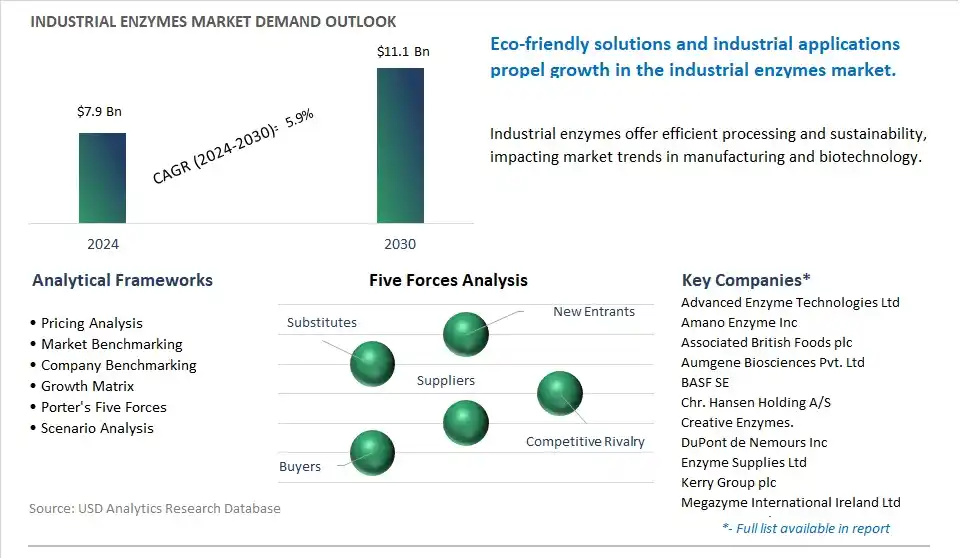
The global Industrial Enzymes Market is poised to register a 5.9% CAGR from $7.9 Billion in 2024 to $11.1 Billion in 2030.
The global Industrial Enzymes Market Study analyzes and forecasts the market size across 6 regions and 24 countries for diverse segments -By Type (Carbohydrases, Proteases, Lipases, Polymerases & Nucleases, Others), By Source (Microorganism, Plant, Animal), By Application (Food & Beverages, Bioethanol, Textiles & Leather, Detergents, Paper & Pulp, Wastewater Treatment, Feed, Soil Treatment, Oil Treatment, Others), By Form (Lyophilized Powder, Liquid).
An Introduction to Global Industrial Enzymes Market in 2024
Industrial enzymes are experiencing a paradigm shift driven by the growing demand for sustainable and eco-friendly manufacturing processes across various industries, including food and beverage, textiles, and biofuels. One key trend shaping the future of the industry is the development of novel enzyme cocktails tailored for specific applications, such as lignocellulosic biomass conversion for biofuel production and the enhancement of detergent formulations for eco-friendly cleaning solutions. Additionally, advancements in enzyme engineering and bioprocessing technologies are leading to improved enzyme stability, specificity, and cost-effectiveness, thereby expanding their applicability in industrial settings. Furthermore, the increasing adoption of biocatalysis as a green chemistry approach is driving research and innovation in enzyme discovery and optimization, paving the way for greener and more sustainable manufacturing practices.
Industrial Enzymes Market Competitive Landscape
The market report analyses the leading companies in the industry including Advanced Enzyme Technologies Ltd, Amano Enzyme Inc, Associated British Foods plc, Aumgene Biosciences Pvt. Ltd, BASF SE, Chr. Hansen Holding A/S, Creative Enzymes., DuPont de Nemours Inc, Enzyme Supplies Ltd, Kerry Group plc, Megazyme International Ireland Ltd, Novozymes A/S, Royal DSM N.V..
Industrial Enzymes Market Dynamics
Industrial Enzymes Market Trend: Growing Demand for Sustainable and Eco-Friendly Solutions
A significant trend in the industrial enzymes market is the increasing demand for sustainable and eco-friendly solutions driven by environmental concerns, regulatory pressures, and corporate sustainability initiatives. Industrial enzymes, known for their ability to catalyze biochemical reactions with high specificity and efficiency, are increasingly favored over traditional chemical processes in various industries such as food and beverage, textiles, biofuels, and detergents. As industries seek to reduce their carbon footprint, minimize waste generation, and improve process efficiency, there is a growing interest in utilizing enzymes as biocatalysts for green manufacturing processes. Enzymes offer advantages such as biodegradability, lower energy consumption, reduced chemical usage, and improved product quality, making them attractive options for sustainable production practices. This trend is reshaping the industrial enzymes market towards increased adoption of enzyme-based solutions that align with environmental sustainability goals and address market demand for eco-friendly alternatives to conventional chemical processes.
Industrial Enzymes Market Driver: Expansion of Biotechnology and Bioprocessing Industries
A key driver propelling the industrial enzymes market is the expansion of the biotechnology and bioprocessing industries driven by advancements in enzyme engineering, fermentation technology, and biomanufacturing processes. With the rapid growth of biopharmaceuticals, industrial biotechnology, and bio-based products, there is a growing demand for enzymes as essential biocatalysts in the production of pharmaceuticals, biofuels, specialty chemicals, and renewable materials. Enzymes play crucial roles in bioprocessing applications such as protein purification, DNA manipulation, fermentation optimization, and biomass conversion, enabling cost-effective and sustainable production of valuable bioproducts. Additionally, advancements in enzyme discovery, protein engineering, and metabolic engineering techniques enable the development of novel enzymes with enhanced catalytic properties, substrate specificity, and stability, expanding the scope of applications and driving innovation in the industrial enzymes market. The expansion of biotechnology and bioprocessing industries presents opportunities for enzyme manufacturers to collaborate with biotech companies, research institutions, and end-users to develop customized enzyme solutions, optimize bioprocesses, and address evolving market needs for biocatalytic technologies.
Industrial Enzymes Market Opportunity: Penetration into New Application Areas and Emerging Markets
An opportunity for market growth lies in the penetration into new application areas and emerging markets that offer untapped potential for enzyme-based solutions. While enzymes have traditionally been used in established industries such as food and beverage, textiles, and detergents, there are opportunities to expand their utilization into emerging sectors such as pharmaceuticals, agriculture, environmental remediation, and waste management. Enzymes offer versatile functionalities that can be harnessed for diverse applications such as drug discovery, crop protection, soil remediation, and waste valorization, addressing global challenges related to healthcare, food security, and environmental sustainability. By leveraging their expertise in enzyme discovery, formulation, and process optimization, enzyme manufacturers can explore new application areas, develop innovative enzyme products, and enter emerging markets with high growth potential. Additionally, strategic partnerships, collaborations, and investments in research and development can facilitate market entry and accelerate the commercialization of enzyme-based solutions, driving expansion and diversification in the industrial enzymes market.
Industrial Enzymes Market Share Analysis: Carbohydrases segment generated the highest revenue in the industry
The carbohydrases segment is the largest segment in the industrial enzymes market, primarily due to diverse factors. Carbohydrases are enzymes that catalyze the breakdown of carbohydrates into simpler sugars, and they find widespread applications in various industries, including food and beverages, animal feed, textiles, biofuels, and pharmaceuticals. One of the key reasons for the dominance of the carbohydrases segment is the extensive use of these enzymes in food and beverage processing. Carbohydrases such as amylases, cellulases, and hemicellulases play crucial roles in starch hydrolysis, sugar conversion, and fiber degradation during the production of various food products, including bread, beer, wine, dairy products, and sweeteners. Additionally, carbohydrases are utilized in the production of animal feed to enhance the digestibility and nutritional value of feed ingredients such as grains and cereals. In addition, carbohydrases find applications in textile processing, where they aid in the removal of starch-based sizing agents and improve fabric finishing processes. Further, the growing demand for biofuels and renewable energy sources has led to increased utilization of carbohydrases in the production of bioethanol and biomass conversion. Additionally, advancements in enzyme engineering and biotechnology have enabled the development of novel carbohydrases with improved specificity, stability, and efficiency, further driving their adoption across various industrial applications. Over the forecast period, the versatility, efficacy, and wide-ranging applications of carbohydrases in multiple industries contribute to their dominance as the largest segment in the industrial enzymes market.
Industrial Enzymes Market Share Analysis: Bioethanol Segment is poised to register the fastest growth rate (CAGR) over the forecast period to 2030
The bioethanol segment is the fastest-growing segment in the industrial enzymes market, driven by diverse key factors. The there is a growing global emphasis on reducing greenhouse gas emissions and transitioning towards sustainable and renewable energy sources. Bioethanol, a renewable fuel derived from biomass feedstocks such as corn, sugarcane, and lignocellulosic materials, plays a crucial role in achieving these objectives by serving as an alternative to conventional fossil fuels. Enzymes, particularly carbohydrases such as cellulases and hemicellulases, are essential in the bioethanol production process as they facilitate the breakdown of complex carbohydrates in biomass into fermentable sugars, which can then be converted into ethanol through fermentation. As governments worldwide implement policies to promote biofuel production and reduce reliance on fossil fuels, the demand for industrial enzymes for bioethanol production is expected to increase significantly. Secondly, advancements in enzyme technology and bioprocessing techniques have led to the development of more efficient and cost-effective enzyme formulations for bioethanol production. Novel enzyme cocktails and enzyme engineering approaches have improved the efficiency of biomass conversion and fermentation processes, leading to higher yields and lower production costs for bioethanol. Additionally, ongoing research and development efforts aimed at enhancing enzyme stability, specificity, and performance further drive the growth of the bioethanol segment in the industrial enzymes market. Further, the increasing availability of lignocellulosic biomass feedstocks, such as agricultural residues, forestry residues, and energy crops, presents opportunities for expanding bioethanol production capacity globally, driving the demand for industrial enzymes in this application. Over the forecast period, the combination of sustainability initiatives, technological advancements, and market opportunities positions the bioethanol segment as the fastest-growing segment in the industrial enzymes market.
Industrial Enzymes Market Report Segmentation
By Type
Carbohydrases
Proteases
Lipases
Polymerases & Nucleases
Others
By Source
Microorganism
Plant
Animal
By Application
Food & Beverages
Bioethanol
Textiles & Leather
Detergents
Paper & Pulp
Wastewater Treatment
Feed
Soil Treatment
Oil Treatment
Others
By Form
Lyophilized Powder
Liquid
Regions Included
North America (US, Canada, Mexico)
Europe (Germany, UK, France, Spain, Italy, Russia, Rest of Europe)
Asia Pacific (China, India, Japan, South Korea, Australia, South East Asia, Rest of Asia)
South America (Brazil, Argentina, Rest of South America)
Middle East and Africa (Saudi Arabia, UAE, Rest of Middle East, South Africa, Egypt, Rest of Africa)
Industrial Enzymes Companies Profiled in the Market Study
Advanced Enzyme Technologies Ltd
Amano Enzyme Inc
Associated British Foods plc
Aumgene Biosciences Pvt. Ltd
BASF SE
Chr. Hansen Holding A/S
Creative Enzymes.
DuPont de Nemours Inc
Enzyme Supplies Ltd
Kerry Group plc
Megazyme International Ireland Ltd
Novozymes A/S
Royal DSM N.V.
*- List Not Exhaustive
TABLE OF CONTENTS
1 Introduction to 2024 Industrial Enzymes Market
1.1 Market Overview
1.2 Quick Facts
1.3 Scope/Objective of the Study
1.4 Market Definition
1.5 Countries and Regions Covered
1.6 Units, Currency, and Conversions
1.7 Industry Value Chain
2 Research Methodology
2.1 Market Size Estimation
2.2 Sources and Research Methodology
2.3 Data Triangulation
2.4 Assumptions and Limitations
3 Executive Summary
3.1 Global Industrial Enzymes Market Size Outlook, $ Million, 2021 to 2030
3.2 Industrial Enzymes Market Outlook by Type, $ Million, 2021 to 2030
3.3 Industrial Enzymes Market Outlook by Product, $ Million, 2021 to 2030
3.4 Industrial Enzymes Market Outlook by Application, $ Million, 2021 to 2030
3.5 Industrial Enzymes Market Outlook by Key Countries, $ Million, 2021 to 2030
4 Market Dynamics
4.1 Key Driving Forces of Industrial Enzymes Industry
4.2 Key Market Trends in Industrial Enzymes Industry
4.3 Potential Opportunities in Industrial Enzymes Industry
4.4 Key Challenges in Industrial Enzymes Industry
5 Market Factor Analysis
5.1 Value Chain Analysis
5.2 Competitive Landscape
5.2.1 Global Industrial Enzymes Market Share by Company (%), 2023
5.2.2 Product Offerings by Company
5.3 Porter’s Five Forces Analysis
5.4 Pricing Analysis and Outlook
6 Growth Outlook Across Scenarios
6.1 Growth Analysis-Case Scenario Definitions
6.2 Low Growth Scenario Forecasts
6.3 Reference Growth Scenario Forecasts
6.4 High Growth Scenario Forecasts
7 Global Industrial Enzymes Market Outlook by Segments
7.1 Industrial Enzymes Market Outlook by Segments, $ Million, 2021- 2030
By Type
Carbohydrases
Proteases
Lipases
Polymerases & Nucleases
Others
By Source
Microorganism
Plant
Animal
By Application
Food & Beverages
Bioethanol
Textiles & Leather
Detergents
Paper & Pulp
Wastewater Treatment
Feed
Soil Treatment
Oil Treatment
Others
By Form
Lyophilized Powder
Liquid
8 North America Industrial Enzymes Market Analysis and Outlook To 2030
8.1 Introduction to North America Industrial Enzymes Markets in 2024
8.2 North America Industrial Enzymes Market Size Outlook by Country, 2021-2030
8.2.1 United States
8.2.2 Canada
8.2.3 Mexico
8.3 North America Industrial Enzymes Market size Outlook by Segments, 2021-2030
By Type
Carbohydrases
Proteases
Lipases
Polymerases & Nucleases
Others
By Source
Microorganism
Plant
Animal
By Application
Food & Beverages
Bioethanol
Textiles & Leather
Detergents
Paper & Pulp
Wastewater Treatment
Feed
Soil Treatment
Oil Treatment
Others
By Form
Lyophilized Powder
Liquid
9 Europe Industrial Enzymes Market Analysis and Outlook To 2030
9.1 Introduction to Europe Industrial Enzymes Markets in 2024
9.2 Europe Industrial Enzymes Market Size Outlook by Country, 2021-2030
9.2.1 Germany
9.2.2 France
9.2.3 Spain
9.2.4 United Kingdom
9.2.4 Italy
9.2.5 Russia
9.2.6 Norway
9.2.7 Rest of Europe
9.3 Europe Industrial Enzymes Market Size Outlook by Segments, 2021-2030
By Type
Carbohydrases
Proteases
Lipases
Polymerases & Nucleases
Others
By Source
Microorganism
Plant
Animal
By Application
Food & Beverages
Bioethanol
Textiles & Leather
Detergents
Paper & Pulp
Wastewater Treatment
Feed
Soil Treatment
Oil Treatment
Others
By Form
Lyophilized Powder
Liquid
10 Asia Pacific Industrial Enzymes Market Analysis and Outlook To 2030
10.1 Introduction to Asia Pacific Industrial Enzymes Markets in 2024
10.2 Asia Pacific Industrial Enzymes Market Size Outlook by Country, 2021-2030
10.2.1 China
10.2.2 India
10.2.3 Japan
10.2.4 South Korea
10.2.5 Indonesia
10.2.6 Malaysia
10.2.7 Australia
10.2.8 Rest of Asia Pacific
10.3 Asia Pacific Industrial Enzymes Market size Outlook by Segments, 2021-2030
By Type
Carbohydrases
Proteases
Lipases
Polymerases & Nucleases
Others
By Source
Microorganism
Plant
Animal
By Application
Food & Beverages
Bioethanol
Textiles & Leather
Detergents
Paper & Pulp
Wastewater Treatment
Feed
Soil Treatment
Oil Treatment
Others
By Form
Lyophilized Powder
Liquid
11 South America Industrial Enzymes Market Analysis and Outlook To 2030
11.1 Introduction to South America Industrial Enzymes Markets in 2024
11.2 South America Industrial Enzymes Market Size Outlook by Country, 2021-2030
11.2.1 Brazil
11.2.2 Argentina
11.2.3 Rest of South America
11.3 South America Industrial Enzymes Market size Outlook by Segments, 2021-2030
By Type
Carbohydrases
Proteases
Lipases
Polymerases & Nucleases
Others
By Source
Microorganism
Plant
Animal
By Application
Food & Beverages
Bioethanol
Textiles & Leather
Detergents
Paper & Pulp
Wastewater Treatment
Feed
Soil Treatment
Oil Treatment
Others
By Form
Lyophilized Powder
Liquid
12 Middle East and Africa Industrial Enzymes Market Analysis and Outlook To 2030
12.1 Introduction to Middle East and Africa Industrial Enzymes Markets in 2024
12.2 Middle East and Africa Industrial Enzymes Market Size Outlook by Country, 2021-2030
12.2.1 Saudi Arabia
12.2.2 UAE
12.2.3 Oman
12.2.4 Rest of Middle East
12.2.5 Egypt
12.2.6 Nigeria
12.2.7 South Africa
12.2.8 Rest of Africa
12.3 Middle East and Africa Industrial Enzymes Market size Outlook by Segments, 2021-2030
By Type
Carbohydrases
Proteases
Lipases
Polymerases & Nucleases
Others
By Source
Microorganism
Plant
Animal
By Application
Food & Beverages
Bioethanol
Textiles & Leather
Detergents
Paper & Pulp
Wastewater Treatment
Feed
Soil Treatment
Oil Treatment
Others
By Form
Lyophilized Powder
Liquid
13 Company Profiles
13.1 Company Snapshot
13.2 SWOT Profiles
13.3 Products and Services
13.4 Recent Developments
13.5 Financial Profile
Advanced Enzyme Technologies Ltd
Amano Enzyme Inc
Associated British Foods plc
Aumgene Biosciences Pvt. Ltd
BASF SE
Chr. Hansen Holding A/S
Creative Enzymes.
DuPont de Nemours Inc
Enzyme Supplies Ltd
Kerry Group plc
Megazyme International Ireland Ltd
Novozymes A/S
Royal DSM N.V.
14 Appendix
14.1 Customization Offerings
14.2 Subscription Services
14.3 Related Reports
14.4 Publisher Expertise
By Type
Carbohydrases
Proteases
Lipases
Polymerases & Nucleases
Others
By Source
Microorganism
Plant
Animal
By Application
Food & Beverages
Bioethanol
Textiles & Leather
Detergents
Paper & Pulp
Wastewater Treatment
Feed
Soil Treatment
Oil Treatment
Others
By Form
Lyophilized Powder
Liquid
Countries Analyzed
North America (US, Canada, Mexico)
Europe (Germany, UK, France, Spain, Italy, Russia, Rest of Europe)
Asia Pacific (China, India, Japan, South Korea, Australia, South East Asia, Rest of Asia)
South America (Brazil, Argentina, Rest of South America)
Middle East and Africa (Saudi Arabia, UAE, Rest of Middle East, South Africa, Egypt, Rest of Africa)
