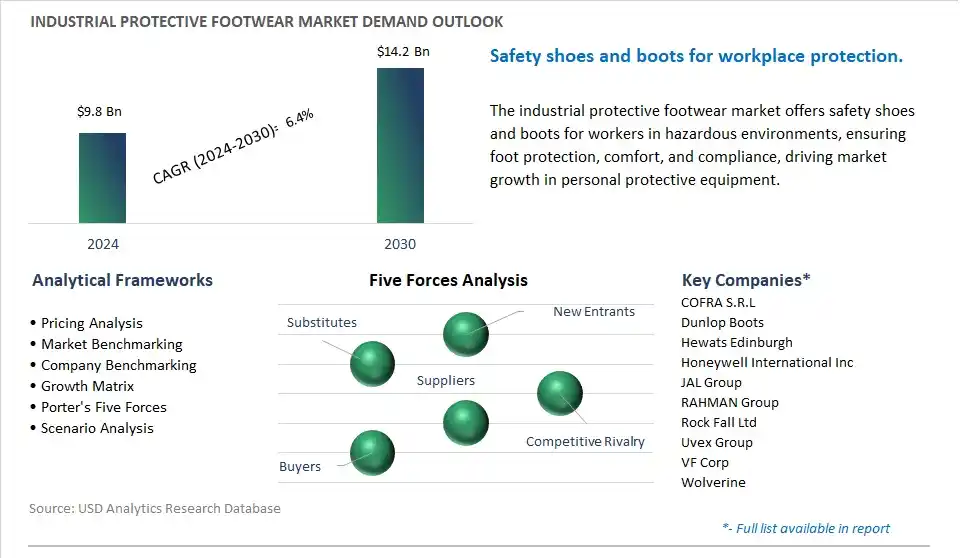
The global Industrial Protective Footwear Market is poised to register a 6.4% CAGR from $9.8 Billion in 2024 to $14.2 Billion in 2030.
The global Industrial Protective Footwear Market Study analyzes and forecasts the market size across 6 regions and 24 countries for diverse segments -By Product (Leather, Rubber, PVC, Polyurethane, Others), By Application (Construction, Manufacturing, Oil & Gas, Chemicals, Food, Pharmaceuticals, Healthcare, Transportation, Mining, Others).
An Introduction to Global Industrial Protective Footwear Market in 2024
Industrial protective footwear is specialized footwear designed to provide safety, comfort, and protection for workers in hazardous industrial environments such as construction sites, manufacturing plants, and oil refineries. One key trend shaping the future of industrial protective footwear is the development of advanced materials and ergonomic designs to enhance wearer comfort, safety performance, and durability while meeting regulatory standards and industry-specific requirements. Footwear manufacturers are innovating new materials, such as lightweight composites, advanced polymers, and breathable textiles, with improved impact resistance, slip resistance, and electrical insulation properties, ensuring optimal protection and comfort for workers in diverse industrial settings. Additionally, advancements in footwear design, such as ergonomic lasts, anatomical footbeds, and customizable fit options, are optimizing wearer comfort, support, and mobility, reducing fatigue and injury risk during prolonged work shifts. Moreover, the integration of smart footwear technologies, such as embedded sensors, RFID tags, and GPS trackers, is enabling real-time monitoring of wearer health and safety metrics, facilitating proactive risk assessment, emergency response, and compliance with occupational safety regulations. As industries prioritize worker safety and well-being, the industrial protective footwear industry is poised for innovation and growth, with opportunities for collaboration, research, and market expansion to meet the evolving needs of manufacturers, employers, and workers.
Industrial Protective Footwear Market Competitive Landscape
The market report analyses the leading companies in the industry including COFRA S.R.L, Dunlop Boots, Hewats Edinburgh, Honeywell International Inc, JAL Group, RAHMAN Group, Rock Fall Ltd, Uvex Group, VF Corp, Wolverine.
Industrial Protective Footwear Market Dynamics
Industrial Protective Footwear Market Trend: Increasing Focus on Workplace Safety and Occupational Health
A prominent trend in the industrial protective footwear market is the escalating focus on workplace safety and occupational health. With stringent regulations and growing awareness about the importance of protecting workers from occupational hazards, industries are prioritizing the provision of high-quality protective footwear to safeguard employees against injuries and accidents. The trend is driving the demand for industrial protective footwear designed to meet specific safety standards and address diverse workplace hazards, including impact, puncture, electrical shock, and chemical exposure. Additionally, the adoption of ergonomic designs and advanced materials in protective footwear is enhancing comfort, mobility, and overall wearer satisfaction.
Industrial Protective Footwear Market Driver: Growth in Industrialization and Manufacturing Activities
A key driver propelling the industrial protective footwear market is the rapid growth in industrialization and manufacturing activities worldwide. As industrial sectors such as construction, manufacturing, oil and gas, mining, and transportation expand, there is an increasing demand for protective footwear to mitigate the risks associated with hazardous working environments. Industries are investing in personal protective equipment (PPE) to comply with regulatory requirements, minimize workplace accidents, and enhance productivity. Moreover, the outsourcing of manufacturing operations to emerging economies is driving the adoption of protective footwear in regions experiencing industrial development, further fueling the growth of the industrial protective footwear market.
Industrial Protective Footwear Market Opportunity: Integration of Smart Technologies in Protective Footwear
An opportunity for innovation and differentiation in the industrial protective footwear market lies in the integration of smart technologies. With the advancement of wearable technology and the Internet of Things (IoT), there is a growing interest in incorporating sensors, connectivity, and data analytics into protective footwear to enhance safety, efficiency, and situational awareness in industrial settings. Smart footwear can provide real-time monitoring of environmental conditions, foot movement, and ergonomic stress, enabling proactive hazard detection, risk assessment, and preventive measures. Additionally, features such as GPS tracking, communication capabilities, and biometric authentication can enhance worker visibility, communication, and security on the job site. By embracing the potential of smart technologies, manufacturers can offer innovative protective footwear solutions that cater to the evolving needs of industries and provide value-added benefits beyond traditional safety features.
Industrial Protective Footwear Market Ecosystem
The industrial protective footwear market involves diverse key stages, from raw material acquisition to end-user applications, with the participation of various companies. The raw material acquisition includes leather suppliers including Hormel Foods Corporation and rubber/plastics manufacturers including Dow Chemical Company and BASF SE, providing materials for durability and safety features in footwear components. Textile manufacturers including DuPont de Nemours, Inc. and Toray Industries, Inc. produce fabrics for linings and laces. In the manufacturing stage, companies including Honeywell International Inc. and Wolverine Worldwide Inc. produce a diverse range of industrial protective footwear, including safety boots and specialty types.
Distribution channels involve safety equipment distributors including Grainger and WESCO International, Inc., distributing a wide array of safety equipment, including industrial protective footwear. Additionally, manufacturers engage in direct sales, offering customized solutions through dedicated sales teams for specific industries. Value-added services include footwear fitting and training services to ensure proper fit and usage, as well as maintenance and repair programs to extend footwear lifespan. End-users span across different industries, including manufacturing, construction, oil & gas, and mining, where protective footwear plays a crucial role in ensuring worker safety.
Industrial Protective Footwear Market Share Analysis: Rubber held the dominant revenue share in 2024
The rubber segment is the largest sector in the Industrial Protective Footwear Market, driven by diverse pivotal factors contributing to its dominance. Rubber footwear offers exceptional durability, flexibility, and protection, making it the preferred choice for various industrial applications. Rubber boots and shoes are widely used in environments where workers are exposed to hazardous conditions such as chemicals, oils, water, and sharp objects. The resilience and resistance of rubber to abrasion, punctures, and slipping make it ideal for providing reliable protection against workplace hazards. In addition, rubber footwear is known for its comfort and ease of cleaning, enhancing wearer satisfaction and compliance with safety regulations. Additionally, rubber boots often feature reinforced toe caps and midsoles for added protection against impacts and punctures, further increasing their suitability for industrial environments. Further, the availability of a wide range of designs, styles, and sizes in rubber footwear caters to the diverse needs and preferences of workers across various industries. As industries prioritize employee safety and compliance with occupational health and safety standards, the rubber segment of the industrial protective footwear market is expected to maintain its leading position and witness sustained growth in the coming years.
Industrial Protective Footwear Market Share Analysis: Healthcare is the fastest growing market segment over the forecast period to 2030
The healthcare segment is the fastest-growing sector in the Industrial Protective Footwear Market, driven by diverse critical factors propelling its rapid expansion. In healthcare environments, including hospitals, clinics, and laboratories, protective footwear is essential for ensuring the safety and well-being of healthcare workers. Healthcare professionals often encounter various occupational hazards, including exposure to infectious agents, hazardous chemicals, sharp objects, and slippery surfaces. Protective footwear designed specifically for the healthcare industry offers features such as slip resistance, chemical resistance, puncture protection, and antimicrobial properties, helping to mitigate these risks and prevent workplace injuries and infections. In addition, with the increasing emphasis on infection control and prevention, especially in light of global health crises such as the COVID-19 pandemic, there's a growing demand for protective footwear that meets stringent hygiene standards and regulatory requirements. Additionally, as healthcare facilities expand and modernize their operations, there's a need for innovative and comfortable footwear solutions that enhance mobility, productivity, and overall workplace safety for healthcare professionals. Further, the rising awareness of occupational health and safety in the healthcare sector, coupled with regulatory mandates and industry standards, drives the adoption of protective footwear as an integral component of comprehensive workplace safety programs. As healthcare organizations prioritize the well-being of their staff and patients, the healthcare segment of the industrial protective footwear market is poised for significant growth, presenting lucrative opportunities for industry stakeholders.
Industrial Protective Footwear Market Report Scope-
By Product
Leather
Rubber
PVC
Polyurethane
Others
By Application
Construction
Manufacturing
Oil & Gas
Chemicals
Food
Pharmaceuticals
Healthcare
Transportation
Mining
Others
Industrial Protective Footwear Market Companies Profiled
COFRA S.R.L
Dunlop Boots
Hewats Edinburgh
Honeywell International Inc
JAL Group
RAHMAN Group
Rock Fall Ltd
Uvex Group
VF Corp
Wolverine
*- List Not Exhaustive
TABLE OF CONTENTS
1 Introduction to 2024 Industrial Protective Footwear Market
1.1 Market Overview
1.2 Quick Facts
1.3 Scope/Objective of the Study
1.4 Market Definition
1.5 Countries and Regions Covered
1.6 Units, Currency, and Conversions
1.7 Industry Value Chain
2 Research Methodology
2.1 Market Size Estimation
2.2 Sources and Research Methodology
2.3 Data Triangulation
2.4 Assumptions and Limitations
3 Executive Summary
3.1 Global Industrial Protective Footwear Market Size Outlook, $ Million, 2021 to 2030
3.2 Industrial Protective Footwear Market Outlook by Type, $ Million, 2021 to 2030
3.3 Industrial Protective Footwear Market Outlook by Product, $ Million, 2021 to 2030
3.4 Industrial Protective Footwear Market Outlook by Application, $ Million, 2021 to 2030
3.5 Industrial Protective Footwear Market Outlook by Key Countries, $ Million, 2021 to 2030
4 Market Dynamics
4.1 Key Driving Forces of Industrial Protective Footwear Industry
4.2 Key Market Trends in Industrial Protective Footwear Industry
4.3 Potential Opportunities in Industrial Protective Footwear Industry
4.4 Key Challenges in Industrial Protective Footwear Industry
5 Market Factor Analysis
5.1 Value Chain Analysis
5.2 Competitive Landscape
5.2.1 Global Industrial Protective Footwear Market Share by Company (%), 2023
5.2.2 Product Offerings by Company
5.3 Porter’s Five Forces Analysis
5.4 Pricing Analysis and Outlook
6 Growth Outlook Across Scenarios
6.1 Growth Analysis-Case Scenario Definitions
6.2 Low Growth Scenario Forecasts
6.3 Reference Growth Scenario Forecasts
6.4 High Growth Scenario Forecasts
7 Global Industrial Protective Footwear Market Outlook by Segments
7.1 Industrial Protective Footwear Market Outlook by Segments, $ Million, 2021- 2030
By Product
Leather
Rubber
PVC
Polyurethane
Others
By Application
Construction
Manufacturing
Oil & Gas
Chemicals
Food
Pharmaceuticals
Healthcare
Transportation
Mining
Others
8 North America Industrial Protective Footwear Market Analysis and Outlook To 2030
8.1 Introduction to North America Industrial Protective Footwear Markets in 2024
8.2 North America Industrial Protective Footwear Market Size Outlook by Country, 2021-2030
8.2.1 United States
8.2.2 Canada
8.2.3 Mexico
8.3 North America Industrial Protective Footwear Market size Outlook by Segments, 2021-2030
By Product
Leather
Rubber
PVC
Polyurethane
Others
By Application
Construction
Manufacturing
Oil & Gas
Chemicals
Food
Pharmaceuticals
Healthcare
Transportation
Mining
Others
9 Europe Industrial Protective Footwear Market Analysis and Outlook To 2030
9.1 Introduction to Europe Industrial Protective Footwear Markets in 2024
9.2 Europe Industrial Protective Footwear Market Size Outlook by Country, 2021-2030
9.2.1 Germany
9.2.2 France
9.2.3 Spain
9.2.4 United Kingdom
9.2.4 Italy
9.2.5 Russia
9.2.6 Norway
9.2.7 Rest of Europe
9.3 Europe Industrial Protective Footwear Market Size Outlook by Segments, 2021-2030
By Product
Leather
Rubber
PVC
Polyurethane
Others
By Application
Construction
Manufacturing
Oil & Gas
Chemicals
Food
Pharmaceuticals
Healthcare
Transportation
Mining
Others
10 Asia Pacific Industrial Protective Footwear Market Analysis and Outlook To 2030
10.1 Introduction to Asia Pacific Industrial Protective Footwear Markets in 2024
10.2 Asia Pacific Industrial Protective Footwear Market Size Outlook by Country, 2021-2030
10.2.1 China
10.2.2 India
10.2.3 Japan
10.2.4 South Korea
10.2.5 Indonesia
10.2.6 Malaysia
10.2.7 Australia
10.2.8 Rest of Asia Pacific
10.3 Asia Pacific Industrial Protective Footwear Market size Outlook by Segments, 2021-2030
By Product
Leather
Rubber
PVC
Polyurethane
Others
By Application
Construction
Manufacturing
Oil & Gas
Chemicals
Food
Pharmaceuticals
Healthcare
Transportation
Mining
Others
11 South America Industrial Protective Footwear Market Analysis and Outlook To 2030
11.1 Introduction to South America Industrial Protective Footwear Markets in 2024
11.2 South America Industrial Protective Footwear Market Size Outlook by Country, 2021-2030
11.2.1 Brazil
11.2.2 Argentina
11.2.3 Rest of South America
11.3 South America Industrial Protective Footwear Market size Outlook by Segments, 2021-2030
By Product
Leather
Rubber
PVC
Polyurethane
Others
By Application
Construction
Manufacturing
Oil & Gas
Chemicals
Food
Pharmaceuticals
Healthcare
Transportation
Mining
Others
12 Middle East and Africa Industrial Protective Footwear Market Analysis and Outlook To 2030
12.1 Introduction to Middle East and Africa Industrial Protective Footwear Markets in 2024
12.2 Middle East and Africa Industrial Protective Footwear Market Size Outlook by Country, 2021-2030
12.2.1 Saudi Arabia
12.2.2 UAE
12.2.3 Oman
12.2.4 Rest of Middle East
12.2.5 Egypt
12.2.6 Nigeria
12.2.7 South Africa
12.2.8 Rest of Africa
12.3 Middle East and Africa Industrial Protective Footwear Market size Outlook by Segments, 2021-2030
By Product
Leather
Rubber
PVC
Polyurethane
Others
By Application
Construction
Manufacturing
Oil & Gas
Chemicals
Food
Pharmaceuticals
Healthcare
Transportation
Mining
Others
13 Company Profiles
13.1 Company Snapshot
13.2 SWOT Profiles
13.3 Products and Services
13.4 Recent Developments
13.5 Financial Profile
COFRA S.R.L
Dunlop Boots
Hewats Edinburgh
Honeywell International Inc
JAL Group
RAHMAN Group
Rock Fall Ltd
Uvex Group
VF Corp
Wolverine
14 Appendix
14.1 Customization Offerings
14.2 Subscription Services
14.3 Related Reports
14.4 Publisher Expertise
By Product
Leather
Rubber
PVC
Polyurethane
Others
By Application
Construction
Manufacturing
Oil & Gas
Chemicals
Food
Pharmaceuticals
Healthcare
Transportation
Mining
Others
Countries Analyzed
North America (US, Canada, Mexico)
Europe (Germany, UK, France, Spain, Italy, Russia, Rest of Europe)
Asia Pacific (China, India, Japan, South Korea, Australia, South East Asia, Rest of Asia)
South America (Brazil, Argentina, Rest of South America)
Middle East and Africa (Saudi Arabia, UAE, Rest of Middle East, South Africa, Egypt, Rest of Africa)
