Infertility Drugs Market is estimated to increase at a growth rate of 6.5% CAGR over the forecast period from 2024 to 2030.
The Infertility Drugs Market study analyzes and forecasts the market size across 6 regions and 24 countries for diverse segments including By Drug Class (Gonadotropins, Aromatase Inhibitors, Selective Estrogen Receptor Modulators (SERMs), Dopamine Agonists, Others), By Distribution Channel (Hospital Pharmacy, Specialty & Retail Pharmacy, Online Pharmacy, Infertility Drugs), By End-User (Men, Women).
An Introduction to Infertility Drugs Market in 2024
The Infertility Drugs market in 2024 is witnessing steady growth driven by the increasing prevalence of infertility, advancements in assisted reproductive technologies, and rising demand for pharmacological interventions to improve fertility outcomes in both men and women. Infertility affects millions of couples worldwide, with factors such as age, lifestyle factors, hormonal imbalances, and underlying medical conditions contributing to difficulties conceiving or maintaining pregnancy. The market offers a variety of infertility drugs, including ovulation induction agents, gonadotropins, selective estrogen receptor modulators (SERMs), aromatase inhibitors, and androgen receptor modulators, which are used to stimulate ovulation, regulate menstrual cycles, and enhance reproductive function. With factors such as delayed childbearing, changing societal norms, and increasing awareness of fertility treatment options driving demand for infertility interventions, pharmaceutical companies, fertility clinics, and reproductive endocrinologists are investing in innovative drug formulations, treatment protocols, and personalized medicine approaches to optimize fertility outcomes, minimize treatment risks, and improve patient satisfaction. Moreover, with a focus on patient-centered care, shared decision-making, and holistic fertility management, the market is witnessing efforts to integrate pharmacological treatments with lifestyle modifications, nutritional counseling, and complementary therapies to address the complex physiological and psychosocial aspects of infertility and enhance overall reproductive health and wellbeing. As the demand for infertility treatments continues to grow, the infertility drugs market is poised for further expansion and innovation, offering hope and solutions to individuals and couples seeking to build their families and fulfill their dreams of parenthood.
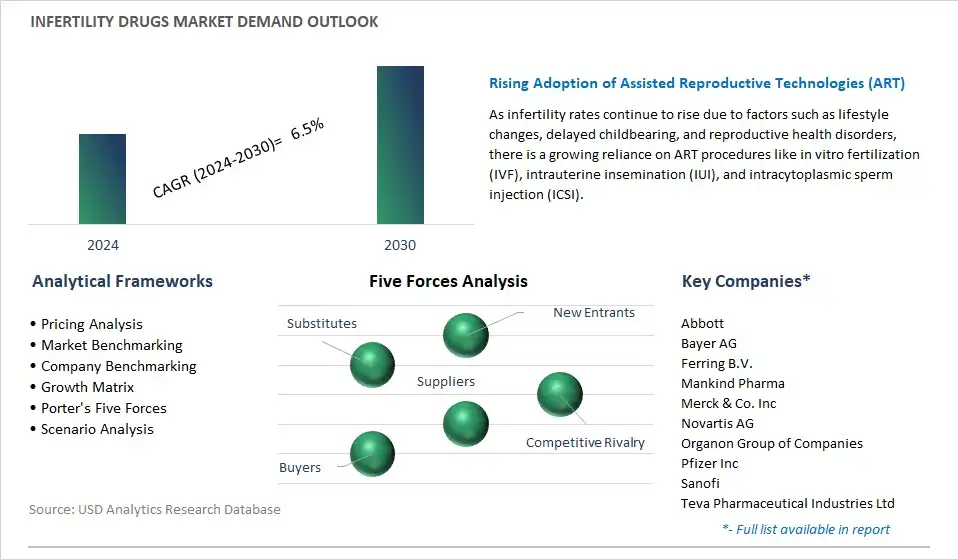
Infertility Drugs Market Trend: Rising Adoption of Assisted Reproductive Technologies (ART)
A significant trend in the Infertility Drugs market is the increasing adoption of Assisted Reproductive Technologies (ART) worldwide. As infertility rates continue to rise due to factors such as lifestyle changes, delayed childbearing, and reproductive health disorders, there is a growing reliance on ART procedures like in vitro fertilization (IVF), intrauterine insemination (IUI), and intracytoplasmic sperm injection (ICSI). This trend is driving the demand for infertility drugs, including ovulation stimulants, gonadotropins, and hormonal therapies, to optimize fertility outcomes and support successful conception in couples undergoing ART treatments.
Market Driver: Growing Prevalence of Infertility and Reproductive Health Disorders
A key driver propelling the growth of the Infertility Drugs market is the increasing prevalence of infertility and reproductive health disorders globally. Factors such as advancing age, lifestyle factors, environmental pollutants, hormonal imbalances, and medical conditions contribute to rising infertility rates among both men and women. As infertility becomes a more prevalent issue affecting individuals and couples of reproductive age, there is a growing demand for pharmacological interventions to address underlying causes, restore fertility, and enhance reproductive outcomes, thus driving the market for infertility drugs.
Infertility Drugs Market Opportunity: Expansion of Personalized Medicine Approaches in Infertility Treatment
An opportunity for the Infertility Drugs market lies in the expansion of personalized medicine approaches tailored to individual patient needs. As our understanding of the underlying causes of infertility continues to evolve, there is a growing emphasis on personalized treatment strategies that consider genetic, hormonal, and physiological factors influencing fertility. By leveraging advancements in genomic testing, biomarker analysis, and predictive analytics, pharmaceutical companies and healthcare providers can develop and implement personalized treatment regimens that optimize efficacy, minimize side effects, and improve patient outcomes in infertility management. This personalized approach presents an opportunity to innovate and differentiate within the Infertility Drugs market, catering to the diverse needs of patients seeking fertility solutions.
Infertility Drugs Market Segmentation
By Drug Class
Gonadotropins
Aromatase Inhibitors
Selective Estrogen Receptor Modulators (SERMs)
Dopamine Agonists
Others
By Distribution Channel
Hospital Pharmacy
Specialty & Retail Pharmacy
Online Pharmacy
Infertility Drugs
By End-User
Men
Women
Geographical Analysis
North America (United States, Canada, Mexico)
Europe (Germany, France, United Kingdom, Spain, Italy, Rest of Europe)
Asia Pacific (China, India, Japan, South Korea, Rest of Asia Pacific)
South America (Brazil, Argentina, Rest of South America)
Middle East and Africa (Saudi Arabia, UAE, Rest of Middle East, South Africa, Egypt, Rest of Africa)
Infertility Drugs Market Companies
Abbott
Bayer AG
Ferring B.V.
Mankind Pharma
Merck & Co. Inc
Novartis AG
Organon Group of Companies
Pfizer Inc
Sanofi
Teva Pharmaceutical Industries Ltd
Reasons to Buy the Infertility Drugs Market Study
• Deepen your industry insights and navigate uncertainties for strategy formulation, CAPEX, and Operational decisions
• Gain access to detailed insights on the Infertility Drugs Market, encompassing current market size, growth trends, and forecasts till 2030.
• Access detailed competitor analysis, enabling competitive advantage through a thorough understanding of market players, strategies, and potential differentiation opportunities
• Stay ahead of the curve with insights on technological advancements, innovations, and upcoming trends
• Identify lucrative investment avenues and expansion opportunities within the Infertility Drugs Market industry, guided by robust, data-backed analysis.
• Understand regional and global markets through country-wise analysis, regional market potential, regulatory nuances, and dynamics
• Execute strategies with confidence and speed through information, analytics, and insights on the industry value chain
• Corporate leaders, strategists, financial experts, shareholders, asset managers, and governmental representatives can make long-term planning scenarios and build an integrated and timely understanding of market dynamics
• Benefit from tailored solutions and expert consultation based on report insights, providing personalized strategies aligned with specific business needs.
TABLE OF CONTENTS
1 Introduction to 2024 Infertility Drugs Market
1.1 Market Overview
1.2 Quick Facts
1.3 Scope/Objective of the Study
1.4 Market Definition
1.5 Countries and Regions Analyzed
1.6 Units, Currency, and Conversions
1.7 Industry Value Chain
2 Research Methodology
2.1 Market Size Estimation
2.2 Sources and Research Methodology
2.3 Data Triangulation
2.4 Assumptions and Limitations
3 Executive Summary
3.1 Global Infertility Drugs Market Size Outlook, $ Million, 2021 to 2030
3.2 Infertility Drugs Market Outlook by Type, $ Million, 2021 to 2030
3.3 Infertility Drugs Market Outlook by Product, $ Million, 2021 to 2030
3.4 Infertility Drugs Market Outlook by Application, $ Million, 2021 to 2030
3.5 Infertility Drugs Market Outlook by Key Countries, $ Million, 2021 to 2030
4 Market Dynamics
4.1 Key Driving Forces of Infertility Drugs Market Industry
4.2 Key Market Trends in Infertility Drugs Market Industry
4.3 Potential Opportunities in Infertility Drugs Market Industry
4.4 Key Challenges in Infertility Drugs Market Industry
5 Market Factor Analysis
5.1 Competitive Landscape
5.1.1 Global Infertility Drugs Market Share by Company (%), 2023
5.1.2 Product Offerings by Company
5.2 Porter’s Five Forces Analysis
6 Growth Outlook Across Scenarios
6.1 Growth Analysis-Case Scenario Definitions
6.2 Low Growth Scenario Forecasts
6.3 Reference Growth Scenario Forecasts
6.4 High Growth Scenario Forecasts
7 Global Infertility Drugs Market Outlook By Segments
7.1 Infertility Drugs Market Outlook by Segments
By Drug Class
Gonadotropins
Aromatase Inhibitors
Selective Estrogen Receptor Modulators (SERMs)
Dopamine Agonists
Others
By Distribution Channel
Hospital Pharmacy
Specialty & Retail Pharmacy
Online Pharmacy
Infertility Drugs
By End-User
Men
Women
8 North America Infertility Drugs Market Analysis And Outlook To 2030
8.1 Introduction to North America Infertility Drugs Markets in 2024
8.2 North America Infertility Drugs Market Size Outlook by Country, 2021-2030
8.2.1 United States
8.2.2 Canada
8.2.3 Mexico
8.3 North America Infertility Drugs Market size Outlook by Segments, 2021-2030
By Drug Class
Gonadotropins
Aromatase Inhibitors
Selective Estrogen Receptor Modulators (SERMs)
Dopamine Agonists
Others
By Distribution Channel
Hospital Pharmacy
Specialty & Retail Pharmacy
Online Pharmacy
Infertility Drugs
By End-User
Men
Women
9 Europe Infertility Drugs Market Analysis And Outlook To 2030
9.1 Introduction to Europe Infertility Drugs Markets in 2024
9.2 Europe Infertility Drugs Market Size Outlook by Country, 2021-2030
9.2.1 Germany
9.2.2 France
9.2.3 Spain
9.2.4 United Kingdom
9.2.4 Italy
9.2.5 Russia
9.2.6 Norway
9.2.7 Rest of Europe
9.3 Europe Infertility Drugs Market Size Outlook By Segments, 2021-2030
By Drug Class
Gonadotropins
Aromatase Inhibitors
Selective Estrogen Receptor Modulators (SERMs)
Dopamine Agonists
Others
By Distribution Channel
Hospital Pharmacy
Specialty & Retail Pharmacy
Online Pharmacy
Infertility Drugs
By End-User
Men
Women
10 Asia Pacific Infertility Drugs Market Analysis And Outlook To 2030
10.1 Introduction to Asia Pacific Infertility Drugs Markets in 2024
10.2 Asia Pacific Infertility Drugs Market Size Outlook by Country, 2021-2030
10.2.1 China
10.2.2 India
10.2.3 Japan
10.2.4 South Korea
10.2.5 Indonesia
10.2.6 Malaysia
10.2.7 Australia
10.2.8 Rest of Asia Pacific
10.3 Asia Pacific Infertility Drugs Market size Outlook by Segments, 2021-2030
By Drug Class
Gonadotropins
Aromatase Inhibitors
Selective Estrogen Receptor Modulators (SERMs)
Dopamine Agonists
Others
By Distribution Channel
Hospital Pharmacy
Specialty & Retail Pharmacy
Online Pharmacy
Infertility Drugs
By End-User
Men
Women
11 South America Infertility Drugs Market Analysis And Outlook To 2030
11.1 Introduction to South America Infertility Drugs Markets in 2024
11.2 South America Infertility Drugs Market Size Outlook by Country, 2021-2030
11.2.1 Brazil
11.2.2 Argentina
11.2.3 Rest of South America
11.3 South America Infertility Drugs Market size Outlook by Segments, 2021-2030
By Drug Class
Gonadotropins
Aromatase Inhibitors
Selective Estrogen Receptor Modulators (SERMs)
Dopamine Agonists
Others
By Distribution Channel
Hospital Pharmacy
Specialty & Retail Pharmacy
Online Pharmacy
Infertility Drugs
By End-User
Men
Women
12 Middle East And Africa Infertility Drugs Market Analysis And Outlook To 2030
12.1 Introduction to Middle East and Africa Infertility Drugs Markets in 2024
12.2 Middle East and Africa Infertility Drugs Market Size Outlook by Country, 2021-2030
12.2.1 Saudi Arabia
12.2.2 UAE
12.2.3 Oman
12.2.4 Rest of Middle East
12.2.5 Egypt
12.2.6 Nigeria
12.2.7 South Africa
12.2.8 Rest of Africa
12.3 Middle East and Africa Infertility Drugs Market size Outlook by Segments, 2021-2030
By Drug Class
Gonadotropins
Aromatase Inhibitors
Selective Estrogen Receptor Modulators (SERMs)
Dopamine Agonists
Others
By Distribution Channel
Hospital Pharmacy
Specialty & Retail Pharmacy
Online Pharmacy
Infertility Drugs
By End-User
Men
Women
13 Company Profiles
13.1 Company Snapshot
13.2 SWOT Profiles
13.3 Products and Services
13.4 Recent Developments
13.5 Financial Profile
List of Companies
Abbott
Bayer AG
Ferring B.V.
Mankind Pharma
Merck & Co. Inc
Novartis AG
Organon Group of Companies
Pfizer Inc
Sanofi
Teva Pharmaceutical Industries Ltd
14 Appendix
14.1 Customization Offerings
14.2 Subscription Services
14.3 Related Reports
14.4 Publisher Expertise
