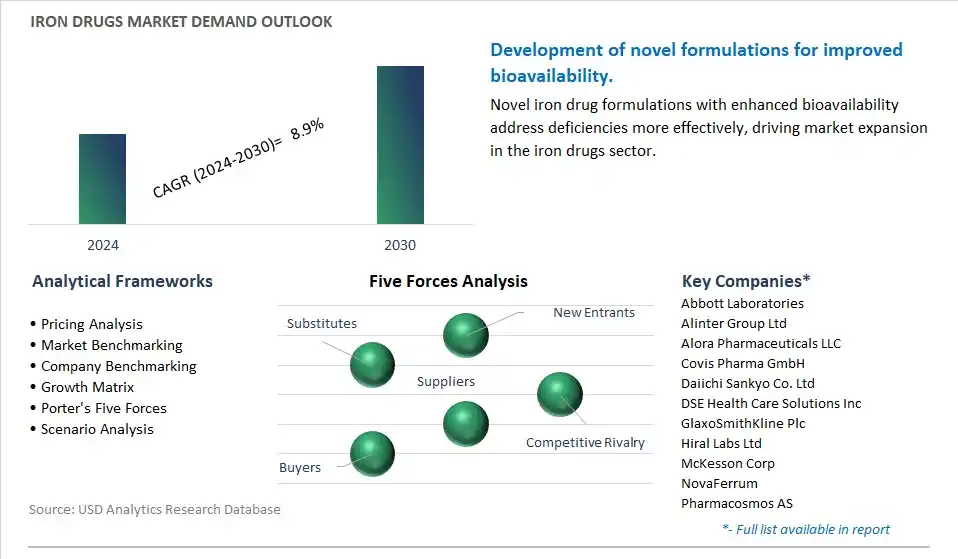
Iron Drugs Market is estimated to increase at a growth rate of 8.9% CAGR over the forecast period from 2024 to 2030.
The global Iron Drugs Market Study analyzes and forecasts the market size across 6 regions and 24 countries for diverse segments including By Product (Oral drug, IV drug), By Age Group (Adult, Pediatric).
An Introduction to Iron Drugs Market in 2024
The Iron Drugs Market comprises pharmaceutical products and supplements used for treating iron deficiency anemia and iron-related disorders. This market includes oral iron supplements, intravenous iron preparations, iron-chelating agents, and iron-fortified foods targeting patients with iron deficiency, chronic kidney disease, thalassemia, and inflammatory conditions. Iron drugs play a crucial role in replenishing iron stores, improving hemoglobin levels, and managing iron overload conditions. Innovations in iron drugs focus on improved formulations, enhanced bioavailability, reduced side effects, and patient compliance, addressing the diverse needs of healthcare providers and patients for effective iron therapy solutions.
Iron Drugs Market Competitive Landscape
The global Iron Drugs Industry is highly competitive with a large number of companies focusing on niche market segments. Amidst intense competitive conditions, Iron Drugs Companies are investing in new product launches and strengthening distribution channels. Key companies operating in the Iron Drugs Industry include- Abbott Laboratories, Alinter Group Ltd, Alora Pharmaceuticals LLC, Covis Pharma GmbH, Daiichi Sankyo Co. Ltd, DSE Health Care Solutions Inc, GlaxoSmithKline Plc, Hiral Labs Ltd, McKesson Corp, NovaFerrum, Pharmacosmos AS, Procter and Gamble, Reckitt Benckiser Group Plc, Rockwell Medical Inc, Sanofi S.A..
Iron Drugs Market Trend: Increasing Awareness and Treatment of Iron Deficiency Disorders
A significant trend in the market for iron drugs is the increasing awareness and treatment of iron deficiency disorders, such as iron deficiency anemia (IDA), globally. Iron deficiency is one of the most common nutritional deficiencies worldwide, affecting individuals of all ages and demographics. Factors such as poor dietary intake, chronic diseases, gastrointestinal disorders, and pregnancy contribute to the prevalence of iron deficiency disorders. This trend is driven by efforts to raise awareness about the importance of iron in maintaining overall health and preventing complications associated with iron deficiency, including anemia, fatigue, impaired cognitive function, and compromised immune function. As healthcare providers and public health organizations prioritize screening, diagnosis, and treatment of iron deficiency disorders, there is growing demand for iron drugs, supplements, and fortified foods to address iron deficiency and improve patient outcomes.
Iron Drugs Market Driver: Growing Incidence of Chronic Diseases and Blood Disorders
The primary driver of the iron drugs market is the growing incidence of chronic diseases and blood disorders that predispose individuals to iron deficiency and anemia. Chronic conditions such as chronic kidney disease (CKD), inflammatory bowel disease (IBD), heart failure, and cancer can lead to anemia of chronic disease, characterized by impaired iron utilization, erythropoiesis, and red blood cell production. Additionally, blood disorders such as thalassemia, sickle cell disease, and hereditary hemochromatosis can result in iron imbalance and require iron supplementation or chelation therapy to manage iron overload or deficiency. As the global burden of chronic diseases and blood disorders continues to rise, there is increasing demand for iron drugs as adjunctive therapy to manage anemia and optimize iron status in affected patients, driving market growth for iron formulations and therapeutic options.
Iron Drugs Market Opportunity: Expansion into Geriatric and Pediatric Populations
An opportunity in the iron drugs market lies in the expansion into geriatric and pediatric populations with specific iron supplementation needs. Geriatric individuals are at increased risk of iron deficiency and anemia due to age-related changes in gastrointestinal function, nutritional status, and chronic health conditions, such as gastrointestinal bleeding or malabsorption syndromes. Similarly, pediatric populations, including infants, children, and adolescents, may experience iron deficiency due to rapid growth, inadequate dietary intake, or chronic diseases. Manufacturers of iron drugs can capitalize on this opportunity by developing age-appropriate formulations, dosage forms, and delivery systems tailored to the unique needs of geriatric and pediatric patients, ultimately addressing unmet medical needs, improving treatment adherence, and enhancing iron supplementation outcomes in these vulnerable populations.
Iron Drugs Market Share Analysis: IV Drug is the fastest growing market segment over the forecast period to 2030
Among the different types of iron drugs, the Intravenous (IV) drug segment is experiencing the fastest growth. IV iron drugs are administered directly into the bloodstream, making them particularly effective for patients with severe iron deficiency or those who cannot tolerate oral iron supplementation due to gastrointestinal issues. IV iron therapy offers rapid replenishment of iron stores and is often preferred in cases of chronic conditions such as chronic kidney disease, inflammatory bowel disease, and certain types of anemia. Additionally, IV iron therapy allows for precise dosing and can bypass issues related to oral iron absorption. As healthcare providers increasingly recognize the benefits of IV iron therapy and its efficacy in managing iron deficiency, the demand for IV iron drugs, particularly among adult patients, is expected to continue growing rapidly.
Iron Drugs Market Segmentation
By Product
Oral drug
IV drug
By Age Group
Adult
Pediatric
Geographical Analysis
North America (United States, Canada, Mexico)
Europe (Germany, France, United Kingdom, Spain, Italy, Rest of Europe)
Asia Pacific (China, India, Japan, South Korea, Rest of Asia Pacific)
South America (Brazil, Argentina, Rest of South America)
Middle East and Africa (Saudi Arabia, UAE, Rest of Middle East, South Africa, Egypt, Rest of Africa)
Iron Drugs Companies
Abbott Laboratories
Alinter Group Ltd
Alora Pharmaceuticals LLC
Covis Pharma GmbH
Daiichi Sankyo Co. Ltd
DSE Health Care Solutions Inc
GlaxoSmithKline Plc
Hiral Labs Ltd
McKesson Corp
NovaFerrum
Pharmacosmos AS
Procter and Gamble
Reckitt Benckiser Group Plc
Rockwell Medical Inc
Sanofi S.A.
* List not Exhaustive
Reasons to Buy the Iron Drugs Market Study
• Deepen your industry insights and navigate uncertainties for strategy formulation, CAPEX, and Operational decisions
• Gain access to detailed insights on the Iron Drugs Market, encompassing current market size, growth trends, and forecasts till 2030.
• Access detailed competitor analysis, enabling competitive advantage through a thorough understanding of market players, strategies, and potential differentiation opportunities
• Stay ahead of the curve with insights on technological advancements, innovations, and upcoming trends
• Identify lucrative investment avenues and expansion opportunities within the Iron Drugs Industry, guided by robust, data-backed analysis.
• Understand regional and global markets through country-wise analysis, regional market potential, regulatory nuances, and dynamics
• Execute strategies with confidence and speed through information, analytics, and insights on the industry value chain
• Corporate leaders, strategists, financial experts, shareholders, asset managers, and governmental representatives can make long-term planning scenarios and build an integrated and timely understanding of market dynamics
• Benefit from tailored solutions and expert consultation based on report insights, providing personalized strategies aligned with specific business needs.
TABLE OF CONTENTS
1 Introduction to 2024 Iron Drugs Market
1.1 Market Overview
1.2 Quick Facts
1.3 Scope/Objective of the Study
1.4 Market Definition
1.5 Countries and Regions Analyzed
1.6 Units, Currency, and Conversions
1.7 Industry Value Chain
2 Research Methodology
2.1 Market Size Estimation
2.2 Sources and Research Methodology
2.3 Data Triangulation
2.4 Assumptions and Limitations
3 Executive Summary
3.1 Global Iron Drugs Market Size Outlook, $ Million, 2021 to 2030
3.2 Iron Drugs Market Outlook by Type, $ Million, 2021 to 2030
3.3 Iron Drugs Market Outlook by Product, $ Million, 2021 to 2030
3.4 Iron Drugs Market Outlook by Application, $ Million, 2021 to 2030
3.5 Iron Drugs Market Outlook by Key Countries, $ Million, 2021 to 2030
4 Market Dynamics
4.1 Key Driving Forces of Iron Drugs Industry
4.2 Key Market Trends in Iron Drugs Industry
4.3 Potential Opportunities in Iron Drugs Industry
4.4 Key Challenges in Iron Drugs Industry
5 Market Factor Analysis
5.1 Value Chain Analysis
5.2 Competitive Landscape
5.2.1 Global Iron Drugs Market Share by Company (%), 2023
5.2.2 Product Offerings by Company
5.3 Porter’s Five Forces Analysis
5.4 Pricing Analysis and Outlook
6 Growth Outlook Across Scenarios
6.1 Growth Analysis-Case Scenario Definitions
6.2 Low Growth Scenario Forecasts
6.3 Reference Growth Scenario Forecasts
6.4 High Growth Scenario Forecasts
7 Global Iron Drugs Market Outlook by Segments
7.1 Iron Drugs Market Outlook by Segments, $ Million, 2021- 2030
By Product
Oral drug
IV drug
By Age Group
Adult
Pediatric
8 North America Iron Drugs Market Analysis and Outlook To 2030
8.1 Introduction to North America Iron Drugs Markets in 2024
8.2 North America Iron Drugs Market Size Outlook by Country, 2021-2030
8.2.1 United States
8.2.2 Canada
8.2.3 Mexico
8.3 North America Iron Drugs Market size Outlook by Segments, 2021-2030
By Product
Oral drug
IV drug
By Age Group
Adult
Pediatric
9 Europe Iron Drugs Market Analysis and Outlook To 2030
9.1 Introduction to Europe Iron Drugs Markets in 2024
9.2 Europe Iron Drugs Market Size Outlook by Country, 2021-2030
9.2.1 Germany
9.2.2 France
9.2.3 Spain
9.2.4 United Kingdom
9.2.4 Italy
9.2.5 Russia
9.2.6 Norway
9.2.7 Rest of Europe
9.3 Europe Iron Drugs Market Size Outlook by Segments, 2021-2030
By Product
Oral drug
IV drug
By Age Group
Adult
Pediatric
10 Asia Pacific Iron Drugs Market Analysis and Outlook To 2030
10.1 Introduction to Asia Pacific Iron Drugs Markets in 2024
10.2 Asia Pacific Iron Drugs Market Size Outlook by Country, 2021-2030
10.2.1 China
10.2.2 India
10.2.3 Japan
10.2.4 South Korea
10.2.5 Indonesia
10.2.6 Malaysia
10.2.7 Australia
10.2.8 Rest of Asia Pacific
10.3 Asia Pacific Iron Drugs Market size Outlook by Segments, 2021-2030
By Product
Oral drug
IV drug
By Age Group
Adult
Pediatric
11 South America Iron Drugs Market Analysis and Outlook To 2030
11.1 Introduction to South America Iron Drugs Markets in 2024
11.2 South America Iron Drugs Market Size Outlook by Country, 2021-2030
11.2.1 Brazil
11.2.2 Argentina
11.2.3 Rest of South America
11.3 South America Iron Drugs Market size Outlook by Segments, 2021-2030
By Product
Oral drug
IV drug
By Age Group
Adult
Pediatric
12 Middle East and Africa Iron Drugs Market Analysis and Outlook To 2030
12.1 Introduction to Middle East and Africa Iron Drugs Markets in 2024
12.2 Middle East and Africa Iron Drugs Market Size Outlook by Country, 2021-2030
12.2.1 Saudi Arabia
12.2.2 UAE
12.2.3 Oman
12.2.4 Rest of Middle East
12.2.5 Egypt
12.2.6 Nigeria
12.2.7 South Africa
12.2.8 Rest of Africa
12.3 Middle East and Africa Iron Drugs Market size Outlook by Segments, 2021-2030
By Product
Oral drug
IV drug
By Age Group
Adult
Pediatric
13 Company Profiles
13.1 Company Snapshot
13.2 SWOT Profiles
13.3 Products and Services
13.4 Recent Developments
13.5 Financial Profile
List of Companies
Abbott Laboratories
Alinter Group Ltd
Alora Pharmaceuticals LLC
Covis Pharma GmbH
Daiichi Sankyo Co. Ltd
DSE Health Care Solutions Inc
GlaxoSmithKline Plc
Hiral Labs Ltd
McKesson Corp
NovaFerrum
Pharmacosmos AS
Procter and Gamble
Reckitt Benckiser Group Plc
Rockwell Medical Inc
Sanofi S.A.
14 Appendix
14.1 Customization Offerings
14.2 Subscription Services
14.3 Related Reports
14.4 Publisher Expertise
