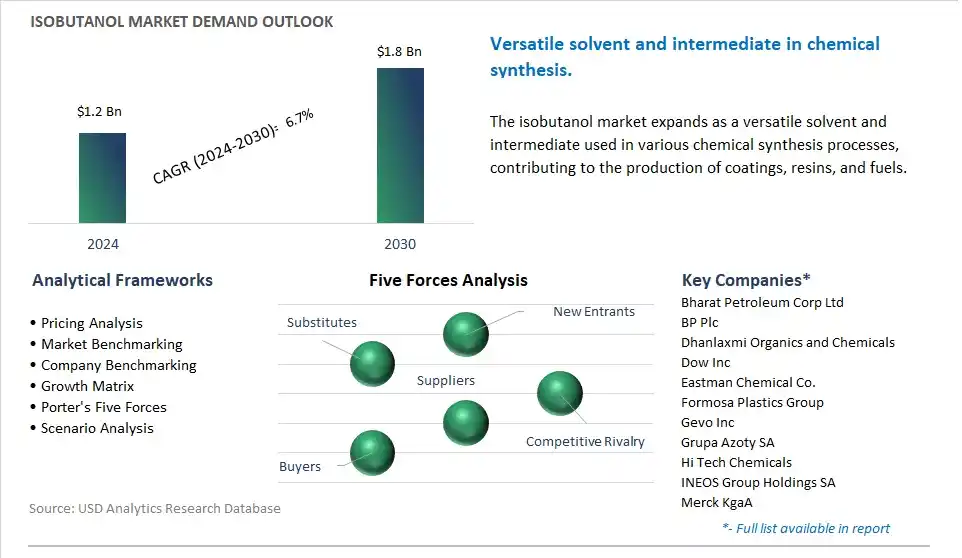
The global Isobutanol Market is poised to register a 6.7% CAGR from $1.2 Billion in 2024 to $1.8 Billion in 2030.
The global Isobutanol Market Study analyzes and forecasts the market size across 6 regions and 24 countries for diverse segments -By Product (Synthetic Isobutanol, Bio Based Isobutanol, Others), By Application (Oil & Gas, Solvents & Coatings, Chemical Intermediate, Pharmaceuticals, Others).
An Introduction to Global Isobutanol Market in 2024
Isobutanol is a four-carbon alcohol commonly used as a solvent, intermediate chemical, and biofuel additive in various industrial applications such as paints, coatings, plastics, and transportation fuels. One key trend shaping the future of isobutanol is the development of sustainable production methods and expanded applications to meet the growing demand for renewable and low-carbon alternatives to traditional petrochemicals and fossil fuels. Isobutanol producers are investing in advanced biorefinery technologies, such as microbial fermentation, enzymatic conversion, and gasification of biomass feedstocks, to produce isobutanol from renewable resources such as agricultural residues, forestry waste, and industrial by-products, reducing dependency on fossil fuels and mitigating greenhouse gas emissions. Additionally, advancements in catalytic processes, separation techniques, and downstream processing are improving process efficiency, yield, and cost-effectiveness of isobutanol production, enabling commercial-scale deployment of bio-based isobutanol as a drop-in replacement for petroleum-derived chemicals and fuels in various end-user industries. Moreover, the integration of isobutanol into sustainable product formulations, such as bio-based paints, bio-plastics, and renewable fuels, is promoting environmental stewardship and circular economy principles, reducing environmental footprint and contributing to the transition towards a more sustainable and resilient economy. As industries and consumers increasingly prioritize sustainability, carbon neutrality, and resource efficiency, the market for isobutanol is poised for innovation and growth, with opportunities for collaboration, research, and market expansion to meet the evolving needs of chemical manufacturers, fuel blenders, and end-users across diverse sectors.
Isobutanol Market Competitive Landscape
The market report analyses the leading companies in the industry including Bharat Petroleum Corp Ltd, BP Plc, Dhanlaxmi Organics and Chemicals, Dow Inc, Eastman Chemical Co., Formosa Plastics Group, Gevo Inc, Grupa Azoty SA, Hi Tech Chemicals, INEOS Group Holdings SA, Merck KgaA, Mitsubishi Chemical Corp, Niksan Pharmaceutical, OQ SAOC, PETRONAS Chemicals Group Berhad.
Isobutanol Market Dynamics
Isobutanol Market Trend: Growing Demand for Bio-Based and Sustainable Chemicals
A prominent trend in the isobutanol market is the growing demand for bio-based and sustainable chemicals. With increasing concerns about environmental sustainability and the depletion of fossil fuel resources, there is a rising preference for renewable and eco-friendly alternatives in the chemical industry. Isobutanol, a versatile alcohol compound derived from renewable feedstocks such as biomass, offers several advantages such as lower carbon footprint, reduced greenhouse gas emissions, and improved environmental performance compared to traditional petroleum-based chemicals. The trend towards bio-based chemicals is driving the adoption of isobutanol as a key ingredient in various applications including solvents, coatings, fuels, and intermediates.
Isobutanol Market Driver: Expansion of Chemical and Petrochemical Industries
A key driver propelling the isobutanol market is the expansion of the chemical and petrochemical industries. Isobutanol serves as a valuable building block chemical in the production of a wide range of downstream products such as esters, ethers, and acrylates, which find applications in paints, coatings, plastics, and pharmaceuticals. The growth of end-user industries such as construction, automotive, packaging, and healthcare drives the demand for isobutanol as a key raw material for manufacturing value-added chemicals and products. Additionally, the versatility of isobutanol in various industrial processes, including solvent extraction, chemical synthesis, and fuel blending, contributes to its widespread use and market growth in the chemical and petrochemical sectors.
Isobutanol Market Opportunity: Expansion into Renewable Energy and Fuel Additives
An opportunity for growth in the isobutanol market lies in the expansion into renewable energy and fuel additives. Isobutanol possesses favorable properties such as high octane rating, low vapor pressure, and compatibility with existing fuel infrastructure, making it a promising candidate for blending with gasoline and biofuels. Isobutanol-based fuel additives offer benefits such as improved engine performance, reduced emissions, and enhanced fuel stability, addressing key challenges in the transportation sector such as air pollution and fuel efficiency. Additionally, there is an opportunity to explore isobutanol as a renewable feedstock for the production of advanced biofuels such as biobutanol, which offer potential alternatives to conventional gasoline and diesel fuels. By capitalizing on advancements in biofuel technology, regulatory incentives, and market demand for sustainable transportation solutions, companies can unlock new opportunities for growth and innovation in the isobutanol market.
Isobutanol Market Ecosystem
The Isobutanol market involves diverse key stages, with production being the initial step. Petroleum-based production, led by oil and gas companies including Exxon Mobil and Royal Dutch Shell, dominates, with refineries integrating processes to produce isobutanol from fossil fuels. Alternatively, bio-based production, spearheaded by companies including Gevo and Amyris, utilizes fermentation processes to convert renewable feedstocks including corn or sugarcane into isobutanol, representing a growing segment. Following production, purification, and separation processes, typically managed by chemical processing companies including Dow Chemical and BASF, yield high-purity isobutanol.
Distribution channels include chemical distributors including Brenntag AG and fuel distributors, offering isobutanol to industrial users and fuel blending applications, respectively. End users span various industries, including chemicals, fuels, pharmaceuticals, and potentially plastics, leveraging isobutanol for applications including solvents, biofuel blendstock, pharmaceutical intermediates, and potentially as a feedstock for bio-based plastics.
Isobutanol Market Share Analysis: Synthetic Isobutanol held the dominant revenue share in 2024
The Synthetic Isobutanol segment is the largest in the Isobutanol Market due to diverse key reasons. Firstly, synthetic isobutanol is produced through conventional chemical processes, which have been well-established and optimized over decades, ensuring reliable and efficient production at scale. This method allows for consistent quality control and cost-effective manufacturing, making synthetic isobutanol the preferred choice for a wide range of industrial applications. Additionally, synthetic isobutanol offers versatility in terms of its chemical properties and applications, making it suitable for use as a solvent, intermediate, or additive in various industries such as chemicals, plastics, pharmaceuticals, and automotive. In addition, the established infrastructure and supply chain for synthetic isobutanol further contributes to its dominance in the market, ensuring reliable availability and distribution to meet the demands of industrial consumers worldwide. Further, advancements in chemical engineering and process technology continue to improve the efficiency and sustainability of synthetic isobutanol production, further reinforcing its position as the largest segment in the Isobutanol Market. With its proven performance, versatility, and established supply chain, synthetic isobutanol remains the preferred choice for industrial applications, driving its dominance in the market.
Isobutanol Market Share Analysis: Solvents and Coatings is the fastest growing market segment over the forecast period to 2030
The Solvents and Coatings segment is the fastest-growing in the Isobutanol Market due to diverse compelling reasons. Firstly, isobutanol is widely used as a solvent in various industries, including paints, coatings, inks, adhesives, and cleaning products. As industries seek alternatives to traditional solvents with volatile organic compounds (VOCs), isobutanol presents an attractive option due to its low volatility, low odor, and high solvent power. Additionally, isobutanol serves as a key ingredient in the production of specialty coatings and paints, where it enhances film formation, adhesion, and durability, leading to increased demand from construction, automotive, and industrial sectors. In addition, the growing construction and infrastructure development activities worldwide drive the demand for paints, coatings, and adhesives, further boosting the consumption of isobutanol as a solvent and raw material. Further, the increasing adoption of eco-friendly and sustainable products in response to environmental regulations and consumer preferences accelerates the transition toward isobutanol-based solvents and coatings. With its versatile applications, environmental benefits, and growing demand across multiple industries, the Solvents and Coatings segment is poised to experience rapid growth in the Isobutanol Market, driving the overall expansion of the industry.
Isobutanol Market Report Scope-
By Product
Synthetic Isobutanol
Bio Based Isobutanol
Others
By Application
Oil & Gas
Solvents & Coatings
Chemical Intermediate
Pharmaceuticals
Others
Isobutanol Market Companies Profiled
Bharat Petroleum Corp Ltd
BP Plc
Dhanlaxmi Organics and Chemicals
Dow Inc
Eastman Chemical Co.
Formosa Plastics Group
Gevo Inc
Grupa Azoty SA
Hi Tech Chemicals
INEOS Group Holdings SA
Merck KgaA
Mitsubishi Chemical Corp
Niksan Pharmaceutical
OQ SAOC
PETRONAS Chemicals Group Berhad
*- List Not Exhaustive
TABLE OF CONTENTS
1 Introduction to 2024 Isobutanol Market
1.1 Market Overview
1.2 Quick Facts
1.3 Scope/Objective of the Study
1.4 Market Definition
1.5 Countries and Regions Covered
1.6 Units, Currency, and Conversions
1.7 Industry Value Chain
2 Research Methodology
2.1 Market Size Estimation
2.2 Sources and Research Methodology
2.3 Data Triangulation
2.4 Assumptions and Limitations
3 Executive Summary
3.1 Global Isobutanol Market Size Outlook, $ Million, 2021 to 2030
3.2 Isobutanol Market Outlook by Type, $ Million, 2021 to 2030
3.3 Isobutanol Market Outlook by Product, $ Million, 2021 to 2030
3.4 Isobutanol Market Outlook by Application, $ Million, 2021 to 2030
3.5 Isobutanol Market Outlook by Key Countries, $ Million, 2021 to 2030
4 Market Dynamics
4.1 Key Driving Forces of Isobutanol Industry
4.2 Key Market Trends in Isobutanol Industry
4.3 Potential Opportunities in Isobutanol Industry
4.4 Key Challenges in Isobutanol Industry
5 Market Factor Analysis
5.1 Value Chain Analysis
5.2 Competitive Landscape
5.2.1 Global Isobutanol Market Share by Company (%), 2023
5.2.2 Product Offerings by Company
5.3 Porter’s Five Forces Analysis
5.4 Pricing Analysis and Outlook
6 Growth Outlook Across Scenarios
6.1 Growth Analysis-Case Scenario Definitions
6.2 Low Growth Scenario Forecasts
6.3 Reference Growth Scenario Forecasts
6.4 High Growth Scenario Forecasts
7 Global Isobutanol Market Outlook by Segments
7.1 Isobutanol Market Outlook by Segments, $ Million, 2021- 2030
By Product
Synthetic Isobutanol
Bio Based Isobutanol
Others
By Application
Oil & Gas
Solvents & Coatings
Chemical Intermediate
Pharmaceuticals
Others
8 North America Isobutanol Market Analysis and Outlook To 2030
8.1 Introduction to North America Isobutanol Markets in 2024
8.2 North America Isobutanol Market Size Outlook by Country, 2021-2030
8.2.1 United States
8.2.2 Canada
8.2.3 Mexico
8.3 North America Isobutanol Market size Outlook by Segments, 2021-2030
By Product
Synthetic Isobutanol
Bio Based Isobutanol
Others
By Application
Oil & Gas
Solvents & Coatings
Chemical Intermediate
Pharmaceuticals
Others
9 Europe Isobutanol Market Analysis and Outlook To 2030
9.1 Introduction to Europe Isobutanol Markets in 2024
9.2 Europe Isobutanol Market Size Outlook by Country, 2021-2030
9.2.1 Germany
9.2.2 France
9.2.3 Spain
9.2.4 United Kingdom
9.2.4 Italy
9.2.5 Russia
9.2.6 Norway
9.2.7 Rest of Europe
9.3 Europe Isobutanol Market Size Outlook by Segments, 2021-2030
By Product
Synthetic Isobutanol
Bio Based Isobutanol
Others
By Application
Oil & Gas
Solvents & Coatings
Chemical Intermediate
Pharmaceuticals
Others
10 Asia Pacific Isobutanol Market Analysis and Outlook To 2030
10.1 Introduction to Asia Pacific Isobutanol Markets in 2024
10.2 Asia Pacific Isobutanol Market Size Outlook by Country, 2021-2030
10.2.1 China
10.2.2 India
10.2.3 Japan
10.2.4 South Korea
10.2.5 Indonesia
10.2.6 Malaysia
10.2.7 Australia
10.2.8 Rest of Asia Pacific
10.3 Asia Pacific Isobutanol Market size Outlook by Segments, 2021-2030
By Product
Synthetic Isobutanol
Bio Based Isobutanol
Others
By Application
Oil & Gas
Solvents & Coatings
Chemical Intermediate
Pharmaceuticals
Others
11 South America Isobutanol Market Analysis and Outlook To 2030
11.1 Introduction to South America Isobutanol Markets in 2024
11.2 South America Isobutanol Market Size Outlook by Country, 2021-2030
11.2.1 Brazil
11.2.2 Argentina
11.2.3 Rest of South America
11.3 South America Isobutanol Market size Outlook by Segments, 2021-2030
By Product
Synthetic Isobutanol
Bio Based Isobutanol
Others
By Application
Oil & Gas
Solvents & Coatings
Chemical Intermediate
Pharmaceuticals
Others
12 Middle East and Africa Isobutanol Market Analysis and Outlook To 2030
12.1 Introduction to Middle East and Africa Isobutanol Markets in 2024
12.2 Middle East and Africa Isobutanol Market Size Outlook by Country, 2021-2030
12.2.1 Saudi Arabia
12.2.2 UAE
12.2.3 Oman
12.2.4 Rest of Middle East
12.2.5 Egypt
12.2.6 Nigeria
12.2.7 South Africa
12.2.8 Rest of Africa
12.3 Middle East and Africa Isobutanol Market size Outlook by Segments, 2021-2030
By Product
Synthetic Isobutanol
Bio Based Isobutanol
Others
By Application
Oil & Gas
Solvents & Coatings
Chemical Intermediate
Pharmaceuticals
Others
13 Company Profiles
13.1 Company Snapshot
13.2 SWOT Profiles
13.3 Products and Services
13.4 Recent Developments
13.5 Financial Profile
Bharat Petroleum Corp Ltd
BP Plc
Dhanlaxmi Organics and Chemicals
Dow Inc
Eastman Chemical Co.
Formosa Plastics Group
Gevo Inc
Grupa Azoty SA
Hi Tech Chemicals
INEOS Group Holdings SA
Merck KgaA
Mitsubishi Chemical Corp
Niksan Pharmaceutical
OQ SAOC
PETRONAS Chemicals Group Berhad
14 Appendix
14.1 Customization Offerings
14.2 Subscription Services
14.3 Related Reports
14.4 Publisher Expertise
By Product
Synthetic Isobutanol
Bio Based Isobutanol
Others
By Application
Oil & Gas
Solvents & Coatings
Chemical Intermediate
Pharmaceuticals
Others
Countries Analyzed
North America (US, Canada, Mexico)
Europe (Germany, UK, France, Spain, Italy, Russia, Rest of Europe)
Asia Pacific (China, India, Japan, South Korea, Australia, South East Asia, Rest of Asia)
South America (Brazil, Argentina, Rest of South America)
Middle East and Africa (Saudi Arabia, UAE, Rest of Middle East, South Africa, Egypt, Rest of Africa)
