Isopropylamine Market to Reach $659.6 Million by 2034 as Agrochemical Optimization and Electronics-Grade Amines Drive Structural Shift
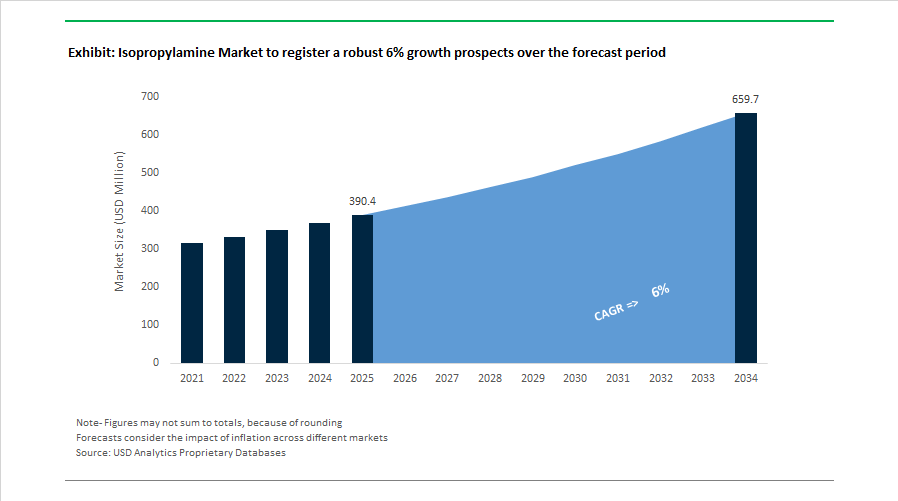
The Isopropylamine Market is projected to expand from $390.4 Million in 2025 to $659.6 Million by 2034, reflecting a CAGR of 6%. Growth is being underpinned by strong demand across agrochemicals, lubricants, polyurethane catalysts, electronics-grade solvents, and specialty intermediates. At the same time, the market is undergoing structural transformation as producers rebalance European operations, onshore high-purity production, and shift portfolios toward higher-value downstream derivatives.
Upstream restructuring in Europe has influenced feedstock dynamics. In May 2024, BASF entered into a global agreement with International Process Plants to market integrated ammonia and methanol assets at Ludwigshafen. As ammonia is a critical precursor in amine synthesis, this divestment reflects broader cost pressures tied to European energy markets and has implications for the competitiveness of regional isopropylamine production. In parallel, Evonik advanced its “Tailor Made” efficiency program in February 2026, consolidating manufacturing within its SYNEQT entity to optimize utility consumption and reduce overhead in German chemical parks. These structural adjustments signal a recalibration of Europe’s aliphatic amine value chain.
North America is emerging as a high-purity hub. In September 2024, Eastman introduced electronic-grade isopropyl alcohol under its EastaPure™ portfolio, reinforcing domestic supply of a key precursor for isopropylamine synthesis. Huntsman expanded purification and packaging capabilities at its E-GRADE® facility in Texas in early 2025, targeting semiconductor-grade amines and solvents used in wafer fabrication. These moves align with the broader semiconductor onshoring strategy in the United States and point to rising demand for ultra-low impurity amine derivatives in chip manufacturing and precision cleaning.
In specialty chemicals, BASF announced in March 2025 an expansion of aminic antioxidant capacity at its Puebla, Mexico site, with completion scheduled for 2026. Isopropylamine intermediates play a central role in producing antioxidants and corrosion inhibitors for high-performance lubricants, a segment benefiting from extended drain intervals and higher engine operating temperatures. Meanwhile, Huntsman launched SHOKLESS™ polyurethane systems in January 2026 to support EV battery encapsulation. Amine catalysts derived from isopropylamine are essential for controlling foam reaction kinetics in these advanced polyurethane systems.
Asia-Pacific remains critical to global supply. Zhejiang Xinhua Chemical, one of the world’s leading isopropylamine producers, announced in March 2025 capacity expansion for specialty derivatives beyond technical-grade amines used in glyphosate. The company is moving into halogen-free flame retardants and catalytic applications, signaling a transition from commodity herbicide salts toward diversified, higher-margin markets. Evonik showcased sustainable amine-based adjuvants at ISAA 2025, improving the environmental profile of glyphosate-isopropylamine salt formulations in response to tightening regulatory scrutiny.
Pricing and cost volatility remain central themes. Eastman implemented off-list price increases for alcohol derivatives in January 2026, raising feedstock costs for downstream amine producers. Concurrently, BASF announced the opening of a Global Digital Hub in Hyderabad in January 2026 to deploy AI-enabled logistics optimization for its aliphatic amine supply chains, improving real-time inventory visibility and margin management.
Portfolio realignment is also reshaping competitive dynamics. Samyang Holdings completed the acquisition of Verdant Specialty Solutions in early 2024, securing a U.S. manufacturing base for amine-based surfactants and specialty chemicals. Lotte Chemical declared 2026 a strategic “Grand Turning Point,” pivoting toward high-purity semiconductor and green energy materials, influencing its specialty amine R&D trajectory.
Trends and Opportunities in the Global Isopropylamine Market
Strategic Capacity Scaling for Herbicide Intermediates Amid Agrochemical Export Growth
The isopropylamine market is structurally anchored to global agrochemical demand, where it functions as a core intermediate for glyphosate isopropylamine salts and atrazine-based herbicides. As agricultural exports rebound and food security becomes a strategic priority, manufacturers are accelerating capacity expansion and backward integration to secure uninterrupted supply of this critical amine.
India has emerged as a focal point of this expansion cycle. Between late 2024 and throughout 2025, leading domestic producers completed large-scale capacity additions in Maharashtra, targeting a 15% increase in export-ready output by the end of 2024. These investments are directly linked to rising demand from Brazil and North America, where herbicide consumption remains resilient due to no-till farming practices and yield optimization programs. Supporting this industrial push, the Indian government’s Production Linked Incentive framework allocated a significant share of a USD 150 million incentive pool during 2023–2024 to specialty amines. This policy objective is explicitly aimed at positioning India as a global supply hub for isopropylamine, reducing structural reliance on Chinese feedstocks and improving supply-chain resilience for global agrochemical majors.
Demand fundamentals remain robust. Global agricultural data for 2024 confirms that glyphosate-related applications alone consume more than 35,000 metric tons of isopropylamine annually. This volume is being sustained by the commercialization of new biotech traits, including nematode-resistant soybean varieties introduced in 2025, which reinforce long-term herbicide usage rather than displacing it. For decision-makers, this underscores that isopropylamine demand is not cyclical but structurally embedded in modern agriculture.
Feedstock Volatility and the Acetone–Acrylonitrile Squeeze
Despite strong downstream pull, isopropylamine pricing remains highly sensitive to upstream feedstock dynamics. Production economics are closely linked to acetone, isopropanol, ammonia, and indirectly to acrylonitrile value chains, creating a volatile cost environment across regions.
In the second quarter of 2025, pronounced regional price divergence became evident. The China isopropylamine price index declined by 5.3% quarter on quarter to around USD 1,050 per metric ton FOB Shanghai, driven by aggressive cost optimization and inventory liquidation. In contrast, U.S. prices remained elevated near USD 1,600 per metric ton FOB Houston, reflecting higher energy costs, stricter environmental compliance, and tighter inventory discipline. This divergence complicates global sourcing strategies for agrochemical formulators operating across continents.
Additional pressure stems from acrylonitrile-linked volatility, where hydrogen cyanide availability indirectly affects amine supply planning. Early 2025 forecasts pointed to initial weakness in North American acrylonitrile pricing, followed by a recovery from March onward as automotive and construction demand stabilized. This unpredictability forces isopropylamine producers to maintain higher safety stocks, tying up working capital and reinforcing the strategic advantage of vertically integrated players. Compounding the challenge, isopropanol prices exhibited swings exceeding 30% over the preceding 24 months, highlighting the margin vulnerability faced by non-integrated amine manufacturers.
Advanced Corrosion Inhibitors for Oilfield and Industrial Water Systems
Beyond agrochemicals, isopropylamine is gaining strategic relevance as a building block for organic corrosion inhibitors used in oilfield, geothermal, and industrial water treatment applications. These filming amines form protective layers on metal surfaces, making them particularly effective in high-salinity and mildly elevated temperature environments typical of enhanced oil recovery operations.
A comparative industry study published in 2025 confirmed that isopropylamine-based inhibitors outperform traditional pyridine-derived chemistries when used at low dosages in saline water. Their ability to adsorb onto carbon steel surfaces and form stable films translates into longer asset life and reduced maintenance costs. This performance advantage is timely, as regulatory pressure intensifies to phase out toxic inorganic inhibitors such as chromates and nitrites. In the United States alone, where annual corrosion-related losses exceed USD 25 billion, the shift toward biodegradable organic inhibitors is opening a durable growth avenue for isopropylamine-derived formulations.
The geothermal sector further strengthens this opportunity. As geothermal energy projects scale, operators require inhibitors that retain performance under extreme thermal stress. Isopropylamine-based chemistries are being engineered specifically for these conditions, creating a differentiated niche that extends beyond traditional oil and gas markets.
High-Purity Chiral Building Blocks in Pharmaceutical Synthesis
Pharmaceutical applications represent a high-margin growth segment for isopropylamine, driven by its role as a chiral auxiliary, salt former, and purification reagent. High-purity grades exceeding 99% are essential for producing stable and bioavailable Active Pharmaceutical Ingredients, particularly in oncology and central nervous system therapies.
Isopropylamine is routinely used in the purification and salt formation of critical antibiotics such as penicillin and streptomycin, where precise crystallinity determines shelf life and dosage reliability. In 2023, the Indian pharmaceutical sector alone consumed more than 2,000 metric tons of isopropylamine for intermediate synthesis. With global pharmaceutical production volumes projected to grow at over 5% annually, this segment is transitioning from a niche application to a strategic demand pillar.
The broader shift toward precision medicine is further amplifying demand. As drug molecules become structurally complex, the requirement for single-enantiomer compounds is rising sharply. Isopropylamine enables asymmetric synthesis pathways that deliver specific three-dimensional molecular architectures, directly influencing drug efficacy and safety. For specialty amine producers, this positions pharmaceutical-grade isopropylamine as a critical profit lever within an otherwise volume-driven market.
Isopropylamine Market Share and Segmentation Insights
Monoisopropylamine Dominates the Isopropylamine Market Through Agrochemical Production Demand
Monoisopropylamine (MIPA) accounted for 72.80% of the Isopropylamine Market share in 2025, making it the dominant product type in global amine production. MIPA is widely used as a chemical intermediate in agrochemical synthesis, particularly in the formulation of herbicides such as glyphosate and atrazine, where it reacts with active ingredients to form amine salts that improve water solubility, stability, and biological effectiveness. The large-scale use of glyphosate-based herbicides in global agriculture has made MIPA a critical feedstock within crop protection chemical manufacturing. Chemical producers value monoisopropylamine for its high reactivity, controlled volatility, and compatibility with industrial synthesis processes, enabling efficient production of agrochemicals and specialty intermediates. In 2025, the demand trajectory for MIPA continues to be strongly linked to glyphosate production volumes, as MIPA-based glyphosate salts provide improved formulation stability and easier handling during storage and transportation compared with alternative salt forms used in herbicide products.
Agrochemical Sector Drives the Largest Consumption of Isopropylamine
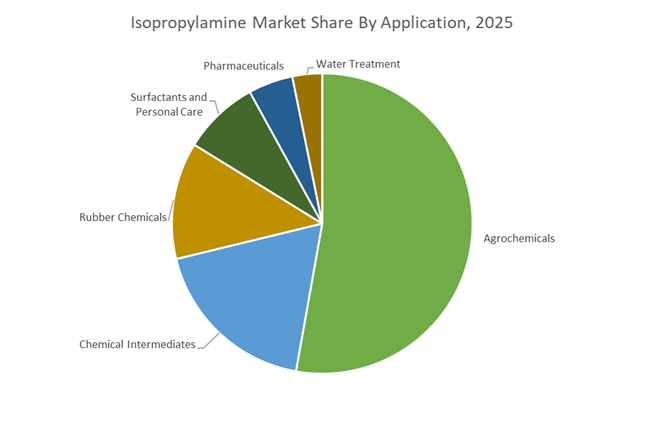
Agrochemicals represented 52.80% of the Isopropylamine Market share in 2025, establishing the sector as the largest application for isopropylamine derivatives. Isopropylamine compounds serve as essential intermediates in the synthesis of herbicides, fungicides, and insecticides, where amine groups enable formation of active salts and functional molecules used in modern crop protection formulations. Among these, glyphosate remains the most important driver of global isopropylamine consumption due to its widespread use in weed management across row crops, horticulture, and plantation agriculture. The scale of agricultural production worldwide ensures consistent demand for herbicide intermediates that support high crop yields and efficient farm management. In 2025, the global market has also been influenced by the continued expansion of generic glyphosate manufacturing, particularly in major agrochemical production hubs such as China and India, where multiple producers manufacture glyphosate-based formulations. This shift has diversified the supply chain for isopropylamine while maintaining strong consumption levels tied to global herbicide demand.
Competitive Landscape in Isopropylamine Market
BASF SE Leads Integrated Amine Production with Carbon Transparency
BASF SE remains one of the largest global producers of amines, leveraging its integrated Verbund system to optimize propylene-based feedstock flows and production efficiency. As of late 2025, the company transitioned its entire amine portfolio at the Nanjing site to 100% renewable electricity, lowering product carbon footprint by approximately 4%. BASF operates the world’s largest integrated amine production network, supplying isopropylamine to global crop protection manufacturers and lubricant additive formulators. Under its Winning Ways strategy, BASF is accelerating Green Transformation by providing batch-level product carbon footprint transparency to support customers’ Scope 3 emission targets. With a 2026 EBITDA guidance of €6.2 billion to €7.0 billion, BASF continues prioritizing high-margin specialty intermediates within the amines segment.
Huntsman Corporation, through its Performance Products division, holds a strong position in high-purity isopropylamine production for agrochemical synthesis and specialty applications. The company reported approximately $6 billion in 2025 revenues from continuing operations and maintains over 55 global manufacturing and R&D facilities. Its isopropylamine is widely used in the synthesis of atrazine and glyphosate, as well as in surfactants and rubber processing chemicals. In 2026, Huntsman is advancing a Safer and Sustainable Chemistry agenda, including ARALDITE epoxy systems incorporating lower-toxicity amine curing agents. A Q1 2026 dividend declaration reinforces financial stability amid cyclical fluctuations in global agrochemical demand.
Alkyl Amines Chemicals Limited is among the top global producers of aliphatic amines and continues expanding its manufacturing footprint in India. Its new multi-product facility at Kurkumbh is expected to reach mechanical completion by March 2026, with commercialization scheduled for the subsequent fiscal quarter. The facility is projected to operate at an asset turnover ratio of 1.50x, emphasizing capital efficiency in methyl isopropylamine and related alkyl amine production. While anticipating subdued volume growth in FY26 due to macroeconomic headwinds, the company maintains a long-term growth outlook of 7 to 15% . With more than four decades of amine process expertise, Alkyl Amines reinforces its role in the global Local-for-Global supply chain for crop protection intermediates and specialty chemical synthesis.
Balaji Amines Diversifies Through Specialty Derivative Investments
Balaji Amines Limited is strengthening its presence in the Asia-Pacific isopropylamine market through capacity diversification and specialty chemical expansion. During 2025–2026, the company reconfigured its Ethyl Amines Unit I facility to produce isopropylamine, adding approximately 20 to 21 tons per day of dedicated capacity. It also plans to commission new Dimethyl Ether and N-Methyl Morpholine plants within the fiscal year to expand downstream derivative offerings. Q2 FY26 sales volumes reached 26,165 metric tons, demonstrating resilience despite softer demand from pharmaceutical and agrichem segments. Through a ₹750 crore greenfield investment via Balaji Speciality Chemicals, the company is entering EDTA and hydrogen cyanide-based intermediates, broadening its specialty chemical portfolio.
Zhejiang Xinhua Chemical Maintains Cost Leadership in Technical-Grade Supply
Zhejiang Xinhua Chemical Co., Ltd. operates one of China’s largest amine production bases, covering nearly 300,000 square meters and employing up to 1,000 personnel in alcohol and amine synthesis. The company dominates exports of technical-grade isopropylamine, widely used in bulk agrochemical formulation, typically packaged in 140 kg drums. With 27 years of continuous verified supply on global chemical exchanges, Zhejiang Xinhua has established long-term credibility in international markets. It serves as a core supplier to China’s glyphosate manufacturing cluster while expanding exports to Southeast Asia and South America. Its scale and cost-efficient production processes position it as a global price influencer in commodity-grade isopropylamine.
Eastman Chemical Shifts Toward High-Purity and Circular Amine Applications
Eastman Chemical Company is repositioning its amine portfolio toward high-purity, task-specific intermediates for pharmaceutical, medical device, and specialty additive applications. The company is targeting adjusted EBITDA above $450 million by the end of 2026, supported by growth in specialty chemicals and circular economy initiatives. Its Kingsport methanolysis facility enhances value capture by enabling molecular recycling of polyesters, projected to contribute $75 million to $100 million in EBITDA during 2025–2026. Eastman is intentionally reducing exposure to commodity-grade amines, instead leveraging its specialty portfolio and proprietary recycling capabilities to shield its business from price volatility common in the global amine market.
China Isopropylamine Market: High-End Supply Expansion and Digitalized Compliance
China’s isopropylamine industry is moving decisively toward higher value-added output under a coordinated industrial policy framework. The September 2025 work plan issued by the Ministry of Industry and Information Technology targets sustained growth in petrochemical added value and explicitly prioritizes the expansion of high-end intermediates such as isopropylamine. This policy direction is translating into tighter alignment between feedstock optimization, purity upgrades, and downstream agrochemical performance. Within this framework, BASF marked the tenth anniversary of its Nanjing site by confirming a full transition of its amine portfolio to 100% renewable electricity, delivering a measurable reduction in product carbon footprint for Asia-Pacific customers and strengthening compliance with multinational procurement standards.
Market dynamics in 2025 reflected operational discipline rather than oversupply. Monoisopropylamine prices stabilized around mid-year despite weather-related output disruptions, supported by lower isopropanol feedstock costs and steady export demand. Structural transformation is also underway at the operational level. Under the “AI plus Petrochemicals” initiative, producers are embedding automated hazard detection and blockchain-enabled traceability into isopropylamine production lines, particularly for agrochemical precursors. Chemical parks are shifting away from commodity volume sales toward integrated offerings, with a clear focus on 99% purity monoisopropylamine for advanced herbicide synthesis and glyphosate-isopropyl ammonium salt formulations.
India Isopropylamine Market: API Localization and Feedstock Capacity Alignment
India’s isopropylamine market is being reshaped by pharmaceutical self-reliance policies and upstream capacity expansion. The Production Linked Incentive scheme for bulk drugs has already mobilized significant investment, enabling domestic manufacture of a large number of APIs and intermediates for the first time. As a key starting material, isopropylamine is benefiting directly from this localization push, with demand anchored in pharmaceutical synthesis rather than cyclical agrochemical swings. To support this, Deepak Chem Tech Limited and other domestic players expanded isopropanol capacity in 2025, strengthening vertical integration and reducing exposure to imported feedstocks.
Policy support extends beyond capacity. Under the Atmanirbhar Bharat framework, authorities reported that domestic production now covers dozens of critical intermediates previously sourced overseas, creating a structurally more resilient supply chain for pharmaceutical-grade isopropylamine. In parallel, government-backed research grants announced in December 2025 are targeting energy efficiency improvements in amine distillation, signaling a shift toward cost-optimized and lower-emission manufacturing. Collectively, these developments position India as a credible regional producer of pharmaceutical-grade isopropylamine rather than a price-taker in global trade.
United States Isopropylamine Market: Pharmaceutical Stability and High-Purity Feedstock Security
The United States isopropylamine market is characterized by pricing stability and demand anchored in regulated end uses. In early 2025, feedstock price adjustments announced by Eastman Chemical Company and ExxonMobil reflected higher energy and operating costs rather than structural shortages. Despite these adjustments, monoisopropylamine pricing remained stable through the first half of 2025, supported by consistent offtake from generics pharmaceuticals and seasonal herbicide blending.
Regulatory developments are shaping future formulations. Consumer Product Safety Commission rules coming into force in February 2026 are encouraging formulators to favor high-purity amines over legacy solvents with less favorable toxicity profiles. At the feedstock level, ExxonMobil’s high-purity isopropyl alcohol project in Baton Rouge is reinforcing domestic supply security for electronics and semiconductor cleaning applications, indirectly supporting downstream amine production. This combination of regulatory alignment and feedstock quality is reinforcing the U.S. position as a supplier of specification-driven isopropylamine grades.
Germany Isopropylamine Market: Verified Carbon Metrics and REACH-Led Reformulation
Germany’s isopropylamine industry is advancing through sustainability verification and regulatory-led product redesign. By late 2025, German producers had achieved ISO 14067 certification for product carbon footprint methodologies, enabling transparent reporting to European buyers focused on Scope 3 emission reductions. This certification is increasingly relevant for agrochemical and water treatment customers seeking audited environmental data as part of supplier qualification.
Regulatory evolution under EU REACH is also influencing product strategy. Following 2025 guidance from the European Chemicals Agency, manufacturers are pivoting toward task-specific amines designed to deliver performance at lower environmental toxicity thresholds. This shift is particularly visible in corrosion inhibitors and water treatment formulations, where isopropylamine derivatives are being optimized for compliance without sacrificing functional efficiency. Germany’s approach emphasizes credibility and compliance rather than volume expansion, reinforcing its role in high-standard European supply chains.
By Product Type (Monoisopropylamine, Diisopropylamine), By Grade (Industrial Grade, Pharmaceutical Grade), By Application (Agrochemicals, Pharmaceuticals, Rubber Chemicals, Surfactants and Personal Care, Water Treatment, Chemical Intermediates), By Production Method (Catalytic Amination, Reductive Amination)
Study Period
2019- 2025 and 2026-2034
Units
Revenue (USD)
Qualitative Analysis
Porter’s Five Forces, SWOT Profile, Market Share, Scenario Forecasts, Market Ecosystem, Company Ranking, Market Dynamics, Industry Benchmarking
Companies
BASF SE, Eastman Chemical Company, Dow Inc., Zhejiang Xinhua Chemical Co., Ltd., Shandong IRO Amine Industry Co., Ltd., Arkema S.A., Deepak Chem Tech Limited, Alkyl Amines Chemicals Ltd., Mitsubishi Chemical Group, Kanto Chemical Co., Inc., Amines and Plasticizers Limited, Balaji Amines Limited, Zhengzhou Harvest Chemical Co., Ltd., Luxi Chemical Group Co., Ltd., Celanese Corporation
Countries
US, Canada, Mexico, Germany, France, Spain, Italy, UK, Russia, China, India, Japan, South Korea, Australia, South East Asia, Brazil, Argentina, Middle East, Africa
Isopropylamine Market Segmentation
By Product Type
Monoisopropylamine
Diisopropylamine
By Grade
Industrial Grade
Pharmaceutical Grade
By Application
Agrochemicals
Pharmaceuticals
Rubber Chemicals
Surfactants and Personal Care
Water Treatment
Chemical Intermediates
By Production Method
Catalytic Amination
Reductive Amination
By Region
North America (United States, Canada, Mexico)
Europe (Germany, France, United Kingdom, Spain, Italy, Rest of Europe)
Asia Pacific (China, India, Japan, South Korea, Australia, Rest of APAC)
South and Central America (Brazil, Argentina, Rest of SCA)
Middle East and Africa (Saudi Arabia, UAE, South Africa, Rest of Middle East, Rest of Africa)
2. Isopropylamine Market Landscape & Outlook (2026–2034)
2.1. Introduction to Isopropylamine Market
2.2. Market Valuation and Growth Projections (2026–2034)
2.3. Agrochemical Demand and Global Herbicide Supply Chain Expansion
2.4. Feedstock Dynamics and Cost Volatility Across Acetone and Ammonia Value Chains
2.5. Growing Demand for High-Purity Amines in Electronics, Pharmaceuticals, and Specialty Chemicals
3. Innovations Reshaping the Isopropylamine Market
3.1. Trend: Strategic Capacity Expansion for Agrochemical Intermediates and Glyphosate Production
3.2. Trend: Feedstock Integration and Supply Chain Optimization in Aliphatic Amine Manufacturing
3.3. Opportunity: Advanced Corrosion Inhibitors for Oilfield and Industrial Water Systems
3.4. Opportunity: High-Purity Chiral Building Blocks for Pharmaceutical and API Synthesis
4. Competitive Landscape and Strategic Initiatives
4.1. Mergers and Acquisitions
4.2. R&D and Material Innovation
4.3. Sustainability and ESG Strategies
4.4. Market Expansion and Regional Focus
5. Market Share and Segmentation Insights: Isopropylamine Market
5.1. By Product Type
5.1.1. Monoisopropylamine
5.1.2. Diisopropylamine
5.2. By Grade
5.2.1. Industrial Grade
5.2.2. Pharmaceutical Grade
5.3. By Application
5.3.1. Agrochemicals
5.3.2. Pharmaceuticals
5.3.3. Rubber Chemicals
5.3.4. Surfactants and Personal Care
5.3.5. Water Treatment
5.3.6. Chemical Intermediates
5.4. By Production Method
5.4.1. Catalytic Amination
5.4.2. Reductive Amination
6. Country Analysis and Outlook of Isopropylamine Market
6.1. United States
6.2. Canada
6.3. Mexico
6.4. Germany
6.5. France
6.6. Spain
6.7. Italy
6.8. UK
6.9. Russia
6.10. China
6.11. India
6.12. Japan
6.13. South Korea
6.14. Australia
6.15. South East Asia
6.16. Brazil
6.17. Argentina
6.18. Middle East
6.19. Africa
7. Isopropylamine Market Size Outlook by Region (2026–2034)
7.1. North America Isopropylamine Market Size Outlook to 2034
7.1.1. By Product Type
7.1.2. By Grade
7.1.3. By Application
7.1.4. By Production Method
7.2. Europe Isopropylamine Market Size Outlook to 2034
7.2.1. By Product Type
7.2.2. By Grade
7.2.3. By Application
7.2.4. By Production Method
7.3. Asia Pacific Isopropylamine Market Size Outlook to 2034
7.3.1. By Product Type
7.3.2. By Grade
7.3.3. By Application
7.3.4. By Production Method
7.4. South America Isopropylamine Market Size Outlook to 2034
7.4.1. By Product Type
7.4.2. By Grade
7.4.3. By Application
7.4.4. By Production Method
7.5. Middle East and Africa Isopropylamine Market Size Outlook to 2034
7.5.1. By Product Type
7.5.2. By Grade
7.5.3. By Application
7.5.4. By Production Method
8. Company Profiles: Leading Players in the Isopropylamine Market
8.1. BASF SE
8.2. Eastman Chemical Company
8.3. Dow Inc.
8.4. Zhejiang Xinhua Chemical Co., Ltd.
8.5. Shandong IRO Amine Industry Co., Ltd.
8.6. Arkema S.A.
8.7. Deepak Chem Tech Limited
8.8. Alkyl Amines Chemicals Ltd.
8.9. Mitsubishi Chemical Group
8.10. Kanto Chemical Co., Inc.
8.11. Amines and Plasticizers Limited
8.12. Balaji Amines Limited
8.13. Zhengzhou Harvest Chemical Co., Ltd.
8.14. Luxi Chemical Group Co., Ltd.
8.15. Celanese Corporation
9. Methodology
9.1. Research Scope
9.2. Market Research Approach
9.3. Market Sizing and Forecasting Model
9.4. Research Coverage
9.5. Data Horizon
9.6. Deliverables
10. Appendix
10.1. Acronyms and Abbreviations
10.2. List of Tables
10.3. List of Figures
Isopropylamine Market Segmentation
By Product Type
Monoisopropylamine
Diisopropylamine
By Grade
Industrial Grade
Pharmaceutical Grade
By Application
Agrochemicals
Pharmaceuticals
Rubber Chemicals
Surfactants and Personal Care
Water Treatment
Chemical Intermediates
By Production Method
Catalytic Amination
Reductive Amination
By Region
North America (United States, Canada, Mexico)
Europe (Germany, France, United Kingdom, Spain, Italy, Rest of Europe)
Asia Pacific (China, India, Japan, South Korea, Australia, Rest of APAC)
South and Central America (Brazil, Argentina, Rest of SCA)
Middle East and Africa (Saudi Arabia, UAE, South Africa, Rest of Middle East, Rest of Africa)
The Isopropylamine Market is expected to grow from $390.4 million in 2025 to $659.6 million by 2034, registering a CAGR of 6%. Market expansion is supported by increasing demand for agrochemical intermediates, pharmaceutical synthesis reagents, corrosion inhibitors, and specialty amine catalysts used in high-performance industrial applications.
Monoisopropylamine (MIPA) accounted for 72.8% of the market share in 2025, making it the leading product type. Its dominant position is linked to its critical role in herbicide synthesis, particularly in producing glyphosate isopropylamine salts that improve water solubility, formulation stability, and handling in crop protection products.
Agrochemicals represented 52.8% of the market demand in 2025, making them the largest application segment. Isopropylamine is widely used in herbicides, fungicides, and insecticides, with glyphosate formulations being the primary demand driver due to their extensive use in modern agriculture and no-till farming systems.
New growth opportunities are emerging in pharmaceutical intermediates, oilfield corrosion inhibitors, and electronics-grade amine solvents. High-purity isopropylamine is increasingly used in chiral pharmaceutical synthesis, advanced polyurethane catalysts for EV battery encapsulation, and semiconductor cleaning applications requiring ultra-low impurity amines.
Key companies operating in the Isopropylamine Market include BASF SE, Eastman Chemical Company, Dow Inc., Zhejiang Xinhua Chemical Co., Ltd., Shandong IRO Amine Industry Co., Ltd., Arkema S.A., Deepak Chem Tech Limited, Alkyl Amines Chemicals Ltd., Mitsubishi Chemical Group, Kanto Chemical Co., Inc., Amines and Plasticizers Limited, Balaji Amines Limited, Zhengzhou Harvest Chemical Co., Ltd., Luxi Chemical Group Co., Ltd., and Celanese Corporation. These companies are expanding high-purity amine production and strengthening agrochemical and specialty chemical supply chains.