Japan Water Treatment Chemicals Market: Growth Forecast and Value Analysis
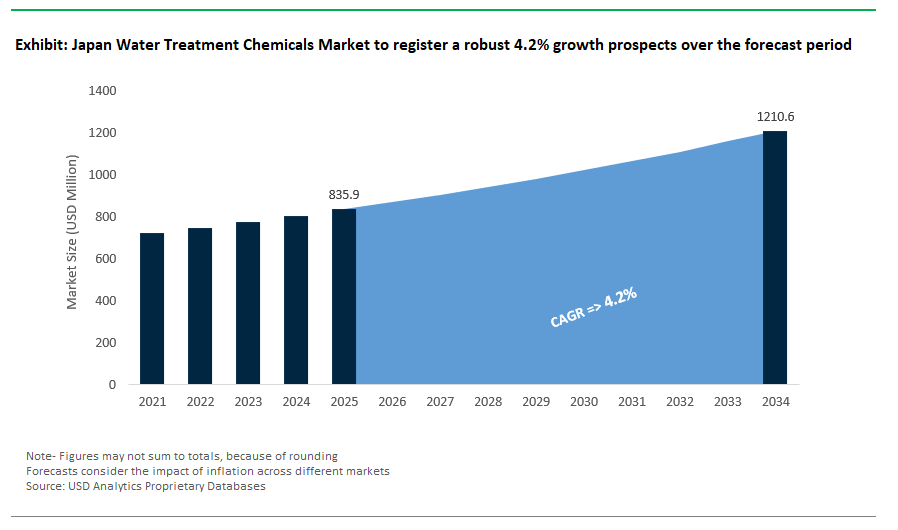
Japan Water Treatment Chemicals Market Size is estimated at $835.9 Million in 2025 and is forecast to register an annual growth rate (CAGR) of 4.2% to reach $1210.5 Million by 2034.
Japan’s water treatment chemicals market is distinguished by its precision-driven approach, emphasis on ultra-clean water standards, and robust infrastructure designed for resilience in the face of natural disasters. This market reflects an advanced synergy of regulatory compliance, precision chemical formulations, and infrastructure resilience, making it a global benchmark for performance and innovation in water treatment.
The country’s globally dominant electronics and semiconductor sectors demand ultrapure water, pushing treatment systems to achieve <0.1 ppb total organic carbon (TOC) using advanced UV/185 nm oxidation combined with membrane degasification, in compliance with SEMI F63 standards. Boron, a critical impurity in chip fabrication, is reduced to below 0.01 ppb using highly selective ion exchange resins under alkaline conditions (pH >10.5), following JIS K 0102 protocols. The stringent requirements for UPW in Japan's semiconductor industry are among the highest globally, driving continuous innovation in this segment.
On the municipal front, water utilities employ low-dose chlorine dioxide disinfection to eliminate coliforms while cutting trihalomethanes (THMs) by over 70%, in accordance with Japanese Water Works Association Standards, which supports the use of chlorine dioxide for effective disinfection with minimized DBP formation. Japan is also a leader in biosolids valorization, leveraging anaerobic digestion coupled with combined heat and power (CHP) systems to recover 60–80% of the energy embedded in municipal sludge, as promoted by the Japan Sewage Works Association. This approach aligns with national circular economy goals and reduces the environmental footprint of wastewater treatment plants.
Earthquake preparedness plays a pivotal role in treatment chemical deployment, with the Ministry of Land, Infrastructure, Transport and Tourism (MLIT) endorsing polymer-based flocculants for sediment stabilization in reservoirs at doses ranging from 0.5 to 2.0 mg/L an essential measure in landslide-prone regions. This proactive approach ensures water supply resilience even during natural calamities.
Looking ahead, the Japanese market is characterized by a growing municipal preference for integrated smart-sensor systems and highly adaptive filtration techniques, particularly for micro-pollutants. Innovations from leading corporations like Mitsubishi Chemical (next-generation polymer resins for toxic element removal), Hitachi (advanced nanofiltration devices), and Kubota Corporation (ceramic membrane systems for reduced maintenance) are driving progress. The emphasis on resource sustainability and stricter environmental directives further propels the adoption of chemical-free or reduced-chemical physical water treatment solutions, such as membrane filtration and advanced UV disinfection, to minimize residual sludge and align with greener industrial processes.
Market Trend: Japan Accelerates Green Chemistry & Digital Precision in Ultra-Pure Water Treatment
Japan’s water treatment chemicals market is rapidly evolving to meet the twin imperatives of extreme purity requirements and environmental compliance, especially in high-tech sectors such as semiconductors and pharmaceuticals. Following Japan’s 2024 PFAS Action Plan banning long-chain fluorinated compounds in industrial effluents, the market is witnessing swift adoption of PFAS-free and bio-based alternatives. Kurita’s Kuriverter® IK-110, a plant-derived antiscalant deployed at TSMC’s new Kumamoto fab, exemplifies this shift delivering 50% TOC reductions and full compliance with sub-ppb UPW thresholds. Meanwhile, enzymatic membrane cleaners like Tosoh’s EcoClean™ are replacing harsh chemical agents in pharma facilities, doubling membrane lifespan while aligning with PMDA purity norms. Digitalization is further reshaping the sector: Mitsubishi Chemical’s AquaAI system integrates predictive analytics to dynamically adjust corrosion inhibitor dosing in industrial cooling towers, reducing overuse by 20%. With over 30% of Japan’s municipal plants requiring corrosion-free upgrades (per METI), and semiconductors demanding <0.1 ppb purity levels, Japan is setting a new global benchmark for ultra-clean, digitally optimized, and green water treatment solutions.
Market Opportunity: Hydrogen & Battery Sectors Create Multibillion-Yen Niche for High-Purity Water Chemistry
Japan’s clean energy revolution anchored in green hydrogen and lithium-ion battery circularity is catalyzing a new ¥350 billion+ market for advanced water treatment chemicals. The Green Innovation Fund’s ¥2 trillion allocation is fast-tracking deployment of HyPure UPW systems from Organo, which blend ion exchange and EDR to produce <0.05 µS/cm feedwater for PEM electrolyzers in partnerships with Kawasaki Heavy Industries. Simultaneously, the EV battery recycling wave is generating demand for lithium-specific coagulants like Sumitomo Metal Mining’s LiPure, which enables 90% water reuse and lithium recovery from acidic leachate streams. With Panasonic’s Osaka facility monetizing cobalt recovery at ¥8,000/kg, chemical suppliers capable of supporting closed-loop water and resource recovery are gaining a competitive edge. Even beyond energy, data center growth is driving adoption of eco-safe biocides like Toray’s CoolGuard™ for Legionella control in NTT’s urban campuses. Backed by carbon credit incentives (e.g., Mitsui’s ZLD plant in Fukuoka earns ¥500/ton CO₂ saved), the synergy between water purification, resource valorization, and emissions reduction positions Japan as a prime innovation hub for next-gen water chemistries.
Competitive Landscape Analysis- Japan Water Treatment Chemicals Market
The Japanese water treatment chemicals market is marked by strong domestic leadership, high technical barriers, and a procurement environment that emphasizes value. Unlike cost-sensitive markets, Japan prioritizes reliability, certification, and long-term partnerships. These factors have led to an ecosystem dominated by local companies while foreign players operate in narrow strategic niches. This situation creates a market structure driven more by technology management, regulatory compliance, and vertical integration than by price competition.
Domestic leaders like Kurita Water Industries, Organo Corporation, and Toray Industries hold about 70% of the market. These companies benefit from long-standing ties, especially through Japan’s keiretsu and industrial groupings. Such relationships result in technological lock-in, where end users seldom change suppliers because of strict internal testing and the high costs of switching. The average contract lasts 7 to 10 years, which raises entry barriers for new challengers. Additionally, many of these firms cover the entire water treatment value chain, from chemical formulation to system installation and maintenance, allowing them to significantly control product performance and integration.
One key feature of the Japanese competitive landscape is premium pricing linked to certification. Products that meet the Japan Industrial Standards (JIS) command a 25% to 30% price premium, which local buyers accept due to the perceived quality, safety, and environmental standards. However, obtaining and maintaining JIS compliance involves high initial costs typically between ¥50 million and ¥100 million per product making it hard for smaller or foreign companies to enter the market. This certification creates a barrier that keeps even high-growth areas like ultrapure water (UPW) for semiconductors limited to a few suppliers who can operate on a large scale.
Vertical integration and government-supported R&D further strengthen incumbents. For example, Toray uses METI-funded projects to improve membrane chemistry, while Kurita's acquisition approach aligns with its smart manufacturing philosophy. This alignment with Japan’s industrial policy and innovation grants enables a sustained edge in high-value sectors such as electronics, automotive, and precision manufacturing.
While foreign firms like Ecolab and BASF have a presence, their impact is limited and highly adapted. Their growth strategies depend on local formulation centers, joint projects (such as those with Toyota), and niche markets like data center cooling or electronics. However, public contracts, particularly in municipal or infrastructure projects, heavily favor domestic vendors, further restricting opportunities for international entrants.
On the fringes, a small but notable segment of innovators holds about 5% market share and is starting to challenge the status quo. Backed by venture capital and institutional funding, companies like Aquatech Innovation and GreenChem Japan target underserved SME manufacturers and align with Society 5.0 goals Japan’s smart city initiative. Their emphasis on IoT, nanobubbles, and plant-based formulations positions them as potential disruptors, especially as sustainability standards tighten and legacy systems age.
Japan Water Treatment Chemicals Market– Segmentation Insights (2025–2034)
By Type of Chemical: Corrosion Inhibitors Lead, Membrane Cleaners Grow Fastest
In the Japan water treatment chemicals market, corrosion and scale inhibitors represent the largest share at 30.2% in 2025, largely due to the country’s aging industrial infrastructure and the need for rigorous equipment maintenance across sectors such as power generation, manufacturing, and petrochemicals. These chemicals play a vital role in preventing scaling and corrosion in boilers, pipelines, and heat exchangers, thereby enhancing equipment lifespan and efficiency. Japan’s strict industrial maintenance codes and safety compliance requirements also contribute to the consistent demand for these inhibitors.
In contrast, membrane cleaning chemicals are projected to grow at the fastest CAGR of 5.6% between 2025 and 2034, propelled by increasing deployment of RO (Reverse Osmosis) and NF (Nanofiltration) systems, particularly in high-tech manufacturing clusters. Sectors such as semiconductors, pharmaceuticals, and ultrapure water (UPW) production demand high-performance chemical treatments to ensure membrane longevity and optimal water quality. The growing trend of decentralised water treatment and water reuse solutions in urban areas is also expanding the footprint of membrane-based purification technologies, further boosting demand for chemical cleaners tailored to scale, biofouling, and particulate buildup. This shift underscores Japan’s move toward precision-driven water treatment approaches, balancing traditional system preservation with cutting-edge purification.
By End-User Industry: Municipal Segment Dominates, Manufacturing Accelerates
From an end-user perspective, the municipal sector holds the largest share at 39.7% in 2025, driven by Japan’s advanced drinking water infrastructure and highly regulated wastewater management frameworks. The country’s strong focus on public health, compliance with national water quality standards, and emphasis on wastewater recycling (especially in urban areas like Tokyo and Osaka) have solidified municipal water treatment as the backbone of chemical demand. Chlorine-based disinfectants, coagulants, and pH adjusters remain central to these operations.
However, the manufacturing sector is emerging as the fastest-growing end-user, expanding at a CAGR of 6.3% through 2034, fueled by rising investments in semiconductor fabs, precision electronics, and biopharmaceutical production facilities. These industries require ultrapure water and closed-loop systems that rely heavily on specialty chemicals, including membrane cleaning agents, biocides, and corrosion inhibitors. Additionally, the use of geothermal energy in Japan’s power sector supports consistent demand for scale inhibitors, while oil & gas and chemical sectors continue to support chemical-intensive water treatment in cooling and steam generation. This dual-market dynamic municipal volume leadership and industrial value acceleration defines the strategic outlook for water treatment chemical suppliers in Japan.
Japan Water Treatment Chemicals Market Report Scope
Japan Water Treatment Chemicals Market
Parameter
Details
Market Size (2025)
$835.9 Million
Market Size (2034)
$1210.5 Million
Market Growth Rate
4.2%
Segments
By Type of Chemical (Coagulants and Flocculants, Corrosion and Scale Inhibitors, Biocides and Disinfectants, pH Adjusters and Softeners, Oxygen Scavengers, Defoamers and Antifoaming Agents, Membrane Cleaning Chemicals, H2S Scavengers, Other Specialty Chemicals), By Application (Municipal Water Treatment, Industrial Water Treatment, Commercial Water Treatment), By End-User Industry (Municipal, Power Generation, Oil and Gas, Chemical and Petrochemical, Manufacturing), By Form of Chemical (Liquid, Powder/Solid), By Distribution Channel (Direct Sales, Distributors/Channel Partners
Study Period
2019- 2024 and 2025-2034
Units
Revenue (USD)
Qualitative Analysis
Porter’s Five Forces, SWOT Profile, Market Share, Scenario Forecasts, Market Ecosystem, Company Ranking, Market Dynamics, Industry Benchmarking
Companies
Kurita Water Industries Ltd., Toray Industries, Inc., Mitsubishi Chemical Corporation (and Mitsubishi Chemical Cleansui), Hitachi Ltd., Kubota Corporation, METAWATER Co., Ltd., Suido Kiko Kaisha, LTD., Taki Chemical Co., Ltd., MT AquaPolymer, Inc., Sanyo Chemical Industries, Ltd., Ecolab Inc. (U.S.), Solenis LLC (U.S.), BASF SE (Germany), Kemira Oyj (Finland), SNF Floerger (France), Veolia Water Technologies (France), The Dow Chemical Company (U.S.),
Japan Water Treatment Chemicals Market Segmentation
By Type of Chemical
Coagulants and Flocculants
Corrosion and Scale Inhibitors
Biocides and Disinfectants
pH Adjusters and Softeners
Oxygen Scavengers
Defoamers and Antifoaming Agents
Membrane Cleaning Chemicals
H2S Scavengers
Other Specialty Chemicals
By Application
Municipal Water Treatment
Drinking Water Treatment
Municipal Wastewater Treatment
Industrial Water Treatment
Cooling Water Treatment
Boiler Water Treatment
Process Water Treatment
Industrial Wastewater Treatment
Water Reuse and Recycling
Industrial Desalination
Sludge Treatment
Commercial Water Treatment
By End-User Industry
Municipal
Power Generation
Oil and Gas
Chemical and Petrochemical
Manufacturing
Food and Beverage
Pulp and Paper
Textile
Mining and Metallurgy
Pharmaceutical
Automotive
Electronics and Semiconductors
Other Industrial Manufacturing
By Form of Chemical
Liquid
Powder/Solid
By Distribution Channel
Direct Sales
Distributors/Channel Partners
Top Companies in Japan Water Treatment Chemicals Market
Kurita Water Industries Ltd.
Toray Industries, Inc.
Mitsubishi Chemical Corporation (and Mitsubishi Chemical Cleansui)
Hitachi Ltd.
Kubota Corporation
METAWATER Co., Ltd.
SuidKikKaisha, LTD.
Taki Chemical Co., Ltd.
MT AquaPolymer, Inc.
SanyChemical Industries, Ltd.
Ecolab Inc. (U.S.)
Solenis LLC (U.S.)
BASF SE (Germany)
Kemira Oyj (Finland)
SNF Floerger (France)
Veolia Water Technologies (France)
The Dow Chemical Company (U.S.)
* List Not Exhaustive
Research Coverage
The Japan Water Treatment Chemicals Market Report by USDAnalytics delivers an in-depth examination of the country’s high-performance water treatment ecosystem, shaped by stringent regulatory compliance, precision-driven ultrapure water (UPW) standards, and sustainability mandates. The report focuses on the integration of advanced chemical formulations with smart digital dosing platforms and PFAS-free chemistries, alongside the shift toward bio-based solutions in alignment with Japan’s 2024 PFAS Action Plan and circular economy objectives.
Scope Includes:
By Type of Chemical: Corrosion and Scale Inhibitors, Coagulants & Flocculants, Biocides, pH Adjusters, Membrane Cleaning Agents, Oxygen Scavengers, Defoamers, Specialty Chemicals
By Application: Municipal Water Treatment (Drinking, Wastewater), Industrial Water Treatment (Cooling, Boiler, Process, Water Reuse), Commercial Water Treatment
By End User: Municipal Utilities, Electronics & Semiconductors, Chemical & Petrochemical, Automotive, Pharmaceuticals, Food & Beverage, Power Generation
By Form: Liquid and Powder/Solid
By Distribution Channel: Direct Sales, Distributors/Channel Partners
Geographic Focus: Comprehensive coverage of industrial hubs like Kanto (Tokyo), Kansai (Osaka), Kyushu (Fukuoka), and Kumamoto for semiconductor manufacturing, municipal water plants, and zero-liquid discharge facilities.
Study Period: Historic: 2021–2024; Forecast: 2025–2034
Leading Players: Kurita Water Industries, Toray Industries, Mitsubishi Chemical Corporation, Ecolab, BASF SE, Kemira Oyj, Solenis LLC, SNF Floerger, Veolia Water Technologies.
Methodology
The study follows a structured, multi-step research methodology, ensuring accuracy and actionable insights:
Primary Research: Interviews with executives from major water chemical firms (e.g., Kurita, Toray), plant operators, and procurement managers in sectors like electronics, municipal utilities, and green hydrogen facilities. Consultations with Japanese regulators (MLIT, METI) and industry associations such as the Japan Sewage Works Association.
Secondary Research: Analysis of government policies (PFAS Action Plan 2024, Green Innovation Fund, Water Works Standards), corporate sustainability disclosures, METI statistical yearbooks, JIS standards, and industrial journals.
Market Modeling: Utilization of bottom-up segmental analysis validated with trade data, capex trends, and UPW plant deployments. AI-powered forecasting models incorporated semiconductor fab expansions, EV battery recycling initiatives, and municipal upgrade projects.
Validation Framework: Cross-checks through case studies such as Kurita’s Kuriverter® IK-110 deployment for semiconductor fabs and municipal trials for PFAS-free chemistries. Benchmarking aligned with REACH compliance, ISO standards, and Japanese Industrial Standards (JIS).
Deliverables
Complete Market Research Report (PDF, Excel): data tables, market charts, and visual insights.
Segment-wise Revenue Projections (2025–2034)
Competitive Benchmarking & SWOT Analysis
Recent Developments & News Tracker
Executive summary and key takeaway slides for boardroom presentations
Post-Purchase Analyst Support for Client-Specific Questions and Custom Data Requirements
Table of Contents: Japan Water Treatment Chemicals Market
1. Executive Summary
1.1. Market Highlights
1.2. Key Findings
1.3. Japan Market Snapshot
2. Japan Water Treatment Chemicals Market Outlook (2025–2034)
2.1. Market Valuation and Growth Projections (2025–2034)
2.1.1. Current Market Size (2025): $835.9 Million
2.1.2. Forecasted Market Size and CAGR (2034): $1210.5 Million at 4.2% CAGR
2.2. Market Distinctions: Precision, Standards, and Resilience
2.3. Core Chemical Applications and Regulatory Compliance
2.3.1. Ultrapure Water (UPW) for Electronics and Semiconductors
2.3.2. Municipal Treatment and Biosolids Valorization
2.3.3. Disaster Preparedness and Infrastructure Resilience
2.4. Technological Innovation from Key Players
3. Market Dynamics: Japan Water Treatment Chemicals
3.1. Market Trend: Green Chemistry and Digital Precision in UPW
3.1.1. Driver: 2024 PFAS Action Plan and Environmental Compliance
3.1.2. Adoption of Bio-Based and Enzymatic Formulations
3.1.3. Rise of AI-Powered Dosing and Predictive Analytics
3.2. Market Opportunity: Hydrogen and Battery Sectors
3.2.1. Driver: Green Innovation Fund and Clean Energy Revolution
3.2.2. Niche for High-Purity Chemistry in Green Hydrogen Production
3.2.3. Demand for Resource Recovery Chemicals in EV Battery Recycling
3.2.4. Synergy with Data Center Growth and Carbon Credit Incentives
4. Competitive Landscape Analysis: Japan Water Treatment Chemicals Market
4.1. Overview of Competitive Structure
4.2. Market Dominance of Domestic Leaders (Kurita, Organo, Toray)
4.3. High Entry Barriers: JIS Certification and Long-Term Contracts
4.4. Strategic Niche Roles for Foreign Firms (Ecolab, BASF)
4.5. The Role of Innovators and Startups
5. Market Segmentation Insights (2025–2034)
5.1. By Type of Chemical
5.1.1. Corrosion and Scale Inhibitors: Largest Share (30.2% in 2025)
Japan’s water treatment chemicals market is distinguished by its demand for products that meet Japan Industrial Standards (JIS), with certification costs typically ranging from ¥50–100 million per product. This premium on reliability and certification creates high entry barriers for new and foreign players. Domestic leaders like Kurita Water Industries, Organo Corporation, and Toray Industries control about 70% of the market, leveraging long-term contracts, vertical integration, and alignment with government procurement to maintain dominance, especially in high-value sectors such as electronics and municipal water supply.
Driven by the 2024 PFAS Action Plan and growing sustainability mandates, Japanese suppliers are rapidly deploying PFAS-free and bio-based alternatives, such as Kurita’s plant-derived antiscalants and Tosoh’s enzymatic membrane cleaners. Digital innovation is also central: smart sensor platforms and AI-powered dosing systems (e.g., Mitsubishi Chemical’s AquaAI) are increasingly used to optimize chemical use and reduce over-dosing. This dual push toward greener and smarter solutions is particularly strong in ultrapure water (UPW) production and in public water systems undergoing corrosion-free upgrades.
Corrosion and scale inhibitors lead in total market share (30.2% in 2025), crucial for aging industrial infrastructure and equipment maintenance. However, membrane cleaning chemicals are projected to register the fastest CAGR (5.6% through 2034), reflecting the rise of RO/NF systems in semiconductor manufacturing, pharmaceuticals, and urban water reuse. The demand for high-performance, low-residue cleaners aligns with Japan’s pursuit of ultra-pure and decentralized water treatment solutions, especially in new data centers and “smart city” infrastructure.
Japan’s green hydrogen and lithium-ion battery recycling industries are catalyzing a new ¥350 billion+ opportunity for advanced water treatment chemicals. PEM electrolyzer projects require ultrapure feedwater, driving demand for ion exchange and electrodialysis solutions, while battery recycling relies on lithium-selective coagulants and water reuse chemistries (e.g., Sumitomo Metal Mining’s LiPure). Integration with carbon credit incentives and the Green Innovation Fund is accelerating market development for suppliers capable of supporting circular water and material flows in energy and manufacturing.
Foreign firms such as Ecolab and BASF maintain a presence through highly adapted, niche strategies (e.g., data center cooling, specialty electronics), but face steep challenges due to Japan’s preference for local vendors, long contract cycles, and the necessity of JIS compliance. Most international entrants focus on local formulation centers, joint R&D projects, and collaborations with major conglomerates (e.g., Toyota). Meanwhile, a new wave of innovative domestic startups, backed by venture capital, is targeting SME manufacturers with IoT, nanobubble, and plant-based solutions, poised to gradually erode incumbent dominance as sustainability demands rise.

.png)