Global Lithium-ion Battery Binders Market Size is valued at $1.9 Billion in 2024 and is forecast to register a growth rate (CAGR) of 16.6% to reach $6.5 Billion by 2032.
The global Lithium-ion Battery Binders Market Study analyzes and forecasts the market size across 6 regions and 24 countries for diverse segments -By Type (Anode Binders, Cathode Binders), By Battery (Lithium iron phosphate, Lithium iron phosphate, Lithium nickel manganese cobalt, Lithium titanate oxide, Others), By Material (Polyvinylidene fluoride, Carboxymethyl cellulose, Polymethyl Methacrylate, Styrene Butadiene Copolymer, Others), By End-User (Automotive, Consumer electronics, Industrial, Energy Storage, Others).
An Introduction to Lithium-ion Battery Binders Market in 2024
Lithium-ion battery binders play a crucial role in battery electrode manufacturing, where they are used to hold active materials (such as lithium compounds) together and adhere them to the current collector. In 2024, the demand for lithium-ion battery binders s to rise alongside the expanding electric vehicle and energy storage markets. Binders help improve the mechanical integrity, stability, and electrical conductivity of battery electrodes, thereby enhancing overall battery performance and lifespan. Polymeric binders such as polyvinylidene fluoride (PVDF), polyacrylic acid (PAA), and styrene-butadiene rubber (SBR) are commonly used due to their excellent adhesion properties, chemical stability, and compatibility with electrode materials. Further, there is a growing interest in developing eco-friendly binders derived from renewable resources or water-based formulations to reduce environmental impact and manufacturing costs. With ongoing research and development efforts focused on improving binder performance, increasing electrode loading capacity, and reducing binder content in electrodes, the market for lithium-ion battery binders is expected to witness significant growth, driven by the increasing demand for high-performance and sustainable energy storage solutions.
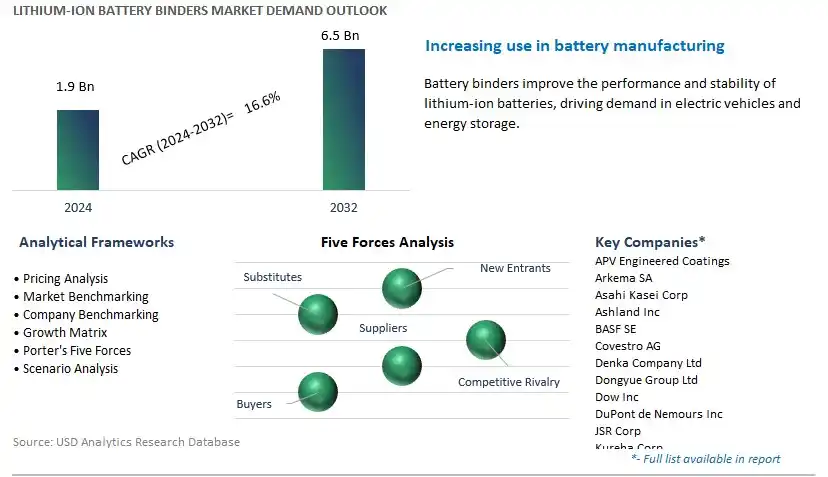
Lithium-ion Battery Binders Market Competitive Landscape
The market report analyses the leading companies in the industry including APV Engineered Coatings, Arkema SA, Asahi Kasei Corp, Ashland Inc, BASF SE, Covestro AG, Denka Company Ltd, Dongyue Group Ltd, Dow Inc, DuPont de Nemours Inc, JSR Corp, Kureha Corp, LG Chem Ltd, Mitsubishi Chemical Corp, Mitsui Chemicals Inc, SABIC, Shanghai 3F New Materials Co. Ltd, Solvay SA, Sumitomo Chemical Co. Ltd, Suzhou Crystal Clear Chemical Co. Ltd, Targray Technology International Inc, Topsoe, Toray Industries Inc, UBE Corp, Zeon Corp, and others.
Lithium-ion Battery Binders Market Dynamics
Market Trend: Demand for High-Performance and Sustainable Binders
The most prominent market trend in lithium-ion battery binders is the increasing demand for high-performance and sustainable binder materials. As the electrification of transportation and the adoption of renewable energy storage solutions continue to grow, there is a rising need for lithium-ion batteries with improved energy density, cycling stability, and safety features. Binders play a crucial role in electrode manufacturing, ensuring the adhesion of active materials to current collectors and maintaining structural integrity during charge-discharge cycles. Manufacturers are therefore seeking binder materials that offer enhanced mechanical strength, chemical stability, and compatibility with advanced electrode formulations. Additionally, there is a growing emphasis on sustainability and environmental stewardship, driving the development of eco-friendly binder alternatives derived from renewable sources or recyclable materials.
Market Driver: Technological Advancements in Battery Manufacturing
A key market driver for lithium-ion battery binders is the continuous technological advancements in battery manufacturing processes. With ongoing research and development efforts focused on improving battery performance, reducing costs, and enhancing safety, there is a growing demand for innovative binder materials that can meet the evolving requirements of next-generation lithium-ion batteries. Advanced electrode designs, such as silicon-graphene composites and high-nickel cathodes, present new challenges and opportunities for binder development, as these materials often exhibit high volumetric expansion or undergo phase transformations during cycling. Binder formulations tailored to specific electrode chemistries and manufacturing techniques, such as slurry casting or roll-to-roll processing, are essential to ensure optimal electrode performance and reliability. Thus, technological advancements in battery manufacturing drive the demand for tailored binder solutions that can enable the commercialization of advanced lithium-ion battery technologies.
Market Opportunity: Development of Functionalized Binder Additives
An emerging opportunity within the lithium-ion battery binder market lies in the development of functionalized binder additives. As battery performance requirements become increasingly stringent, there is a growing need for binder formulations that can address specific challenges associated with electrode materials and operating conditions. Functionalized additives, such as conductive polymers, crosslinking agents, and electrolyte-compatible additives, offer opportunities to enhance binder performance and functionality. These additives can improve electronic conductivity, enhance adhesion to electrode surfaces, and mitigate side reactions at electrode-electrolyte interfaces, thereby improving battery efficiency, stability, and safety. By integrating functionalized additives into binder formulations, manufacturers can tailor binder properties to meet the unique requirements of diverse battery applications, including electric vehicles, consumer electronics, and grid-scale energy storage systems. This presents a compelling opportunity for innovation and differentiation in the lithium-ion battery binder market, as companies seek to develop customized solutions that enable the next generation of high-performance and sustainable lithium-ion batteries.
Lithium-ion Battery Binders Market Share Analysis: Cathode Binders segment generated the highest revenue in 2024
The Cathode Binders segment is the largest segment within the lithium-ion battery binders market. Cathode binders play a crucial role in the production of lithium-ion batteries by ensuring the adhesion of active cathode materials to the current collector, facilitating efficient electron transport and ion diffusion during battery operation. With the increasing demand for high-performance lithium-ion batteries in electric vehicles (EVs), consumer electronics, and energy storage systems, there is a corresponding surge in the production of cathode binders to meet the stringent performance requirements of these applications. Additionally, advancements in cathode binder formulations and manufacturing processes contribute to improved battery performance, cycle life, and safety, further driving the demand for cathode binders within the lithium-ion battery industry. Moreover, the growing focus on energy efficiency, sustainability, and cost-effectiveness in battery manufacturing processes propels the adoption of advanced cathode binders. With its pivotal role in enhancing battery performance and reliability, the Cathode Binders segment maintains its position as the largest and most significant market segment within the lithium-ion battery binders market.
Lithium-ion Battery Binders Market Share Analysis: Lithium Nickel Manganese Cobalt (NMC) is poised to register the fastest CAGR over the forecast period
The Lithium Nickel Manganese Cobalt (NMC) segment is the fastest-growing segment within the lithium-ion battery binders market. NMC batteries are widely utilized in electric vehicles (EVs), portable electronics, and grid storage systems due to their high energy density, long cycle life, and excellent thermal stability. As the demand for EVs and energy storage solutions continues to soar globally, there is a corresponding surge in the production of NMC batteries, creating a significant market opportunity for binders used in their manufacturing. Additionally, ongoing research and development efforts aimed at improving the performance, safety, and cost-effectiveness of NMC batteries drive the demand for advanced binders capable of meeting the stringent requirements of these applications. Moreover, the increasing focus on sustainability and environmental stewardship in the battery industry propels the adoption of eco-friendly binders for NMC battery production. With its pivotal role in enhancing battery performance and reliability, the Lithium Nickel Manganese Cobalt (NMC) segment is poised for continued rapid growth within the lithium-ion battery binders market.
Lithium-ion Battery Binders Market Share Analysis: Polyvinylidene Fluoride (PVDF) segment generated the highest revenue in 2024
The Polyvinylidene Fluoride (PVDF) segment is the largest segment within the lithium-ion battery binders market. PVDF is a widely used binder material in lithium-ion battery manufacturing due to its exceptional properties, including high chemical resistance, thermal stability, and mechanical strength. These attributes make PVDF an ideal choice for binding active electrode materials and ensuring the structural integrity and performance of lithium-ion batteries. Additionally, PVDF exhibits excellent adhesion properties, allowing for strong bonding between electrode materials and current collectors, which is essential for efficient electron transport and ion diffusion during battery operation. Moreover, the growing demand for high-performance lithium-ion batteries in electric vehicles (EVs), consumer electronics, and grid storage systems fuels the demand for PVDF binders. With its superior characteristics and widespread adoption in battery manufacturing, the Polyvinylidene Fluoride (PVDF) segment maintains its position as the largest and most significant market segment within the lithium-ion battery binders market.
Lithium-ion Battery Binders Market Share Analysis: Energy Storage is poised to register the fastest CAGR over the forecast period
The Energy Storage segment is the fastest-growing segment within the lithium-ion battery binders market. With the increasing adoption of renewable energy sources such as solar and wind power, there is a growing need for efficient energy storage solutions to address intermittency and meet demand fluctuations. Lithium-ion batteries play a crucial role in energy storage systems, providing reliable and scalable solutions for storing excess energy generated from renewable sources. Binders used in the manufacturing of lithium-ion batteries for energy storage applications must meet stringent requirements for stability, durability, and performance to ensure the long-term reliability of these systems. Additionally, advancements in battery technology and declining costs have made lithium-ion batteries increasingly competitive compared to traditional energy storage solutions, further driving their adoption in residential, commercial, and utility-scale energy storage projects. With the growing emphasis on decarbonization and the transition towards renewable energy sources, the Energy Storage segment is poised for continued rapid growth within the lithium-ion battery binders market.
Lithium-ion Battery Binders Market
By Type
Anode Binders
Cathode Binders
By Battery
Lithium iron phosphate
Lithium iron phosphate
Lithium nickel manganese cobalt
Lithium titanate oxide
Others
By Material
Polyvinylidene fluoride
Carboxymethyl cellulose
Polymethyl Methacrylate
Styrene Butadiene Copolymer
Others
By End-User
Automotive
Consumer electronics
Industrial
Energy Storage
Others
Countries Analyzed
North America (US, Canada, Mexico)
Europe (Germany, UK, France, Spain, Italy, Russia, Rest of Europe)
Asia Pacific (China, India, Japan, South Korea, Australia, South East Asia, Rest of Asia)
South America (Brazil, Argentina, Rest of South America)
Middle East and Africa (Saudi Arabia, UAE, Rest of Middle East, South Africa, Egypt, Rest of Africa)
Lithium ion Battery Binders Companies Profiled in the Study
APV Engineered Coatings
Arkema SA
Asahi Kasei Corp
Ashland Inc
BASF SE
Covestro AG
Denka Company Ltd
Dongyue Group Ltd
Dow Inc
DuPont de Nemours Inc
JSR Corp
Kureha Corp
LG Chem Ltd
Mitsubishi Chemical Corp
Mitsui Chemicals Inc
SABIC
Shanghai 3F New Materials Co. Ltd
Solvay SA
Sumitomo Chemical Co. Ltd
Suzhou Crystal Clear Chemical Co. Ltd
Targray Technology International Inc
Topsoe
Toray Industries Inc
UBE Corp
Zeon Corp
*- List Not Exhaustive
TABLE OF CONTENTS
1 Introduction to 2024 Lithium ion Battery Binders Market
1.1 Market Overview
1.2 Quick Facts
1.3 Scope/Objective of the Study
1.4 Market Definition
1.5 Countries and Regions Covered
1.6 Units, Currency, and Conversions
1.7 Industry Value Chain
2 Research Methodology
2.1 Market Size Estimation
2.2 Sources and Research Methodology
2.3 Data Triangulation
2.4 Assumptions and Limitations
3 Executive Summary
3.1 Global Lithium ion Battery Binders Market Size Outlook, $ Million, 2021 to 2032
3.2 Lithium ion Battery Binders Market Outlook by Type, $ Million, 2021 to 2032
3.3 Lithium ion Battery Binders Market Outlook by Product, $ Million, 2021 to 2032
3.4 Lithium ion Battery Binders Market Outlook by Application, $ Million, 2021 to 2032
3.5 Lithium ion Battery Binders Market Outlook by Key Countries, $ Million, 2021 to 2032
4 Market Dynamics
4.1 Key Driving Forces of Lithium ion Battery Binders Industry
4.2 Key Market Trends in Lithium ion Battery Binders Industry
4.3 Potential Opportunities in Lithium ion Battery Binders Industry
4.4 Key Challenges in Lithium ion Battery Binders Industry
5 Market Factor Analysis
5.1 Value Chain Analysis
5.2 Competitive Landscape
5.2.1 Global Lithium ion Battery Binders Market Share by Company (%), 2023
5.2.2 Product Offerings by Company
5.3 Porter’s Five Forces Analysis
5.4 Pricing Analysis and Outlook
6 Growth Outlook Across Scenarios
6.1 Growth Analysis-Case Scenario Definitions
6.2 Low Growth Scenario Forecasts
6.3 Reference Growth Scenario Forecasts
6.4 High Growth Scenario Forecasts
7 Global Lithium ion Battery Binders Market Outlook by Segments
7.1 Lithium ion Battery Binders Market Outlook by Segments, $ Million, 2021- 2032
By Type
Anode Binders
Cathode Binders
By Battery
Lithium iron phosphate
Lithium iron phosphate
Lithium nickel manganese cobalt
Lithium titanate oxide
Others
By Material
Polyvinylidene fluoride
Carboxymethyl cellulose
Polymethyl Methacrylate
Styrene Butadiene Copolymer
Others
By End-User
Automotive
Consumer electronics
Industrial
Energy Storage
Others
8 North America Lithium ion Battery Binders Market Analysis and Outlook To 2032
8.1 Introduction to North America Lithium ion Battery Binders Markets in 2024
8.2 North America Lithium ion Battery Binders Market Size Outlook by Country, 2021-2032
8.2.1 United States
8.2.2 Canada
8.2.3 Mexico
8.3 North America Lithium ion Battery Binders Market size Outlook by Segments, 2021-2032
By Type
Anode Binders
Cathode Binders
By Battery
Lithium iron phosphate
Lithium iron phosphate
Lithium nickel manganese cobalt
Lithium titanate oxide
Others
By Material
Polyvinylidene fluoride
Carboxymethyl cellulose
Polymethyl Methacrylate
Styrene Butadiene Copolymer
Others
By End-User
Automotive
Consumer electronics
Industrial
Energy Storage
Others
9 Europe Lithium ion Battery Binders Market Analysis and Outlook To 2032
9.1 Introduction to Europe Lithium ion Battery Binders Markets in 2024
9.2 Europe Lithium ion Battery Binders Market Size Outlook by Country, 2021-2032
9.2.1 Germany
9.2.2 France
9.2.3 Spain
9.2.4 United Kingdom
9.2.4 Italy
9.2.5 Russia
9.2.6 Norway
9.2.7 Rest of Europe
9.3 Europe Lithium ion Battery Binders Market Size Outlook by Segments, 2021-2032
By Type
Anode Binders
Cathode Binders
By Battery
Lithium iron phosphate
Lithium iron phosphate
Lithium nickel manganese cobalt
Lithium titanate oxide
Others
By Material
Polyvinylidene fluoride
Carboxymethyl cellulose
Polymethyl Methacrylate
Styrene Butadiene Copolymer
Others
By End-User
Automotive
Consumer electronics
Industrial
Energy Storage
Others
10 Asia Pacific Lithium ion Battery Binders Market Analysis and Outlook To 2032
10.1 Introduction to Asia Pacific Lithium ion Battery Binders Markets in 2024
10.2 Asia Pacific Lithium ion Battery Binders Market Size Outlook by Country, 2021-2032
10.2.1 China
10.2.2 India
10.2.3 Japan
10.2.4 South Korea
10.2.5 Indonesia
10.2.6 Malaysia
10.2.7 Australia
10.2.8 Rest of Asia Pacific
10.3 Asia Pacific Lithium ion Battery Binders Market size Outlook by Segments, 2021-2032
By Type
Anode Binders
Cathode Binders
By Battery
Lithium iron phosphate
Lithium iron phosphate
Lithium nickel manganese cobalt
Lithium titanate oxide
Others
By Material
Polyvinylidene fluoride
Carboxymethyl cellulose
Polymethyl Methacrylate
Styrene Butadiene Copolymer
Others
By End-User
Automotive
Consumer electronics
Industrial
Energy Storage
Others
11 South America Lithium ion Battery Binders Market Analysis and Outlook To 2032
11.1 Introduction to South America Lithium ion Battery Binders Markets in 2024
11.2 South America Lithium ion Battery Binders Market Size Outlook by Country, 2021-2032
11.2.1 Brazil
11.2.2 Argentina
11.2.3 Rest of South America
11.3 South America Lithium ion Battery Binders Market size Outlook by Segments, 2021-2032
By Type
Anode Binders
Cathode Binders
By Battery
Lithium iron phosphate
Lithium iron phosphate
Lithium nickel manganese cobalt
Lithium titanate oxide
Others
By Material
Polyvinylidene fluoride
Carboxymethyl cellulose
Polymethyl Methacrylate
Styrene Butadiene Copolymer
Others
By End-User
Automotive
Consumer electronics
Industrial
Energy Storage
Others
12 Middle East and Africa Lithium ion Battery Binders Market Analysis and Outlook To 2032
12.1 Introduction to Middle East and Africa Lithium ion Battery Binders Markets in 2024
12.2 Middle East and Africa Lithium ion Battery Binders Market Size Outlook by Country, 2021-2032
12.2.1 Saudi Arabia
12.2.2 UAE
12.2.3 Oman
12.2.4 Rest of Middle East
12.2.5 Egypt
12.2.6 Nigeria
12.2.7 South Africa
12.2.8 Rest of Africa
12.3 Middle East and Africa Lithium ion Battery Binders Market size Outlook by Segments, 2021-2032
By Type
Anode Binders
Cathode Binders
By Battery
Lithium iron phosphate
Lithium iron phosphate
Lithium nickel manganese cobalt
Lithium titanate oxide
Others
By Material
Polyvinylidene fluoride
Carboxymethyl cellulose
Polymethyl Methacrylate
Styrene Butadiene Copolymer
Others
By End-User
Automotive
Consumer electronics
Industrial
Energy Storage
Others
13 Company Profiles
13.1 Company Snapshot
13.2 SWOT Profiles
13.3 Products and Services
13.4 Recent Developments
13.5 Financial Profile
APV Engineered Coatings
Arkema SA
Asahi Kasei Corp
Ashland Inc
BASF SE
Covestro AG
Denka Company Ltd
Dongyue Group Ltd
Dow Inc
DuPont de Nemours Inc
JSR Corp
Kureha Corp
LG Chem Ltd
Mitsubishi Chemical Corp
Mitsui Chemicals Inc
SABIC
Shanghai 3F New Materials Co. Ltd
Solvay SA
Sumitomo Chemical Co. Ltd
Suzhou Crystal Clear Chemical Co. Ltd
Targray Technology International Inc
Topsoe
Toray Industries Inc
UBE Corp
Zeon Corp
14 Appendix
14.1 Customization Offerings
14.2 Subscription Services
14.3 Related Reports
14.4 Publisher Expertise
By Type
Anode Binders
Cathode Binders
By Battery
Lithium iron phosphate
Lithium iron phosphate
Lithium nickel manganese cobalt
Lithium titanate oxide
Others
By Material
Polyvinylidene fluoride
Carboxymethyl cellulose
Polymethyl Methacrylate
Styrene Butadiene Copolymer
Others
By End-User
Automotive
Consumer electronics
Industrial
Energy Storage
Others
Countries Analyzed
North America (US, Canada, Mexico)
Europe (Germany, UK, France, Spain, Italy, Russia, Rest of Europe)
Asia Pacific (China, India, Japan, South Korea, Australia, South East Asia, Rest of Asia)
South America (Brazil, Argentina, Rest of South America)
Middle East and Africa (Saudi Arabia, UAE, Rest of Middle East, South Africa, Egypt, Rest of Africa)
