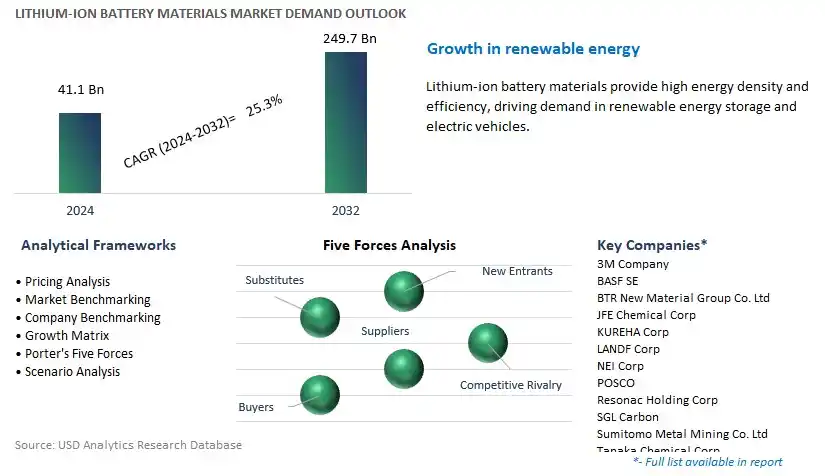
Global Lithium-ion Battery Materials Market Size is valued at $41.1 Billion in 2024 and is forecast to register a growth rate (CAGR) of 25.3% to reach $249.7 Billion by 2032.
The global Lithium-ion Battery Materials Market Study analyzes and forecasts the market size across 6 regions and 24 countries for diverse segments -By Battery (Lithium Nickel Manganese Cobalt, Lithium Iron Phosphate, Power Cobalt Oxide, Lithium Manganese Oxide, Lithium Nickel Cobalt Aluminum Oxide), By Material (Cathode Material, Anode Material, Electrolyte Material, Others), By Application (Portable Devices, Electric Vehicles, Industrial, Others).
An Introduction to Lithium-ion Battery Materials Market in 2024
Lithium-ion battery materials encompass a wide range of components used in the manufacture of lithium-ion batteries, including cathode materials, anode materials, electrolytes, separators, binders, and conductive additives. In 2024, the demand for lithium-ion battery materials s to surge due to the rapid expansion of electric vehicle production, energy storage deployment, and portable electronics markets. Cathode materials, such as lithium cobalt oxide (LCO), lithium iron phosphate (LFP), and nickel cobalt manganese oxide (NCM), are critical for determining battery energy density, voltage, and cycle life. Anode materials, such as graphite, silicon, and lithium metal, play a key role in determining battery capacity, charging rate, and cycle stability. Electrolytes, separators, and additives are essential for facilitating ion transport, preventing internal short circuits, and enhancing battery safety and performance. With ongoing advancements in material science, manufacturing processes, and battery chemistries, there is a growing emphasis on developing high-performance and sustainable battery materials with improved energy density, safety, and environmental compatibility. As the demand for lithium-ion batteries s to soar globally, the market for lithium-ion battery materials is expected to witness robust growth, driven by investments in research and development, expanding manufacturing capacities, and the adoption of electrification and renewable energy solutions.
Lithium-ion Battery Materials Market Competitive Landscape
The market report analyses the leading companies in the industry including 3M Company, BASF SE, BTR New Material Group Co. Ltd, JFE Chemical Corp, KUREHA Corp, LANDF Corp, NEI Corp, POSCO, Resonac Holding Corp, SGL Carbon, Sumitomo Metal Mining Co. Ltd, Tanaka Chemical Corp, Toda Kogyo Corp, UBE Corp, Umicore NV, and others.
Lithium-ion Battery Materials Market Dynamics
Market Trend: Growing Demand for High-Energy-Density Materials
The most prominent market trend in lithium-ion battery materials is the growing demand for high-energy-density materials. As the electrification of transportation and the adoption of renewable energy sources continue to expand, there is an increasing need for lithium-ion batteries with greater energy storage capacity and longer cycle life. This trend is driving the development of advanced battery materials, such as high-nickel cathodes, silicon-based anodes, and solid electrolytes, which offer higher energy densities and improved performance compared to traditional materials. Manufacturers are investing in research and development to innovate new materials and optimize existing ones to meet the evolving requirements of next-generation lithium-ion batteries, driving market growth and technological advancement.
Market Driver: Technological Advancements in Battery Chemistry
A key market driver for lithium-ion battery materials is the continuous technological advancements in battery chemistry. With ongoing research efforts focused on improving battery performance, reducing costs, and enhancing safety, there is a growing demand for innovative materials that can enable the commercialization of advanced lithium-ion battery technologies. Advances in electrode materials, electrolytes, separators, and additives are driving the development of batteries with higher energy densities, faster charging rates, and longer cycle lives. Moreover, breakthroughs in manufacturing processes, such as electrode coating techniques and cell assembly methods, are facilitating the integration of new materials into battery production at scale. Thus, technological advancements in battery chemistry are driving the demand for high-performance materials that can unlock the full potential of next-generation lithium-ion batteries and enable the transition to a more sustainable energy future.
Market Opportunity: Recycling and Circular Economy Initiatives
An emerging opportunity within the lithium-ion battery materials market lies in recycling and circular economy initiatives. With the rapid growth of electric vehicles, consumer electronics, and grid-scale energy storage systems, there is a corresponding increase in battery waste at end-of-life. Recycling lithium-ion batteries not only helps recover valuable metals and materials, such as lithium, cobalt, nickel, and graphite but also reduces environmental pollution and conserves natural resources. Manufacturers and recyclers are investing in technologies and processes to develop efficient and cost-effective methods for battery recycling and materials recovery. Additionally, there is potential for integrating recycled materials into new battery production, closing the loop and creating a more sustainable supply chain. By embracing recycling and circular economy principles, companies can not only mitigate environmental impact but also create new revenue streams and enhance market competitiveness in the rapidly evolving lithium-ion battery materials market.
Lithium-ion Battery Materials Market Share Analysis: Lithium Nickel Manganese Cobalt (NMC) segment generated the highest revenue in 2024
The Lithium Nickel Manganese Cobalt (NMC) segment is the largest segment within the lithium-ion battery materials market. NMC batteries are widely utilized in various applications, including electric vehicles (EVs), consumer electronics, and grid storage systems, due to their high energy density, long cycle life, and excellent thermal stability. The NMC chemistry, typically represented as NMC x:y:z (where x, y, and z denote the respective proportions of nickel, manganese, and cobalt), offers a balanced combination of energy density, power output, and safety characteristics, making it suitable for a wide range of battery applications. Moreover, advancements in NMC battery technology, such as the development of higher nickel content cathodes and improved manufacturing processes, contribute to the continuous improvement of NMC batteries' performance and cost-effectiveness. Additionally, the increasing demand for electric vehicles and energy storage solutions worldwide further fuels the demand for NMC batteries and their constituent materials. With its versatility, performance benefits, and widespread adoption across various industries, the Lithium Nickel Manganese Cobalt (NMC) segment maintains its position as the largest and most significant market segment within the lithium-ion battery materials market.
Lithium-ion Battery Materials Market Share Analysis: Electrolyte Material is poised to register the fastest CAGR over the forecast period
The Electrolyte Material segment is the fastest-growing segment within the lithium-ion battery materials market. Electrolytes are critical components of lithium-ion batteries, facilitating the movement of ions between the cathode and anode during charge and discharge cycles. As the demand for high-performance lithium-ion batteries continues to soar across various industries, including electric vehicles, consumer electronics, and grid storage systems, there is a corresponding surge in the demand for advanced electrolyte materials capable of meeting the stringent requirements of these applications. Additionally, ongoing research and development efforts aimed at improving battery performance, safety, and energy density drive the demand for electrolyte materials with enhanced properties, such as higher conductivity, wider operating temperature range, and improved stability. Moreover, the increasing focus on enhancing battery efficiency and reliability, coupled with the growing emphasis on sustainability and environmental stewardship, further propels the adoption of eco-friendly electrolyte materials. With its pivotal role in determining battery performance and longevity, the Electrolyte Material segment is poised for continued rapid growth within the lithium-ion battery materials market.
Lithium-ion Battery Materials Market Share Analysis: Electric Vehicles segment generated the highest revenue in 2024
The Electric Vehicles segment is the largest segment within the lithium-ion battery materials market. With the global shift towards sustainable transportation and the increasing adoption of electric vehicles (EVs) to reduce greenhouse gas emissions and dependence on fossil fuels, there is a corresponding surge in the production of lithium-ion batteries for EV applications. Lithium-ion batteries are the primary power source for electric vehicles, providing the energy storage needed to propel the vehicle and sustain its operations. Consequently, the demand for lithium-ion battery materials, including cathode materials, anode materials, electrolyte materials, and separators, is significantly higher in the electric vehicle segment compared to other applications. Additionally, ongoing advancements in battery technology aimed at improving energy density, charging speed, and longevity further drive the demand for high-quality battery materials in electric vehicle manufacturing. Moreover, government incentives, regulatory mandates, and consumer preferences for cleaner and more sustainable transportation options continue to fuel the growth of the electric vehicle market, thereby sustaining the demand for lithium-ion battery materials. With electric vehicles at the forefront of the transportation revolution, the Electric Vehicles segment maintains its position as the largest and most significant market segment within the lithium-ion battery materials market.
Lithium-ion Battery Materials Market
By Battery
Lithium Nickel Manganese Cobalt
Lithium Iron Phosphate
Power Cobalt Oxide
Lithium Manganese Oxide
Lithium Nickel Cobalt Aluminum Oxide
By Material
Cathode Material
Anode Material
Electrolyte Material
Others
By Application
Portable Devices
Electric Vehicles
Industrial
Others
Countries Analyzed
North America (US, Canada, Mexico)
Europe (Germany, UK, France, Spain, Italy, Russia, Rest of Europe)
Asia Pacific (China, India, Japan, South Korea, Australia, South East Asia, Rest of Asia)
South America (Brazil, Argentina, Rest of South America)
Middle East and Africa (Saudi Arabia, UAE, Rest of Middle East, South Africa, Egypt, Rest of Africa)
Lithium ion Battery Materials Companies Profiled in the Study
3M Company
BASF SE
BTR New Material Group Co. Ltd
JFE Chemical Corp
KUREHA Corp
LANDF Corp
NEI Corp
POSCO
Resonac Holding Corp
SGL Carbon
Sumitomo Metal Mining Co. Ltd
Tanaka Chemical Corp
Toda Kogyo Corp
UBE Corp
Umicore NV
*- List Not Exhaustive
TABLE OF CONTENTS
1 Introduction to 2024 Lithium ion Battery Materials Market
1.1 Market Overview
1.2 Quick Facts
1.3 Scope/Objective of the Study
1.4 Market Definition
1.5 Countries and Regions Covered
1.6 Units, Currency, and Conversions
1.7 Industry Value Chain
2 Research Methodology
2.1 Market Size Estimation
2.2 Sources and Research Methodology
2.3 Data Triangulation
2.4 Assumptions and Limitations
3 Executive Summary
3.1 Global Lithium ion Battery Materials Market Size Outlook, $ Million, 2021 to 2032
3.2 Lithium ion Battery Materials Market Outlook by Type, $ Million, 2021 to 2032
3.3 Lithium ion Battery Materials Market Outlook by Product, $ Million, 2021 to 2032
3.4 Lithium ion Battery Materials Market Outlook by Application, $ Million, 2021 to 2032
3.5 Lithium ion Battery Materials Market Outlook by Key Countries, $ Million, 2021 to 2032
4 Market Dynamics
4.1 Key Driving Forces of Lithium ion Battery Materials Industry
4.2 Key Market Trends in Lithium ion Battery Materials Industry
4.3 Potential Opportunities in Lithium ion Battery Materials Industry
4.4 Key Challenges in Lithium ion Battery Materials Industry
5 Market Factor Analysis
5.1 Value Chain Analysis
5.2 Competitive Landscape
5.2.1 Global Lithium ion Battery Materials Market Share by Company (%), 2023
5.2.2 Product Offerings by Company
5.3 Porter’s Five Forces Analysis
5.4 Pricing Analysis and Outlook
6 Growth Outlook Across Scenarios
6.1 Growth Analysis-Case Scenario Definitions
6.2 Low Growth Scenario Forecasts
6.3 Reference Growth Scenario Forecasts
6.4 High Growth Scenario Forecasts
7 Global Lithium ion Battery Materials Market Outlook by Segments
7.1 Lithium ion Battery Materials Market Outlook by Segments, $ Million, 2021- 2032
By Battery
Lithium Nickel Manganese Cobalt
Lithium Iron Phosphate
Power Cobalt Oxide
Lithium Manganese Oxide
Lithium Nickel Cobalt Aluminum Oxide
By Material
Cathode Material
Anode Material
Electrolyte Material
Others
By Application
Portable Devices
Electric Vehicles
Industrial
Others
8 North America Lithium ion Battery Materials Market Analysis and Outlook To 2032
8.1 Introduction to North America Lithium ion Battery Materials Markets in 2024
8.2 North America Lithium ion Battery Materials Market Size Outlook by Country, 2021-2032
8.2.1 United States
8.2.2 Canada
8.2.3 Mexico
8.3 North America Lithium ion Battery Materials Market size Outlook by Segments, 2021-2032
By Battery
Lithium Nickel Manganese Cobalt
Lithium Iron Phosphate
Power Cobalt Oxide
Lithium Manganese Oxide
Lithium Nickel Cobalt Aluminum Oxide
By Material
Cathode Material
Anode Material
Electrolyte Material
Others
By Application
Portable Devices
Electric Vehicles
Industrial
Others
9 Europe Lithium ion Battery Materials Market Analysis and Outlook To 2032
9.1 Introduction to Europe Lithium ion Battery Materials Markets in 2024
9.2 Europe Lithium ion Battery Materials Market Size Outlook by Country, 2021-2032
9.2.1 Germany
9.2.2 France
9.2.3 Spain
9.2.4 United Kingdom
9.2.4 Italy
9.2.5 Russia
9.2.6 Norway
9.2.7 Rest of Europe
9.3 Europe Lithium ion Battery Materials Market Size Outlook by Segments, 2021-2032
By Battery
Lithium Nickel Manganese Cobalt
Lithium Iron Phosphate
Power Cobalt Oxide
Lithium Manganese Oxide
Lithium Nickel Cobalt Aluminum Oxide
By Material
Cathode Material
Anode Material
Electrolyte Material
Others
By Application
Portable Devices
Electric Vehicles
Industrial
Others
10 Asia Pacific Lithium ion Battery Materials Market Analysis and Outlook To 2032
10.1 Introduction to Asia Pacific Lithium ion Battery Materials Markets in 2024
10.2 Asia Pacific Lithium ion Battery Materials Market Size Outlook by Country, 2021-2032
10.2.1 China
10.2.2 India
10.2.3 Japan
10.2.4 South Korea
10.2.5 Indonesia
10.2.6 Malaysia
10.2.7 Australia
10.2.8 Rest of Asia Pacific
10.3 Asia Pacific Lithium ion Battery Materials Market size Outlook by Segments, 2021-2032
By Battery
Lithium Nickel Manganese Cobalt
Lithium Iron Phosphate
Power Cobalt Oxide
Lithium Manganese Oxide
Lithium Nickel Cobalt Aluminum Oxide
By Material
Cathode Material
Anode Material
Electrolyte Material
Others
By Application
Portable Devices
Electric Vehicles
Industrial
Others
11 South America Lithium ion Battery Materials Market Analysis and Outlook To 2032
11.1 Introduction to South America Lithium ion Battery Materials Markets in 2024
11.2 South America Lithium ion Battery Materials Market Size Outlook by Country, 2021-2032
11.2.1 Brazil
11.2.2 Argentina
11.2.3 Rest of South America
11.3 South America Lithium ion Battery Materials Market size Outlook by Segments, 2021-2032
By Battery
Lithium Nickel Manganese Cobalt
Lithium Iron Phosphate
Power Cobalt Oxide
Lithium Manganese Oxide
Lithium Nickel Cobalt Aluminum Oxide
By Material
Cathode Material
Anode Material
Electrolyte Material
Others
By Application
Portable Devices
Electric Vehicles
Industrial
Others
12 Middle East and Africa Lithium ion Battery Materials Market Analysis and Outlook To 2032
12.1 Introduction to Middle East and Africa Lithium ion Battery Materials Markets in 2024
12.2 Middle East and Africa Lithium ion Battery Materials Market Size Outlook by Country, 2021-2032
12.2.1 Saudi Arabia
12.2.2 UAE
12.2.3 Oman
12.2.4 Rest of Middle East
12.2.5 Egypt
12.2.6 Nigeria
12.2.7 South Africa
12.2.8 Rest of Africa
12.3 Middle East and Africa Lithium ion Battery Materials Market size Outlook by Segments, 2021-2032
By Battery
Lithium Nickel Manganese Cobalt
Lithium Iron Phosphate
Power Cobalt Oxide
Lithium Manganese Oxide
Lithium Nickel Cobalt Aluminum Oxide
By Material
Cathode Material
Anode Material
Electrolyte Material
Others
By Application
Portable Devices
Electric Vehicles
Industrial
Others
13 Company Profiles
13.1 Company Snapshot
13.2 SWOT Profiles
13.3 Products and Services
13.4 Recent Developments
13.5 Financial Profile
3M Company
BASF SE
BTR New Material Group Co. Ltd
JFE Chemical Corp
KUREHA Corp
LANDF Corp
NEI Corp
POSCO
Resonac Holding Corp
SGL Carbon
Sumitomo Metal Mining Co. Ltd
Tanaka Chemical Corp
Toda Kogyo Corp
UBE Corp
Umicore NV
14 Appendix
14.1 Customization Offerings
14.2 Subscription Services
14.3 Related Reports
14.4 Publisher Expertise
By Battery
Lithium Nickel Manganese Cobalt
Lithium Iron Phosphate
Power Cobalt Oxide
Lithium Manganese Oxide
Lithium Nickel Cobalt Aluminum Oxide
By Material
Cathode Material
Anode Material
Electrolyte Material
Others
By Application
Portable Devices
Electric Vehicles
Industrial
Others
Countries Analyzed
North America (US, Canada, Mexico)
Europe (Germany, UK, France, Spain, Italy, Russia, Rest of Europe)
Asia Pacific (China, India, Japan, South Korea, Australia, South East Asia, Rest of Asia)
South America (Brazil, Argentina, Rest of South America)
Middle East and Africa (Saudi Arabia, UAE, Rest of Middle East, South Africa, Egypt, Rest of Africa)
