
The Low Molecular Weight Heparin Market study analyzes and forecasts the market size across 6 regions and 24 countries for diverse segments- By Product (Enoxaparin, Dalteparin, Tinzaparin, Fondaparinux, Others), By Application (Deep Vein Thrombosis, Acute coronary syndrome (ACS), Pulmonary Embolism, Others), By End-User (Hospitals, Clinics, Ambulatory Surgical Centers, Pharmaceutical and Biotechnology Companies, Others).
In 2024, the market for low molecular weight heparin (LMWH) continues to be essential in anticoagulant therapy, thromboprophylaxis, and the management of various cardiovascular and thromboembolic disorders. LMWHs are derived from unfractionated heparin through chemical or enzymatic depolymerization processes, resulting in smaller molecular weight fragments with enhanced pharmacokinetic properties, including greater bioavailability, longer half-life, and predictable dose-response relationships. These characteristics make LMWHs preferred anticoagulants for both prophylactic and therapeutic indications, such as venous thromboembolism (VTE) prophylaxis in hospitalized patients, treatment of deep vein thrombosis (DVT) and pulmonary embolism (PE), and prevention of thromboembolic complications in patients undergoing surgery or with acute coronary syndromes. LMWHs exhibit a more predictable anticoagulant effect compared to unfractionated heparin, allowing for fixed dosing regimens without the need for routine monitoring of coagulation parameters. Technological advancements in LMWH formulations, including biosimilar versions and novel administration routes, enhance treatment options and patient adherence. With the growing prevalence of cardiovascular diseases, venous thromboembolism, and atrial fibrillation, the market for LMWH is poised for continued growth and innovation, offering patients and healthcare providers effective and safe anticoagulant therapy options for the prevention and treatment of thrombotic disorders.
A prominent trend in the low molecular weight heparin (LMWH) market is the increasing preference for outpatient and home-based treatment options. Traditionally administered in hospital settings for conditions such as deep vein thrombosis (DVT) and pulmonary embolism (PE), LMWHs are now being used more frequently in outpatient settings for the prevention and treatment of thromboembolic disorders. This trend is driven by advancements in self-administration techniques, improved patient education, and the availability of convenient prefilled syringes or pens, allowing patients to administer LMWH injections at home or in community settings. As healthcare systems strive to reduce hospital admissions and healthcare costs while enhancing patient convenience and autonomy, the demand for outpatient-friendly LMWH formulations continues to grow, shaping the market landscape and driving innovation in drug delivery systems.
A key driver for the LMWH market is the rising incidence of thromboembolic disorders and chronic diseases. Thromboembolic disorders, including DVT, PE, and venous thromboembolism (VTE), pose significant morbidity and mortality risks, particularly among elderly individuals, patients undergoing surgery or cancer treatment, and those with chronic medical conditions such as cardiovascular disease and cancer. With aging populations, increasing prevalence of obesity, and rising rates of chronic diseases worldwide, the burden of thromboembolic disorders is expected to escalate, driving demand for anticoagulant therapies such as LMWHs. Additionally, the expanding indications for LMWHs in conditions such as acute coronary syndrome, atrial fibrillation, and thromboprophylaxis further contribute to market growth, as healthcare providers seek effective and safe treatment options for their patients.
An emerging opportunity in the LMWH market lies in the development of biosimilar and generic LMWH formulations. While LMWHs are highly effective anticoagulants, their widespread use can be limited by high costs, particularly in resource-constrained healthcare settings. Biosimilar and generic versions of LMWHs offer potential opportunities to increase access to essential anticoagulant therapies, reduce treatment costs, and improve affordability for patients and healthcare systems. With patents for some LMWH products expiring or nearing expiration, there is an opportunity for pharmaceutical companies to develop biosimilar or generic LMWH formulations that meet stringent regulatory standards for safety, efficacy, and quality. By introducing competitively priced alternatives to branded LMWHs, manufacturers can capture market share, expand patient access to treatment, and address unmet medical needs, driving market competition and enhancing the affordability and availability of LMWH therapies.
Fondaparinux emerges as the fast-growing product segment within the low molecular weight heparin market. This growth is driven by several factors. Firstly, fondaparinux offers several advantages over traditional low molecular weight heparins (LMWHs), including a more predictable pharmacokinetic profile, reduced risk of heparin-induced thrombocytopenia (HIT), and convenient once-daily subcutaneous administration. These attributes make fondaparinux an attractive option for the prevention and treatment of various thrombotic conditions, including deep vein thrombosis (DVT), pulmonary embolism (PE), and acute coronary syndrome (ACS). Additionally, fondaparinux's efficacy and safety profile demonstrated in clinical trials have contributed to its increasing acceptance and adoption by healthcare providers worldwide. Moreover, the expanding indications for fondaparinux in both hospital and outpatient settings, along with its compatibility with various diagnostic and interventional procedures, further drive its market growth. Furthermore, the growing prevalence of thrombotic disorders, coupled with the increasing demand for effective anticoagulant therapies, positions fondaparinux as a key driver of growth within the low molecular weight heparin market. Overall, the combination of clinical benefits, therapeutic versatility, and market demand propels fondaparinux as the fast-growing segment in this market.
The market research study provides in-depth insights into leading companies including the SWOT analyses, product profile, financial details, and recent developments acrossAbbott Laboratories, Aspen Pharmacare Holdings Ltd, B. Braun Melsungen AG, Changzhou Qianhong Bio-Pharma Co. Ltd, Dr. Reddy's Laboratories Ltd, LEO Pharma A/S, Novartis AG, Pfizer Inc, Sanofi S.A., Teva Pharmaceutical Industries Ltd
By Product
Enoxaparin
Dalteparin
Tinzaparin
Fondaparinux
Others
By Application
Deep Vein Thrombosis
Acute coronary syndrome (ACS)
Pulmonary Embolism
Others
By End-User
Hospitals
Clinics
Ambulatory Surgical Centers
Pharmaceutical and Biotechnology Companies
Others
Geographical Analysis
North America (United States, Canada, Mexico)
Europe (Germany, France, United Kingdom, Spain, Italy, Rest of Europe)
Asia Pacific (China, India, Japan, South Korea, Rest of Asia Pacific)
South America (Brazil, Argentina, Rest of South America)
Middle East and Africa (Saudi Arabia, UAE, Rest of Middle East, South Africa, Egypt, Rest of Africa)
Abbott Laboratories
Aspen Pharmacare Holdings Ltd
B. Braun Melsungen AG
Changzhou Qianhong Bio-Pharma Co. Ltd
Dr. Reddy's Laboratories Ltd
LEO Pharma A/S
Novartis AG
Pfizer Inc
Sanofi S.A.
Teva Pharmaceutical Industries Ltd
• Deepen your industry insights and navigate uncertainties for strategy formulation, CAPEX, and Operational decisions
• Gain access to detailed insights on the Low Molecular Weight Heparin Market, encompassing current market size, growth trends, and forecasts till 2030.
• Access detailed competitor analysis, enabling competitive advantage through a thorough understanding of market players, strategies, and potential differentiation opportunities
• Stay ahead of the curve with insights on technological advancements, innovations, and upcoming trends
• Identify lucrative investment avenues and expansion opportunities within the Low Molecular Weight Heparin Market industry, guided by robust, data-backed analysis.
• Understand regional and global markets through country-wise analysis, regional market potential, regulatory nuances, and dynamics
• Execute strategies with confidence and speed through information, analytics, and insights on the industry value chain
• Corporate leaders, strategists, financial experts, shareholders, asset managers, and governmental representatives can make long-term planning scenarios and build an integrated and timely understanding of market dynamics
• Benefit from tailored solutions and expert consultation based on report insights, providing personalized strategies aligned with specific business needs.
TABLE OF CONTENTS
1 Introduction to 2024 Low Molecular Weight Heparin Market
1.1 Market Overview
1.2 Quick Facts
1.3 Scope/Objective of the Study
1.4 Market Definition
1.5 Countries and Regions Covered
1.6 Units, Currency, and Conversions
1.7 Industry Value Chain
2 Research Methodology
2.1 Market Size Estimation
2.2 Sources and Research Methodology
2.3 Data Triangulation
2.4 Assumptions and Limitations
3 Executive Summary
3.1 Global Low Molecular Weight Heparin Market Size Outlook, $ Million, 2021 to 2030
3.2 Low Molecular Weight Heparin Market Outlook by Type, $ Million, 2021 to 2030
3.3 Low Molecular Weight Heparin Market Outlook by Product, $ Million, 2021 to 2030
3.4 Low Molecular Weight Heparin Market Outlook by Application, $ Million, 2021 to 2030
3.5 Low Molecular Weight Heparin Market Outlook by Key Countries, $ Million, 2021 to 2030
4 Market Dynamics
4.1 Key Driving Forces of Low Molecular Weight Heparin Industry
4.2 Key Market Trends in Low Molecular Weight Heparin Industry
4.3 Potential Opportunities in Low Molecular Weight Heparin Industry
4.4 Key Challenges in Low Molecular Weight Heparin Industry
5 Market Factor Analysis
5.1 Value Chain Analysis
5.2 Competitive Landscape
5.2.1 Global Low Molecular Weight Heparin Market Share by Company (%), 2023
5.2.2 Product Offerings by Company
5.3 Porter’s Five Forces Analysis
5.4 Pricing Analysis and Outlook
6 Growth Outlook Across Scenarios
6.1 Growth Analysis-Case Scenario Definitions
6.2 Low Growth Scenario Forecasts
6.3 Reference Growth Scenario Forecasts
6.4 High Growth Scenario Forecasts
7 Global Low Molecular Weight Heparin Market Outlook by Segments
7.1 Low Molecular Weight Heparin Market Outlook by Segments, $ Million, 2021- 2030
By Product
Enoxaparin
Dalteparin
Tinzaparin
Fondaparinux
Others
By Application
Deep Vein Thrombosis
Acute coronary syndrome (ACS)
Pulmonary Embolism
Others
By End-User
Hospitals
Clinics
Ambulatory Surgical Centers
Pharmaceutical and Biotechnology Companies
Others
8 North America Low Molecular Weight Heparin Market Analysis and Outlook To 2030
8.1 Introduction to North America Low Molecular Weight Heparin Markets in 2024
8.2 North America Low Molecular Weight Heparin Market Size Outlook by Country, 2021-2030
8.2.1 United States
8.2.2 Canada
8.2.3 Mexico
8.3 North America Low Molecular Weight Heparin Market size Outlook by Segments, 2021-2030
By Product
Enoxaparin
Dalteparin
Tinzaparin
Fondaparinux
Others
By Application
Deep Vein Thrombosis
Acute coronary syndrome (ACS)
Pulmonary Embolism
Others
By End-User
Hospitals
Clinics
Ambulatory Surgical Centers
Pharmaceutical and Biotechnology Companies
Others
9 Europe Low Molecular Weight Heparin Market Analysis and Outlook To 2030
9.1 Introduction to Europe Low Molecular Weight Heparin Markets in 2024
9.2 Europe Low Molecular Weight Heparin Market Size Outlook by Country, 2021-2030
9.2.1 Germany
9.2.2 France
9.2.3 Spain
9.2.4 United Kingdom
9.2.4 Italy
9.2.5 Russia
9.2.6 Norway
9.2.7 Rest of Europe
9.3 Europe Low Molecular Weight Heparin Market Size Outlook by Segments, 2021-2030
By Product
Enoxaparin
Dalteparin
Tinzaparin
Fondaparinux
Others
By Application
Deep Vein Thrombosis
Acute coronary syndrome (ACS)
Pulmonary Embolism
Others
By End-User
Hospitals
Clinics
Ambulatory Surgical Centers
Pharmaceutical and Biotechnology Companies
Others
10 Asia Pacific Low Molecular Weight Heparin Market Analysis and Outlook To 2030
10.1 Introduction to Asia Pacific Low Molecular Weight Heparin Markets in 2024
10.2 Asia Pacific Low Molecular Weight Heparin Market Size Outlook by Country, 2021-2030
10.2.1 China
10.2.2 India
10.2.3 Japan
10.2.4 South Korea
10.2.5 Indonesia
10.2.6 Malaysia
10.2.7 Australia
10.2.8 Rest of Asia Pacific
10.3 Asia Pacific Low Molecular Weight Heparin Market size Outlook by Segments, 2021-2030
By Product
Enoxaparin
Dalteparin
Tinzaparin
Fondaparinux
Others
By Application
Deep Vein Thrombosis
Acute coronary syndrome (ACS)
Pulmonary Embolism
Others
By End-User
Hospitals
Clinics
Ambulatory Surgical Centers
Pharmaceutical and Biotechnology Companies
Others
11 South America Low Molecular Weight Heparin Market Analysis and Outlook To 2030
11.1 Introduction to South America Low Molecular Weight Heparin Markets in 2024
11.2 South America Low Molecular Weight Heparin Market Size Outlook by Country, 2021-2030
11.2.1 Brazil
11.2.2 Argentina
11.2.3 Rest of South America
11.3 South America Low Molecular Weight Heparin Market size Outlook by Segments, 2021-2030
By Product
Enoxaparin
Dalteparin
Tinzaparin
Fondaparinux
Others
By Application
Deep Vein Thrombosis
Acute coronary syndrome (ACS)
Pulmonary Embolism
Others
By End-User
Hospitals
Clinics
Ambulatory Surgical Centers
Pharmaceutical and Biotechnology Companies
Others
12 Middle East and Africa Low Molecular Weight Heparin Market Analysis and Outlook To 2030
12.1 Introduction to Middle East and Africa Low Molecular Weight Heparin Markets in 2024
12.2 Middle East and Africa Low Molecular Weight Heparin Market Size Outlook by Country, 2021-2030
12.2.1 Saudi Arabia
12.2.2 UAE
12.2.3 Oman
12.2.4 Rest of Middle East
12.2.5 Egypt
12.2.6 Nigeria
12.2.7 South Africa
12.2.8 Rest of Africa
12.3 Middle East and Africa Low Molecular Weight Heparin Market size Outlook by Segments, 2021-2030
By Product
Enoxaparin
Dalteparin
Tinzaparin
Fondaparinux
Others
By Application
Deep Vein Thrombosis
Acute coronary syndrome (ACS)
Pulmonary Embolism
Others
By End-User
Hospitals
Clinics
Ambulatory Surgical Centers
Pharmaceutical and Biotechnology Companies
Others
13 Company Profiles
13.1 Company Snapshot
13.2 SWOT Profiles
13.3 Products and Services
13.4 Recent Developments
13.5 Financial Profile
List of Companies
Abbott Laboratories
Aspen Pharmacare Holdings Ltd
B. Braun Melsungen AG
Changzhou Qianhong Bio-Pharma Co. Ltd
Dr. Reddy's Laboratories Ltd
LEO Pharma A/S
Novartis AG
Pfizer Inc
Sanofi S.A.
Teva Pharmaceutical Industries Ltd
14 Appendix
14.1 Customization Offerings
14.2 Subscription Services
14.3 Related Reports
14.4 Publisher Expertise
By Product
Enoxaparin
Dalteparin
Tinzaparin
Fondaparinux
Others
By Application
Deep Vein Thrombosis
Acute coronary syndrome (ACS)
Pulmonary Embolism
Others
By End-User
Hospitals
Clinics
Ambulatory Surgical Centers
Pharmaceutical and Biotechnology Companies
Others
Countries Analyzed
North America (United States, Canada, Mexico)
Europe (Germany, France, United Kingdom, Spain, Italy, Rest of Europe)
Asia Pacific (China, India, Japan, South Korea, Rest of Asia Pacific)
South America (Brazil, Argentina, Rest of South America)
Middle East and Africa (Saudi Arabia, UAE, Rest of Middle East, South Africa, Egypt, Rest of Africa)
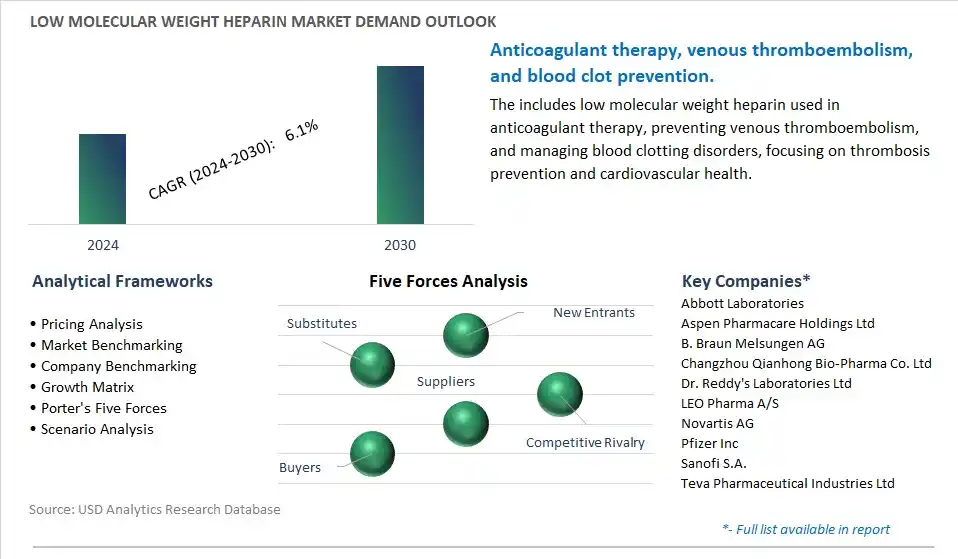
The global Low Molecular Weight Heparin Market is one of the lucrative growth markets, poised to register a 6.1% growth (CAGR) between 2024 and 2030.
Emerging Markets across Asia Pacific, Europe, and Americas present robust growth prospects.
Abbott Laboratories, Aspen Pharmacare Holdings Ltd, B. Braun Melsungen AG, Changzhou Qianhong Bio-Pharma Co. Ltd, Dr. Reddy's Laboratories Ltd, LEO Pharma A/S, Novartis AG, Pfizer Inc, Sanofi S.A., Teva Pharmaceutical Industries Ltd
Base Year- 2023; Estimated Year- 2024; Historic Period- 2018-2023; Forecast period- 2024 to 2030; Currency: USD; Volume