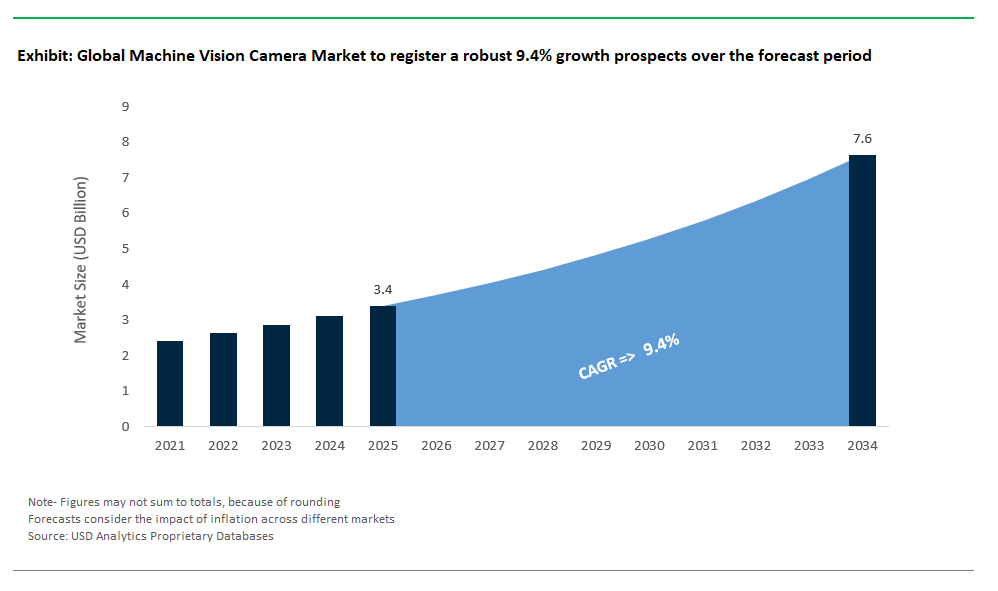
The Global Machine Vision Camera Market Size is estimated at $3.4 Billion in 2025 and is forecast to register an annual growth rate (CAGR) of 9.4% to reach $7.6 Billion by 2034.
The global Machine Vision Camera Market Study analyzes and forecasts the market size across 6 regions and 24 countries for diverse segments -By Type (Line scan, Area scan, 3D scan cameras), By Platform (PC based camera, Smart camera, Wireless camera, Wearable camera), By Hardware Standard (Camera Link HS, Camera Link, GigE Vision, CoaXPress, USB3 Vision, Others), By Process (1D Image Sensor, 2D Image Sensor, 3D Image Sensor), By Spectrum (Infrared Spectrum, X-Ray Spectrum, Visible Light Spectrum, Others).
An Introduction to Machine Vision Camera Market in 2025
The Machine Vision Camera Market is set for substantial growth in 2025, driven by its increasing adoption in industries like manufacturing, automotive, electronics, and healthcare. These cameras are crucial for quality control, defect detection, and automation, enabling precise and efficient operations. Advancements in AI and deep learning are enhancing the capabilities of machine vision cameras, particularly in identifying complex patterns and anomalies. The rise of Industry 4.0 is further accelerating adoption, with Asia-Pacific emerging as a key market due to its strong industrial base. Challenges include high initial investment costs and the need for skilled personnel to implement these systems effectively.
Machine Vision (MV) Camera Competitive Landscape
The market report analyses the leading companies in the industry including Alpha MOS, AMETEK Inc, Banner Engineering Corp, Basler AG, Baumer Holding AG, Cognex Corp, Datalogic SpA, Decision Technology LLC, Hangzhou Hikvision Digital Technology Co. Ltd, Hitachi Ltd, Intel Corp, JAI AS, Keyence Corp, National Instruments Corp, OMRON Corp, SICK AG, Sony Group Corp, Teledyne Technologies Inc, TKH Group NV, and others.
Machine Vision Camera Market Dynamics
Machine Vision Camera Market Trend: Increasing Use of AI for Advanced Image Processing
The Machine Vision Camera Market is experiencing a significant trend of increasing integration with artificial intelligence (AI) to enable advanced image processing capabilities. AI technologies, particularly machine learning and deep learning, are helping machine vision systems improve the accuracy and efficiency of image analysis. These systems can now perform tasks such as defect detection, object recognition, and quality inspection with greater precision and speed than traditional methods. The combination of machine vision cameras with AI algorithms allows for faster decision-making and automation of complex processes, particularly in industries like manufacturing, automotive, and electronics. This trend is transforming machine vision cameras from simple image capture devices to sophisticated solutions for automated quality control and process optimization.
Machine Vision Camera Market Driver: Demand for Automation and Quality Control in Manufacturing
The primary driver of growth in the Machine Vision Camera Market is the increasing demand for automation and quality control in manufacturing industries. As industries like automotive, electronics, and pharmaceuticals seek to improve production efficiency and product quality, machine vision cameras play a crucial role in automating inspection processes. These cameras are capable of detecting defects, ensuring precise assembly, and monitoring production lines in real-time, reducing the need for manual inspection. The adoption of machine vision in industries that require high accuracy and high throughput is growing, contributing to the market's expansion. Furthermore, the rise of Industry 4.0 and smart factories is accelerating the need for automated quality control systems, further driving the demand for machine vision cameras.
Machine Vision Camera Market Opportunity: Integration with Robotics and Smart Manufacturing Systems
An exciting opportunity in the Machine Vision Camera Market lies in its integration with robotics and smart manufacturing systems. As manufacturing becomes more automated, the need for machine vision cameras to work in tandem with robotic systems is increasing. Machine vision cameras provide robots with the ability to "see" and interpret their environment, enabling them to perform tasks such as picking and placing items, inspecting products, and even conducting repairs autonomously. This synergy between machine vision and robotics is pivotal in industries like automotive, logistics, and electronics, where precision and efficiency are critical. The continued growth of smart manufacturing and the adoption of Industry 4.0 technologies present a significant opportunity for machine vision camera manufacturers to provide integrated solutions that enhance automation and productivity.
Machine Vision Camera Market Share Analysis: PC-Based Camera is expected to generate the highest revenue in 2025.
The largest segment in the machine vision camera market by platform is the PC-based camera. PC-based cameras dominate the market due to their versatility, high processing power, and ability to integrate with complex machine vision systems. These cameras are widely used in industries like automotive, electronics, and manufacturing, where high precision and image processing capabilities are critical for quality control, inspection, and automation processes. The ability to connect seamlessly with industrial PCs and run advanced software algorithms for image analysis makes PC-based cameras the preferred choice in a variety of applications. Their robustness, high-resolution imaging, and ability to handle demanding tasks solidify their position as the largest segment in the machine vision camera market.
Machine Vision Camera Market Share Analysis: 3D Scan Cameras is poised to register the fastest growth rate (CAGR) over the forecast period from 2025 to 2034.
The fastest-growing segment in the machine vision camera market by type is 3D scan cameras. These cameras are gaining significant traction due to their ability to capture detailed, three-dimensional data, which is essential for applications requiring precise measurements, complex inspections, and high accuracy. Industries such as automotive, aerospace, and healthcare are increasingly adopting 3D scan cameras for quality control, reverse engineering, and surface inspection. The rise of automation, coupled with advancements in 3D imaging technology, is driving the demand for these cameras, as they enable more comprehensive data collection and analysis compared to traditional 2D imaging. As industries strive for higher precision and enhanced productivity, 3D scan cameras are expected to experience rapid growth through 2034.
Machine Vision Camera Market Share Analysis: GigE Vision is expected to generate the highest revenue in 2025.
The largest segment in the machine vision camera market by hardware standard is GigE Vision. GigE Vision is widely adopted due to its high-speed data transfer capabilities, ease of integration, and cost-effectiveness, making it a preferred choice for industrial applications that require reliable and fast image acquisition. The standard's compatibility with Ethernet networking allows for long-distance communication and the ability to integrate with existing network infrastructures, which is essential for industries such as automotive, electronics, and food processing. Additionally, its scalability and flexibility in various environments, along with the growing adoption of Industrial Ethernet, have solidified GigE Vision’s position as the dominant hardware standard in the market. As industries demand more sophisticated machine vision solutions, the popularity of GigE Vision cameras is expected to continue growing.
Machine Vision Camera Market Share Analysis: Infrared Spectrum is poised to register the fastest growth rate (CAGR) over the forecast period from 2025 to 2034.
The fastest-growing segment in the machine vision camera market by spectrum is the infrared spectrum. Infrared cameras are increasingly being adopted across various industries, including automotive, manufacturing, and healthcare, due to their ability to capture images in low-light or no-light environments and detect temperature variations. This makes infrared cameras highly suitable for applications such as thermal inspections, quality control, predictive maintenance, and security surveillance. As industries seek to enhance automation, increase safety, and improve efficiency, infrared spectrum cameras are gaining popularity for their ability to provide valuable insights that are not visible in the visible light spectrum. Additionally, advancements in infrared camera technology, including higher resolution and faster processing speeds, are driving their rapid growth over the forecast period to 2034.
Machine Vision Camera Market Report Scope
|
Parameter
|
Details
|
|
Market Size (2025)
|
3.4 Billion
|
|
Market Size (2034)
|
7.6 Billion
|
|
Market Growth Rate
|
9.4%
|
|
Segments
|
By Type (Line scan, Area scan, 3D scan cameras), By Platform (PC based camera, Smart camera, Wireless camera, Wearable camera), By Hardware Standard (Camera Link HS, Camera Link, GigE Vision, CoaXPress, USB3 Vision, Others), By Process (1D Image Sensor, 2D Image Sensor, 3D Image Sensor), By Spectrum (Infrared Spectrum, X-Ray Spectrum, Visible Light Spectrum, Others)
|
|
Study Period
|
2019- 2024 and 2025-2034
|
|
Units
|
Revenue (USD)
|
|
Qualitative Analysis
|
Porter’s Five Forces, SWOT Profile, Market Share, Scenario Forecasts, Market Ecosystem, Company Ranking, Market Dynamics, Industry Benchmarking
|
|
Companies
|
Alpha MOS, AMETEK Inc, Banner Engineering Corp, Basler AG, Baumer Holding AG, Cognex Corp, Datalogic SpA, Decision Technology LLC, Hangzhou Hikvision Digital Technology Co. Ltd, Hitachi Ltd, Intel Corp, JAI AS, Keyence Corp, National Instruments Corp, OMRON Corp, SICK AG, Sony Group Corp, Teledyne Technologies Inc, TKH Group NV
|
|
Countries
|
US, Canada, Mexico, Germany, France, Spain, Italy, UK, Russia, China, India, Japan, South Korea, Australia, South East Asia, Brazil, Argentina, Middle East, Africa
|
Machine Vision Camera Market Segmentation
By Type
Line scan
Area scan
3D scan cameras
By Platform
PC based camera
Smart camera
Wireless camera
Wearable camera
By Hardware Standard
Camera Link HS
Camera Link
GigE Vision
CoaXPress
USB3 Vision
Others
By Process
1D Image Sensor
2D Image Sensor
3D Image Sensor
By Spectrum
Infrared Spectrum
X-Ray Spectrum
Visible Light Spectrum
Others
Countries Analyzed
North America (US, Canada, Mexico)
Europe (Germany, UK, France, Spain, Italy, Russia, Rest of Europe)
Asia Pacific (China, India, Japan, South Korea, Australia, South East Asia, Rest of Asia)
South America (Brazil, Argentina, Rest of South America)
Middle East and Africa (Saudi Arabia, UAE, Rest of Middle East, South Africa, Egypt, Rest of Africa)
Machine Vision (MV) Camera Companies Profiled in the Study
Alpha MOS
AMETEK Inc
Banner Engineering Corp
Basler AG
Baumer Holding AG
Cognex Corp
Datalogic SpA
Decision Technology LLC
Hangzhou Hikvision Digital Technology Co. Ltd
Hitachi Ltd
Intel Corp
JAI AS
Keyence Corp
National Instruments Corp
OMRON Corp
SICK AG
Sony Group Corp
Teledyne Technologies Inc
TKH Group NV
*- List Not Exhaustive
TABLE OF CONTENTS
1 Introduction to 2025 Machine Vision (MV) Camera Market
1.1 Market Overview
1.2 Quick Facts
1.3 Scope/Objective of the Study
1.4 Market Definition
1.5 Countries and Regions Covered
1.6 Units, Currency, and Conversions
1.7 Industry Value Chain
2 Research Methodology
2.1 Market Size Estimation
2.2 Sources and Research Methodology
2.3 Data Triangulation
2.4 Assumptions and Limitations
3 Executive Summary
3.1 Global Machine Vision (MV) Camera Market Size Outlook, $ Million, 2021 to 2034
3.2 Machine Vision (MV) Camera Market Outlook by Type, $ Million, 2021 to 2034
3.3 Machine Vision (MV) Camera Market Outlook by Product, $ Million, 2021 to 2034
3.4 Machine Vision (MV) Camera Market Outlook by Application, $ Million, 2021 to 2034
3.5 Machine Vision (MV) Camera Market Outlook by Key Countries, $ Million, 2021 to 2034
4 Market Dynamics
4.1 Key Driving Forces of Machine Vision (MV) Camera Industry
4.2 Key Market Trends in Machine Vision (MV) Camera Industry
4.3 Potential Opportunities in Machine Vision (MV) Camera Industry
4.4 Key Challenges in Machine Vision (MV) Camera Industry
5 Market Factor Analysis
5.1 Value Chain Analysis
5.2 Competitive Landscape
5.2.1 Global Machine Vision (MV) Camera Market Share by Company (%), 2024
5.2.2 Product Offerings by Company
5.3 Porter’s Five Forces Analysis
5.4 Pricing Analysis and Outlook
6 Growth Outlook Across Scenarios
6.1 Growth Analysis-Case Scenario Definitions
6.2 Low Growth Scenario Forecasts
6.3 Reference Growth Scenario Forecasts
6.4 High Growth Scenario Forecasts
7 Global Machine Vision (MV) Camera Market Outlook by Segments
7.1 Machine Vision (MV) Camera Market Outlook by Segments, $ Million, 2021- 2034
By Type
Line scan
Area scan
3D scan cameras
By Platform
PC based camera
Smart camera
Wireless camera
Wearable camera
By Hardware Standard
Camera Link HS
Camera Link
GigE Vision
CoaXPress
USB3 Vision
Others
By Process
1D Image Sensor
2D Image Sensor
3D Image Sensor
By Spectrum
Infrared Spectrum
X-Ray Spectrum
Visible Light Spectrum
Others
8 North America Machine Vision (MV) Camera Market Analysis and Outlook To 2034
8.1 Introduction to North America Machine Vision (MV) Camera Markets in 2025
8.2 North America Machine Vision (MV) Camera Market Size Outlook by Country, 2021-2034
8.2.1 United States
8.2.2 Canada
8.2.3 Mexico
8.3 North America Machine Vision (MV) Camera Market size Outlook by Segments, 2021-2034
By Type
Line scan
Area scan
3D scan cameras
By Platform
PC based camera
Smart camera
Wireless camera
Wearable camera
By Hardware Standard
Camera Link HS
Camera Link
GigE Vision
CoaXPress
USB3 Vision
Others
By Process
1D Image Sensor
2D Image Sensor
3D Image Sensor
By Spectrum
Infrared Spectrum
X-Ray Spectrum
Visible Light Spectrum
Others
9 Europe Machine Vision (MV) Camera Market Analysis and Outlook To 2034
9.1 Introduction to Europe Machine Vision (MV) Camera Markets in 2025
9.2 Europe Machine Vision (MV) Camera Market Size Outlook by Country, 2021-2034
9.2.1 Germany
9.2.2 France
9.2.3 Spain
9.2.4 United Kingdom
9.2.4 Italy
9.2.5 Russia
9.2.6 Norway
9.2.7 Rest of Europe
9.3 Europe Machine Vision (MV) Camera Market Size Outlook by Segments, 2021-2034
By Type
Line scan
Area scan
3D scan cameras
By Platform
PC based camera
Smart camera
Wireless camera
Wearable camera
By Hardware Standard
Camera Link HS
Camera Link
GigE Vision
CoaXPress
USB3 Vision
Others
By Process
1D Image Sensor
2D Image Sensor
3D Image Sensor
By Spectrum
Infrared Spectrum
X-Ray Spectrum
Visible Light Spectrum
Others
10 Asia Pacific Machine Vision (MV) Camera Market Analysis and Outlook To 2034
10.1 Introduction to Asia Pacific Machine Vision (MV) Camera Markets in 2025
10.2 Asia Pacific Machine Vision (MV) Camera Market Size Outlook by Country, 2021-2034
10.2.1 China
10.2.2 India
10.2.3 Japan
10.2.4 South Korea
10.2.5 Indonesia
10.2.6 Malaysia
10.2.7 Australia
10.2.8 Rest of Asia Pacific
10.3 Asia Pacific Machine Vision (MV) Camera Market size Outlook by Segments, 2021-2034
By Type
Line scan
Area scan
3D scan cameras
By Platform
PC based camera
Smart camera
Wireless camera
Wearable camera
By Hardware Standard
Camera Link HS
Camera Link
GigE Vision
CoaXPress
USB3 Vision
Others
By Process
1D Image Sensor
2D Image Sensor
3D Image Sensor
By Spectrum
Infrared Spectrum
X-Ray Spectrum
Visible Light Spectrum
Others
11 South America Machine Vision (MV) Camera Market Analysis and Outlook To 2034
11.1 Introduction to South America Machine Vision (MV) Camera Markets in 2025
11.2 South America Machine Vision (MV) Camera Market Size Outlook by Country, 2021-2034
11.2.1 Brazil
11.2.2 Argentina
11.2.3 Rest of South America
11.3 South America Machine Vision (MV) Camera Market size Outlook by Segments, 2021-2034
By Type
Line scan
Area scan
3D scan cameras
By Platform
PC based camera
Smart camera
Wireless camera
Wearable camera
By Hardware Standard
Camera Link HS
Camera Link
GigE Vision
CoaXPress
USB3 Vision
Others
By Process
1D Image Sensor
2D Image Sensor
3D Image Sensor
By Spectrum
Infrared Spectrum
X-Ray Spectrum
Visible Light Spectrum
Others
12 Middle East and Africa Machine Vision (MV) Camera Market Analysis and Outlook To 2034
12.1 Introduction to Middle East and Africa Machine Vision (MV) Camera Markets in 2025
12.2 Middle East and Africa Machine Vision (MV) Camera Market Size Outlook by Country, 2021-2034
12.2.1 Saudi Arabia
12.2.2 UAE
12.2.3 Oman
12.2.4 Rest of Middle East
12.2.5 Egypt
12.2.6 Nigeria
12.2.7 South Africa
12.2.8 Rest of Africa
12.3 Middle East and Africa Machine Vision (MV) Camera Market size Outlook by Segments, 2021-2034
By Type
Line scan
Area scan
3D scan cameras
By Platform
PC based camera
Smart camera
Wireless camera
Wearable camera
By Hardware Standard
Camera Link HS
Camera Link
GigE Vision
CoaXPress
USB3 Vision
Others
By Process
1D Image Sensor
2D Image Sensor
3D Image Sensor
By Spectrum
Infrared Spectrum
X-Ray Spectrum
Visible Light Spectrum
Others
13 Company Profiles
13.1 Company Snapshot
13.2 SWOT Profiles
13.3 Products and Services
13.4 Recent Developments
13.5 Financial Profile
Alpha MOS
AMETEK Inc
Banner Engineering Corp
Basler AG
Baumer Holding AG
Cognex Corp
Datalogic SpA
Decision Technology LLC
Hangzhou Hikvision Digital Technology Co. Ltd
Hitachi Ltd
Intel Corp
JAI AS
Keyence Corp
National Instruments Corp
OMRON Corp
SICK AG
Sony Group Corp
Teledyne Technologies Inc
TKH Group NV
14 Appendix
14.1 Customization Offerings
14.2 Subscription Services
14.3 Related Reports
14.4 Publisher Expertise
