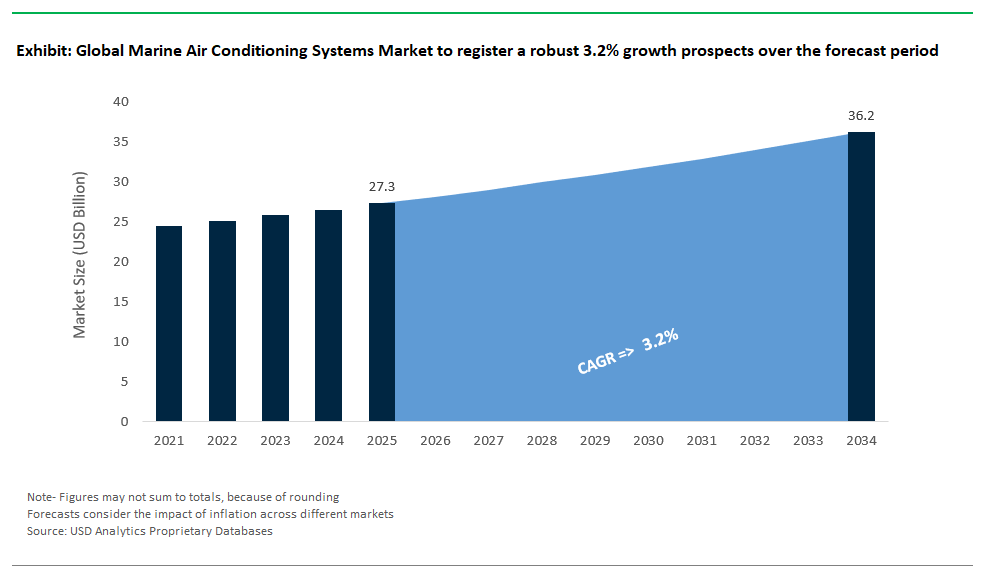
The Global Marine Air Conditioning Systems Market Size is estimated at $27.3 Billion in 2025 and is forecast to register an annual growth rate (CAGR) of 3.2% to reach $36.3 Billion by 2034.
The global Marine Air Conditioning Systems Market Study analyzes and forecasts the market size across 6 regions and 24 countries for diverse segments -By Product (Chiller systems, Self-contained systems, Split systems), By End-user (Leisure ships, Commercial ships).
An Introduction to Marine Air Conditioning Systems Market in 2025
The Marine Air Conditioning Systems Market is anticipated to witness robust growth in 2025, fueled by the expansion of the global shipping and cruise industries. These systems are essential for maintaining comfort and operational efficiency in vessels, including cargo ships, naval ships, and luxury yachts. Growing environmental concerns are driving the development of eco-friendly and energy-efficient air conditioning solutions that comply with stringent maritime regulations. Technological advancements like compact, high-performance systems are gaining popularity, particularly in the Asia-Pacific region, where shipbuilding activities are booming. However, high installation costs and maintenance complexity pose challenges for smaller operators.
Marine Air Conditioning (AC) Systems Competitive Landscape
The market report analyses the leading companies in the industry including BRONSWERK GROUP Ltd, Carrier Global Corp, Chongqing Acir Marine Co. Ltd, Daikin Industries Ltd, Dometic Group AB, Eberca Holding BV, Flagship Marine Inc, FRIGOMAR Srl, GEA Group AG, Heinen and Hopman, Johnson Controls International Plc, Mabru Power Systems, MARINAIRE TECHNOLOGIES Inc, Nissin Refrigeration and Engineering Ltd, Ocean Breeze, Pompanette LLC, The Koja Group, Veco S.p.A, Webasto SE, and others.
Marine Air Conditioning Systems Market Dynamics
Marine Air Conditioning Systems Market Trend: Shift Toward Energy-efficient and Environmentally Friendly Solutions
A key trend in the Marine Air Conditioning Systems Market is the shift toward energy-efficient and environmentally friendly solutions. With the increasing pressure on the maritime industry to reduce its carbon footprint, ship owners and operators are seeking air conditioning systems that consume less power and use refrigerants with lower environmental impact. Marine air conditioning systems are increasingly being designed with energy-saving features such as variable speed drives, smart temperature control, and eco-friendly refrigerants. These advancements are not only in line with regulatory standards but also help reduce operational costs by minimizing energy consumption. The trend toward sustainable and energy-efficient marine air conditioning is expected to continue, driven by both regulatory pressure and the industry's need for cost-effective solutions.
Marine Air Conditioning Systems Market Driver: Growing Demand for Comfort and Climate Control in Commercial and Passenger Vessels
The growing demand for comfort and climate control in commercial and passenger vessels is a major driver of the Marine Air Conditioning Systems Market. As the cruise and shipping industries continue to expand, the need for advanced air conditioning systems that provide a comfortable environment for passengers and crew is critical. Modern cruise ships, yachts, and large cargo vessels require robust HVAC systems that can efficiently manage temperature and humidity levels across large areas of the ship. In addition, the growth in offshore activities, including oil rigs and research vessels, further contributes to the demand for effective and reliable climate control solutions in marine environments. The increasing emphasis on passenger comfort and the need for climate-controlled spaces are key factors driving the market.
Marine Air Conditioning Systems Market Opportunity: Technological Integration for Predictive Maintenance and Remote Monitoring
An opportunity in the Marine Air Conditioning Systems Market lies in the integration of predictive maintenance and remote monitoring technologies. By incorporating sensors and IoT-enabled platforms, marine HVAC systems can now be monitored in real-time, providing operators with valuable data on system performance. Predictive maintenance tools can help identify potential issues before they escalate into costly repairs, thus reducing downtime and ensuring optimal performance during voyages. Additionally, remote monitoring capabilities allow for better management of multiple vessels from a central location, improving operational efficiency. As the maritime industry continues to embrace digitalization and IoT technologies, the integration of smart monitoring and predictive maintenance solutions in marine air conditioning systems offers significant growth potential.
Marine Air Conditioning Systems Market Share Analysis: Commercial Ships is expected to generate the highest revenue in 2025.
The largest segment in the marine air conditioning systems market by end-user is commercial ships. Commercial vessels, including cargo ships, tankers, and passenger ships, require advanced air conditioning systems to ensure the comfort of passengers and crew, maintain proper cargo conditions, and meet environmental regulations. These ships operate over long durations and travel through diverse climates, making reliable and energy-efficient air conditioning systems essential. The commercial sector's higher demand for larger, more complex systems, due to the sheer size and operational scale of these vessels, positions it as the dominant segment in the marine air conditioning market. As international trade continues to grow, so does the need for efficient and durable air conditioning solutions on commercial ships, solidifying this segment’s market leadership.
Marine Air Conditioning Systems Market Share Analysis: Chiller Systems is poised to register the fastest growth rate (CAGR) over the forecast period from 2025 to 2034.
The fastest-growing segment in the marine air conditioning systems market by product is chiller systems. Chiller systems are gaining popularity due to their energy efficiency, ability to maintain a consistent temperature, and suitability for large vessels with high cooling demands, such as cruise ships and large cargo ships. As the demand for larger and more luxurious vessels increases, the need for advanced air conditioning solutions like chiller systems is rising. These systems are highly valued for their ability to provide cooling to multiple zones simultaneously, ensuring optimal comfort in various areas of a ship. Additionally, their ability to operate efficiently in different climates contributes to their rapid growth over the forecast period to 2034, particularly with increasing awareness of sustainability and energy efficiency in the marine industry.
Marine Air Conditioning Systems Market Report Scope
|
Parameter
|
Details
|
|
Market Size (2025)
|
27.3 Billion
|
|
Market Size (2034)
|
36.3 Billion
|
|
Market Growth Rate
|
3.2%
|
|
Segments
|
By Product (Chiller systems, Self-contained systems, Split systems), By End-user (Leisure ships, Commercial ships)
|
|
Study Period
|
2019- 2024 and 2025-2034
|
|
Units
|
Revenue (USD)
|
|
Qualitative Analysis
|
Porter’s Five Forces, SWOT Profile, Market Share, Scenario Forecasts, Market Ecosystem, Company Ranking, Market Dynamics, Industry Benchmarking
|
|
Companies
|
BRONSWERK GROUP Ltd, Carrier Global Corp, Chongqing Acir Marine Co. Ltd, Daikin Industries Ltd, Dometic Group AB, Eberca Holding BV, Flagship Marine Inc, FRIGOMAR Srl, GEA Group AG, Heinen and Hopman, Johnson Controls International Plc, Mabru Power Systems, MARINAIRE TECHNOLOGIES Inc, Nissin Refrigeration and Engineering Ltd, Ocean Breeze, Pompanette LLC, The Koja Group, Veco S.p.A, Webasto SE
|
|
Countries
|
US, Canada, Mexico, Germany, France, Spain, Italy, UK, Russia, China, India, Japan, South Korea, Australia, South East Asia, Brazil, Argentina, Middle East, Africa
|
Marine Air Conditioning Systems Market Segmentation
By Product
Chiller systems
Self-contained systems
Split systems
By End-user
Leisure ships
Commercial ships
Countries Analyzed
North America (US, Canada, Mexico)
Europe (Germany, UK, France, Spain, Italy, Russia, Rest of Europe)
Asia Pacific (China, India, Japan, South Korea, Australia, South East Asia, Rest of Asia)
South America (Brazil, Argentina, Rest of South America)
Middle East and Africa (Saudi Arabia, UAE, Rest of Middle East, South Africa, Egypt, Rest of Africa)
Marine Air Conditioning (AC) Systems Companies Profiled in the Study
BRONSWERK GROUP Ltd
Carrier Global Corp
Chongqing Acir Marine Co. Ltd
Daikin Industries Ltd
Dometic Group AB
Eberca Holding BV
Flagship Marine Inc
FRIGOMAR Srl
GEA Group AG
Heinen and Hopman
Johnson Controls International Plc
Mabru Power Systems
MARINAIRE TECHNOLOGIES Inc
Nissin Refrigeration and Engineering Ltd
Ocean Breeze
Pompanette LLC
The Koja Group
Veco S.p.A
Webasto SE
*- List Not Exhaustive
TABLE OF CONTENTS
1 Introduction to 2025 Marine Air Conditioning (AC) Systems Market
1.1 Market Overview
1.2 Quick Facts
1.3 Scope/Objective of the Study
1.4 Market Definition
1.5 Countries and Regions Covered
1.6 Units, Currency, and Conversions
1.7 Industry Value Chain
2 Research Methodology
2.1 Market Size Estimation
2.2 Sources and Research Methodology
2.3 Data Triangulation
2.4 Assumptions and Limitations
3 Executive Summary
3.1 Global Marine Air Conditioning (AC) Systems Market Size Outlook, $ Million, 2021 to 2034
3.2 Marine Air Conditioning (AC) Systems Market Outlook by Type, $ Million, 2021 to 2034
3.3 Marine Air Conditioning (AC) Systems Market Outlook by Product, $ Million, 2021 to 2034
3.4 Marine Air Conditioning (AC) Systems Market Outlook by Application, $ Million, 2021 to 2034
3.5 Marine Air Conditioning (AC) Systems Market Outlook by Key Countries, $ Million, 2021 to 2034
4 Market Dynamics
4.1 Key Driving Forces of Marine Air Conditioning (AC) Systems Industry
4.2 Key Market Trends in Marine Air Conditioning (AC) Systems Industry
4.3 Potential Opportunities in Marine Air Conditioning (AC) Systems Industry
4.4 Key Challenges in Marine Air Conditioning (AC) Systems Industry
5 Market Factor Analysis
5.1 Value Chain Analysis
5.2 Competitive Landscape
5.2.1 Global Marine Air Conditioning (AC) Systems Market Share by Company (%), 2024
5.2.2 Product Offerings by Company
5.3 Porter’s Five Forces Analysis
5.4 Pricing Analysis and Outlook
6 Growth Outlook Across Scenarios
6.1 Growth Analysis-Case Scenario Definitions
6.2 Low Growth Scenario Forecasts
6.3 Reference Growth Scenario Forecasts
6.4 High Growth Scenario Forecasts
7 Global Marine Air Conditioning (AC) Systems Market Outlook by Segments
7.1 Marine Air Conditioning (AC) Systems Market Outlook by Segments, $ Million, 2021- 2034
By Product
Chiller systems
Self-contained systems
Split systems
By End-user
Leisure ships
Commercial ships
8 North America Marine Air Conditioning (AC) Systems Market Analysis and Outlook To 2034
8.1 Introduction to North America Marine Air Conditioning (AC) Systems Markets in 2025
8.2 North America Marine Air Conditioning (AC) Systems Market Size Outlook by Country, 2021-2034
8.2.1 United States
8.2.2 Canada
8.2.3 Mexico
8.3 North America Marine Air Conditioning (AC) Systems Market size Outlook by Segments, 2021-2034
By Product
Chiller systems
Self-contained systems
Split systems
By End-user
Leisure ships
Commercial ships
9 Europe Marine Air Conditioning (AC) Systems Market Analysis and Outlook To 2034
9.1 Introduction to Europe Marine Air Conditioning (AC) Systems Markets in 2025
9.2 Europe Marine Air Conditioning (AC) Systems Market Size Outlook by Country, 2021-2034
9.2.1 Germany
9.2.2 France
9.2.3 Spain
9.2.4 United Kingdom
9.2.4 Italy
9.2.5 Russia
9.2.6 Norway
9.2.7 Rest of Europe
9.3 Europe Marine Air Conditioning (AC) Systems Market Size Outlook by Segments, 2021-2034
By Product
Chiller systems
Self-contained systems
Split systems
By End-user
Leisure ships
Commercial ships
10 Asia Pacific Marine Air Conditioning (AC) Systems Market Analysis and Outlook To 2034
10.1 Introduction to Asia Pacific Marine Air Conditioning (AC) Systems Markets in 2025
10.2 Asia Pacific Marine Air Conditioning (AC) Systems Market Size Outlook by Country, 2021-2034
10.2.1 China
10.2.2 India
10.2.3 Japan
10.2.4 South Korea
10.2.5 Indonesia
10.2.6 Malaysia
10.2.7 Australia
10.2.8 Rest of Asia Pacific
10.3 Asia Pacific Marine Air Conditioning (AC) Systems Market size Outlook by Segments, 2021-2034
By Product
Chiller systems
Self-contained systems
Split systems
By End-user
Leisure ships
Commercial ships
11 South America Marine Air Conditioning (AC) Systems Market Analysis and Outlook To 2034
11.1 Introduction to South America Marine Air Conditioning (AC) Systems Markets in 2025
11.2 South America Marine Air Conditioning (AC) Systems Market Size Outlook by Country, 2021-2034
11.2.1 Brazil
11.2.2 Argentina
11.2.3 Rest of South America
11.3 South America Marine Air Conditioning (AC) Systems Market size Outlook by Segments, 2021-2034
By Product
Chiller systems
Self-contained systems
Split systems
By End-user
Leisure ships
Commercial ships
12 Middle East and Africa Marine Air Conditioning (AC) Systems Market Analysis and Outlook To 2034
12.1 Introduction to Middle East and Africa Marine Air Conditioning (AC) Systems Markets in 2025
12.2 Middle East and Africa Marine Air Conditioning (AC) Systems Market Size Outlook by Country, 2021-2034
12.2.1 Saudi Arabia
12.2.2 UAE
12.2.3 Oman
12.2.4 Rest of Middle East
12.2.5 Egypt
12.2.6 Nigeria
12.2.7 South Africa
12.2.8 Rest of Africa
12.3 Middle East and Africa Marine Air Conditioning (AC) Systems Market size Outlook by Segments, 2021-2034
By Product
Chiller systems
Self-contained systems
Split systems
By End-user
Leisure ships
Commercial ships
13 Company Profiles
13.1 Company Snapshot
13.2 SWOT Profiles
13.3 Products and Services
13.4 Recent Developments
13.5 Financial Profile
BRONSWERK GROUP Ltd
Carrier Global Corp
Chongqing Acir Marine Co. Ltd
Daikin Industries Ltd
Dometic Group AB
Eberca Holding BV
Flagship Marine Inc
FRIGOMAR Srl
GEA Group AG
Heinen and Hopman
Johnson Controls International Plc
Mabru Power Systems
MARINAIRE TECHNOLOGIES Inc
Nissin Refrigeration and Engineering Ltd
Ocean Breeze
Pompanette LLC
The Koja Group
Veco S.p.A
Webasto SE
14 Appendix
14.1 Customization Offerings
14.2 Subscription Services
14.3 Related Reports
14.4 Publisher Expertise
