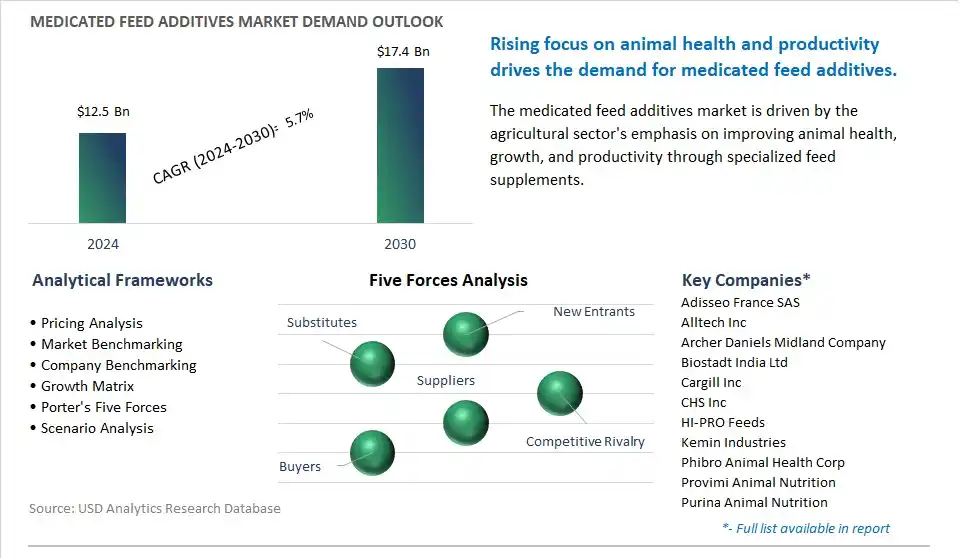
The global Medicated Feed Additives Market is poised to register a 5.7% CAGR from $12.5 Billion in 2024 to $17.4 Billion in 2030.
The global Medicated Feed Additives Market Study analyzes and forecasts the market size across 6 regions and 24 countries for diverse segments -By Type (Antibiotics, Vitamins, Antioxidants, Amino Acids, Prebiotics, Probiotics, Enzymes, Others), By Mixture (Supplements, Concentrates, Premixes, Base Mixes), By Animal (Ruminants, Swine, Poultry, Aquaculture, Others).
An Introduction to Global Medicated Feed Additives Market in 2024
The future of medicated feed additives is shaped by several key trends, including increasing demand for animal nutrition solutions in livestock production, advancements in feed additive technology and formulation science, and growing emphasis on animal health, performance, and food safety. Medicated feed additives are substances added to animal feed to improve growth, prevent diseases, and enhance feed efficiency, offering benefits such as antimicrobial activity, nutrient supplementation, and disease control. With the rise of global meat consumption, antibiotic stewardship, and regulatory scrutiny, there's a growing need for medicated feed additives that offer targeted health benefits, reduced environmental impact, and compliance with regulatory standards while supporting animal welfare and productivity. Moreover, advancements in feed additive research, such as probiotics, prebiotics, and phytogenics, are driving the development of alternative solutions for disease prevention, gut health, and performance enhancement in livestock and poultry production. Additionally, the integration of medicated feed additives with precision feeding technologies, such as feed sensors, automated dosing systems, and data analytics, is enabling precise and timely delivery of therapeutic agents, optimizing animal health outcomes and production efficiency. Collaboration between feed additive manufacturers, veterinarians, nutritionists, regulatory agencies, and livestock producers is essential to drive innovation, ensure product efficacy, and address market demands in the medicated feed additives industry.
Medicated Feed Additives Market Competitive Landscape
The market report analyses the leading companies in the industry including Adisseo France SAS, Alltech Inc, Archer Daniels Midland Company, Biostadt India Ltd, Cargill Inc, CHS Inc, HI-PRO Feeds, Kemin Industries, Phibro Animal Health Corp, Provimi Animal Nutrition, Purina Animal Nutrition, Zagro Corp, Zoetis Inc.
Medicated Feed Additives Market Dynamics
Medicated Feed Additives Market Trend: Increasing Focus on Animal Health and Antibiotic Alternatives
A significant trend in the medicated feed additives market is the increasing focus on animal health and the search for antibiotic alternatives. With growing concerns over antibiotic resistance and the need to ensure food safety, there's a notable shift towards medicated feed additives that promote animal well-being and improve disease resistance without relying solely on antibiotics. This trend is driving the development of alternative additives such as probiotics, prebiotics, organic acids, and phytogenics, which offer benefits such as improved gut health, immune stimulation, and enhanced growth performance in livestock and poultry. Additionally, regulatory efforts to reduce the use of antibiotics in animal agriculture are further accelerating the adoption of medicated feed additives as a sustainable solution to promote animal health and productivity while safeguarding public health.
Medicated Feed Additives Market Driver: Rising Demand for Quality Animal Products and Sustainable Farming Practices
A major driver of the medicated feed additives market is the rising demand for quality animal products and sustainable farming practices. As consumer awareness regarding food safety, animal welfare, and environmental sustainability grows, there's increasing pressure on livestock producers to adopt practices that ensure the health and welfare of their animals while minimizing the environmental impact of farming operations. Medicated feed additives play a crucial role in achieving these objectives by improving animal health, optimizing nutrient utilization, and reducing the need for therapeutic antibiotics. Furthermore, the rising global demand for protein-rich diets, particularly in developing countries, is driving the expansion of the livestock industry, thereby increasing the demand for medicated feed additives to support efficient and sustainable animal production systems.
Medicated Feed Additives Market Opportunity: Innovation in Functional Feed Ingredients and Targeted Nutritional Solutions
An opportunity within the medicated feed additives market lies in innovation in functional feed ingredients and targeted nutritional solutions. With advancements in feed technology and nutrigenomics, there's potential to develop customized additives that address specific health challenges and nutritional requirements of different animal species and production systems. This includes the development of additives tailored for different stages of animal growth, specific health conditions, and environmental challenges. Additionally, there's a growing interest in natural and botanical additives with antimicrobial, anti-inflammatory, and immunomodulatory properties, offering sustainable alternatives to traditional medicated feed additives. By investing in research and development and collaborating with animal nutritionists and veterinarians, companies can capitalize on the demand for innovative medicated feed additives that enhance animal health, performance, and sustainability, thus unlocking new opportunities for growth and market differentiation.
Medicated Feed Additives Market Share Analysis: The Antibiotics segment generated the highest revenue in 2024
The largest segment in the Medicated Feed Additives Market is the Antibiotics segment. Antibiotics are widely used in medicated feed additives for livestock and poultry to prevent and treat bacterial infections, promote growth, and improve feed efficiency. These additives help in maintaining animal health and enhancing productivity in intensive animal farming operations. Antibiotics are effective in controlling diseases and reducing mortality rates, thereby ensuring a steady supply of meat, dairy, and poultry products. Additionally, antibiotics play a crucial role in optimizing feed conversion ratios and maximizing weight gain, which is essential for meeting the growing global demand for animal protein. Despite increasing concerns about antimicrobial resistance and the need for judicious antibiotic use in animal agriculture, antibiotics continue to be widely used in medicated feed additives due to their proven efficacy and economic benefits. Accordingly, the Antibiotics segment remains dominant in the Medicated Feed Additives Market, reflecting its critical role in promoting animal health and productivity in the livestock industry.
Medicated Feed Additives Market Share Analysis: The Premixes segment is poised to register the fastest growth rate (CAGR) over the forecast period to 2030
The Premixes segment is experiencing rapid growth in the Medicated Feed Additives Market. Premixes are formulations that contain a combination of medicated additives, such as antibiotics, vitamins, minerals, and other nutritional supplements, mixed with carrier substances to create a homogeneous blend. These premixes offer potential advantages, including accurate dosing, uniform distribution of active ingredients in animal feed, and ease of handling and storage. Further, premixes allow feed manufacturers and livestock producers to customize feed formulations according to the specific nutritional requirements and health needs of different animal species and production stages. With the increasing focus on precision nutrition and the growing awareness of the importance of balanced diets in animal health and performance, there is a rising demand for specialized premix formulations tailored to address specific nutritional deficiencies and health challenges in livestock and poultry production. Additionally, the expansion of intensive animal farming practices and the rising prevalence of diseases and stressors in livestock populations further drive the demand for medicated feed premixes as an essential component of modern animal nutrition programs. Accordingly, the Premixes segment is the fastest-growing segment in the Medicated Feed Additives Market, fueled by the increasing adoption of precision feeding strategies and the need for targeted solutions to optimize animal health and productivity.
Medicated Feed Additives Market Share Analysis: The Aquaculture segment is poised to register the fastest growth rate (CAGR) over the forecast period to 2030
The fastest-growing segment in the Medicated Feed Additives Market is Aquaculture. Over recent years, there has been a surge in demand for seafood, driven by the growing population and increasing awareness of the health benefits associated with consuming fish and other aquatic products. Accordingly, the aquaculture industry has experienced significant expansion to meet this demand, leading to intensified production practices. However, this rapid growth has also brought about various challenges, including disease outbreaks and environmental concerns. To address these issues and ensure optimal health and growth of aquatic species, medicated feed additives are increasingly being utilized in aquaculture operations. These additives help to enhance immune function, prevent diseases, and promote growth, thereby improving the overall efficiency and productivity of aquaculture systems. Additionally, regulatory frameworks governing the use of medicated feed additives in aquaculture are evolving, further driving the market growth as companies strive to comply with stringent standards while meeting the rising demand for safe and sustainable seafood.
Medicated Feed Additives Market Report Segmentation
By Type
Antibiotics
Vitamins
Antioxidants
Amino Acids
Prebiotics
Probiotics
Enzymes
Others
By Mixture
Supplements
Concentrates
Premixes
Base Mixes
By Animal
Ruminants
Swine
Poultry
Aquaculture
Others
Regions Included
North America (US, Canada, Mexico)
Europe (Germany, UK, France, Spain, Italy, Russia, Rest of Europe)
Asia Pacific (China, India, Japan, South Korea, Australia, South East Asia, Rest of Asia)
South America (Brazil, Argentina, Rest of South America)
Middle East and Africa (Saudi Arabia, UAE, Rest of Middle East, South Africa, Egypt, Rest of Africa)
Medicated Feed Additives Companies Profiled in the Market Study
Adisseo France SAS
Alltech Inc
Archer Daniels Midland Company
Biostadt India Ltd
Cargill Inc
CHS Inc
HI-PRO Feeds
Kemin Industries
Phibro Animal Health Corp
Provimi Animal Nutrition
Purina Animal Nutrition
Zagro Corp
Zoetis Inc
*- List Not Exhaustive
TABLE OF CONTENTS
1 Introduction to 2024 Medicated Feed Additives Market
1.1 Market Overview
1.2 Quick Facts
1.3 Scope/Objective of the Study
1.4 Market Definition
1.5 Countries and Regions Covered
1.6 Units, Currency, and Conversions
1.7 Industry Value Chain
2 Research Methodology
2.1 Market Size Estimation
2.2 Sources and Research Methodology
2.3 Data Triangulation
2.4 Assumptions and Limitations
3 Executive Summary
3.1 Global Medicated Feed Additives Market Size Outlook, $ Million, 2021 to 2030
3.2 Medicated Feed Additives Market Outlook by Type, $ Million, 2021 to 2030
3.3 Medicated Feed Additives Market Outlook by Product, $ Million, 2021 to 2030
3.4 Medicated Feed Additives Market Outlook by Application, $ Million, 2021 to 2030
3.5 Medicated Feed Additives Market Outlook by Key Countries, $ Million, 2021 to 2030
4 Market Dynamics
4.1 Key Driving Forces of Medicated Feed Additives Industry
4.2 Key Market Trends in Medicated Feed Additives Industry
4.3 Potential Opportunities in Medicated Feed Additives Industry
4.4 Key Challenges in Medicated Feed Additives Industry
5 Market Factor Analysis
5.1 Value Chain Analysis
5.2 Competitive Landscape
5.2.1 Global Medicated Feed Additives Market Share by Company (%), 2023
5.2.2 Product Offerings by Company
5.3 Porter’s Five Forces Analysis
5.4 Pricing Analysis and Outlook
6 Growth Outlook Across Scenarios
6.1 Growth Analysis-Case Scenario Definitions
6.2 Low Growth Scenario Forecasts
6.3 Reference Growth Scenario Forecasts
6.4 High Growth Scenario Forecasts
7 Global Medicated Feed Additives Market Outlook by Segments
7.1 Medicated Feed Additives Market Outlook by Segments, $ Million, 2021- 2030
By Type
Antibiotics
Vitamins
Antioxidants
Amino Acids
Prebiotics
Probiotics
Enzymes
Others
By Mixture
Supplements
Concentrates
Premixes
Base Mixes
By Animal
Ruminants
Swine
Poultry
Aquaculture
Others
8 North America Medicated Feed Additives Market Analysis and Outlook To 2030
8.1 Introduction to North America Medicated Feed Additives Markets in 2024
8.2 North America Medicated Feed Additives Market Size Outlook by Country, 2021-2030
8.2.1 United States
8.2.2 Canada
8.2.3 Mexico
8.3 North America Medicated Feed Additives Market size Outlook by Segments, 2021-2030
By Type
Antibiotics
Vitamins
Antioxidants
Amino Acids
Prebiotics
Probiotics
Enzymes
Others
By Mixture
Supplements
Concentrates
Premixes
Base Mixes
By Animal
Ruminants
Swine
Poultry
Aquaculture
Others
9 Europe Medicated Feed Additives Market Analysis and Outlook To 2030
9.1 Introduction to Europe Medicated Feed Additives Markets in 2024
9.2 Europe Medicated Feed Additives Market Size Outlook by Country, 2021-2030
9.2.1 Germany
9.2.2 France
9.2.3 Spain
9.2.4 United Kingdom
9.2.4 Italy
9.2.5 Russia
9.2.6 Norway
9.2.7 Rest of Europe
9.3 Europe Medicated Feed Additives Market Size Outlook by Segments, 2021-2030
By Type
Antibiotics
Vitamins
Antioxidants
Amino Acids
Prebiotics
Probiotics
Enzymes
Others
By Mixture
Supplements
Concentrates
Premixes
Base Mixes
By Animal
Ruminants
Swine
Poultry
Aquaculture
Others
10 Asia Pacific Medicated Feed Additives Market Analysis and Outlook To 2030
10.1 Introduction to Asia Pacific Medicated Feed Additives Markets in 2024
10.2 Asia Pacific Medicated Feed Additives Market Size Outlook by Country, 2021-2030
10.2.1 China
10.2.2 India
10.2.3 Japan
10.2.4 South Korea
10.2.5 Indonesia
10.2.6 Malaysia
10.2.7 Australia
10.2.8 Rest of Asia Pacific
10.3 Asia Pacific Medicated Feed Additives Market size Outlook by Segments, 2021-2030
By Type
Antibiotics
Vitamins
Antioxidants
Amino Acids
Prebiotics
Probiotics
Enzymes
Others
By Mixture
Supplements
Concentrates
Premixes
Base Mixes
By Animal
Ruminants
Swine
Poultry
Aquaculture
Others
11 South America Medicated Feed Additives Market Analysis and Outlook To 2030
11.1 Introduction to South America Medicated Feed Additives Markets in 2024
11.2 South America Medicated Feed Additives Market Size Outlook by Country, 2021-2030
11.2.1 Brazil
11.2.2 Argentina
11.2.3 Rest of South America
11.3 South America Medicated Feed Additives Market size Outlook by Segments, 2021-2030
By Type
Antibiotics
Vitamins
Antioxidants
Amino Acids
Prebiotics
Probiotics
Enzymes
Others
By Mixture
Supplements
Concentrates
Premixes
Base Mixes
By Animal
Ruminants
Swine
Poultry
Aquaculture
Others
12 Middle East and Africa Medicated Feed Additives Market Analysis and Outlook To 2030
12.1 Introduction to Middle East and Africa Medicated Feed Additives Markets in 2024
12.2 Middle East and Africa Medicated Feed Additives Market Size Outlook by Country, 2021-2030
12.2.1 Saudi Arabia
12.2.2 UAE
12.2.3 Oman
12.2.4 Rest of Middle East
12.2.5 Egypt
12.2.6 Nigeria
12.2.7 South Africa
12.2.8 Rest of Africa
12.3 Middle East and Africa Medicated Feed Additives Market size Outlook by Segments, 2021-2030
By Type
Antibiotics
Vitamins
Antioxidants
Amino Acids
Prebiotics
Probiotics
Enzymes
Others
By Mixture
Supplements
Concentrates
Premixes
Base Mixes
By Animal
Ruminants
Swine
Poultry
Aquaculture
Others
13 Company Profiles
13.1 Company Snapshot
13.2 SWOT Profiles
13.3 Products and Services
13.4 Recent Developments
13.5 Financial Profile
Adisseo France SAS
Alltech Inc
Archer Daniels Midland Company
Biostadt India Ltd
Cargill Inc
CHS Inc
HI-PRO Feeds
Kemin Industries
Phibro Animal Health Corp
Provimi Animal Nutrition
Purina Animal Nutrition
Zagro Corp
Zoetis Inc
14 Appendix
14.1 Customization Offerings
14.2 Subscription Services
14.3 Related Reports
14.4 Publisher Expertise
By Type
Antibiotics
Vitamins
Antioxidants
Amino Acids
Prebiotics
Probiotics
Enzymes
Others
By Mixture
Supplements
Concentrates
Premixes
Base Mixes
By Animal
Ruminants
Swine
Poultry
Aquaculture
Others
Countries Analyzed
North America (US, Canada, Mexico)
Europe (Germany, UK, France, Spain, Italy, Russia, Rest of Europe)
Asia Pacific (China, India, Japan, South Korea, Australia, South East Asia, Rest of Asia)
South America (Brazil, Argentina, Rest of South America)
Middle East and Africa (Saudi Arabia, UAE, Rest of Middle East, South Africa, Egypt, Rest of Africa)
