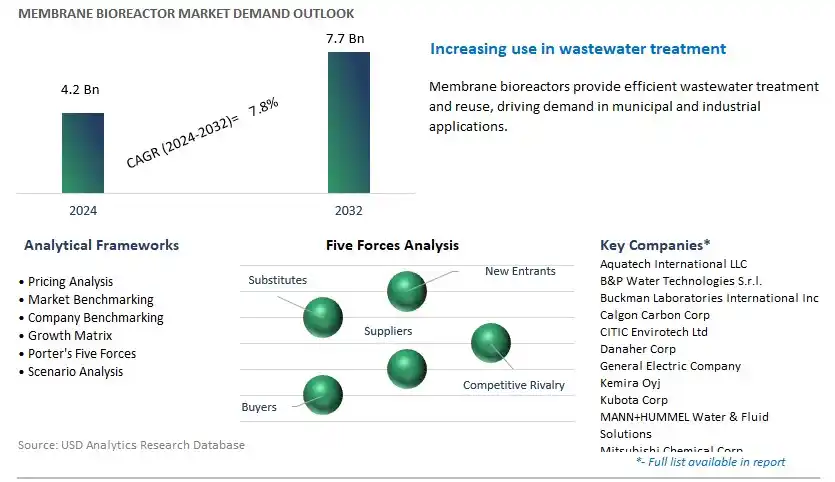
Global Membrane Bioreactor Market Size is valued at $4.2 Billion in 2024 and is forecast to register a growth rate (CAGR) of 7.8% to reach $7.7 Billion by 2032.
The global Membrane Bioreactor Market Study analyzes and forecasts the market size across 6 regions and 24 countries for diverse segments -By Product (Hollow Fiber, Flat Sheet, Multi-Tubular), By Configuration (Submerged, Side Stream), By Application (Municipal, Industrial).
An Introduction to Membrane Bioreactor Market in 2024
Membrane bioreactor (MBR) technology combines biological treatment processes with membrane filtration to achieve advanced wastewater treatment and water reuse in municipal and industrial applications. In 2024, the demand for membrane bioreactors s to rise as municipalities, industries, and environmental agencies seek efficient and sustainable solutions for wastewater treatment and resource recovery. MBR systems utilize microorganisms to degrade organic pollutants and remove nutrients from wastewater, followed by ultrafiltration or microfiltration membranes to separate treated water from suspended solids and pathogens. The membranes in MBR systems provide a physical barrier that retains particles and microorganisms, allowing for higher effluent quality and reduced footprint compared to conventional wastewater treatment methods. MBR technology offers advantages such as high treatment efficiency, compact design, and flexibility to handle fluctuations in flow and pollutant load. It is widely used in applications such as municipal wastewater treatment, industrial wastewater recycling, decentralized wastewater treatment, and water reclamation for irrigation and non-potable reuse. With advancements in membrane materials, module design, and process control, there is ongoing research into improving the performance and cost-effectiveness of MBR systems, as well as expanding their applicability to emerging contaminants such as pharmaceuticals and microplastics. Further, the adoption of MBR technology supports sustainable water management practices by reducing freshwater consumption, minimizing discharge of pollutants into water bodies, and recovering valuable resources from wastewater streams. As water scarcity and pollution concerns to escalate globally, the demand for membrane bioreactors as a sustainable solution for wastewater treatment and resource recovery is expected to increase, driving innovation and investment in MBR technology.
Membrane Bioreactor Market Competitive Landscape
The market report analyses the leading companies in the industry including Aquatech International LLC, B&P Water Technologies S.r.l., Buckman Laboratories International Inc, Calgon Carbon Corp, CITIC Envirotech Ltd, Danaher Corp, General Electric Company, Kemira Oyj, Kubota Corp, MANN+HUMMEL Water & Fluid Solutions, Mitsubishi Chemical Corp, Reynolds Culligan, SUEZ, Toray Industries Inc, Veolia Environnement SA, and others.
Membrane Bioreactor Market Dynamics
Market Trend: Increasing Adoption of Wastewater Treatment Technologies
A prominent market trend for membrane bioreactors (MBRs) is the increasing adoption of advanced wastewater treatment technologies globally. With growing concerns about water scarcity, pollution, and environmental sustainability, there's a rising demand for efficient and effective solutions to treat wastewater and reclaim water resources. Membrane bioreactors offer a compact and versatile approach to wastewater treatment, combining biological treatment processes with membrane filtration to produce high-quality effluent suitable for reuse or discharge. This trend is driven by regulatory requirements, population growth, urbanization, and industrialization, leading to the expansion of MBR installations in municipal, industrial, and commercial sectors worldwide.
Market Driver: Stringent Environmental Regulations and Water Quality Standards
A key market driver for membrane bioreactors is the implementation of stringent environmental regulations and water quality standards by government agencies and regulatory bodies. As concerns about water pollution and environmental degradation continue to rise, authorities are imposing stricter limits on effluent discharge and wastewater treatment requirements to protect public health and safeguard natural ecosystems. Membrane bioreactors provide a reliable and efficient solution for meeting these regulatory standards by removing contaminants, pathogens, and pollutants from wastewater streams, ensuring compliance with discharge limits and environmental regulations. The need to comply with regulatory mandates drives the demand for MBR systems in industries such as municipal wastewater treatment, food and beverage manufacturing, pharmaceuticals, and chemical processing.
Market Opportunity: Expansion into Emerging Markets and Industrial Applications
A potential opportunity for membrane bioreactors lies in the expansion into emerging markets and industrial applications beyond traditional municipal wastewater treatment. Opportunities exist for MBR technology to address wastewater treatment challenges in developing regions experiencing rapid urbanization, industrial growth, and limited access to clean water resources. Additionally, there's potential for the adoption of membrane bioreactors in various industrial sectors such as food and beverage, pulp and paper, textiles, and mining, where stringent water quality standards, water reuse requirements, and sustainability goals drive the demand for advanced wastewater treatment solutions. By targeting emerging markets and industrial applications, MBR manufacturers can capitalize on this opportunity to broaden their customer base, diversify revenue streams, and contribute to global efforts towards sustainable water management.
Membrane Bioreactor Market Share Analysis: Hollow Fiber segment generated the highest revenue in 2024
Within the Membrane Bioreactor market segmented by product, hollow fiber membranes emerge as the largest and most significant segment. Hollow fiber membranes offer a unique combination of properties that make them highly versatile and suitable for various applications in wastewater treatment and water purification processes. These membranes provide a large surface area for filtration within a compact module, allowing for efficient separation of solids, bacteria, and contaminants from water and wastewater streams. Additionally, hollow fiber membranes exhibit excellent mechanical strength, chemical resistance, and fouling resistance, ensuring long-term durability and performance in demanding operating conditions. Moreover, the modular design of hollow fiber membrane systems allows for scalability, flexibility, and ease of installation, making them preferred choices for both small-scale and large-scale water treatment facilities. As the demand for advanced membrane bioreactor systems continues to grow globally to address water scarcity and environmental concerns, the hollow fiber segment is expected to maintain its dominance in the Membrane Bioreactor market.
Membrane Bioreactor Market Share Analysis: Submerged Configuration segment generated the highest revenue in 2024
Among the configurations in the Membrane Bioreactor market, the submerged configuration is experiencing rapid growth. Submerged membrane bioreactors offer potential advantages over side stream configurations, including compact footprint, simplified operation, and reduced energy consumption. In submerged configurations, membranes are fully immersed in the bioreactor tank, allowing for direct contact between the biomass and the membranes. This facilitates efficient solids separation and biomass retention, resulting in higher treatment efficiencies and superior effluent quality. Additionally, submerged membrane bioreactors are less susceptible to membrane fouling and require minimal pre-treatment, making them ideal for treating challenging wastewater streams with high solids content or variable flow rates. Moreover, advancements in membrane technology, such as improved membrane materials and module designs, enhance the performance and reliability of submerged membrane bioreactors, further driving their adoption. As industries and municipalities seek sustainable and cost-effective solutions for wastewater treatment, the submerged configuration segment is expected to continue its rapid growth trajectory in the Membrane Bioreactor market.
Membrane Bioreactor Market Share Analysis: Municipal segment generated the highest revenue in 2024
Within the Membrane Bioreactor market segmented by application, the municipal sector is the largest and most significant segment. Municipalities around the world are increasingly investing in advanced wastewater treatment technologies to address growing urbanization, population growth, and environmental concerns. Membrane bioreactors offer an effective solution for treating municipal wastewater by combining biological treatment processes with membrane filtration to achieve high-quality effluent standards. Additionally, membrane bioreactors provide potential advantages for municipal applications, including compact footprint, flexible design, and superior treatment efficiency. They are capable of removing suspended solids, pathogens, and nutrients from wastewater, ensuring compliance with regulatory standards and protecting public health and the environment. Moreover, the modular nature of membrane bioreactor systems allows for easy scalability to meet the varying needs of municipal wastewater treatment plants. As municipalities continue to prioritize sustainable and efficient wastewater treatment solutions, the municipal sector is expected to maintain its dominance in the Membrane Bioreactor market.
Membrane Bioreactor Market
By Product
Hollow Fiber
Flat Sheet
Multi-Tubular
By Configuration
Submerged
Side Stream
By Application
Municipal
IndustrialCountries Analyzed
North America (US, Canada, Mexico)
Europe (Germany, UK, France, Spain, Italy, Russia, Rest of Europe)
Asia Pacific (China, India, Japan, South Korea, Australia, South East Asia, Rest of Asia)
South America (Brazil, Argentina, Rest of South America)
Middle East and Africa (Saudi Arabia, UAE, Rest of Middle East, South Africa, Egypt, Rest of Africa)
Membrane Bioreactor Companies Profiled in the Study
Aquatech International LLC
B&P Water Technologies S.r.l.
Buckman Laboratories International Inc
Calgon Carbon Corp
CITIC Envirotech Ltd
Danaher Corp
General Electric Company
Kemira Oyj
Kubota Corp
MANN+HUMMEL Water & Fluid Solutions
Mitsubishi Chemical Corp
Reynolds Culligan
SUEZ
Toray Industries Inc
Veolia Environnement SA
*- List Not Exhaustive
TABLE OF CONTENTS
1 Introduction to 2024 Membrane Bioreactor Market
1.1 Market Overview
1.2 Quick Facts
1.3 Scope/Objective of the Study
1.4 Market Definition
1.5 Countries and Regions Covered
1.6 Units, Currency, and Conversions
1.7 Industry Value Chain
2 Research Methodology
2.1 Market Size Estimation
2.2 Sources and Research Methodology
2.3 Data Triangulation
2.4 Assumptions and Limitations
3 Executive Summary
3.1 Global Membrane Bioreactor Market Size Outlook, $ Million, 2021 to 2032
3.2 Membrane Bioreactor Market Outlook by Type, $ Million, 2021 to 2032
3.3 Membrane Bioreactor Market Outlook by Product, $ Million, 2021 to 2032
3.4 Membrane Bioreactor Market Outlook by Application, $ Million, 2021 to 2032
3.5 Membrane Bioreactor Market Outlook by Key Countries, $ Million, 2021 to 2032
4 Market Dynamics
4.1 Key Driving Forces of Membrane Bioreactor Industry
4.2 Key Market Trends in Membrane Bioreactor Industry
4.3 Potential Opportunities in Membrane Bioreactor Industry
4.4 Key Challenges in Membrane Bioreactor Industry
5 Market Factor Analysis
5.1 Value Chain Analysis
5.2 Competitive Landscape
5.2.1 Global Membrane Bioreactor Market Share by Company (%), 2023
5.2.2 Product Offerings by Company
5.3 Porter’s Five Forces Analysis
5.4 Pricing Analysis and Outlook
6 Growth Outlook Across Scenarios
6.1 Growth Analysis-Case Scenario Definitions
6.2 Low Growth Scenario Forecasts
6.3 Reference Growth Scenario Forecasts
6.4 High Growth Scenario Forecasts
7 Global Membrane Bioreactor Market Outlook by Segments
7.1 Membrane Bioreactor Market Outlook by Segments, $ Million, 2021- 2032
By Product
Hollow Fiber
Flat Sheet
Multi-Tubular
By Configuration
Submerged
Side Stream
By Application
Municipal
Industrial
8 North America Membrane Bioreactor Market Analysis and Outlook To 2032
8.1 Introduction to North America Membrane Bioreactor Markets in 2024
8.2 North America Membrane Bioreactor Market Size Outlook by Country, 2021-2032
8.2.1 United States
8.2.2 Canada
8.2.3 Mexico
8.3 North America Membrane Bioreactor Market size Outlook by Segments, 2021-2032
By Product
Hollow Fiber
Flat Sheet
Multi-Tubular
By Configuration
Submerged
Side Stream
By Application
Municipal
Industrial
9 Europe Membrane Bioreactor Market Analysis and Outlook To 2032
9.1 Introduction to Europe Membrane Bioreactor Markets in 2024
9.2 Europe Membrane Bioreactor Market Size Outlook by Country, 2021-2032
9.2.1 Germany
9.2.2 France
9.2.3 Spain
9.2.4 United Kingdom
9.2.4 Italy
9.2.5 Russia
9.2.6 Norway
9.2.7 Rest of Europe
9.3 Europe Membrane Bioreactor Market Size Outlook by Segments, 2021-2032
By Product
Hollow Fiber
Flat Sheet
Multi-Tubular
By Configuration
Submerged
Side Stream
By Application
Municipal
Industrial
10 Asia Pacific Membrane Bioreactor Market Analysis and Outlook To 2032
10.1 Introduction to Asia Pacific Membrane Bioreactor Markets in 2024
10.2 Asia Pacific Membrane Bioreactor Market Size Outlook by Country, 2021-2032
10.2.1 China
10.2.2 India
10.2.3 Japan
10.2.4 South Korea
10.2.5 Indonesia
10.2.6 Malaysia
10.2.7 Australia
10.2.8 Rest of Asia Pacific
10.3 Asia Pacific Membrane Bioreactor Market size Outlook by Segments, 2021-2032
By Product
Hollow Fiber
Flat Sheet
Multi-Tubular
By Configuration
Submerged
Side Stream
By Application
Municipal
Industrial
11 South America Membrane Bioreactor Market Analysis and Outlook To 2032
11.1 Introduction to South America Membrane Bioreactor Markets in 2024
11.2 South America Membrane Bioreactor Market Size Outlook by Country, 2021-2032
11.2.1 Brazil
11.2.2 Argentina
11.2.3 Rest of South America
11.3 South America Membrane Bioreactor Market size Outlook by Segments, 2021-2032
By Product
Hollow Fiber
Flat Sheet
Multi-Tubular
By Configuration
Submerged
Side Stream
By Application
Municipal
Industrial
12 Middle East and Africa Membrane Bioreactor Market Analysis and Outlook To 2032
12.1 Introduction to Middle East and Africa Membrane Bioreactor Markets in 2024
12.2 Middle East and Africa Membrane Bioreactor Market Size Outlook by Country, 2021-2032
12.2.1 Saudi Arabia
12.2.2 UAE
12.2.3 Oman
12.2.4 Rest of Middle East
12.2.5 Egypt
12.2.6 Nigeria
12.2.7 South Africa
12.2.8 Rest of Africa
12.3 Middle East and Africa Membrane Bioreactor Market size Outlook by Segments, 2021-2032
By Product
Hollow Fiber
Flat Sheet
Multi-Tubular
By Configuration
Submerged
Side Stream
By Application
Municipal
Industrial
13 Company Profiles
13.1 Company Snapshot
13.2 SWOT Profiles
13.3 Products and Services
13.4 Recent Developments
13.5 Financial Profile
Aquatech International LLC
B&P Water Technologies S.r.l.
Buckman Laboratories International Inc
Calgon Carbon Corp
CITIC Envirotech Ltd
Danaher Corp
General Electric Company
Kemira Oyj
Kubota Corp
MANN+HUMMEL Water & Fluid Solutions
Mitsubishi Chemical Corp
Reynolds Culligan
SUEZ
Toray Industries Inc
Veolia Environnement SA
14 Appendix
14.1 Customization Offerings
14.2 Subscription Services
14.3 Related Reports
14.4 Publisher Expertise
By Product
Hollow Fiber
Flat Sheet
Multi-Tubular
By Configuration
Submerged
Side Stream
By Application
Municipal
Industrial
Countries Analyzed
North America (US, Canada, Mexico)
Europe (Germany, UK, France, Spain, Italy, Russia, Rest of Europe)
Asia Pacific (China, India, Japan, South Korea, Australia, South East Asia, Rest of Asia)
South America (Brazil, Argentina, Rest of South America)
Middle East and Africa (Saudi Arabia, UAE, Rest of Middle East, South Africa, Egypt, Rest of Africa)
