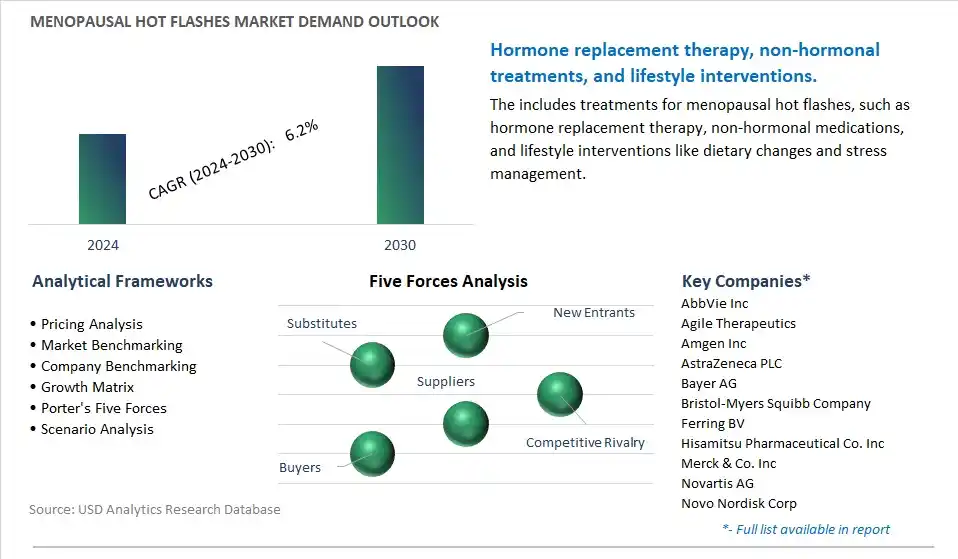
Menopausal Hot Flashes Market is estimated to increase at a Compounded Annual Growth Rate of 6.2% CAGR over the forecast period from 2024 to 2030
The Menopausal Hot Flashes Market study analyzes and forecasts the market size across 6 regions and 24 countries for diverse segments- By Treatment (Hormonal Treatment (Estrogen, Progesterone, Estrogen-Progesterone Combination), Non-hormonal Treatment).
An Introduction to Menopausal Hot Flashes Market in 2024
In 2024, the market for menopausal hot flashes addresses a common symptom experienced by women during menopause, characterized by sudden feelings of intense heat, sweating, and flushing of the face and upper body. Menopausal hot flashes result from hormonal changes, particularly decreased estrogen levels, and can significantly impact quality of life and daily activities for many women. Various treatment options are available to manage hot flashes, including hormone replacement therapy (HRT), non-hormonal medications, lifestyle modifications, and alternative therapies such as acupuncture and herbal supplements. Technological advancements in drug delivery systems and personalized medicine approaches offer new opportunities for targeted and tailored interventions, providing women with effective relief from menopausal symptoms while minimizing potential risks and side effects. With the aging population and increasing awareness of menopause-related issues, the market for menopausal hot flash treatments is poised for continued growth and innovation, offering women a range of options to manage this common menopausal symptom and improve their overall well-being.
Market Trend: Shift Towards Non-Hormonal Therapies
A prominent trend in the menopausal hot flashes market is the increasing demand for non-hormonal therapies for managing menopausal symptoms. With concerns about the potential risks and side effects associated with hormone replacement therapy (HRT), particularly in long-term use, there is a growing preference among menopausal women for alternative treatments that offer effective relief without hormonal intervention. Non-hormonal therapies, such as selective serotonin reuptake inhibitors (SSRIs), serotonin-norepinephrine reuptake inhibitors (SNRIs), gabapentinoids, and lifestyle modifications, are gaining popularity due to their perceived safety and efficacy in alleviating hot flashes and other menopausal symptoms. This trend is driven by increased awareness of the diverse treatment options available, as well as growing consumer demand for natural and holistic approaches to menopause management. Consequently, pharmaceutical companies and healthcare providers are focusing on developing and promoting non-hormonal therapies as viable alternatives to HRT, driving market growth and innovation in the menopausal hot flashes segment.
Market Driver: Aging Population and Menopause Awareness
The primary driver propelling the menopausal hot flashes market is the aging population and increased awareness of menopause as a natural stage of life. As the global population ages, the number of women reaching menopausal age is on the rise, leading to a growing prevalence of menopausal symptoms such as hot flashes, night sweats, and mood disturbances. Additionally, greater awareness and education about menopause and its associated symptoms have empowered women to seek help and treatment options to manage their symptoms effectively. This demographic shift, coupled with changing societal attitudes towards menopause, drives the demand for therapeutic interventions that address the unique needs and preferences of menopausal women. Consequently, healthcare providers, pharmaceutical companies, and wellness practitioners are investing in research, education, and outreach efforts to raise awareness about menopause and promote access to evidence-based treatments for menopausal symptoms, fueling market growth and addressing unmet needs in menopause care.
Market Opportunity: Development of Novel Therapies and Formulations
An opportunity within the menopausal hot flashes market lies in the development of novel therapies and formulations that offer improved efficacy, safety, and convenience for menopausal symptom management. Despite the availability of various treatment options, there remains a need for innovative therapies that provide rapid and sustained relief from hot flashes with minimal side effects. Pharmaceutical companies have the opportunity to explore new drug targets, delivery mechanisms, and formulations to optimize treatment outcomes and patient adherence. Additionally, there is potential for the development of combination therapies that target multiple pathways involved in hot flash generation, such as neuroendocrine modulation, vasomotor control, and thermoregulation. Moreover, opportunities exist for non-pharmacological interventions, including medical devices, dietary supplements, and lifestyle interventions, that offer complementary or adjunctive approaches to menopause management. By leveraging advancements in drug discovery, formulation sciences, and personalized medicine approaches, stakeholders in the menopausal hot flashes market can capitalize on this opportunity to address the diverse needs and preferences of menopausal women and improve their quality of life during this transitional phase.
Menopausal Hot Flashes Market Share Analysis: Non-hormonal Treatment for Menopausal Hot Flashes
The fast-growing segment within the menopausal hot flashes market is non-hormonal treatment options. This growth is driven by several factors. Firstly, many women seek alternatives to hormonal therapy due to concerns about potential side effects and risks associated with hormone-based treatments, such as increased risk of breast cancer, cardiovascular disease, and thromboembolic events. Non-hormonal treatments offer a safer and potentially more tolerable option for managing menopausal symptoms, including hot flashes. Secondly, non-hormonal treatments encompass a variety of approaches, including lifestyle modifications, dietary supplements, herbal remedies, and non-pharmacological interventions, providing women with a range of choices to address their individual needs and preferences. These treatments may include cognitive-behavioral therapy, acupuncture, yoga, meditation, and certain medications such as selective serotonin reuptake inhibitors (SSRIs), serotonin-norepinephrine reuptake inhibitors (SNRIs), gabapentin, and clonidine. Additionally, non-hormonal treatments are often recommended for women who have contraindications to hormonal therapy or prefer not to use hormones for personal or medical reasons. Furthermore, research into non-hormonal treatments for menopausal symptoms is ongoing, with ongoing clinical trials and studies exploring new therapeutic approaches and interventions. The growing interest in integrative and complementary medicine also contributes to the increasing demand for non-hormonal treatments among women experiencing menopausal hot flashes. Overall, the combination of safety concerns, treatment preferences, and expanding treatment options positions non-hormonal treatment as the fast-growing segment within the menopausal hot flashes market.
Menopausal Hot Flashes Competitive Analysis
The market research study provides in-depth insights into leading companies including the SWOT analyses, product profile, financial details, and recent developments acrossAbbVie Inc, Agile Therapeutics, Amgen Inc, AstraZeneca PLC, Bayer AG, Bristol-Myers Squibb Company, Ferring BV, Hisamitsu Pharmaceutical Co. Inc, Merck & Co. Inc, Novartis AG, Novo Nordisk Corp, Pfizer Inc, Teva Pharmaceutical Industries Ltd
Menopausal Hot Flashes Market Segmentation
By Treatment
Hormonal Treatment
-Estrogen
-Progesterone
-Estrogen-Progesterone Combination
Non-hormonal Treatment
-Antidepressants
-Others
Geographical Analysis
North America (United States, Canada, Mexico)
Europe (Germany, France, United Kingdom, Spain, Italy, Rest of Europe)
Asia Pacific (China, India, Japan, South Korea, Rest of Asia Pacific)
South America (Brazil, Argentina, Rest of South America)
Middle East and Africa (Saudi Arabia, UAE, Rest of Middle East, South Africa, Egypt, Rest of Africa)
Menopausal Hot Flashes Market Companies
AbbVie Inc
Agile Therapeutics
Amgen Inc
AstraZeneca PLC
Bayer AG
Bristol-Myers Squibb Company
Ferring BV
Hisamitsu Pharmaceutical Co. Inc
Merck & Co. Inc
Novartis AG
Novo Nordisk Corp
Pfizer Inc
Teva Pharmaceutical Industries Ltd
Reasons to Buy the Menopausal Hot Flashes Market Study
• Deepen your industry insights and navigate uncertainties for strategy formulation, CAPEX, and Operational decisions
• Gain access to detailed insights on the Menopausal Hot Flashes Market, encompassing current market size, growth trends, and forecasts till 2030.
• Access detailed competitor analysis, enabling competitive advantage through a thorough understanding of market players, strategies, and potential differentiation opportunities
• Stay ahead of the curve with insights on technological advancements, innovations, and upcoming trends
• Identify lucrative investment avenues and expansion opportunities within the Menopausal Hot Flashes Market industry, guided by robust, data-backed analysis.
• Understand regional and global markets through country-wise analysis, regional market potential, regulatory nuances, and dynamics
• Execute strategies with confidence and speed through information, analytics, and insights on the industry value chain
• Corporate leaders, strategists, financial experts, shareholders, asset managers, and governmental representatives can make long-term planning scenarios and build an integrated and timely understanding of market dynamics
• Benefit from tailored solutions and expert consultation based on report insights, providing personalized strategies aligned with specific business needs.
TABLE OF CONTENTS
1 Introduction to 2024 Menopausal Hot Flashes Market
1.1 Market Overview
1.2 Quick Facts
1.3 Scope/Objective of the Study
1.4 Market Definition
1.5 Countries and Regions Covered
1.6 Units, Currency, and Conversions
1.7 Industry Value Chain
2 Research Methodology
2.1 Market Size Estimation
2.2 Sources and Research Methodology
2.3 Data Triangulation
2.4 Assumptions and Limitations
3 Executive Summary
3.1 Global Menopausal Hot Flashes Market Size Outlook, $ Million, 2021 to 2030
3.2 Menopausal Hot Flashes Market Outlook by Type, $ Million, 2021 to 2030
3.3 Menopausal Hot Flashes Market Outlook by Product, $ Million, 2021 to 2030
3.4 Menopausal Hot Flashes Market Outlook by Application, $ Million, 2021 to 2030
3.5 Menopausal Hot Flashes Market Outlook by Key Countries, $ Million, 2021 to 2030
4 Market Dynamics
4.1 Key Driving Forces of Menopausal Hot Flashes Industry
4.2 Key Market Trends in Menopausal Hot Flashes Industry
4.3 Potential Opportunities in Menopausal Hot Flashes Industry
4.4 Key Challenges in Menopausal Hot Flashes Industry
5 Market Factor Analysis
5.1 Value Chain Analysis
5.2 Competitive Landscape
5.2.1 Global Menopausal Hot Flashes Market Share by Company (%), 2023
5.2.2 Product Offerings by Company
5.3 Porter’s Five Forces Analysis
5.4 Pricing Analysis and Outlook
6 Growth Outlook Across Scenarios
6.1 Growth Analysis-Case Scenario Definitions
6.2 Low Growth Scenario Forecasts
6.3 Reference Growth Scenario Forecasts
6.4 High Growth Scenario Forecasts
7 Global Menopausal Hot Flashes Market Outlook by Segments
7.1 Menopausal Hot Flashes Market Outlook by Segments, $ Million, 2021- 2030
By Treatment
Hormonal Treatment
-Estrogen
-Progesterone
-Estrogen-Progesterone Combination
Non-hormonal Treatment
-Antidepressants
-Others
8 North America Menopausal Hot Flashes Market Analysis and Outlook To 2030
8.1 Introduction to North America Menopausal Hot Flashes Markets in 2024
8.2 North America Menopausal Hot Flashes Market Size Outlook by Country, 2021-2030
8.2.1 United States
8.2.2 Canada
8.2.3 Mexico
8.3 North America Menopausal Hot Flashes Market size Outlook by Segments, 2021-2030
By Treatment
Hormonal Treatment
-Estrogen
-Progesterone
-Estrogen-Progesterone Combination
Non-hormonal Treatment
-Antidepressants
-Others
9 Europe Menopausal Hot Flashes Market Analysis and Outlook To 2030
9.1 Introduction to Europe Menopausal Hot Flashes Markets in 2024
9.2 Europe Menopausal Hot Flashes Market Size Outlook by Country, 2021-2030
9.2.1 Germany
9.2.2 France
9.2.3 Spain
9.2.4 United Kingdom
9.2.4 Italy
9.2.5 Russia
9.2.6 Norway
9.2.7 Rest of Europe
9.3 Europe Menopausal Hot Flashes Market Size Outlook by Segments, 2021-2030
By Treatment
Hormonal Treatment
-Estrogen
-Progesterone
-Estrogen-Progesterone Combination
Non-hormonal Treatment
-Antidepressants
-Others
10 Asia Pacific Menopausal Hot Flashes Market Analysis and Outlook To 2030
10.1 Introduction to Asia Pacific Menopausal Hot Flashes Markets in 2024
10.2 Asia Pacific Menopausal Hot Flashes Market Size Outlook by Country, 2021-2030
10.2.1 China
10.2.2 India
10.2.3 Japan
10.2.4 South Korea
10.2.5 Indonesia
10.2.6 Malaysia
10.2.7 Australia
10.2.8 Rest of Asia Pacific
10.3 Asia Pacific Menopausal Hot Flashes Market size Outlook by Segments, 2021-2030
By Treatment
Hormonal Treatment
-Estrogen
-Progesterone
-Estrogen-Progesterone Combination
Non-hormonal Treatment
-Antidepressants
-Others
11 South America Menopausal Hot Flashes Market Analysis and Outlook To 2030
11.1 Introduction to South America Menopausal Hot Flashes Markets in 2024
11.2 South America Menopausal Hot Flashes Market Size Outlook by Country, 2021-2030
11.2.1 Brazil
11.2.2 Argentina
11.2.3 Rest of South America
11.3 South America Menopausal Hot Flashes Market size Outlook by Segments, 2021-2030
By Treatment
Hormonal Treatment
-Estrogen
-Progesterone
-Estrogen-Progesterone Combination
Non-hormonal Treatment
-Antidepressants
-Others
12 Middle East and Africa Menopausal Hot Flashes Market Analysis and Outlook To 2030
12.1 Introduction to Middle East and Africa Menopausal Hot Flashes Markets in 2024
12.2 Middle East and Africa Menopausal Hot Flashes Market Size Outlook by Country, 2021-2030
12.2.1 Saudi Arabia
12.2.2 UAE
12.2.3 Oman
12.2.4 Rest of Middle East
12.2.5 Egypt
12.2.6 Nigeria
12.2.7 South Africa
12.2.8 Rest of Africa
12.3 Middle East and Africa Menopausal Hot Flashes Market size Outlook by Segments, 2021-2030
By Treatment
Hormonal Treatment
-Estrogen
-Progesterone
-Estrogen-Progesterone Combination
Non-hormonal Treatment
-Antidepressants
-Others
13 Company Profiles
13.1 Company Snapshot
13.2 SWOT Profiles
13.3 Products and Services
13.4 Recent Developments
13.5 Financial Profile
List of Companies
AbbVie Inc
Agile Therapeutics
Amgen Inc
AstraZeneca PLC
Bayer AG
Bristol-Myers Squibb Company
Ferring BV
Hisamitsu Pharmaceutical Co. Inc
Merck & Co. Inc
Novartis AG
Novo Nordisk Corp
Pfizer Inc
Teva Pharmaceutical Industries Ltd
14 Appendix
14.1 Customization Offerings
14.2 Subscription Services
14.3 Related Reports
14.4 Publisher Expertise
By Treatment
Hormonal Treatment
-Estrogen
-Progesterone
-Estrogen-Progesterone Combination
Non-hormonal Treatment
-Antidepressants
-Others
Countries Analyzed
North America (United States, Canada, Mexico)
Europe (Germany, France, United Kingdom, Spain, Italy, Rest of Europe)
Asia Pacific (China, India, Japan, South Korea, Rest of Asia Pacific)
South America (Brazil, Argentina, Rest of South America)
Middle East and Africa (Saudi Arabia, UAE, Rest of Middle East, South Africa, Egypt, Rest of Africa)
