
The global Mercerized Cotton Market Study analyzes and forecasts the market size across 6 regions and 24 countries for diverse segments -By Type (Yarn Mercerization, Knit Mercerization), By Application (Household, Garment Fabrics).
The future of mercerized cotton is shaped by several key trends reflecting advancements in textile technology, sustainability initiatives, and consumer preferences in the apparel and home textiles industries. One significant trend is the increasing demand for mercerized cotton fabrics and yarns known for their lustrous sheen, smooth handfeel, and enhanced strength and dye affinity. Mercerization is a textile finishing process that involves treating cotton fibers with caustic soda and tension to increase their surface area and improve their performance properties. Additionally, advancements in mercerization techniques, dyeing processes, and quality control standards are enhancing the consistency, durability, and colorfastness of mercerized cotton textiles while reducing environmental impact and resource consumption. Moreover, there is growing interest in the use of mercerized cotton as a sustainable and natural alternative to synthetic fibers, aligning with consumer preferences for eco-friendly and biodegradable materials in fashion and home décor. As brands and retailers increasingly prioritize transparency, traceability, and ethical sourcing in their supply chains, the demand for mercerized cotton is expected to grow, driving opportunities for cotton growers, spinners, and textile manufacturers to innovate and deliver high-quality, sustainable products that meet the evolving needs of the market.
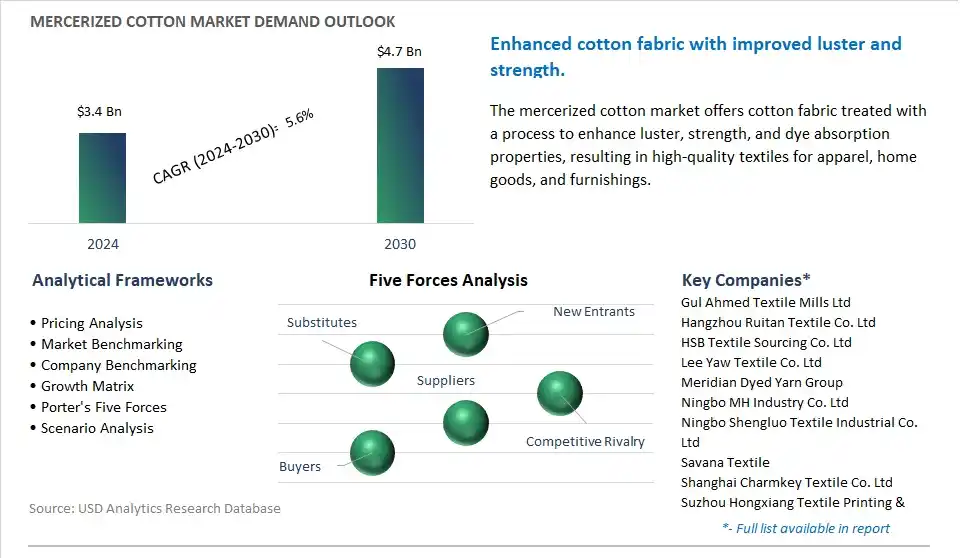
The market report analyses the leading companies in the industry including Gul Ahmed Textile Mills Ltd, Hangzhou Ruitan Textile Co. Ltd, HSB Textile Sourcing Co. Ltd, Lee Yaw Textile Co. Ltd, Meridian Dyed Yarn Group, Ningbo MH Industry Co. Ltd, Ningbo Shengluo Textile Industrial Co. Ltd, Savana Textile, Shanghai Charmkey Textile Co. Ltd, Suzhou Hongxiang Textile Printing & Dyeing Factory Co. Ltd, Wuxi Natural Textile Industrial Co. Ltd.
A significant trend in the Mercerized Cotton market is the increased demand for high-quality and luxurious textile products. Mercerized cotton, known for its smoothness, luster, and strength, is highly sought after by consumers looking for premium fabrics with superior aesthetics and durability. With a growing preference for luxury and comfort in apparel, home textiles, and interior furnishings, there's a rising demand for mercerized cotton fabrics that offer a luxurious feel, vibrant colors, and enhanced performance characteristics. The trend towards premiumization is encouraging companies to invest in consumers' need for superior quality and craftsmanship in their clothing and home décor, driving the demand for mercerized cotton and related products.
A key driver propelling the Mercerized Cotton market is advancements in textile processing technology and finishing techniques. Innovations in mercerization processes, dyeing methods, and fabric treatments have led to improvements in the quality, consistency, and versatility of mercerized cotton fabrics. Advanced mercerization techniques, such as cold mercerization and continuous mercerization, allow manufacturers to achieve needd fabric properties such as increased strength, color fastness, and dimensional stability while minimizing environmental impact. Additionally, developments in eco-friendly dyeing and finishing technologies enable the production of mercerized cotton fabrics with reduced water and chemical usage, meeting sustainability standards and consumer preferences. These technological advancements drive market growth by enhancing the performance and sustainability of mercerized cotton products and expanding their applications across various textile segments.
An opportunity in the Mercerized Cotton market lies in the expansion into high-end fashion and home textile markets. While mercerized cotton has long been favored for its superior qualities in apparel such as dress shirts, lingerie, and fine knitwear, there's potential for growth in luxury fashion segments such as designer clothing, couture collections, and bespoke tailoring. Mercerized cotton's smooth texture, vibrant colors, and ability to hold intricate designs make it an ideal choice for creating premium garments with a luxurious feel and aesthetic appeal. Additionally, there's an opportunity to explore the use of mercerized cotton fabrics in high-end home textiles such as bed linens, towels, and upholstery, catering to consumers seeking luxury and sophistication in their interior décor. By targeting these high-end fashion and home textile markets with innovative designs and premium mercerized cotton products, manufacturers and retailers can capitalize on new growth opportunities and elevate their brand presence in the luxury textile industry.
The Yarn Mercerization segment stands as the largest segment in the Mercerized Cotton Market. This dominance is driven by to the widespread use of mercerized cotton yarn in various textile applications, such as apparel, home textiles, and industrial textiles. Mercerization is a process that enhances the properties of cotton yarn, including increased strength, luster, and dye affinity, by treating it with caustic soda under tension. Mercerized cotton yarns exhibit improved smoothness, uniformity, and color brilliance compared to untreated cotton yarns, making them highly desirable for high-quality textile products. Additionally, mercerized cotton yarns are favored by textile manufacturers for their versatility and compatibility with different weaving, knitting, and dyeing processes. As consumer preferences shift towards premium and luxury textile products that offer superior aesthetics and performance, the demand for yarn mercerization in the textile industry is expected to remain robust, solidifying its position as the largest segment in the Mercerized Cotton Market.
The Garment Fabrics segment is the fastest-growing segment in the Mercerized Cotton Market. This growth is driven by the increasing demand for high-quality and luxurious textiles in the fashion industry. Mercerized cotton fabrics offer potential advantages, including enhanced luster, strength, and dye affinity, making them ideal for premium garment applications. Garment manufacturers prefer mercerized cotton fabrics for their ability to showcase vibrant colors and intricate patterns while maintaining a smooth and refined texture. Additionally, mercerized cotton fabrics exhibit improved resistance to shrinkage and pilling, resulting in garments that retain their shape and appearance over time. As consumers seek clothing that combines style with durability and comfort, the demand for mercerized cotton garment fabrics continues to rise. Further, the growing popularity of sustainable and natural fibers in the fashion industry further fuels the adoption of mercerized cotton fabrics, contributing to the rapid growth of the Garment Fabrics segment in the Mercerized Cotton Market.
By Type
Yarn Mercerization
Knit Mercerization
By Application
Household
Garment Fabrics
Regions Included
North America (US, Canada, Mexico)
Europe (Germany, UK, France, Spain, Italy, Russia, Rest of Europe)
Asia Pacific (China, India, Japan, South Korea, Australia, South East Asia, Rest of Asia)
South America (Brazil, Argentina, Rest of South America)
Middle East and Africa (Saudi Arabia, UAE, Rest of Middle East, South Africa, Egypt, Rest of Africa)
Gul Ahmed Textile Mills Ltd
Hangzhou Ruitan Textile Co. Ltd
HSB Textile Sourcing Co. Ltd
Lee Yaw Textile Co. Ltd
Meridian Dyed Yarn Group
Ningbo MH Industry Co. Ltd
Ningbo Shengluo Textile Industrial Co. Ltd
Savana Textile
Shanghai Charmkey Textile Co. Ltd
Suzhou Hongxiang Textile Printing & Dyeing Factory Co. Ltd
Wuxi Natural Textile Industrial Co. Ltd
*- List Not Exhaustive
TABLE OF CONTENTS
1 Introduction to 2024 Mercerized Cotton Market
1.1 Market Overview
1.2 Quick Facts
1.3 Scope/Objective of the Study
1.4 Market Definition
1.5 Countries and Regions Covered
1.6 Units, Currency, and Conversions
1.7 Industry Value Chain
2 Research Methodology
2.1 Market Size Estimation
2.2 Sources and Research Methodology
2.3 Data Triangulation
2.4 Assumptions and Limitations
3 Executive Summary
3.1 Global Mercerized Cotton Market Size Outlook, $ Million, 2021 to 2030
3.2 Mercerized Cotton Market Outlook by Type, $ Million, 2021 to 2030
3.3 Mercerized Cotton Market Outlook by Product, $ Million, 2021 to 2030
3.4 Mercerized Cotton Market Outlook by Application, $ Million, 2021 to 2030
3.5 Mercerized Cotton Market Outlook by Key Countries, $ Million, 2021 to 2030
4 Market Dynamics
4.1 Key Driving Forces of Mercerized Cotton Industry
4.2 Key Market Trends in Mercerized Cotton Industry
4.3 Potential Opportunities in Mercerized Cotton Industry
4.4 Key Challenges in Mercerized Cotton Industry
5 Market Factor Analysis
5.1 Value Chain Analysis
5.2 Competitive Landscape
5.2.1 Global Mercerized Cotton Market Share by Company (%), 2023
5.2.2 Product Offerings by Company
5.3 Porter’s Five Forces Analysis
5.4 Pricing Analysis and Outlook
6 Growth Outlook Across Scenarios
6.1 Growth Analysis-Case Scenario Definitions
6.2 Low Growth Scenario Forecasts
6.3 Reference Growth Scenario Forecasts
6.4 High Growth Scenario Forecasts
7 Global Mercerized Cotton Market Outlook by Segments
7.1 Mercerized Cotton Market Outlook by Segments, $ Million, 2021- 2030
By Type
Yarn Mercerization
Knit Mercerization
By Application
Household
Garment Fabrics
8 North America Mercerized Cotton Market Analysis and Outlook To 2030
8.1 Introduction to North America Mercerized Cotton Markets in 2024
8.2 North America Mercerized Cotton Market Size Outlook by Country, 2021-2030
8.2.1 United States
8.2.2 Canada
8.2.3 Mexico
8.3 North America Mercerized Cotton Market size Outlook by Segments, 2021-2030
By Type
Yarn Mercerization
Knit Mercerization
By Application
Household
Garment Fabrics
9 Europe Mercerized Cotton Market Analysis and Outlook To 2030
9.1 Introduction to Europe Mercerized Cotton Markets in 2024
9.2 Europe Mercerized Cotton Market Size Outlook by Country, 2021-2030
9.2.1 Germany
9.2.2 France
9.2.3 Spain
9.2.4 United Kingdom
9.2.4 Italy
9.2.5 Russia
9.2.6 Norway
9.2.7 Rest of Europe
9.3 Europe Mercerized Cotton Market Size Outlook by Segments, 2021-2030
By Type
Yarn Mercerization
Knit Mercerization
By Application
Household
Garment Fabrics
10 Asia Pacific Mercerized Cotton Market Analysis and Outlook To 2030
10.1 Introduction to Asia Pacific Mercerized Cotton Markets in 2024
10.2 Asia Pacific Mercerized Cotton Market Size Outlook by Country, 2021-2030
10.2.1 China
10.2.2 India
10.2.3 Japan
10.2.4 South Korea
10.2.5 Indonesia
10.2.6 Malaysia
10.2.7 Australia
10.2.8 Rest of Asia Pacific
10.3 Asia Pacific Mercerized Cotton Market size Outlook by Segments, 2021-2030
By Type
Yarn Mercerization
Knit Mercerization
By Application
Household
Garment Fabrics
11 South America Mercerized Cotton Market Analysis and Outlook To 2030
11.1 Introduction to South America Mercerized Cotton Markets in 2024
11.2 South America Mercerized Cotton Market Size Outlook by Country, 2021-2030
11.2.1 Brazil
11.2.2 Argentina
11.2.3 Rest of South America
11.3 South America Mercerized Cotton Market size Outlook by Segments, 2021-2030
By Type
Yarn Mercerization
Knit Mercerization
By Application
Household
Garment Fabrics
12 Middle East and Africa Mercerized Cotton Market Analysis and Outlook To 2030
12.1 Introduction to Middle East and Africa Mercerized Cotton Markets in 2024
12.2 Middle East and Africa Mercerized Cotton Market Size Outlook by Country, 2021-2030
12.2.1 Saudi Arabia
12.2.2 UAE
12.2.3 Oman
12.2.4 Rest of Middle East
12.2.5 Egypt
12.2.6 Nigeria
12.2.7 South Africa
12.2.8 Rest of Africa
12.3 Middle East and Africa Mercerized Cotton Market size Outlook by Segments, 2021-2030
By Type
Yarn Mercerization
Knit Mercerization
By Application
Household
Garment Fabrics
13 Company Profiles
13.1 Company Snapshot
13.2 SWOT Profiles
13.3 Products and Services
13.4 Recent Developments
13.5 Financial Profile
Gul Ahmed Textile Mills Ltd
Hangzhou Ruitan Textile Co. Ltd
HSB Textile Sourcing Co. Ltd
Lee Yaw Textile Co. Ltd
Meridian Dyed Yarn Group
Ningbo MH Industry Co. Ltd
Ningbo Shengluo Textile Industrial Co. Ltd
Savana Textile
Shanghai Charmkey Textile Co. Ltd
Suzhou Hongxiang Textile Printing & Dyeing Factory Co. Ltd
Wuxi Natural Textile Industrial Co. Ltd
14 Appendix
14.1 Customization Offerings
14.2 Subscription Services
14.3 Related Reports
14.4 Publisher Expertise
By Type
Yarn Mercerization
Knit Mercerization
By Application
Household
Garment Fabrics
Countries Analyzed
North America (US, Canada, Mexico)
Europe (Germany, UK, France, Spain, Italy, Russia, Rest of Europe)
Asia Pacific (China, India, Japan, South Korea, Australia, South East Asia, Rest of Asia)
South America (Brazil, Argentina, Rest of South America)
Middle East and Africa (Saudi Arabia, UAE, Rest of Middle East, South Africa, Egypt, Rest of Africa)
Global Mercerized Cotton is forecast to reach $4.7 Billion in 2030 from $3.4 Billion in 2024, registering a CAGR of 5.6%
Emerging Markets across Asia Pacific, Europe, and Americas present robust growth prospects.
Gul Ahmed Textile Mills Ltd, Hangzhou Ruitan Textile Co. Ltd, HSB Textile Sourcing Co. Ltd, Lee Yaw Textile Co. Ltd, Meridian Dyed Yarn Group, Ningbo MH Industry Co. Ltd, Ningbo Shengluo Textile Industrial Co. Ltd, Savana Textile, Shanghai Charmkey Textile Co. Ltd, Suzhou Hongxiang Textile Printing & Dyeing Factory Co. Ltd, Wuxi Natural Textile Industrial Co. Ltd
Base Year- 2023; Estimated Year- 2024; Historic Period- 2018-2023; Forecast period- 2024 to 2030; Currency: Revenue (USD); Volume