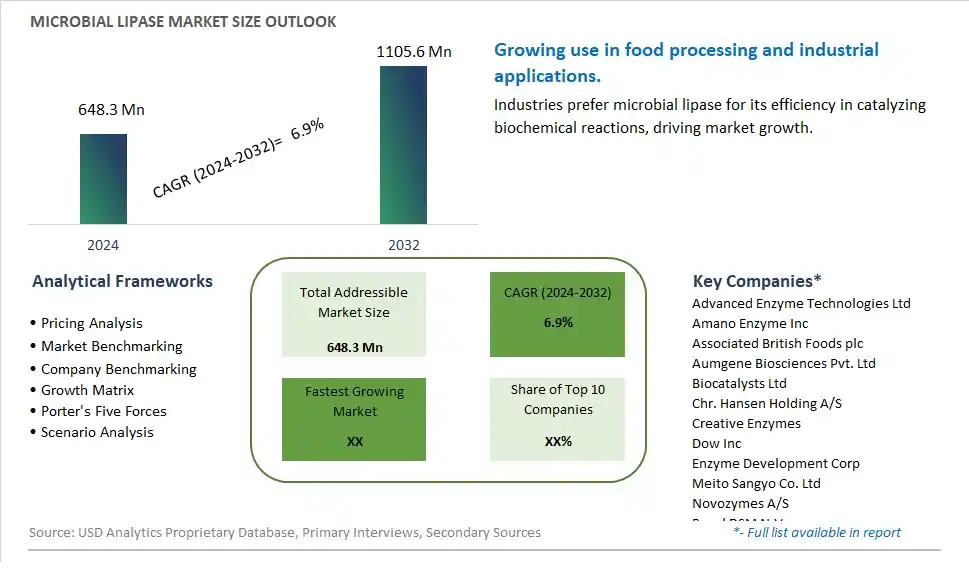
Global Microbial Lipase Market Size is valued at $648.3 Million in 2024 and is forecast to register a growth rate (CAGR) of 6.9% to reach $1105.6 Million by 2032.
The global Microbial Lipase Market Comprehensive Study analyzes and forecasts the market size across 6 regions and 24 countries for diverse segments -By Application (Cleaning agents, Animal feed, Dairy products, Bakery products, Confectionery products, Others), By Form (Powder, Liquid), By Source (Fungi, Bacteria)
An Introduction to Microbial Lipase Market
The microbial lipase market in 2024 is witnessing steady growth, driven by increasing demand for enzyme-based solutions in various industrial applications, including food processing, dairy, bakery, and detergent manufacturing. Microbial lipases, a class of enzymes produced by microorganisms such as bacteria and fungi, play a crucial role in catalyzing lipid hydrolysis, flavor development, and texture modification in food and non-food applications. With consumers seeking clean label and sustainable ingredients, manufacturers are replacing chemical additives and synthetic emulsifiers with microbial lipases to enhance product quality, functionality, and shelf life. Moreover, advancements in enzyme engineering and fermentation technologies are enabling the production of highly efficient and cost-effective microbial lipase preparations tailored to specific industrial requirements. Additionally, strategic collaborations between enzyme manufacturers, research institutions, and end-user industries are driving product innovation, market expansion, and application diversification. Furthermore, regulatory approvals and certifications affirming the safety and efficacy of microbial lipase preparations are bolstering consumer confidence and market acceptance. Overall, the microbial lipase market is poised for sustained growth as its versatility, eco-friendly profile, and performance advantages continue to be recognized across diverse sectors.
Microbial Lipase Competitive Landscape
The market report analyses the leading companies in the industry including Advanced Enzyme Technologies Ltd, Amano Enzyme Inc, Associated British Foods plc, Aumgene Biosciences Pvt. Ltd, Biocatalysts Ltd, Chr. Hansen Holding A/S, Creative Enzymes, Dow Inc, Enzyme Development Corp, Meito Sangyo Co. Ltd, Novozymes A/S, Royal DSM N.V., and Others.
Microbial Lipase Market Dynamics
Microbial Lipase Market Trend: Increasing Demand for Enzyme Solutions in Food and Beverage Industry
One prominent trend in the microbial lipase market is the increasing demand for enzyme solutions in the food and beverage industry. As consumers become more health-conscious and seek cleaner labels, manufacturers are turning to enzymes like microbial lipase to enhance product quality, flavor, and nutritional value. Microbial lipase finds extensive applications in dairy, bakery, and cheese industries, where it helps in flavor development, fat breakdown, and texture improvement. This trend is driven by the need for natural, sustainable, and effective ingredients to meet evolving consumer preferences and regulatory requirements.
Market Driver: Growth in Processed Food Consumption and Innovation in Food Formulations
A key driver in the microbial lipase market is the growth in processed food consumption and innovation in food formulations. With changing lifestyles, urbanization, and increasing disposable incomes, there's a rising demand for convenient, ready-to-eat food products. Microbial lipase plays a vital role in enhancing the flavor, texture, and shelf-life of processed foods, making it indispensable for manufacturers seeking to meet consumer expectations for taste and quality. Additionally, ongoing research and development efforts are driving innovation in food formulations, leading to new opportunities for microbial lipase applications in diverse food products.
Market Opportunity: Expansion into Non-Food Applications and Biotechnological Industries
An emerging opportunity in the microbial lipase market is the expansion into non-food applications and biotechnological industries. While microbial lipase is primarily used in the food and beverage sector, there's growing interest in its potential applications beyond food. Lipases have significant industrial relevance due to their ability to catalyze various chemical reactions, making them valuable in sectors such as biofuel production, pharmaceuticals, detergents, and cosmetics. By leveraging the versatility and specificity of microbial lipase enzymes, companies can tap into new markets and develop innovative solutions for a wide range of industrial processes, creating opportunities for growth and diversification.
Microbial Lipase Market Share Analysis: Dairy Products held the dominant market share in 2024
Within the microbial lipase market, the Dairy Products segment is the largest, driven by several pivotal factors. Dairy products, including cheese, butter, and yogurt, represent a significant portion of global food consumption, with a growing demand fueled by increasing population, rising disposable incomes, and changing dietary preferences. Microbial lipases play a crucial role in dairy processing, facilitating flavor development, texture enhancement, and shelf-life extension in various dairy products. Further, advancements in microbial lipase technology have led to the development of highly efficient enzymes tailored for specific applications, further optimizing dairy production processes and product quality. Additionally, the growing trend of clean label and natural ingredients in dairy products drives the demand for microbial lipases as alternatives to traditional chemical additives, enhancing the appeal of these products among health-conscious consumers. Furthermore, the versatility of microbial lipases enables their application in a wide range of dairy products, including hard and soft cheeses, cultured dairy products, and milk-based desserts, further driving their prevalence and dominance in the microbial lipase market. As the dairy industry continues to expand globally, driven by evolving consumer preferences and technological innovations, the demand for microbial lipases in dairy applications is expected to remain robust, sustaining the dominance of the Dairy Products segment in the microbial lipase market.
Microbial Lipase Market Share Analysis: Liquid market is poised to register the fastest growth rae over the forecast period to 2032
Within the microbial lipase market, the Liquid segment is the fastest-growing, driven by several pivotal factors. Liquid microbial lipases offer unique advantages over their powdered counterparts, including higher activity levels, better dispersibility, and greater ease of incorporation into various food and industrial applications. Additionally, the liquid form allows for more precise dosage control and uniform distribution within formulations, leading to improved process efficiency and product quality. Further, technological advancements in enzyme production and formulation techniques have led to the development of highly stable liquid microbial lipase preparations, extending their shelf life and enhancing their performance in diverse environments. Furthermore, the growing demand for clean label and natural ingredients in food and industrial processes drives the adoption of liquid microbial lipases as preferred alternatives to synthetic additives, further fueling their rapid growth in the market. As industries continue to seek efficient and sustainable solutions for enzyme applications, the liquid form of microbial lipases stands out as a dynamic and indispensable segment driving innovation and growth in the microbial lipase market.
Microbial Lipase Market Share Analysis: Powder held the dominant market share in 2024
In the microbial lipase market, the Powder segment is experiencing rapid growth due to several key factors. Powdered microbial lipases offer versatility and convenience, making them ideal for a wide range of applications in various industries such as food, pharmaceuticals, and biofuels. Their dry form ensures long-term stability and ease of storage, enabling manufacturers to maintain product integrity and shelf life. Further, powdered lipases are easily dispersible and compatible with different formulations, facilitating uniform mixing and distribution, which is crucial for achieving desired enzymatic activity levels in diverse processes. Additionally, advancements in enzyme production technology have led to the development of highly concentrated and efficient powdered lipase preparations, meeting the increasing demand for cost-effective and high-performance enzyme solutions. Furthermore, the growing awareness among consumers and manufacturers regarding the benefits of microbial lipases in enhancing product quality, improving process efficiency, and reducing environmental impact further drives the demand for powdered lipases in the market. As industries continue to seek innovative enzyme solutions for various applications, the Powder segment of the microbial lipase market is poised to maintain its rapid growth trajectory.
Microbial Lipase Market Share Analysis: Fungi held the dominant market share in 2024
Within the microbial lipase market, the Fungi segment is the largest, driven by several pivotal factors. Fungi are prolific producers of lipases, with a diverse range of species yielding enzymes with varying properties and applications. This diversity allows for the development of highly specialized lipase formulations tailored to specific industrial processes, including food and beverage production, pharmaceuticals, and biofuels. Further, fungi-derived lipases are characterized by high stability, activity, and tolerance to a wide range of pH and temperature conditions, making them versatile and adaptable to various manufacturing environments. Additionally, advancements in fermentation technology have led to improved yields and cost-effective production of fungal lipases, further enhancing their competitiveness in the market. Furthermore, the growing demand for natural and sustainable ingredients in consumer products drives the preference for fungal lipases over synthetic alternatives, further solidifying the dominance of the Fungi segment in the microbial lipase market. As industries continue to seek efficient and eco-friendly enzyme solutions, fungal-derived lipases remain at the forefront, driving growth and innovation in the microbial lipase market.
Microbial Lipase Market Segmentation
By Application
Cleaning agents
Animal feed
Dairy products
Bakery products
Confectionery products
Others
By Form
Powder
Liquid
By Source
Fungi
Bacteria
Countries Analyzed
North America (US, Canada, Mexico)
Europe (Germany, UK, France, Spain, Italy, Russia, Rest of Europe)
Asia Pacific (China, India, Japan, South Korea, Australia, South East Asia, Rest of Asia)
South America (Brazil, Argentina, Rest of South America)
Middle East and Africa (Saudi Arabia, UAE, Rest of Middle East, South Africa, Egypt, Rest of Africa)
Microbial Lipase Companies Profiled in the Study
Advanced Enzyme Technologies Ltd
Amano Enzyme Inc
Associated British Foods plc
Aumgene Biosciences Pvt. Ltd
Biocatalysts Ltd
Chr. Hansen Holding A/S
Creative Enzymes
Dow Inc
Enzyme Development Corp
Meito Sangyo Co. Ltd
Novozymes A/S
Royal DSM N.V.
*- List Not Exhaustive
Chapter 1. TABLE OF CONTENTS
Chapter 2. Introduction to Microbial Lipase Market
2.1. Market Overview
2.2. Key Statistics and Report Highlights
2.3. Scope of the Comprehensive Study
2.3.1. Market Definition
2.3.2 Countries and Regions Covered
2.3.3 Research Objective
2.3.4 Units, Currency, and Conversions
2.3.5 Industry Value Chain
2.4. Key Market Segments
2.5. Key Companies
2.6. Study Period
Chapter 3. Strategic Analysis Review
3.1. Microbial Lipase Pricing Analysis and Forecast
3.2. Porter’s Five Forces
3.3. Market Ecosystem
3.4. SWOT Analysis
3.5. Regulatory Scenario
3.3. Effects of Inflation, Russia-Ukraine War, moderating economic growth, and other macroeconomic factors
Chapter 4. Competitive Landscape
4.1. Market Share Analysis
4.1.1. Global Microbial Lipase Market Share by Company, 2023
4.1.2. Product Offerings of Leading Microbial Lipase Companies
4.2. Market Entropy
4.2.1. New Product Launches in the Industry
4.2.2. Mergers, Acquisitions, Joint ventures, and Partnerships
4.3. Key Strategies and Best Practices
Chapter 5. Global Market Projections: Best, Reference, and Low Case Scenarios
5.1. Growth Analysis- Case Scenario Definitions
5.2. Low Growth Case Scenario Forecasts
5.3. Reference Growth Case Scenario Forecasts
5.4. High Growth Case Scenario Forecasts
Chapter 6. Market Dynamics
6.1. Microbial Lipase Market Drivers
6.2. Microbial Lipase Market Challenges
6.6. Microbial Lipase Market Opportunities
6.4. Microbial Lipase Market Trends
Chapter 7. Global Microbial Lipase Market Outlook Trends
7.1. Global Microbial Lipase Revenue (USD Million) and CAGR (%) by Type (2021-2032)
7.2. Global Microbial Lipase Revenue (USD Million) and CAGR (%) by Application (2021-2032)
7.3. Global Microbial Lipase Revenue (USD Million) and CAGR (%) by Product (2021-2032)
By Application
Cleaning agents
Animal feed
Dairy products
Bakery products
Confectionery products
Others
By Form
Powder
Liquid
By Source
Fungi
Bacteria
Chapter 8. Global Microbial Lipase Regional Analysis and Outlook
8.1. Global Microbial Lipase Revenue (USD Million) By Regions (2021- 2032)
8.2. North America Microbial Lipase Revenue (USD Million) by Country (2021-2032)
8.2.1. United States Microbial Lipase Regional Analysis and Outlook
8.2.2. Canada Microbial Lipase Regional Analysis and Outlook
8.2.3. Mexico Microbial Lipase Regional Analysis and Outlook
8.3. Europe Microbial Lipase Revenue (USD Million), by Country (2021-2032)
8.3.1. Germany Microbial Lipase Regional Analysis and Outlook
8.3.2. France Microbial Lipase Regional Analysis and Outlook
8.3.3. United Kingdom Microbial Lipase Regional Analysis and Outlook
8.3.4. Spain Microbial Lipase Regional Analysis and Outlook
8.3.5. Italy Microbial Lipase Regional Analysis and Outlook
8.3.6. Russia Microbial Lipase Regional Analysis and Outlook
8.3.7. Rest of Europe Microbial Lipase Regional Analysis and Outlook
8.4. Asia Pacific Microbial Lipase Revenue (USD Million) by Country (2021-2032)
8.4.1. China Microbial Lipase Regional Analysis and Outlook
8.4.2. Japan Microbial Lipase Regional Analysis and Outlook
8.4.3. India Microbial Lipase Regional Analysis and Outlook
8.4.4. South Korea Microbial Lipase Regional Analysis and Outlook
8.4.5. Australia Microbial Lipase Regional Analysis and Outlook
8.4.6. South East Asia Microbial Lipase Regional Analysis and Outlook
8.4.7. Rest of Asia Pacific Microbial Lipase Regional Analysis and Outlook
8.5. South America Microbial Lipase Revenue (USD Million), by Country (2021-2032)
8.5.1. Brazil Microbial Lipase Regional Analysis and Outlook
8.5.2. Argentina Microbial Lipase Regional Analysis and Outlook
8.5.3. Rest of South America Microbial Lipase Regional Analysis and Outlook
8.6. Middle East and Africa Microbial Lipase Revenue (USD Million) by Country (2021-2032)
8.6.1. Middle East Microbial Lipase Regional Analysis and Outlook
8.6.2. Africa Microbial Lipase Regional Analysis and Outlook
Chapter 9. North America Microbial Lipase Analysis and Outlook
9.1. North America Microbial Lipase Revenue (USD Million) by Segments (2021-2032)
9.1.1. North America Microbial Lipase Revenue (USD Million) by Type (2021-2032)
9.1.2. North America Microbial Lipase Revenue (USD Million) by Application (2021-2032)
9.1.3. North America Microbial Lipase Revenue (USD Million) by Product (2021-2032)
By Application
Cleaning agents
Animal feed
Dairy products
Bakery products
Confectionery products
Others
By Form
Powder
Liquid
By Source
Fungi
Bacteria
Chapter 10. Europe Microbial Lipase Analysis and Outlook
10.1. Europe Microbial Lipase Revenue (USD Million), by Segments (USD Million) (2021-2032)
10.1.1. Europe Microbial Lipase Revenue (USD Million) by Type (2021-2032)
10.1.2. Europe Microbial Lipase Revenue (USD Million) by Application (2021-2032)
10.1.3. Europe Microbial Lipase Revenue (USD Million) by Product (2021-2032)
By Application
Cleaning agents
Animal feed
Dairy products
Bakery products
Confectionery products
Others
By Form
Powder
Liquid
By Source
Fungi
Bacteria
Chapter 11. Asia Pacific Microbial Lipase Analysis and Outlook
11.1. Asia Pacific Microbial Lipase Revenue (USD Million), and Revenue (USD Million) by Segments (2021-2032)
11.1.1. Asia Pacific Microbial Lipase Revenue (USD Million) by Type (2021-2032)
11.1.2. Asia Pacific Microbial Lipase Revenue (USD Million) by Application (2021-2032)
11.1.3. Asia Pacific Microbial Lipase Revenue (USD Million) by Product (2021-2032)
By Application
Cleaning agents
Animal feed
Dairy products
Bakery products
Confectionery products
Others
By Form
Powder
Liquid
By Source
Fungi
Bacteria
Chapter 12. South America Microbial Lipase Analysis and Outlook
12.1. South America Microbial Lipase Revenue (USD Million), by Segments (2021-2032)
12.1.1. South America Microbial Lipase Revenue (USD Million) by Type (2021-2032)
12.1.2. South America Microbial Lipase Revenue (USD Million) by Application (2021-2032)
12.1.3. South America Microbial Lipase Revenue (USD Million) by Product (2021-2032)
By Application
Cleaning agents
Animal feed
Dairy products
Bakery products
Confectionery products
Others
By Form
Powder
Liquid
By Source
Fungi
Bacteria
Chapter 13. Middle East and Africa Microbial Lipase Analysis and Outlook
13.1. Middle East and Africa Microbial Lipase Revenue (USD Million), by Segments (2021-2032)
13.1.1. Middle East and Africa Microbial Lipase Revenue (USD Million) by Type (2021-2032)
13.1.2. Middle East and Africa Microbial Lipase Revenue (USD Million) by Application (2021-2032)
13.1.3. Middle East and Africa Microbial Lipase Revenue (USD Million) by Product (2021-2032)
By Application
Cleaning agents
Animal feed
Dairy products
Bakery products
Confectionery products
Others
By Form
Powder
Liquid
By Source
Fungi
Bacteria
Chapter 14. Microbial Lipase Company Profiles
14.1 Business Overview
14.2 Product Profiles
14.3 SWOT Profiles
14.5 Recent Developments
14.6 Financial Profile
List of Companies
Advanced Enzyme Technologies Ltd
Amano Enzyme Inc
Associated British Foods plc
Aumgene Biosciences Pvt. Ltd
Biocatalysts Ltd
Chr. Hansen Holding A/S
Creative Enzymes
Dow Inc
Enzyme Development Corp
Meito Sangyo Co. Ltd
Novozymes A/S
Royal DSM N.V.
15. Methodology and Data Sources
15.1 Customization Offerings
15.2 Subscription Services
15.3 Related Reports
15.4 Publisher Expertise
LIST OF TABLES
Table 1 Market Segmentation Analysis
Table 2 Global Microbial Lipase Market Share of Leading Companies, 2023
Table 3 Product Offerings of Leading Companies
Table 4 Low Growth Scenario Forecasts
Table 5 Reference Case Growth Scenario
Table 6 High Growth Case Scenario
Table 7 Global Microbial Lipase Revenue (USD Million) And CAGR (%) By Type (2021-2032)
Table 8 Global Microbial Lipase Revenue (USD Million) And CAGR (%) By Application (2021-2032)
Table 9 Global Microbial Lipase Revenue (USD Million) And CAGR (%) By Product (2021-2032)
Table 10 Global Microbial Lipase Market Revenue (USD Million) By Regions (2021-2032)
Table 11 Global Microbial Lipase Market Share (%) By Regions (2021-2032)
Table 12 North America Microbial Lipase Revenue (USD Million) By Country (2021-2032)
Table 13 Europe Microbial Lipase Revenue (USD Million) By Country (2021-2032)
Table 14 Asia Pacific Microbial Lipase Revenue (USD Million) By Country (2021-2032)
Table 15 South America Microbial Lipase Revenue (USD Million) By Country (2021-2032)
Table 16 Middle East and Africa Microbial Lipase Revenue (USD Million) By Region (2021-2032)
Table 17 North America Microbial Lipase Revenue (USD Million) By Type (2021-2032)
Table 18 North America Microbial Lipase Revenue (USD Million) By Application (2021-2032)
Table 19 North America Microbial Lipase Revenue (USD Million) By Product (2021-2032)
Table 20 Europe Microbial Lipase Revenue (USD Million) By Type (2021-2032)
Table 21 Europe Microbial Lipase Revenue (USD Million) By Application (2021-2032)
Table 22 Europe Microbial Lipase Revenue (USD Million) By Product (2021-2032)
Table 23 Asia Pacific Microbial Lipase Revenue (USD Million) By Type (2021-2032)
Table 24 Asia Pacific Microbial Lipase Revenue (USD Million) By Application (2021-2032)
Table 25 Asia Pacific Microbial Lipase Revenue (USD Million) By Product (2021-2032)
Table 26 South America Microbial Lipase Revenue (USD Million) By Type (2021-2032)
Table 27 South America Microbial Lipase Revenue (USD Million) By Application (2021-2032)
Table 28 South America Microbial Lipase Revenue (USD Million) By Product (2021-2032)
Table 29 Middle East and Africa Microbial Lipase Revenue (USD Million) By Type (2021-2032)
Table 30 Middle East and Africa Microbial Lipase Revenue (USD Million) By Application (2021-2032)
Table 31 Middle East and Africa Microbial Lipase Revenue (USD Million) By Product (2021-2032)
LIST OF FIGURES
Figure 1. Market Scope
Figure 2. Pricing Forecasts Per Unit, 2023- 2032
Figure 3. Porter’s Five Forces
Figure 4. Global Microbial Lipase Market Revenue (USD Million) By Regions (2021-2032)
Figure 5. Global Microbial Lipase Market Share (%) By Regions (2023)
Figure 6. North America Microbial Lipase Revenue (USD Million) By Country (2021-2032)
Figure 7. United States Microbial Lipase Revenue (USD Million) By Country (2021-2032)
Figure 8. Canada Microbial Lipase Revenue (USD Million) By Country (2021-2032)
Figure 9. Mexico Microbial Lipase Revenue (USD Million) By Country (2021-2032)
Figure 10. Europe Microbial Lipase Revenue (USD Million) By Country (2021-2032)
Figure 11. Germany Microbial Lipase Revenue (USD Million) By Country (2021-2032)
Figure 12. France Microbial Lipase Revenue (USD Million) By Country (2021-2032)
Figure 13. United Kingdom Microbial Lipase Revenue (USD Million) By Country (2021-2032)
Figure 14. Spain Microbial Lipase Revenue (USD Million) By Country (2021-2032)
Figure 15. Italy Microbial Lipase Revenue (USD Million) By Country (2021-2032)
Figure 16. Russia Microbial Lipase Revenue (USD Million) By Country (2021-2032)
Figure 17. Rest of Europe Microbial Lipase Revenue (USD Million) By Country (2021-2032)
Figure 11. Asia Pacific Microbial Lipase Revenue (USD Million) By Country (2021-2032)
Figure 12. China Microbial Lipase Revenue (USD Million) By Country (2021-2032)
Figure 13. Japan Microbial Lipase Revenue (USD Million) By Country (2021-2032)
Figure 14. India Microbial Lipase Revenue (USD Million) By Country (2021-2032)
Figure 15. South Korea Microbial Lipase Revenue (USD Million) By Country (2021-2032)
Figure 16. Australia Microbial Lipase Revenue (USD Million) By Country (2021-2032)
Figure 17. South East Asia Microbial Lipase Revenue (USD Million) By Country (2021-2032)
Figure 18. South America Microbial Lipase Revenue (USD Million) By Country (2021-2032)
Figure 19. Brazil Microbial Lipase Revenue (USD Million) By Country (2021-2032)
Figure 20. Argentina Microbial Lipase Revenue (USD Million) By Country (2021-2032)
Figure 21. Rest of Asia Pacific Microbial Lipase Revenue (USD Million) By Country (2021-2032)
Figure 22. Middle East and Africa Microbial Lipase Revenue (USD Million) By Region (2021-2032)
Figure 23. Saudi Arabia Microbial Lipase Revenue (USD Million) By Region (2021-2032)
Figure 24. The UAE Microbial Lipase Revenue (USD Million) By Region (2021-2032)
Figure 25. Rest of Middle East Microbial Lipase Revenue (USD Million) By Region (2021-2032)
Figure 26. South Africa Microbial Lipase Revenue (USD Million) By Region (2021-2032)
Figure 27. Africa Microbial Lipase Revenue (USD Million) By Region (2021-2032)
Figure 28. North America Microbial Lipase Revenue (USD Million) By Type (2021-2032)
Figure 29. North America Microbial Lipase Revenue (USD Million) By Application (2021-2032)
Figure 30. North America Microbial Lipase Revenue (USD Million) By Product (2021-2032)
Figure 31. Europe Microbial Lipase Revenue (USD Million) By Type (2021-2032)
Figure 32. Europe Microbial Lipase Revenue (USD Million) By Application (2021-2032)
Figure 33. Europe Microbial Lipase Revenue (USD Million) By Product (2021-2032)
Figure 34. Asia Pacific Microbial Lipase Revenue (USD Million) By Type (2021-2032)
Figure 35. Asia Pacific Microbial Lipase Revenue (USD Million) By Application (2021-2032)
Figure 36. Asia Pacific Microbial Lipase Revenue (USD Million) By Product (2021-2032)
Figure 37. South America Microbial Lipase Revenue (USD Million) By Type (2021-2032)
Figure 38. South America Microbial Lipase Revenue (USD Million) By Application (2021-2032)
Figure 39. South America Microbial Lipase Revenue (USD Million) By Product (2021-2032)
Figure 40. Middle East and Africa Microbial Lipase Revenue (USD Million) By Type (2021-2032)
Figure 41. Middle East and Africa Microbial Lipase Revenue (USD Million) By Application (2021-2032)
Figure 42. Middle East and Africa Microbial Lipase Revenue (USD Million) By Product (2021-2032)
By Application
Cleaning agents
Animal feed
Dairy products
Bakery products
Confectionery products
Others
By Form
Powder
Liquid
By Source
Fungi
Bacteria
Countries Analyzed
North America (US, Canada, Mexico)
Europe (Germany, UK, France, Spain, Italy, Russia, Rest of Europe)
Asia Pacific (China, India, Japan, South Korea, Australia, South East Asia, Rest of Asia)
South America (Brazil, Argentina, Rest of South America)
Middle East and Africa (Saudi Arabia, UAE, Rest of Middle East, South Africa, Egypt, Rest of Africa)
