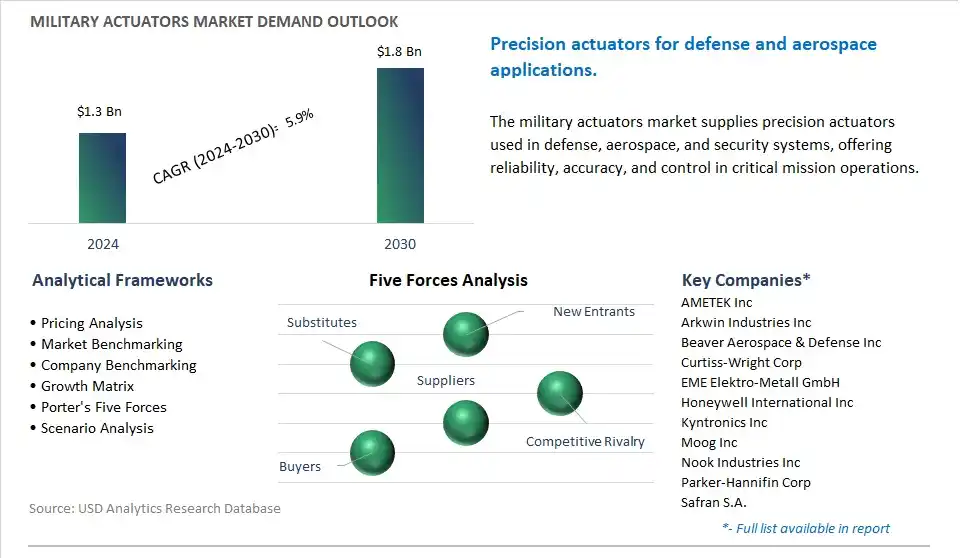
The global Military Actuators Market is poised to register a 5.9% CAGR from $1.3 Billion in 2024 to $1.8 Billion in 2030.
The global Military Actuators Market Study analyzes and forecasts the market size across 6 regions and 24 countries for diverse segments -By Component (Cylinders, Drives, Servo Valves, Manifolds, Others), By System (Hydraulic Actuators, Electrical Actuators, Pneumatic Actuators, Electromechanical Actuators, Electrohydraulic Actuators, Others), By Type (Linear Actuators, Rotary Actuators, Multi-axis Positioning Actuators, Semi-rotary Actuators), By Application (Air, Land, Naval).
An Introduction to Global Military Actuators Market in 2024
The future of military actuators is influenced by several key trends reflecting advancements in defense technology, automation, and mission requirements in military applications. One significant trend is the increasing demand for high-performance actuators capable of providing precise and reliable motion control in a wide range of military systems and platforms, including aircraft, vehicles, unmanned vehicles, and robotics. Military actuators play a critical role in various functions such as weapon systems, flight control surfaces, surveillance systems, and robotic manipulators, enabling mission-critical operations in challenging environments. Additionally, advancements in materials, electronics, and control systems are driving innovations in military actuator design, enhancing their performance, durability, and functionality while reducing size, weight, and power consumption. Moreover, there is a growing emphasis on integrating smart technologies such as sensors, feedback systems, and artificial intelligence into military actuators to enhance situational awareness, autonomy, and mission effectiveness. As defense agencies seek to modernize their capabilities and adapt to emerging threats, the demand for advanced military actuators is expected to grow, driving opportunities for manufacturers, technology providers, and defense contractors to innovate and deliver solutions that meet the evolving needs of military customers while ensuring reliability, durability, and mission readiness.
Military Actuators Market Competitive Landscape
The market report analyses the leading companies in the industry including AMETEK Inc, Arkwin Industries Inc, Beaver Aerospace & Defense Inc, Curtiss-Wright Corp, EME Elektro-Metall GmbH, Honeywell International Inc, Kyntronics Inc, Moog Inc, Nook Industries Inc, Parker-Hannifin Corp, Safran S.A., Temis SRL, Triumph Group Inc, Ultra Motion LLC, Whippany Actuation Systems LLC, Woodward Inc.
Military Actuators Market Dynamics
Military Actuators Market Trend: Integration of Smart and Autonomous Actuation Systems
A significant trend in the Military Actuators market is the integration of smart and autonomous actuation systems into military vehicles, aircraft, and equipment. As defense technologies evolve, there's a growing emphasis on enhancing the performance, reliability, and efficiency of actuation systems used in various military applications. Smart actuators equipped with sensors, controllers, and embedded intelligence enable real-time monitoring, adaptive control, and predictive maintenance, enhancing situational awareness and mission effectiveness. Additionally, the development of autonomous actuators capable of self-adjusting and self-optimizing their operation in response to changing conditions contributes to improved maneuverability, stealth, and survivability of military platforms.
Military Actuators Market Driver: Demand for Precision and High-Speed Motion Control
A key driver propelling the Military Actuators market is the demand for precision and high-speed motion control in modern military systems and equipment. Military operations often require rapid and precise movement of mechanical components, such as weapon systems, surveillance payloads, and control surfaces, to achieve mission objectives effectively. Actuators play a critical role in providing the necessary force, speed, and accuracy to execute various functions, including aiming, targeting, steering, and propulsion. With advancements in materials, manufacturing techniques, and electro-mechanical technologies, there's an increasing capability to develop actuators with higher power density, faster response times, and tighter positional accuracy, meeting the demanding requirements of next-generation military platforms and weapon systems.
Military Actuators Market Opportunity: Development of Miniature and Lightweight Actuation Solutions
An opportunity in the Military Actuators market lies in the development of miniature and lightweight actuation solutions tailored to the requirements of unmanned aerial vehicles (UAVs), unmanned ground vehicles (UGVs), and soldier-worn equipment. As military operations become more expeditionary and asymmetric, there's a need for compact and low-profile actuators that can be seamlessly integrated into small-scale platforms and wearable devices. Miniaturized actuators with reduced size, weight, and power consumption offer advantages in terms of mobility, stealth, and energy efficiency, enabling enhanced agility and maneuverability in urban environments, confined spaces, and remote locations. By focusing on miniaturization, companies can capitalize on the growing demand for compact actuation solutions for a wide range of military applications, including reconnaissance, surveillance, logistics, and special operations.
Military Actuators Market Share Analysis: Cylinders component generated the highest revenue in 2024
The largest segment in the Military Actuators Market is the Cylinder component segment. The market growth is driven by cylinders are fundamental components of various actuator systems used in military applications, providing linear motion and force transmission to perform a wide range of tasks, including movement, lifting, positioning, and actuation of mechanical systems. Cylinders are commonly employed in hydraulic and pneumatic actuator systems utilized in military vehicles, aircraft, weapon systems, robotics, and other defense platforms. Further, the versatility and reliability of cylinder-based actuation systems make them indispensable in military applications, where ruggedness, durability, and precision are essential requirements. Cylinders are capable of exerting high forces, operating in harsh environments, and withstanding extreme temperatures, pressures, and vibration levels commonly encountered in military operations. In addition, the extensive use of cylinders in military actuation systems is driven by the need for precise control, rapid response, and mission-critical performance in various defense applications. Whether for controlling vehicle movements, operating weapon systems, or deploying equipment, cylinders play a crucial role in ensuring the functionality and effectiveness of military platforms and systems. Additionally, advancements in cylinder design, materials, and manufacturing processes further enhance their performance, reliability, and longevity, reinforcing their dominance in the Military Actuators Market. Over the forecast period, the combination of their essential role, versatility, reliability, and continuous technological improvements positions the Cylinder component segment as the largest in the Military Actuators Market.
Military Actuators Market Share Analysis: Electromechanical Actuators segment is poised to register the fastest growth rate (CAGR) over the forecast period to 2030
The fastest-growing segment in the Military Actuators Market is the Electromechanical Actuators segment. electromechanical actuators offer potential advantages over traditional hydraulic, pneumatic, and electrical actuators in military applications. Electromechanical actuators provide precise control, high-speed operation, and enhanced efficiency compared to hydraulic and pneumatic systems, which rely on fluid power. Additionally, electromechanical actuators offer superior controllability and reliability compared to purely electrical actuators, as they combine the benefits of both electrical and mechanical actuation systems. Further, advancements in electromechanical actuator technology, including improvements in motor design, materials, control algorithms, and feedback mechanisms, have led to the development of more compact, lightweight, and robust actuators suitable for military use. These advancements enable electromechanical actuators to meet the stringent performance requirements of modern military platforms, such as aircraft, unmanned aerial vehicles (UAVs), ground vehicles, and naval vessels. In addition, the increasing adoption of electrification and automation trends in military systems drives the demand for electromechanical actuators. As military platforms become more sophisticated and integrated, there is a growing need for actuation systems that can interface seamlessly with onboard electronics, control systems, and networked architectures. Electromechanical actuators offer compatibility with digital control interfaces, communication protocols, and remote monitoring capabilities, making them well-suited for next-generation military applications. Additionally, the modular design and flexibility of electromechanical actuators allow for easy integration, retrofitting, and maintenance in existing and future military platforms, further driving their growth in the Military Actuators Market. Over the forecast period, the combination of their performance advantages, technological advancements, and alignment with military modernization initiatives positions the Electromechanical Actuators segment as the fastest-growing in the Military Actuators Market.
Military Actuators Market Share Analysis: Multi-axis Positioning Actuators segment is poised to register the fastest growth rate (CAGR) over the forecast period to 2030
The fastest-growing segment in the Military Actuators Market is the Multi-Axis Positioning Actuators segment. military applications often require precise and complex motion control in multiple axes to perform various tasks such as aiming, positioning, stabilization, and manipulation of equipment and payloads. Multi-axis positioning actuators offer the capability to control motion in multiple directions simultaneously, providing enhanced agility, flexibility, and versatility compared to single-axis actuators. These actuators enable military platforms, such as unmanned aerial vehicles (UAVs), ground vehicles, robotic systems, and surveillance equipment, to perform dynamic and coordinated movements with greater efficiency and accuracy. Further, advancements in sensor technology, control algorithms, and automation systems have led to the development of more sophisticated multi-axis positioning actuators with improved performance, reliability, and functionality. These advancements enable precise motion control, synchronization, and trajectory planning in real-time, even in challenging operating conditions encountered in military environments. In addition, the increasing adoption of unmanned and autonomous military systems drives the demand for multi-axis positioning actuators. Unmanned platforms require advanced actuation systems capable of performing complex maneuvers, navigating rugged terrain, and executing mission-critical tasks with minimal human intervention. Multi-axis positioning actuators enable autonomous platforms to achieve precise motion control and dynamic positioning in diverse operating scenarios, enhancing their operational effectiveness and mission capabilities. Additionally, the modular design and scalability of multi-axis positioning actuators allow for easy integration into existing and future military platforms, offering scalability, adaptability, and cost-effectiveness. Over the forecast period, the combination of their performance advantages, technological advancements, and alignment with military modernization initiatives positions the Multi-Axis Positioning Actuators segment as the fastest-growing in the Military Actuators Market.
Military Actuators Market Report Segmentation
By Component
Cylinders
Drives
Servo Valves
Manifolds
Others
By System
Hydraulic Actuators
Electrical Actuators
Pneumatic Actuators
Electromechanical Actuators
Electrohydraulic Actuators
Others
By Type
Linear Actuators
Rotary Actuators
Multi-axis Positioning Actuators
Semi-rotary Actuators
By Application
Air
Land
Naval
Regions Included
North America (US, Canada, Mexico)
Europe (Germany, UK, France, Spain, Italy, Russia, Rest of Europe)
Asia Pacific (China, India, Japan, South Korea, Australia, South East Asia, Rest of Asia)
South America (Brazil, Argentina, Rest of South America)
Middle East and Africa (Saudi Arabia, UAE, Rest of Middle East, South Africa, Egypt, Rest of Africa)
Military Actuators Companies Profiled in the Market Study
AMETEK Inc
Arkwin Industries Inc
Beaver Aerospace & Defense Inc
Curtiss-Wright Corp
EME Elektro-Metall GmbH
Honeywell International Inc
Kyntronics Inc
Moog Inc
Nook Industries Inc
Parker-Hannifin Corp
Safran S.A.
Temis SRL
Triumph Group Inc
Ultra Motion LLC
Whippany Actuation Systems LLC
Woodward Inc
*- List Not Exhaustive
