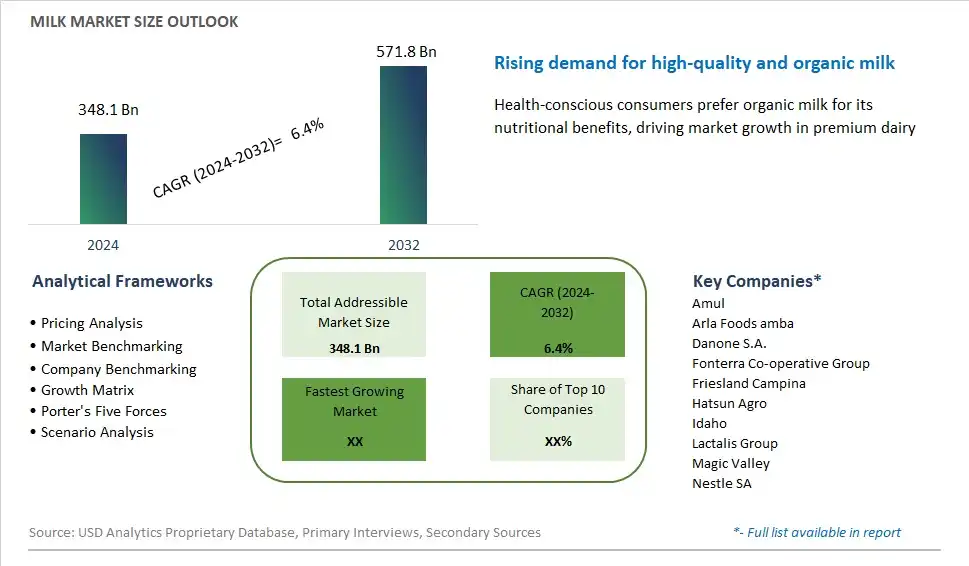
Global Milk Market Size is valued at $348.1 Billion in 2024 and is forecast to register a growth rate (CAGR) of 6.4% to reach $571.8 Billion by 2032.
The global Milk Market Comprehensive Study analyzes and forecasts the market size across 6 regions and 24 countries for diverse segments -By Distribution Channel (Supermarkets/Hypermarkets, Convenience Stores, Specialist Retailers, Online Retail Stores, Others), By Product (Butter, Cheese, Cream, Dairy Desserts, Yoghurt, Milk, Others)
An Introduction to Milk Market
Milk, an indispensable staple in the global diet, continues to be a focal point of innovation and diversification in 2024. Amidst evolving consumer preferences, the milk market is witnessing a paradigm shift towards plant-based alternatives, driven by health, environmental, and ethical considerations. While traditional dairy consumption remains robust, the rise of plant-based milks derived from soy, almond, oat, and other sources is reshaping the industry landscape. Beyond product diversification, advancements in processing technologies, such as ultra-high temperature treatment and cold-pressed extraction, are enhancing milk quality, extending shelf life, and preserving nutritional value. Furthermore, sustainable practices throughout the dairy supply chain, including animal welfare initiatives and eco-friendly packaging solutions, are gaining traction as consumers seek transparency and ethical sourcing in their dairy products.
Milk Competitive Landscape
The market report analyses the leading companies in the industry including Amul, Arla Foods amba, Danone S.A., Fonterra Co-operative Group, Friesland Campina, Hatsun Agro, Idaho, Lactalis Group, Magic Valley, Nestle SA, and Others.
Milk Market Dynamics
Milk Market Trend: Increasing Demand for Plant-Based Milk Alternatives
In recent years, the milk market has witnessed a significant shift towards plant-based milk alternatives. This trend is driven by a growing consumer preference for dairy-free options due to health concerns, lactose intolerance, and ethical considerations regarding animal welfare. Products such as almond milk, soy milk, and oat milk have gained substantial popularity, leading to an expanding product range and increased shelf space in retail stores. The rising awareness of the environmental impact of dairy farming has also contributed to this trend, as plant-based alternatives are perceived to be more sustainable. This shift is not only reshaping consumer behavior but also encouraging dairy companies to diversify their product portfolios to include plant-based options.
Market Driver: Health and Wellness Consciousness
A major driver of the milk market is the increasing consumer focus on health and wellness. As individuals become more health-conscious, there is a growing demand for milk products that offer enhanced nutritional benefits. Functional milk products fortified with vitamins, minerals, and probiotics are gaining traction as consumers seek beverages that contribute to their overall health. Additionally, the shift towards organic and hormone-free milk options reflects the desire for cleaner and more natural products. This health-driven demand is encouraging producers to innovate and develop new formulations that cater to the nutritional needs and preferences of modern consumers.
Market Opportunity: Expansion into Emerging Markets
The milk market holds significant potential for growth in emerging markets. As disposable incomes rise and urbanization progresses in regions such as Asia-Pacific, Latin America, and Africa, there is an increasing demand for milk and milk-based products. These markets present opportunities for both traditional dairy products and plant-based alternatives. Companies that can effectively navigate these markets by understanding local preferences, investing in distribution networks, and offering affordable yet high-quality products are well-positioned to capitalize on this growth. Furthermore, introducing educational campaigns about the nutritional benefits of milk can help drive consumption in these developing regions, thereby expanding market reach and profitability.
Milk Market Share Analysis: Supermarkets/Hypermarkets held the dominant market share in 2024
Supermarkets and hypermarkets represent the largest segment in the milk market by distribution channel. This dominance is due to their widespread availability, extensive product variety, and the convenience they offer to consumers. Supermarkets and hypermarkets provide a one-stop shopping experience, where consumers can easily find a wide range of milk products, including fresh milk, flavored milk, organic milk, and lactose-free options. These stores also frequently run promotions and discounts, making milk more affordable and attractive to a broad customer base. Additionally, the well-established supply chains of supermarkets and hypermarkets ensure a consistent and reliable supply of milk, meeting the daily needs of households. The extensive reach of these retail outlets, combined with their ability to stock a diverse array of products, cements their position as the primary choice for consumers purchasing milk, thereby making them the largest distribution channel in the milk market.
Milk Market Share Analysis: Yoghurt market is poised to register the fastest growth rae over the forecast period to 2032
Yoghurt is the fastest-growing segment within the milk market, experiencing exponential growth owing to several factors. Firstly, the increasing consumer awareness regarding health and wellness has led to a surge in demand for yoghurt, perceived as a nutritious and probiotic-rich dairy product. With growing concerns about digestive health, consumers are actively seeking products that aid gut health, propelling the popularity of yoghurt. Further, the versatility of yoghurt as a standalone snack, a breakfast staple, or an ingredient in various culinary creations further contributes to its soaring demand. The innovation in flavors and formulations, including plant-based alternatives, caters to diverse consumer preferences, widening the market scope. Additionally, the expansion of distribution channels, including online platforms, has enhanced accessibility, driving yoghurt consumption across demographics. Thus, amidst evolving dietary trends and lifestyle preferences, yoghurt stands out as a frontrunner, reshaping the landscape of the milk market with its robust growth trajectory.
Milk Market Segmentation
By Distribution Channel
Supermarkets/Hypermarkets
Convenience Stores
Specialist Retailers
Online Retail Stores
Others
By Product
Butter
Cheese
Cream
Dairy Desserts
Yoghurt
Milk
Others
Countries Analyzed
North America (US, Canada, Mexico)
Europe (Germany, UK, France, Spain, Italy, Russia, Rest of Europe)
Asia Pacific (China, India, Japan, South Korea, Australia, South East Asia, Rest of Asia)
South America (Brazil, Argentina, Rest of South America)
Middle East and Africa (Saudi Arabia, UAE, Rest of Middle East, South Africa, Egypt, Rest of Africa)
Milk Companies Profiled in the Study
Amul
Arla Foods amba
Danone S.A.
Fonterra Co-operative Group
Friesland Campina
Hatsun Agro
Idaho
Lactalis Group
Magic Valley
Nestle SA
*- List Not Exhaustive
Chapter 1. TABLE OF CONTENTS
Chapter 2. Introduction to Milk Market
2.1. Market Overview
2.2. Key Statistics and Report Highlights
2.3. Scope of the Comprehensive Study
2.3.1. Market Definition
2.3.2 Countries and Regions Covered
2.3.3 Research Objective
2.3.4 Units, Currency, and Conversions
2.3.5 Industry Value Chain
2.4. Key Market Segments
2.5. Key Companies
2.6. Study Period
Chapter 3. Strategic Analysis Review
3.1. Milk Pricing Analysis and Forecast
3.2. Porter’s Five Forces
3.3. Market Ecosystem
3.4. SWOT Analysis
3.5. Regulatory Scenario
3.3. Effects of Inflation, Russia-Ukraine War, moderating economic growth, and other macroeconomic factors
Chapter 4. Competitive Landscape
4.1. Market Share Analysis
4.1.1. Global Milk Market Share by Company, 2023
4.1.2. Product Offerings of Leading Milk Companies
4.2. Market Entropy
4.2.1. New Product Launches in the Industry
4.2.2. Mergers, Acquisitions, Joint ventures, and Partnerships
4.3. Key Strategies and Best Practices
Chapter 5. Global Market Projections: Best, Reference, and Low Case Scenarios
5.1. Growth Analysis- Case Scenario Definitions
5.2. Low Growth Case Scenario Forecasts
5.3. Reference Growth Case Scenario Forecasts
5.4. High Growth Case Scenario Forecasts
Chapter 6. Market Dynamics
6.1. Milk Market Drivers
6.2. Milk Market Challenges
6.6. Milk Market Opportunities
6.4. Milk Market Trends
Chapter 7. Global Milk Market Outlook Trends
7.1. Global Milk Revenue (USD Million) and CAGR (%) by Type (2021-2032)
7.2. Global Milk Revenue (USD Million) and CAGR (%) by Application (2021-2032)
7.3. Global Milk Revenue (USD Million) and CAGR (%) by Product (2021-2032)
By Distribution Channel
Supermarkets/Hypermarkets
Convenience Stores
Specialist Retailers
Online Retail Stores
Others
By Product
Butter
Cheese
Cream
Dairy Desserts
Yoghurt
Milk
Others
Chapter 8. Global Milk Regional Analysis and Outlook
8.1. Global Milk Revenue (USD Million) By Regions (2021- 2032)
8.2. North America Milk Revenue (USD Million) by Country (2021-2032)
8.2.1. United States Milk Regional Analysis and Outlook
8.2.2. Canada Milk Regional Analysis and Outlook
8.2.3. Mexico Milk Regional Analysis and Outlook
8.3. Europe Milk Revenue (USD Million), by Country (2021-2032)
8.3.1. Germany Milk Regional Analysis and Outlook
8.3.2. France Milk Regional Analysis and Outlook
8.3.3. United Kingdom Milk Regional Analysis and Outlook
8.3.4. Spain Milk Regional Analysis and Outlook
8.3.5. Italy Milk Regional Analysis and Outlook
8.3.6. Russia Milk Regional Analysis and Outlook
8.3.7. Rest of Europe Milk Regional Analysis and Outlook
8.4. Asia Pacific Milk Revenue (USD Million) by Country (2021-2032)
8.4.1. China Milk Regional Analysis and Outlook
8.4.2. Japan Milk Regional Analysis and Outlook
8.4.3. India Milk Regional Analysis and Outlook
8.4.4. South Korea Milk Regional Analysis and Outlook
8.4.5. Australia Milk Regional Analysis and Outlook
8.4.6. South East Asia Milk Regional Analysis and Outlook
8.4.7. Rest of Asia Pacific Milk Regional Analysis and Outlook
8.5. South America Milk Revenue (USD Million), by Country (2021-2032)
8.5.1. Brazil Milk Regional Analysis and Outlook
8.5.2. Argentina Milk Regional Analysis and Outlook
8.5.3. Rest of South America Milk Regional Analysis and Outlook
8.6. Middle East and Africa Milk Revenue (USD Million) by Country (2021-2032)
8.6.1. Middle East Milk Regional Analysis and Outlook
8.6.2. Africa Milk Regional Analysis and Outlook
Chapter 9. North America Milk Analysis and Outlook
9.1. North America Milk Revenue (USD Million) by Segments (2021-2032)
9.1.1. North America Milk Revenue (USD Million) by Type (2021-2032)
9.1.2. North America Milk Revenue (USD Million) by Application (2021-2032)
9.1.3. North America Milk Revenue (USD Million) by Product (2021-2032)
By Distribution Channel
Supermarkets/Hypermarkets
Convenience Stores
Specialist Retailers
Online Retail Stores
Others
By Product
Butter
Cheese
Cream
Dairy Desserts
Yoghurt
Milk
Others
Chapter 10. Europe Milk Analysis and Outlook
10.1. Europe Milk Revenue (USD Million), by Segments (USD Million) (2021-2032)
10.1.1. Europe Milk Revenue (USD Million) by Type (2021-2032)
10.1.2. Europe Milk Revenue (USD Million) by Application (2021-2032)
10.1.3. Europe Milk Revenue (USD Million) by Product (2021-2032)
By Distribution Channel
Supermarkets/Hypermarkets
Convenience Stores
Specialist Retailers
Online Retail Stores
Others
By Product
Butter
Cheese
Cream
Dairy Desserts
Yoghurt
Milk
Others
Chapter 11. Asia Pacific Milk Analysis and Outlook
11.1. Asia Pacific Milk Revenue (USD Million), and Revenue (USD Million) by Segments (2021-2032)
11.1.1. Asia Pacific Milk Revenue (USD Million) by Type (2021-2032)
11.1.2. Asia Pacific Milk Revenue (USD Million) by Application (2021-2032)
11.1.3. Asia Pacific Milk Revenue (USD Million) by Product (2021-2032)
By Distribution Channel
Supermarkets/Hypermarkets
Convenience Stores
Specialist Retailers
Online Retail Stores
Others
By Product
Butter
Cheese
Cream
Dairy Desserts
Yoghurt
Milk
Others
Chapter 12. South America Milk Analysis and Outlook
12.1. South America Milk Revenue (USD Million), by Segments (2021-2032)
12.1.1. South America Milk Revenue (USD Million) by Type (2021-2032)
12.1.2. South America Milk Revenue (USD Million) by Application (2021-2032)
12.1.3. South America Milk Revenue (USD Million) by Product (2021-2032)
By Distribution Channel
Supermarkets/Hypermarkets
Convenience Stores
Specialist Retailers
Online Retail Stores
Others
By Product
Butter
Cheese
Cream
Dairy Desserts
Yoghurt
Milk
Others
Chapter 13. Middle East and Africa Milk Analysis and Outlook
13.1. Middle East and Africa Milk Revenue (USD Million), by Segments (2021-2032)
13.1.1. Middle East and Africa Milk Revenue (USD Million) by Type (2021-2032)
13.1.2. Middle East and Africa Milk Revenue (USD Million) by Application (2021-2032)
13.1.3. Middle East and Africa Milk Revenue (USD Million) by Product (2021-2032)
By Distribution Channel
Supermarkets/Hypermarkets
Convenience Stores
Specialist Retailers
Online Retail Stores
Others
By Product
Butter
Cheese
Cream
Dairy Desserts
Yoghurt
Milk
Others
Chapter 14. Milk Company Profiles
14.1 Business Overview
14.2 Product Profiles
14.3 SWOT Profiles
14.5 Recent Developments
14.6 Financial Profile
List of Companies
Amul
Arla Foods amba
Danone S.A.
Fonterra Co-operative Group
Friesland Campina
Hatsun Agro
Idaho
Lactalis Group
Magic Valley
Nestle SA
15. Methodology and Data Sources
15.1 Customization Offerings
15.2 Subscription Services
15.3 Related Reports
15.4 Publisher Expertise
LIST OF TABLES
Table 1 Market Segmentation Analysis
Table 2 Global Milk Market Share of Leading Companies, 2023
Table 3 Product Offerings of Leading Companies
Table 4 Low Growth Scenario Forecasts
Table 5 Reference Case Growth Scenario
Table 6 High Growth Case Scenario
Table 7 Global Milk Revenue (USD Million) And CAGR (%) By Type (2021-2032)
Table 8 Global Milk Revenue (USD Million) And CAGR (%) By Application (2021-2032)
Table 9 Global Milk Revenue (USD Million) And CAGR (%) By Product (2021-2032)
Table 10 Global Milk Market Revenue (USD Million) By Regions (2021-2032)
Table 11 Global Milk Market Share (%) By Regions (2021-2032)
Table 12 North America Milk Revenue (USD Million) By Country (2021-2032)
Table 13 Europe Milk Revenue (USD Million) By Country (2021-2032)
Table 14 Asia Pacific Milk Revenue (USD Million) By Country (2021-2032)
Table 15 South America Milk Revenue (USD Million) By Country (2021-2032)
Table 16 Middle East and Africa Milk Revenue (USD Million) By Region (2021-2032)
Table 17 North America Milk Revenue (USD Million) By Type (2021-2032)
Table 18 North America Milk Revenue (USD Million) By Application (2021-2032)
Table 19 North America Milk Revenue (USD Million) By Product (2021-2032)
Table 20 Europe Milk Revenue (USD Million) By Type (2021-2032)
Table 21 Europe Milk Revenue (USD Million) By Application (2021-2032)
Table 22 Europe Milk Revenue (USD Million) By Product (2021-2032)
Table 23 Asia Pacific Milk Revenue (USD Million) By Type (2021-2032)
Table 24 Asia Pacific Milk Revenue (USD Million) By Application (2021-2032)
Table 25 Asia Pacific Milk Revenue (USD Million) By Product (2021-2032)
Table 26 South America Milk Revenue (USD Million) By Type (2021-2032)
Table 27 South America Milk Revenue (USD Million) By Application (2021-2032)
Table 28 South America Milk Revenue (USD Million) By Product (2021-2032)
Table 29 Middle East and Africa Milk Revenue (USD Million) By Type (2021-2032)
Table 30 Middle East and Africa Milk Revenue (USD Million) By Application (2021-2032)
Table 31 Middle East and Africa Milk Revenue (USD Million) By Product (2021-2032)
LIST OF FIGURES
Figure 1. Market Scope
Figure 2. Pricing Forecasts Per Unit, 2023- 2032
Figure 3. Porter’s Five Forces
Figure 4. Global Milk Market Revenue (USD Million) By Regions (2021-2032)
Figure 5. Global Milk Market Share (%) By Regions (2023)
Figure 6. North America Milk Revenue (USD Million) By Country (2021-2032)
Figure 7. United States Milk Revenue (USD Million) By Country (2021-2032)
Figure 8. Canada Milk Revenue (USD Million) By Country (2021-2032)
Figure 9. Mexico Milk Revenue (USD Million) By Country (2021-2032)
Figure 10. Europe Milk Revenue (USD Million) By Country (2021-2032)
Figure 11. Germany Milk Revenue (USD Million) By Country (2021-2032)
Figure 12. France Milk Revenue (USD Million) By Country (2021-2032)
Figure 13. United Kingdom Milk Revenue (USD Million) By Country (2021-2032)
Figure 14. Spain Milk Revenue (USD Million) By Country (2021-2032)
Figure 15. Italy Milk Revenue (USD Million) By Country (2021-2032)
Figure 16. Russia Milk Revenue (USD Million) By Country (2021-2032)
Figure 17. Rest of Europe Milk Revenue (USD Million) By Country (2021-2032)
Figure 11. Asia Pacific Milk Revenue (USD Million) By Country (2021-2032)
Figure 12. China Milk Revenue (USD Million) By Country (2021-2032)
Figure 13. Japan Milk Revenue (USD Million) By Country (2021-2032)
Figure 14. India Milk Revenue (USD Million) By Country (2021-2032)
Figure 15. South Korea Milk Revenue (USD Million) By Country (2021-2032)
Figure 16. Australia Milk Revenue (USD Million) By Country (2021-2032)
Figure 17. South East Asia Milk Revenue (USD Million) By Country (2021-2032)
Figure 18. South America Milk Revenue (USD Million) By Country (2021-2032)
Figure 19. Brazil Milk Revenue (USD Million) By Country (2021-2032)
Figure 20. Argentina Milk Revenue (USD Million) By Country (2021-2032)
Figure 21. Rest of Asia Pacific Milk Revenue (USD Million) By Country (2021-2032)
Figure 22. Middle East and Africa Milk Revenue (USD Million) By Region (2021-2032)
Figure 23. Saudi Arabia Milk Revenue (USD Million) By Region (2021-2032)
Figure 24. The UAE Milk Revenue (USD Million) By Region (2021-2032)
Figure 25. Rest of Middle East Milk Revenue (USD Million) By Region (2021-2032)
Figure 26. South Africa Milk Revenue (USD Million) By Region (2021-2032)
Figure 27. Africa Milk Revenue (USD Million) By Region (2021-2032)
Figure 28. North America Milk Revenue (USD Million) By Type (2021-2032)
Figure 29. North America Milk Revenue (USD Million) By Application (2021-2032)
Figure 30. North America Milk Revenue (USD Million) By Product (2021-2032)
Figure 31. Europe Milk Revenue (USD Million) By Type (2021-2032)
Figure 32. Europe Milk Revenue (USD Million) By Application (2021-2032)
Figure 33. Europe Milk Revenue (USD Million) By Product (2021-2032)
Figure 34. Asia Pacific Milk Revenue (USD Million) By Type (2021-2032)
Figure 35. Asia Pacific Milk Revenue (USD Million) By Application (2021-2032)
Figure 36. Asia Pacific Milk Revenue (USD Million) By Product (2021-2032)
Figure 37. South America Milk Revenue (USD Million) By Type (2021-2032)
Figure 38. South America Milk Revenue (USD Million) By Application (2021-2032)
Figure 39. South America Milk Revenue (USD Million) By Product (2021-2032)
Figure 40. Middle East and Africa Milk Revenue (USD Million) By Type (2021-2032)
Figure 41. Middle East and Africa Milk Revenue (USD Million) By Application (2021-2032)
Figure 42. Middle East and Africa Milk Revenue (USD Million) By Product (2021-2032)
By Distribution Channel
Supermarkets/Hypermarkets
Convenience Stores
Specialist Retailers
Online Retail Stores
Others
By Product
Butter
Cheese
Cream
Dairy Desserts
Yoghurt
Milk
Others
Countries Analyzed
North America (US, Canada, Mexico)
Europe (Germany, UK, France, Spain, Italy, Russia, Rest of Europe)
Asia Pacific (China, India, Japan, South Korea, Australia, South East Asia, Rest of Asia)
South America (Brazil, Argentina, Rest of South America)
Middle East and Africa (Saudi Arabia, UAE, Rest of Middle East, South Africa, Egypt, Rest of Africa)
