
The global Mineral Oil Market Study analyzes and forecasts the market size across 6 regions and 24 countries for diverse segments -By Grade (Technical Oil, White Oil ), By Application (Baby Oil, Cosmetics, Skin Care Products, Hair Care Products, Consumer Goods, Others).
The future of mineral oil is shaped by several key trends reflecting its diverse applications in industries such as automotive, pharmaceuticals, cosmetics, and industrial lubricants. One significant trend is the increasing demand for mineral oil as a versatile and cost-effective base material in various formulations, including lubricating oils, hydraulic fluids, cutting fluids, and pharmaceutical excipients. Mineral oil offers properties such as lubricity, heat resistance, and chemical stability, making it suitable for a wide range of applications where performance, reliability, and compatibility are essential. Additionally, advancements in refining technology and processing methods are driving improvements in mineral oil quality, purity, and consistency, enabling manufacturers to meet stringent regulatory requirements and industry standards. Moreover, there is growing interest in sustainable and environmentally friendly mineral oil formulations, such as bio-based or recycled mineral oils, to address environmental concerns and support green initiatives in product development and manufacturing. As industries continue to seek cost-effective and reliable solutions for lubrication, insulation, and formulation needs, the demand for mineral oil is expected to remain steady, driving opportunities for producers, formulators, and end-users to innovate and develop solutions that meet the diverse needs of the market while addressing sustainability and regulatory challenges.
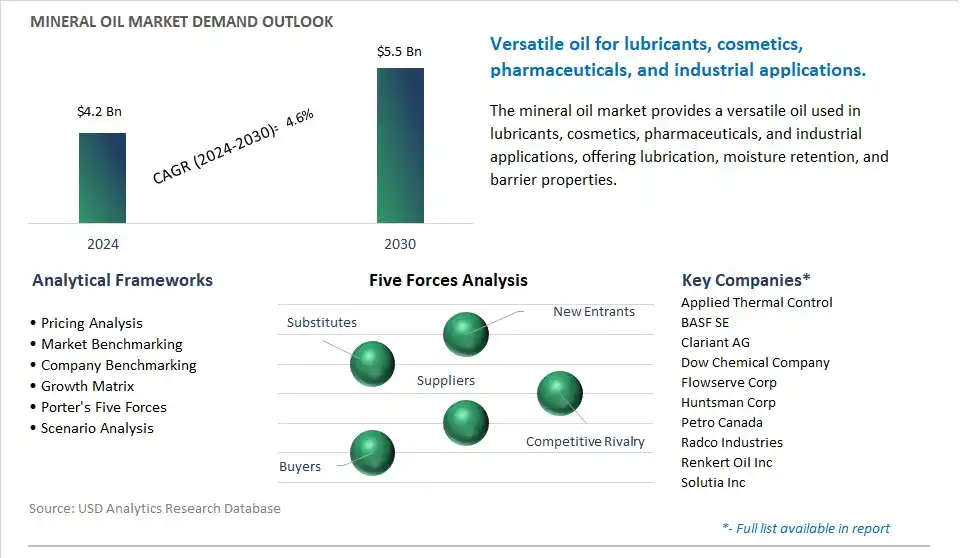
The market report analyses the leading companies in the industry including Applied Thermal Control, BASF SE, Clariant AG, Dow Chemical Company, Flowserve Corp, Huntsman Corp, Petro Canada, Radco Industries, Renkert Oil Inc, Solutia Inc.
A significant trend in the Mineral Oil market is the shift towards bio-based and environmentally friendly alternatives. With increasing environmental awareness and regulatory pressure to reduce carbon emissions and dependence on fossil fuels, there's a growing demand for mineral oil substitutes derived from renewable sources such as plant oils or synthetic alternatives. Bio-based mineral oil replacements offer similar functionality and performance characteristics while mitigating environmental impact and reducing reliance on finite natural resources. As sustainability concerns continue to drive consumer preferences and industry regulations, manufacturers are investing in the development and commercialization of bio-based mineral oil alternatives to meet evolving market demands.
A key driver propelling the Mineral Oil market is the diverse range of industrial applications and end-use sectors that rely on mineral oil products. Mineral oils find widespread use across various industries, including automotive, pharmaceuticals, cosmetics, lubricants, and food processing, due to their versatile properties such as lubricity, thermal stability, insulating properties, and inertness. In automotive applications, mineral oils serve as lubricants for engines, transmissions, and hydraulic systems, while in the pharmaceutical industry, they are used as excipients in drug formulations and as base oils for ointments and creams. Additionally, mineral oils are employed in cosmetics as moisturizers, emollients, and carriers for active ingredients. The broad spectrum of applications and market diversity ensures steady demand for mineral oil products across multiple sectors, driving market growth and stability.
An opportunity in the Mineral Oil market lies in the development of specialty and high-performance formulations tailored to specific industrial applications and performance requirements. While traditional mineral oils offer general-purpose functionality, there's a growing demand for specialized formulations optimized for niche applications or extreme operating conditions. For example, there's an opportunity to develop high-performance lubricants for industrial machinery operating in high-temperature or high-pressure environments, as well as specialty oils for precision machining, metalworking, or electrical insulation applications. Furthermore, there's potential to innovate in the development of food-grade mineral oils with enhanced purity and stability for use as release agents, anti-foaming agents, or lubricants in food processing and packaging applications. By focusing on niche markets and value-added solutions, manufacturers can differentiate their offerings, capture higher margins, and capitalize on untapped opportunities within the Mineral Oil market.
The largest segment in the Mineral Oil Market is the Technical Oil grade segment. The market growth is driven by Technical Oil, also known as industrial or lubricating oil, which is widely used across various industries for a multitude of applications. It serves as a crucial component in the manufacturing processes of lubricants, greases, hydraulic fluids, metalworking fluids, and other industrial products. Technical oil is utilized for its lubricating properties, heat transfer capabilities, corrosion resistance, and insulating properties, making it indispensable in machinery, equipment, and industrial processes. Further, Technical Oil is commonly employed in automotive, manufacturing, construction, mining, and other heavy industries where the demand for lubrication and protection of machinery and equipment is high. It is utilized for lubricating moving parts, reducing friction, dissipating heat, sealing, and protecting against wear and tear. In addition, the Technical Oil segment encompasses a wide range of oil grades and formulations tailored to specific industrial applications and performance requirements. These include mineral-based oils, synthetic oils, and specialty additives designed to meet the diverse needs of industrial users. Additionally, the Technical Oil segment benefits from ongoing industrialization, infrastructure development, and economic growth in emerging markets, driving demand for lubricants and industrial oils. Over the forecast period, the combination of its widespread industrial applications, essential role in manufacturing processes, and diverse product offerings position the Technical Oil grade segment as the largest in the Mineral Oil Market.
The fastest-growing segment in the Mineral Oil Market is the Cosmetics segment. There is a rising demand for cosmetics and personal care products globally, driven by increasing consumer awareness of skincare and beauty regimes, growing disposable incomes, and changing lifestyle trends. Mineral oil is a common ingredient in cosmetics formulations due to its emollient properties, which help moisturize and soften the skin, creating a smooth and hydrated appearance. Further, mineral oil serves as a versatile base ingredient in a wide range of cosmetic products, including moisturizers, lotions, creams, foundations, lip balms, and makeup removers. It is valued for its ability to form a protective barrier on the skin's surface, preventing moisture loss and improving skin texture and appearance. In addition, the popularity of mineral oil in cosmetics formulations is further fueled by its non-comedogenic and hypoallergenic properties, making it suitable for sensitive skin types and individuals prone to skin irritation or allergic reactions. Additionally, advancements in cosmetic formulation technology and increasing consumer demand for natural and organic products drive innovation in mineral oil-based cosmetics, leading to the development of safer, more effective, and environmentally friendly formulations. Further, the expansion of the beauty and personal care industry into emerging markets, coupled with the growing popularity of e-commerce platforms and social media influencers, contributes to the growth of the cosmetics segment in the Mineral Oil Market. Over the forecast period, the combination of increasing consumer demand for skincare and beauty products, the versatility of mineral oil in cosmetics formulations, and ongoing innovations in product development and marketing strategies position the Cosmetics segment as the fastest-growing in the Mineral Oil Market.
By Grade
Technical Oil
White Oil
By Application
Baby Oil
Cosmetics
Skin Care Products
Hair Care Products
Consumer Goods
Others
Regions Included
North America (US, Canada, Mexico)
Europe (Germany, UK, France, Spain, Italy, Russia, Rest of Europe)
Asia Pacific (China, India, Japan, South Korea, Australia, South East Asia, Rest of Asia)
South America (Brazil, Argentina, Rest of South America)
Middle East and Africa (Saudi Arabia, UAE, Rest of Middle East, South Africa, Egypt, Rest of Africa)
Applied Thermal Control
BASF SE
Clariant AG
Dow Chemical Company
Flowserve Corp
Huntsman Corp
Petro Canada
Radco Industries
Renkert Oil Inc
Solutia Inc
*- List Not Exhaustive
TABLE OF CONTENTS
1 Introduction to 2025 Mineral Oil Market
1.1 Market Overview
1.2 Quick Facts
1.3 Scope/Objective of the Study
1.4 Market Definition
1.5 Countries and Regions Covered
1.6 Units, Currency, and Conversions
1.7 Industry Value Chain
2 Research Methodology
2.1 Market Size Estimation
2.2 Sources and Research Methodology
2.3 Data Triangulation
2.4 Assumptions and Limitations
3 Executive Summary
3.1 Global Mineral Oil Market Size Outlook, $ Million, 2021 to 2034
3.2 Mineral Oil Market Outlook by Type, $ Million, 2021 to 2034
3.3 Mineral Oil Market Outlook by Product, $ Million, 2021 to 2034
3.4 Mineral Oil Market Outlook by Application, $ Million, 2021 to 2034
3.5 Mineral Oil Market Outlook by Key Countries, $ Million, 2021 to 2034
4 Market Dynamics
4.1 Key Driving Forces of Mineral Oil Industry
4.2 Key Market Trends in Mineral Oil Industry
4.3 Potential Opportunities in Mineral Oil Industry
4.4 Key Challenges in Mineral Oil Industry
5 Market Factor Analysis
5.1 Value Chain Analysis
5.2 Competitive Landscape
5.2.1 Global Mineral Oil Market Share by Company (%), 2025
5.2.2 Product Offerings by Company
5.3 Porter’s Five Forces Analysis
5.4 Pricing Analysis and Outlook
6 Growth Outlook Across Scenarios
6.1 Growth Analysis-Case Scenario Definitions
6.2 Low Growth Scenario Forecasts
6.3 Reference Growth Scenario Forecasts
6.4 High Growth Scenario Forecasts
7 Global Mineral Oil Market Outlook by Segments
7.1 Mineral Oil Market Outlook by Segments, $ Million, 2021- 2034
By Grade
Technical Oil
White Oil
By Application
Baby Oil
Cosmetics
Skin Care Products
Hair Care Products
Consumer Goods
Others
8 North America Mineral Oil Market Analysis and Outlook To 2030
8.1 Introduction to North America Mineral Oil Markets in 2024
8.2 North America Mineral Oil Market Size Outlook by Country, 2021-2034
8.2.1 United States
8.2.2 Canada
8.2.3 Mexico
8.3 North America Mineral Oil Market size Outlook by Segments, 2021-2034
By Grade
Technical Oil
White Oil
By Application
Baby Oil
Cosmetics
Skin Care Products
Hair Care Products
Consumer Goods
Others
9 Europe Mineral Oil Market Analysis and Outlook To 2030
9.1 Introduction to Europe Mineral Oil Markets in 2024
9.2 Europe Mineral Oil Market Size Outlook by Country, 2021-2034
9.2.1 Germany
9.2.2 France
9.2.3 Spain
9.2.4 United Kingdom
9.2.4 Italy
9.2.5 Russia
9.2.6 Norway
9.2.7 Rest of Europe
9.3 Europe Mineral Oil Market Size Outlook by Segments, 2021-2034
By Grade
Technical Oil
White Oil
By Application
Baby Oil
Cosmetics
Skin Care Products
Hair Care Products
Consumer Goods
Others
10 Asia Pacific Mineral Oil Market Analysis and Outlook To 2030
10.1 Introduction to Asia Pacific Mineral Oil Markets in 2024
10.2 Asia Pacific Mineral Oil Market Size Outlook by Country, 2021-2034
10.2.1 China
10.2.2 India
10.2.3 Japan
10.2.4 South Korea
10.2.5 Indonesia
10.2.6 Malaysia
10.2.7 Australia
10.2.8 Rest of Asia Pacific
10.3 Asia Pacific Mineral Oil Market size Outlook by Segments, 2021-2034
By Grade
Technical Oil
White Oil
By Application
Baby Oil
Cosmetics
Skin Care Products
Hair Care Products
Consumer Goods
Others
11 South America Mineral Oil Market Analysis and Outlook To 2030
11.1 Introduction to South America Mineral Oil Markets in 2024
11.2 South America Mineral Oil Market Size Outlook by Country, 2021-2034
11.2.1 Brazil
11.2.2 Argentina
11.2.3 Rest of South America
11.3 South America Mineral Oil Market size Outlook by Segments, 2021-2034
By Grade
Technical Oil
White Oil
By Application
Baby Oil
Cosmetics
Skin Care Products
Hair Care Products
Consumer Goods
Others
12 Middle East and Africa Mineral Oil Market Analysis and Outlook To 2030
12.1 Introduction to Middle East and Africa Mineral Oil Markets in 2024
12.2 Middle East and Africa Mineral Oil Market Size Outlook by Country, 2021-2034
12.2.1 Saudi Arabia
12.2.2 UAE
12.2.3 Oman
12.2.4 Rest of Middle East
12.2.5 Egypt
12.2.6 Nigeria
12.2.7 South Africa
12.2.8 Rest of Africa
12.3 Middle East and Africa Mineral Oil Market size Outlook by Segments, 2021-2034
By Grade
Technical Oil
White Oil
By Application
Baby Oil
Cosmetics
Skin Care Products
Hair Care Products
Consumer Goods
Others
13 Company Profiles
13.1 Company Snapshot
13.2 SWOT Profiles
13.3 Products and Services
13.4 Recent Developments
13.5 Financial Profile
Applied Thermal Control
BASF SE
Clariant AG
Dow Chemical Company
Flowserve Corp
Huntsman Corp
Petro Canada
Radco Industries
Renkert Oil Inc
Solutia Inc
14 Appendix
14.1 Customization Offerings
14.2 Subscription Services
14.3 Related Reports
14.4 Publisher Expertise
By Grade
Technical Oil
White Oil
By Application
Baby Oil
Cosmetics
Skin Care Products
Hair Care Products
Consumer Goods
Others
Countries Analyzed
North America (US, Canada, Mexico)
Europe (Germany, UK, France, Spain, Italy, Russia, Rest of Europe)
Asia Pacific (China, India, Japan, South Korea, Australia, South East Asia, Rest of Asia)
South America (Brazil, Argentina, Rest of South America)
Middle East and Africa (Saudi Arabia, UAE, Rest of Middle East, South Africa, Egypt, Rest of Africa)
According to USD Analytics the Global Mineral Oil is forecast to reach $5.5 Billion in 2034 from $4.2 Billion in 2025, registering a CAGR of 4.6%
Emerging Markets across Asia Pacific, Europe, and Americas present robust growth prospects.
Applied Thermal Control, BASF SE, Clariant AG, Dow Chemical Company, Flowserve Corp, Huntsman Corp, Petro Canada, Radco Industries, Renkert Oil Inc, Solutia Inc
Base Year- 2024; Estimated Year- 2025; Historic Period- 2019-2024; Forecast period- 2025 to 2034; Currency: Revenue (USD); Volume