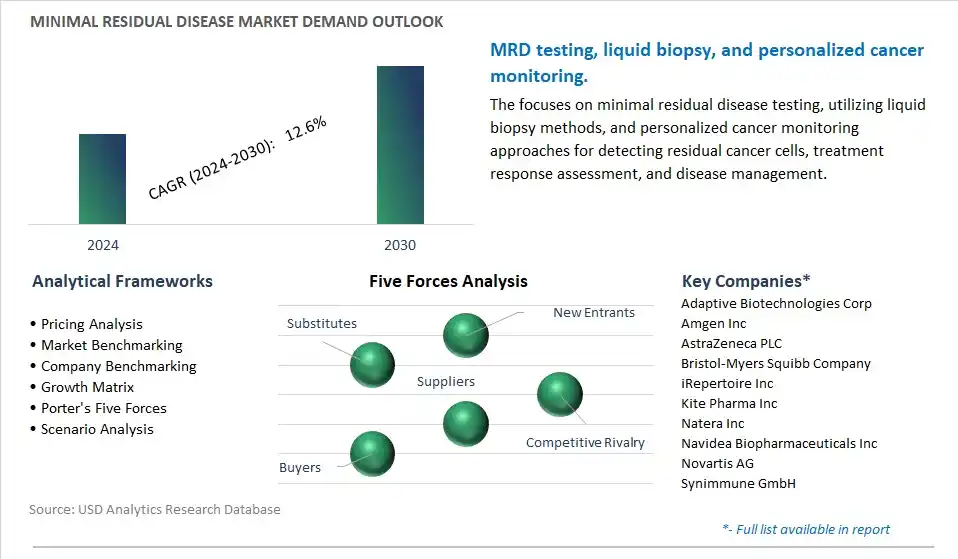
Minimal Residual Disease Market is estimated to increase at a Compounded Annual Growth Rate of 12.6% CAGR over the forecast period from 2024 to 2030
The Minimal Residual Disease Market study analyzes and forecasts the market size across 6 regions and 24 countries for diverse segments- By Test, Polymerase Chain Reaction, Fluorescence In Situ Hybridization (FISH), Next Generation Sequencing (NGS)), By Detection Target (Leukemia, Lymphoma, Solid Tumors, Others), By End-User (Hospitals, Laboratory centers, Specialty Clinics).
An Introduction to Minimal Residual Disease Market in 2024
In 2024, the market for minimal residual disease (MRD) detection and monitoring continues to advance, offering valuable insights into the effectiveness of cancer treatment and the risk of disease recurrence in patients with hematologic malignancies and certain solid tumors. MRD refers to the small number of cancer cells that may remain in the body after initial treatment, undetectable by conventional diagnostic methods such as imaging or blood tests. Detecting and monitoring MRD levels using sensitive molecular and immunological techniques, such as polymerase chain reaction (PCR), flow cytometry, and next-generation sequencing (NGS), enables healthcare providers to assess treatment response, tailor therapy strategies, and predict long-term outcomes for cancer patients. Technological advancements in MRD detection platforms, such as digital PCR, single-cell sequencing, and multiparametric flow cytometry, offer enhanced sensitivity, specificity, and reproducibility, enabling accurate and reliable assessment of MRD status at various stages of the disease course. Moreover, the integration of MRD testing into clinical practice guidelines and treatment algorithms facilitates standardized approaches to risk stratification, treatment decision-making, and long-term follow-up care for cancer survivors. With the increasing emphasis on precision oncology, personalized treatment approaches, and improved patient outcomes, the market for minimal residual disease detection and monitoring is poised for continued growth and innovation, offering valuable tools for optimizing cancer care and survivorship
Market Trend: Advancements in Molecular Diagnostics and Detection Technologies
A prominent trend in the minimal residual disease (MRD) market is the advancements in molecular diagnostics and detection technologies. MRD refers to the small number of cancer cells that remain in the body after treatment and may not be detected by traditional diagnostic methods. Recent advancements in genomic sequencing, polymerase chain reaction (PCR), flow cytometry, and next-generation sequencing (NGS) have significantly improved the sensitivity and specificity of MRD detection, allowing for earlier and more accurate assessment of treatment response and disease recurrence. This trend is driven by the growing recognition of the clinical significance of MRD monitoring in predicting long-term outcomes and guiding treatment decisions in various hematological malignancies and solid tumors. As healthcare providers increasingly adopt MRD testing as part of routine clinical practice, there is a growing demand for innovative diagnostic assays and platforms that enable precise and reliable detection of minimal residual disease, driving market growth and innovation in the MRD segment.
Market Driver: Emphasis on Personalized Cancer Care and Precision Medicine
The primary driver propelling the minimal residual disease (MRD) market is the emphasis on personalized cancer care and precision medicine. MRD testing plays a crucial role in tailoring treatment strategies and optimizing therapeutic interventions for cancer patients by providing real-time information about disease burden, treatment response, and risk of relapse. With the shift towards precision oncology approaches, there is a growing recognition of the importance of MRD monitoring in guiding treatment decisions, adjusting therapy regimens, and minimizing the risk of disease progression and recurrence. This driver is further fueled by advancements in cancer therapies, such as immunotherapy and targeted therapies, which have led to improved survival rates and increased focus on achieving deep and durable responses. Consequently, there is a growing demand for MRD testing as an integral component of personalized cancer management, driving market expansion and adoption of MRD assays and technologies in oncology practice.
Market Opportunity: Integration of Artificial Intelligence and Digital Health Solutions
An opportunity within the minimal residual disease (MRD) market lies in the integration of artificial intelligence (AI) and digital health solutions to enhance MRD detection, monitoring, and interpretation. AI-powered algorithms have shown promise in analyzing complex molecular and clinical data sets to identify MRD patterns, predict treatment responses, and stratify patients based on their risk of relapse. Additionally, digital health platforms and mobile applications offer opportunities for remote monitoring of MRD levels, patient engagement, and real-time communication between healthcare providers and patients. By leveraging AI and digital health technologies, stakeholders in the MRD market can improve
Minimal Residual Disease Market Share Analysis: Next Generation Sequencing (NGS) Tests
The fast-growing segment within the minimal residual disease (MRD) market is Next Generation Sequencing (NGS) tests for MRD detection in leukemia. This growth is driven by several factors. Firstly, NGS technology enables comprehensive and sensitive detection of residual cancer cells at the molecular level, offering higher resolution and accuracy compared to traditional methods such as polymerase chain reaction (PCR) and fluorescence in situ hybridization (FISH). In the context of leukemia, where even small numbers of residual leukemic cells can have prognostic significance and impact treatment decisions, the high sensitivity and specificity of NGS-based MRD testing are particularly valuable for assessing treatment response and guiding therapeutic strategies. Secondly, the increasing adoption of precision medicine and personalized treatment approaches in oncology emphasizes the importance of accurate MRD monitoring to tailor therapy according to individual patient's disease burden and risk of relapse. NGS-based MRD tests provide detailed genetic profiling of leukemia cells, allowing for the identification of specific mutations, gene fusions, and clonal evolution patterns that may influence disease progression and treatment response. Additionally, the versatility of NGS platforms allows for multiplexed testing of multiple gene targets simultaneously, facilitating comprehensive MRD assessment across different leukemia subtypes and disease stages. Moreover, ongoing advancements in NGS technology, bioinformatics analysis, and assay standardization continue to improve the performance and accessibility of NGS-based MRD testing, driving adoption in clinical practice and research settings. Furthermore, the expanding role of MRD assessment as a surrogate endpoint in clinical trials and regulatory approval processes further accelerates market growth and validation of NGS-based assays for leukemia MRD detection. Overall, the combination of technological innovation, clinical utility, and research investment positions NGS tests for MRD detection in leukemia as the fast-growing segment within the minimal residual disease market.
Minimal Residual Disease Competitive Analysis
The market research study provides in-depth insights into leading companies including the SWOT analyses, product profile, financial details, and recent developments acrossAdaptive Biotechnologies Corp, Amgen Inc, AstraZeneca PLC, Bristol-Myers Squibb Company, iRepertoire Inc, Kite Pharma Inc, Natera Inc, Navidea Biopharmaceuticals Inc, Novartis AG, Synimmune GmbH
Minimal Residual Disease Market Segmentation
By Test
Polymerase Chain Reaction
Fluorescence In Situ Hybridization (FISH)
Next Generation Sequencing (NGS)
By Detection Target
Leukemia
Lymphoma
Solid Tumors
Others
By End-User
Hospitals
Laboratory centers
Specialty Clinics
Geographical Analysis
North America (United States, Canada, Mexico)
Europe (Germany, France, United Kingdom, Spain, Italy, Rest of Europe)
Asia Pacific (China, India, Japan, South Korea, Rest of Asia Pacific)
South America (Brazil, Argentina, Rest of South America)
Middle East and Africa (Saudi Arabia, UAE, Rest of Middle East, South Africa, Egypt, Rest of Africa)
Minimal Residual Disease Market Companies
Adaptive Biotechnologies Corp
Amgen Inc
AstraZeneca PLC
Bristol-Myers Squibb Company
iRepertoire Inc
Kite Pharma Inc
Natera Inc
Navidea Biopharmaceuticals Inc
Novartis AG
Synimmune GmbH
Reasons to Buy the Minimal Residual Disease Market Study
• Deepen your industry insights and navigate uncertainties for strategy formulation, CAPEX, and Operational decisions
• Gain access to detailed insights on the Minimal Residual Disease Market, encompassing current market size, growth trends, and forecasts till 2030.
• Access detailed competitor analysis, enabling competitive advantage through a thorough understanding of market players, strategies, and potential differentiation opportunities
• Stay ahead of the curve with insights on technological advancements, innovations, and upcoming trends
• Identify lucrative investment avenues and expansion opportunities within the Minimal Residual Disease Market industry, guided by robust, data-backed analysis.
• Understand regional and global markets through country-wise analysis, regional market potential, regulatory nuances, and dynamics
• Execute strategies with confidence and speed through information, analytics, and insights on the industry value chain
• Corporate leaders, strategists, financial experts, shareholders, asset managers, and governmental representatives can make long-term planning scenarios and build an integrated and timely understanding of market dynamics
• Benefit from tailored solutions and expert consultation based on report insights, providing personalized strategies aligned with specific business needs.
TABLE OF CONTENTS
1 Introduction to 2024 Minimal Residual Disease Market
1.1 Market Overview
1.2 Quick Facts
1.3 Scope/Objective of the Study
1.4 Market Definition
1.5 Countries and Regions Covered
1.6 Units, Currency, and Conversions
1.7 Industry Value Chain
2 Research Methodology
2.1 Market Size Estimation
2.2 Sources and Research Methodology
2.3 Data Triangulation
2.4 Assumptions and Limitations
3 Executive Summary
3.1 Global Minimal Residual Disease Market Size Outlook, $ Million, 2021 to 2030
3.2 Minimal Residual Disease Market Outlook by Type, $ Million, 2021 to 2030
3.3 Minimal Residual Disease Market Outlook by Product, $ Million, 2021 to 2030
3.4 Minimal Residual Disease Market Outlook by Application, $ Million, 2021 to 2030
3.5 Minimal Residual Disease Market Outlook by Key Countries, $ Million, 2021 to 2030
4 Market Dynamics
4.1 Key Driving Forces of Minimal Residual Disease Industry
4.2 Key Market Trends in Minimal Residual Disease Industry
4.3 Potential Opportunities in Minimal Residual Disease Industry
4.4 Key Challenges in Minimal Residual Disease Industry
5 Market Factor Analysis
5.1 Value Chain Analysis
5.2 Competitive Landscape
5.2.1 Global Minimal Residual Disease Market Share by Company (%), 2023
5.2.2 Product Offerings by Company
5.3 Porter’s Five Forces Analysis
5.4 Pricing Analysis and Outlook
6 Growth Outlook Across Scenarios
6.1 Growth Analysis-Case Scenario Definitions
6.2 Low Growth Scenario Forecasts
6.3 Reference Growth Scenario Forecasts
6.4 High Growth Scenario Forecasts
7 Global Minimal Residual Disease Market Outlook by Segments
7.1 Minimal Residual Disease Market Outlook by Segments, $ Million, 2021- 2030
By Test
Polymerase Chain Reaction
Fluorescence In Situ Hybridization (FISH)
Next Generation Sequencing (NGS)
By Detection Target
Leukemia
Lymphoma
Solid Tumors
Others
By End-User
Hospitals
Laboratory centers
Specialty Clinics
8 North America Minimal Residual Disease Market Analysis and Outlook To 2030
8.1 Introduction to North America Minimal Residual Disease Markets in 2024
8.2 North America Minimal Residual Disease Market Size Outlook by Country, 2021-2030
8.2.1 United States
8.2.2 Canada
8.2.3 Mexico
8.3 North America Minimal Residual Disease Market size Outlook by Segments, 2021-2030
By Test
Polymerase Chain Reaction
Fluorescence In Situ Hybridization (FISH)
Next Generation Sequencing (NGS)
By Detection Target
Leukemia
Lymphoma
Solid Tumors
Others
By End-User
Hospitals
Laboratory centers
Specialty Clinics
9 Europe Minimal Residual Disease Market Analysis and Outlook To 2030
9.1 Introduction to Europe Minimal Residual Disease Markets in 2024
9.2 Europe Minimal Residual Disease Market Size Outlook by Country, 2021-2030
9.2.1 Germany
9.2.2 France
9.2.3 Spain
9.2.4 United Kingdom
9.2.4 Italy
9.2.5 Russia
9.2.6 Norway
9.2.7 Rest of Europe
9.3 Europe Minimal Residual Disease Market Size Outlook by Segments, 2021-2030
By Test
Polymerase Chain Reaction
Fluorescence In Situ Hybridization (FISH)
Next Generation Sequencing (NGS)
By Detection Target
Leukemia
Lymphoma
Solid Tumors
Others
By End-User
Hospitals
Laboratory centers
Specialty Clinics
10 Asia Pacific Minimal Residual Disease Market Analysis and Outlook To 2030
10.1 Introduction to Asia Pacific Minimal Residual Disease Markets in 2024
10.2 Asia Pacific Minimal Residual Disease Market Size Outlook by Country, 2021-2030
10.2.1 China
10.2.2 India
10.2.3 Japan
10.2.4 South Korea
10.2.5 Indonesia
10.2.6 Malaysia
10.2.7 Australia
10.2.8 Rest of Asia Pacific
10.3 Asia Pacific Minimal Residual Disease Market size Outlook by Segments, 2021-2030
By Test
Polymerase Chain Reaction
Fluorescence In Situ Hybridization (FISH)
Next Generation Sequencing (NGS)
By Detection Target
Leukemia
Lymphoma
Solid Tumors
Others
By End-User
Hospitals
Laboratory centers
Specialty Clinics
11 South America Minimal Residual Disease Market Analysis and Outlook To 2030
11.1 Introduction to South America Minimal Residual Disease Markets in 2024
11.2 South America Minimal Residual Disease Market Size Outlook by Country, 2021-2030
11.2.1 Brazil
11.2.2 Argentina
11.2.3 Rest of South America
11.3 South America Minimal Residual Disease Market size Outlook by Segments, 2021-2030
By Test
Polymerase Chain Reaction
Fluorescence In Situ Hybridization (FISH)
Next Generation Sequencing (NGS)
By Detection Target
Leukemia
Lymphoma
Solid Tumors
Others
By End-User
Hospitals
Laboratory centers
Specialty Clinics
12 Middle East and Africa Minimal Residual Disease Market Analysis and Outlook To 2030
12.1 Introduction to Middle East and Africa Minimal Residual Disease Markets in 2024
12.2 Middle East and Africa Minimal Residual Disease Market Size Outlook by Country, 2021-2030
12.2.1 Saudi Arabia
12.2.2 UAE
12.2.3 Oman
12.2.4 Rest of Middle East
12.2.5 Egypt
12.2.6 Nigeria
12.2.7 South Africa
12.2.8 Rest of Africa
12.3 Middle East and Africa Minimal Residual Disease Market size Outlook by Segments, 2021-2030
By Test
Polymerase Chain Reaction
Fluorescence In Situ Hybridization (FISH)
Next Generation Sequencing (NGS)
By Detection Target
Leukemia
Lymphoma
Solid Tumors
Others
By End-User
Hospitals
Laboratory centers
Specialty Clinics
13 Company Profiles
13.1 Company Snapshot
13.2 SWOT Profiles
13.3 Products and Services
13.4 Recent Developments
13.5 Financial Profile
List of Companies
Adaptive Biotechnologies Corp
Amgen Inc
AstraZeneca PLC
Bristol-Myers Squibb Company
iRepertoire Inc
Kite Pharma Inc
Natera Inc
Navidea Biopharmaceuticals Inc
Novartis AG
Synimmune GmbH
14 Appendix
14.1 Customization Offerings
14.2 Subscription Services
14.3 Related Reports
14.4 Publisher Expertise
By Test
Polymerase Chain Reaction
Fluorescence In Situ Hybridization (FISH)
Next Generation Sequencing (NGS)
By Detection Target
Leukemia
Lymphoma
Solid Tumors
Others
By End-User
Hospitals
Laboratory centers
Specialty Clinics
Countries Analyzed
North America (United States, Canada, Mexico)
Europe (Germany, France, United Kingdom, Spain, Italy, Rest of Europe)
Asia Pacific (China, India, Japan, South Korea, Rest of Asia Pacific)
South America (Brazil, Argentina, Rest of South America)
Middle East and Africa (Saudi Arabia, UAE, Rest of Middle East, South Africa, Egypt, Rest of Africa)
