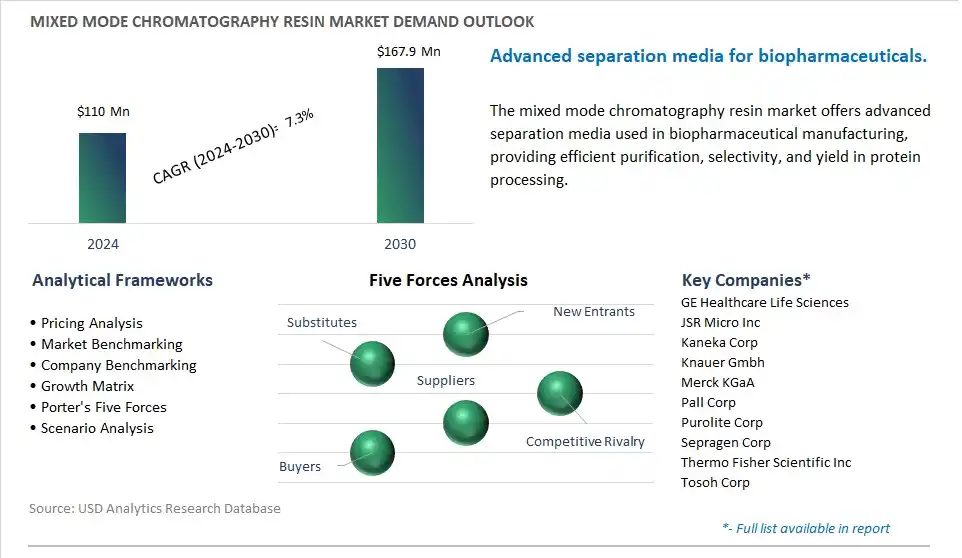
The global Mixed Mode Chromatography Resin Market is poised to register a 7.3% CAGR from $110 Million in 2024 to $167.9 Million in 2030.
The global Mixed Mode Chromatography Resin Market Study analyzes and forecasts the market size across 6 regions and 24 countries for diverse segments -By Type (Ion Exchange-Hydrophobic Type, Hydroxyapatite Type, Others), By Application (Antibodies Production, Vaccine Production, Non-antibody Proteins, Antibody-drug conjugate, Separation of low molecular weight impurities).
An Introduction to Global Mixed Mode Chromatography Resin Market in 2024
The future of chromatography resin is marked by advancements aimed at enhancing purification efficiency, scalability, and cost-effectiveness. One prominent trend is the development of mixed-mode chromatography resins that offer improved selectivity and versatility, allowing for the purification of complex biomolecules with greater precision and throughput. Manufacturers are also investing in the optimization of resin chemistries and particle designs to achieve higher binding capacities and faster mass transfer kinetics, thereby reducing process cycle times and increasing productivity. Moreover, there's a growing demand for resin products that are compatible with a wide range of buffer conditions and can withstand harsh cleaning and sanitization protocols, ensuring long-term stability and reusability. As biopharmaceutical production continues to expand, driven by the growing demand for personalized medicine and biologics, mixed-mode chromatography resin technologies are poised to play a pivotal role in enabling efficient downstream processing and purification of therapeutic molecules.
Mixed Mode Chromatography Resin Market Competitive Landscape
The market report analyses the leading companies in the industry including GE Healthcare Life Sciences, JSR Micro Inc, Kaneka Corp, Knauer Gmbh, Merck KGaA, Pall Corp, Purolite Corp, Sepragen Corp, Thermo Fisher Scientific Inc, Tosoh Corp.
Mixed Mode Chromatography Resin Market Dynamics
Mixed Mode Chromatography Resin Market Trend: Increasing Adoption of Biopharmaceuticals and Protein Therapeutics
A significant trend in the Mixed Mode Chromatography Resin market is the increasing adoption of biopharmaceuticals and protein therapeutics. With the growing prevalence of complex diseases and the advancement of biotechnology, there's a rising demand for innovative biopharmaceutical products such as monoclonal antibodies, recombinant proteins, and gene therapies. Mixed mode chromatography resins, known for their versatility in separating and purifying biomolecules based on multiple interaction modes (e.g., ion exchange, hydrophobic interaction, and affinity), are becoming essential tools in downstream bioprocessing for the purification of biotherapeutics. The trend towards biopharmaceutical development drives the demand for mixed mode chromatography resins as a crucial component in bioprocess purification workflows.
Mixed Mode Chromatography Resin Market Driver: Need for High Selectivity and Efficiency in Biomolecule Purification
A key driver propelling the Mixed Mode Chromatography Resin market is the need for high selectivity and efficiency in biomolecule purification processes. In biopharmaceutical manufacturing, the purification of therapeutic proteins and antibodies from complex biological matrices requires chromatography resins capable of achieving high levels of purity and yield while maintaining product stability and bioactivity. Mixed mode chromatography resins offer distinct advantages over traditional chromatography media by providing multiple binding mechanisms that enable selective capture and purification of target molecules with minimal non-specific binding. As biopharmaceutical companies strive to optimize production processes and ensure product quality, the demand for mixed mode chromatography resins with superior selectivity, resolution, and throughput continues to grow.
Mixed Mode Chromatography Resin Market Opportunity: Development of Next-Generation Chromatography Resins
An opportunity in the Mixed Mode Chromatography Resin market lies in the development of next-generation chromatography resins with enhanced performance and versatility. With advancements in resin chemistry, material science, and manufacturing technologies, there's potential to innovate and create novel chromatography resins that offer improved binding capacity, stability, and ease of use. Manufacturers aim to capitalize on this opportunity by investing in research and development to engineer resins with tailored properties for specific biomolecule purification applications, such as virus removal, aggregate removal, and polishing steps in downstream processing. Additionally, there's an opportunity to explore the integration of mixed mode chromatography resins with other purification modalities, such as affinity chromatography and size exclusion chromatography, to develop integrated purification platforms that streamline bioprocess workflows and enhance productivity. By addressing unmet needs and offering advanced solutions, manufacturers can capture market share and drive growth in the mixed mode chromatography resin market.
Mixed Mode Chromatography Resin Market Share Analysis: Ion Exchange-Hydrophobic generated the highest revenue in 2024
The largest segment in the Mixed mixed-mode chromatography Resin Market is the Ion Exchange-Hydrophobic Type. The market growth is driven by Ion Exchange-Hydrophobic resins offer a versatile and effective solution for various chromatography applications, including protein purification, biomolecule separation, and pharmaceutical processing. These resins combine the principles of both ion exchange and hydrophobic interaction chromatography, allowing for simultaneous purification based on the charge and hydrophobicity characteristics of target molecules. This dual-mode functionality enables Ion Exchange-Hydrophobic resins to effectively separate complex mixtures of biomolecules, proteins, peptides, and nucleic acids with high resolution and selectivity. Further, Ion Exchange-Hydrophobic resins exhibit excellent binding capacity, dynamic binding capacity (DBC), and throughput performance, making them suitable for large-scale industrial production processes in biopharmaceutical, biotechnology, and life sciences industries. These resins offer high affinity and specificity for target molecules, enabling efficient capture, purification, and recovery of biomolecules from crude feedstocks and cell culture supernatants. In addition, Ion Exchange-Hydrophobic resins are available in various particle sizes, pore structures, and surface chemistries to accommodate different applications, sample matrices, and process conditions. Manufacturers offer customization options for resin ligand chemistry, ligand density, and functional groups to optimize resin performance and compatibility with specific biomolecules and target purification objectives. Additionally, Ion Exchange-Hydrophobic resins are compatible with a wide range of buffer systems, pH conditions, and elution strategies, allowing for flexibility and control in chromatographic separations. Further, Ion Exchange-Hydrophobic resins offer scalability and reproducibility across different chromatography scales, from laboratory-scale research and development to large-scale manufacturing and production processes. Their robust performance, versatility, and compatibility with automated chromatography systems make them the preferred choice for purification processes in the biopharmaceutical and biotechnology industries. Over the forecast period, the combination of their dual-mode functionality, high binding capacity, customization options, scalability, and compatibility position the Ion Exchange-Hydrophobic Type segment as the largest in the Mixed Mode Chromatography Resin Market.
Mixed Mode Chromatography Resin Market Share Analysis: Antibody Production segment is poised to register the fastest growth rate (CAGR) over the forecast period to 2030
The fastest-growing segment in the Mixed Mode Chromatography Resin Market is the Antibody Production application segment. There is a rising demand for therapeutic antibodies in the biopharmaceutical industry due to their increasing use in the treatment of various diseases, including cancer, autoimmune disorders, and infectious diseases. Antibodies are essential components of biological drugs and monoclonal antibody therapies, driving the need for efficient purification methods to isolate and purify antibodies from complex biological matrices. Mixed-mode chromatography resins offer unique advantages for antibody purification by providing multiple interaction modes, including ion exchange, hydrophobic interaction, and affinity interactions, enabling selective and efficient capture and purification of antibodies from cell culture supernatants, fermentation broths, and other crude sources. Further, the biopharmaceutical industry is witnessing a surge in antibody-based drug development pipelines, with a growing number of monoclonal antibody candidates entering clinical trials and commercialization stages. As the demand for therapeutic antibodies continues to rise, there is increasing pressure to develop cost-effective and scalable purification processes to meet production demands and regulatory requirements. Mixed-mode chromatography resins offer high binding capacity, selectivity, and resolution for antibody purification, enabling manufacturers to achieve high yields and purity levels while minimizing process steps and production costs. In addition, technological advancements in antibody production processes, cell culture systems, and expression platforms drive the adoption of mixed-mode chromatography resins for antibody purification. Manufacturers are investing in innovative resin chemistries, ligand designs, and process optimization strategies to enhance resin performance, process efficiency, and product quality. Additionally, mixed-mode chromatography resins offer versatility and flexibility in antibody purification processes, allowing for customized purification strategies tailored to specific antibody characteristics, such as charge, hydrophobicity, and affinity. Further, the increasing trend towards integrated and continuous biomanufacturing processes in the biopharmaceutical industry creates opportunities for mixed-mode chromatography resins to be incorporated into streamlined and automated purification platforms, enabling rapid and efficient antibody production workflows. Over the forecast period, the combination of growing demand for therapeutic antibodies, advancements in antibody production technologies, and the versatility of mixed-mode chromatography resins positions the Antibody Production application segment as the fastest-growing in the mixed-mode chromatography Resin Market.
Mixed Mode Chromatography Resin Market Report Segmentation
By Type
Ion Exchange-Hydrophobic Type
Hydroxyapatite Type
Others
By Application
Antibodies Production
Vaccine Production
Non-antibody Proteins
Antibody-drug conjugate
Separation of low molecular weight impurities
Regions Included
North America (US, Canada, Mexico)
Europe (Germany, UK, France, Spain, Italy, Russia, Rest of Europe)
Asia Pacific (China, India, Japan, South Korea, Australia, South East Asia, Rest of Asia)
South America (Brazil, Argentina, Rest of South America)
Middle East and Africa (Saudi Arabia, UAE, Rest of Middle East, South Africa, Egypt, Rest of Africa)
Mixed Mode Chromatography Resin Companies Profiled in the Market Study
GE Healthcare Life Sciences
JSR Micro Inc
Kaneka Corp
Knauer Gmbh
Merck KGaA
Pall Corp
Purolite Corp
Sepragen Corp
Thermo Fisher Scientific Inc
Tosoh Corp
*- List Not Exhaustive
TABLE OF CONTENTS
1 Introduction to 2024 Mixed Mode Chromatography Resin Market
1.1 Market Overview
1.2 Quick Facts
1.3 Scope/Objective of the Study
1.4 Market Definition
1.5 Countries and Regions Covered
1.6 Units, Currency, and Conversions
1.7 Industry Value Chain
2 Research Methodology
2.1 Market Size Estimation
2.2 Sources and Research Methodology
2.3 Data Triangulation
2.4 Assumptions and Limitations
3 Executive Summary
3.1 Global Mixed Mode Chromatography Resin Market Size Outlook, $ Million, 2021 to 2030
3.2 Mixed Mode Chromatography Resin Market Outlook by Type, $ Million, 2021 to 2030
3.3 Mixed Mode Chromatography Resin Market Outlook by Product, $ Million, 2021 to 2030
3.4 Mixed Mode Chromatography Resin Market Outlook by Application, $ Million, 2021 to 2030
3.5 Mixed Mode Chromatography Resin Market Outlook by Key Countries, $ Million, 2021 to 2030
4 Market Dynamics
4.1 Key Driving Forces of Mixed Mode Chromatography Resin Industry
4.2 Key Market Trends in Mixed Mode Chromatography Resin Industry
4.3 Potential Opportunities in Mixed Mode Chromatography Resin Industry
4.4 Key Challenges in Mixed Mode Chromatography Resin Industry
5 Market Factor Analysis
5.1 Value Chain Analysis
5.2 Competitive Landscape
5.2.1 Global Mixed Mode Chromatography Resin Market Share by Company (%), 2023
5.2.2 Product Offerings by Company
5.3 Porter’s Five Forces Analysis
5.4 Pricing Analysis and Outlook
6 Growth Outlook Across Scenarios
6.1 Growth Analysis-Case Scenario Definitions
6.2 Low Growth Scenario Forecasts
6.3 Reference Growth Scenario Forecasts
6.4 High Growth Scenario Forecasts
7 Global Mixed Mode Chromatography Resin Market Outlook by Segments
7.1 Mixed Mode Chromatography Resin Market Outlook by Segments, $ Million, 2021- 2030
By Type
Ion Exchange-Hydrophobic Type
Hydroxyapatite Type
Others
By Application
Antibodies Production
Vaccine Production
Non-antibody Proteins
Antibody-drug conjugate
Separation of low molecular weight impurities
8 North America Mixed Mode Chromatography Resin Market Analysis and Outlook To 2030
8.1 Introduction to North America Mixed Mode Chromatography Resin Markets in 2024
8.2 North America Mixed Mode Chromatography Resin Market Size Outlook by Country, 2021-2030
8.2.1 United States
8.2.2 Canada
8.2.3 Mexico
8.3 North America Mixed Mode Chromatography Resin Market size Outlook by Segments, 2021-2030
By Type
Ion Exchange-Hydrophobic Type
Hydroxyapatite Type
Others
By Application
Antibodies Production
Vaccine Production
Non-antibody Proteins
Antibody-drug conjugate
Separation of low molecular weight impurities
9 Europe Mixed Mode Chromatography Resin Market Analysis and Outlook To 2030
9.1 Introduction to Europe Mixed Mode Chromatography Resin Markets in 2024
9.2 Europe Mixed Mode Chromatography Resin Market Size Outlook by Country, 2021-2030
9.2.1 Germany
9.2.2 France
9.2.3 Spain
9.2.4 United Kingdom
9.2.4 Italy
9.2.5 Russia
9.2.6 Norway
9.2.7 Rest of Europe
9.3 Europe Mixed Mode Chromatography Resin Market Size Outlook by Segments, 2021-2030
By Type
Ion Exchange-Hydrophobic Type
Hydroxyapatite Type
Others
By Application
Antibodies Production
Vaccine Production
Non-antibody Proteins
Antibody-drug conjugate
Separation of low molecular weight impurities
10 Asia Pacific Mixed Mode Chromatography Resin Market Analysis and Outlook To 2030
10.1 Introduction to Asia Pacific Mixed Mode Chromatography Resin Markets in 2024
10.2 Asia Pacific Mixed Mode Chromatography Resin Market Size Outlook by Country, 2021-2030
10.2.1 China
10.2.2 India
10.2.3 Japan
10.2.4 South Korea
10.2.5 Indonesia
10.2.6 Malaysia
10.2.7 Australia
10.2.8 Rest of Asia Pacific
10.3 Asia Pacific Mixed Mode Chromatography Resin Market size Outlook by Segments, 2021-2030
By Type
Ion Exchange-Hydrophobic Type
Hydroxyapatite Type
Others
By Application
Antibodies Production
Vaccine Production
Non-antibody Proteins
Antibody-drug conjugate
Separation of low molecular weight impurities
11 South America Mixed Mode Chromatography Resin Market Analysis and Outlook To 2030
11.1 Introduction to South America Mixed Mode Chromatography Resin Markets in 2024
11.2 South America Mixed Mode Chromatography Resin Market Size Outlook by Country, 2021-2030
11.2.1 Brazil
11.2.2 Argentina
11.2.3 Rest of South America
11.3 South America Mixed Mode Chromatography Resin Market size Outlook by Segments, 2021-2030
By Type
Ion Exchange-Hydrophobic Type
Hydroxyapatite Type
Others
By Application
Antibodies Production
Vaccine Production
Non-antibody Proteins
Antibody-drug conjugate
Separation of low molecular weight impurities
12 Middle East and Africa Mixed Mode Chromatography Resin Market Analysis and Outlook To 2030
12.1 Introduction to Middle East and Africa Mixed Mode Chromatography Resin Markets in 2024
12.2 Middle East and Africa Mixed Mode Chromatography Resin Market Size Outlook by Country, 2021-2030
12.2.1 Saudi Arabia
12.2.2 UAE
12.2.3 Oman
12.2.4 Rest of Middle East
12.2.5 Egypt
12.2.6 Nigeria
12.2.7 South Africa
12.2.8 Rest of Africa
12.3 Middle East and Africa Mixed Mode Chromatography Resin Market size Outlook by Segments, 2021-2030
By Type
Ion Exchange-Hydrophobic Type
Hydroxyapatite Type
Others
By Application
Antibodies Production
Vaccine Production
Non-antibody Proteins
Antibody-drug conjugate
Separation of low molecular weight impurities
13 Company Profiles
13.1 Company Snapshot
13.2 SWOT Profiles
13.3 Products and Services
13.4 Recent Developments
13.5 Financial Profile
GE Healthcare Life Sciences
JSR Micro Inc
Kaneka Corp
Knauer Gmbh
Merck KGaA
Pall Corp
Purolite Corp
Sepragen Corp
Thermo Fisher Scientific Inc
Tosoh Corp
14 Appendix
14.1 Customization Offerings
14.2 Subscription Services
14.3 Related Reports
14.4 Publisher Expertise
By Type
Ion Exchange-Hydrophobic Type
Hydroxyapatite Type
Others
By Application
Antibodies Production
Vaccine Production
Non-antibody Proteins
Antibody-drug conjugate
Separation of low molecular weight impurities
Countries Analyzed
North America (US, Canada, Mexico)
Europe (Germany, UK, France, Spain, Italy, Russia, Rest of Europe)
Asia Pacific (China, India, Japan, South Korea, Australia, South East Asia, Rest of Asia)
South America (Brazil, Argentina, Rest of South America)
Middle East and Africa (Saudi Arabia, UAE, Rest of Middle East, South Africa, Egypt, Rest of Africa)
