Mobile Cafe Franchise Service Market Overview: Agility, Innovation, and Consumer Convenience Driving Global Growth
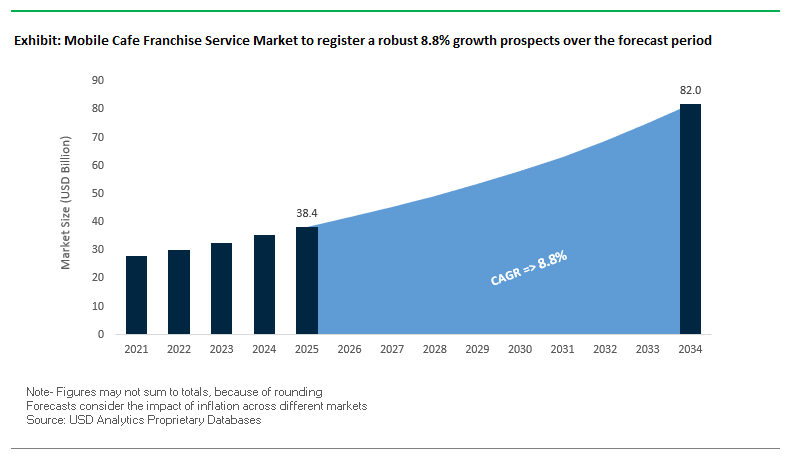
The global market for mobile cafe franchises is expected to grow from $38.4 billion in 2025 to $82 billion in 2034, with a CAGR of 8.8%. The business is among the most dynamic niches of the food and beverage sector, offering franchisees with low overhead, high operational mobility, and direct access to a fast-growing convenience-driven base of customers. By eliminating the limitations of traditional fixed locations, mobile cafe franchises are revolutionizing coffee culture by delivering upscale, specialty beverages and snacks directly to high-traffic areas, venues, and workplaces.
The rapid growth of the business is propelled by increasing urbanization, the boom in coffee culture globally, and the affordability of mobile business models. Compared to traditional cafés, mobile franchises are less expensive to invest in initially, which is attractive to new business owners but also-scalable. Additionally, their ability to serve from a broad variety of locations ranging from commuter hubs to corporate events creates multiple streams of revenue.
Key Insights for Industry Professionals:
- Urban Mobility Advantage: Serves high-traffic areas without fixed real estate costs.
- Coffee Culture Expansion: Rising specialty coffee consumption supports premium mobile offerings.
- Low Entry Barriers: Reduced startup costs increase franchise accessibility.
- Operational Flexibility: Adaptable models trucks, vans, carts support varied event and daily routes.
- Health & Wellness Demand: Plant-based, organic, and functional beverages are emerging as key differentiators.
Mobile Cafe Franchise Service Market Analysis: Technological Integration, Wellness Trends, and Expansion Strategies
Mobile cafe franchise business has embraced technology and increased product menus in recent times to respond to evolving customer preferences. In August 2024, a premier mobile food chain restaurant company launched an enhanced mobile ordering app that enabled customers to order and pay in advance online, reducing wait times and boosting operating volume. Industry data from the National Restaurant Association as of February 2025 showed that 70% of consumers chose quick-service coffee, 60% of which ordered through the mobile app, driving adoption of app-based and drive-thru formats.
Franchises have also undertaken targeted geographic expansion. July 2025 witnessed Coffee-Bike expanding with independent stores that don't need external utilities, perfect for festivals and busy areas. August 2024 witnessed Urban Eats opening 50 North American franchise stores, a sign of strong investor confidence. The industry has also capitalized on niche consumer trends September 2024 witnessed the introduction of a mobile cafe menu of organic and plant-based drinks, while April 2025 witnessed the introduction of a CBD-infused coffee format in legally permissible markets.
Operational innovation is a growth driver. In October 2024, real-time mobile cafe tracking was introduced, which enhances customer engagement. January 2025, on the other hand, saw a large franchise spend on an e-learning system to ensure service consistency across its chain. Combined, these initiatives demonstrate how mobile cafe franchises are leveraging agility, brand, and product innovation to win market share from both mature and emerging markets for coffee.
Trends and Opportunities Shaping the Mobile Café Franchise Service Market
EV-Powered Micro-Mobility Coffee Units Transform Urban Operations
The shift from conventional gas-fueled trucks to EV-fueled mobile cafés is transforming the competitive landscape. These battery- or clean-energy-powered units are more appealing in zero-emission zones required by cities, allowing operators to enter pedestrian-heavy areas, parks, and shopping malls off-limits to combustion-engine vehicles. At the operational level, EV platforms save on fuel, lower mechanical maintenance, and include onboard power for grinders, espresso, and refrigeration units that eliminate noisy generators. Quiet, environmentally friendly operation maximizes customer experience in noise-sensitive residential and commercial neighborhoods. Strategically, sustainability credentials fuel franchise marketing, aligning brands with climate-conscious consumers, particularly Millennials and Gen Z, who actively seek businesses demonstrating environmental responsibility.
AI-Optimized Location Routing Increases Revenue per Stop
Franchises are employing AI-based location optimizing software to dynamically reposition units in real-time, replacing static route planning with predictive algorithms. Inputs vary from historical pedestrian traffic flows to live traffic feeds, weather patterns, and even trending social media events. This enables accurate positioning such as outside an office high-rise during the morning rush hour or outside a sporting park during the lunchtime event to capture the highest daily yield. AI systems also adapt on-the-fly to disruptions, repositioning units instantly if a road closure or unexpected crowd gather. This real-time adaptation increases velocity of sales, reduces idle time, and increases fuel efficiency, allowing mobile cafés to be operated at maximum profit potential every time with operating overhead kept to a bare minimum.
Corporate Campus Partnerships for Guaranteed Volume
Technology, healthcare, and manufacturing corporate campuses represent an underpenetrated, high-margin mobile café franchise channel. These captive markets are usually comprised of thousands of employees in remote locations with limited premium coffee alternatives. Regular campus visitation or sole on-site partnerships provide stable, high-volume demand with minimal competitive risk. Franchises can enjoy fixed-term service contracts, providing predictable revenue flow. In addition, tailored services such as company-specific beverage menus for company events or seasonal promotions allow franchise cafes to integrate into the company culture. With minimal marketing investment and high-margin sales in a low customer churn environment, this model offers good ROI to franchisees.
Modular Franchise Kits Lower Entry Barriers for Entrepreneurs
Turnkey modular café packages with EV-powered units, complete equipment packages, brand materials, and training simplify entry for prospective owners in franchise models. Packages remove business operation risk by merging a proven business model with standardized SOPs. Low capital outlay versus traditional brick-and-mortar cafes increases the target investor universe, and financing partnerships and low-interest loan programs facilitate entry. Comprehensive training in coffee craft, customer service, inventory management, and marketing enables franchisees to ramp up operations rapidly. Scalability is inherent in the model successful operators can add units without incremental high overhead, facilitating fleet-based expansion in high-demand markets.
Mobile Café Franchise Service Market Share and Segmentation Insights
Service Model Performance: Coffee Vans Lead; Kiosks and Pop-Ups Gain Niche Strength
Coffee vans and trucks (45% market share) dominate the mobile café franchise service market, favored for their high street visibility, mobility, and ability to deliver high-volume service across multiple locations. Their versatility enables them to be utilized for event-based sales and repositioning heavy-traffic locations. Carts and kiosks (30%) flourish in transit hubs, malls, and corporate reception areas where small footprints are essential and rental expenses are lower. Experiential coffee service requirements at weddings, festivals, and private events are driving pop-up cafés and event catering as high-margin opportunities, where brand exposure is optimized and per-unit revenues are higher than daily street operations.
.png)
Product Offering Performance: Specialty Coffee Anchors Premium Margins
Specialty coffee (40% market share) like cold brew, nitro coffee, and single-origin espresso supports premium positioning and margin expansion, appealing to consumers craving artisanal, Instagrammable beverages. Everyday coffee is volume bread-and-butter, offering steady throughput and for price-sensitive consumers. Tea and other beverages broaden reach to non-coffee consumers and health-oriented consumers with matcha, herbal teas, and smoothies. Snacks and pastries (10%) support margins, bumping average order value (AOV) while providing cross-selling opportunities. Locally baked goods, in turn, drive community building and differentiate franchises from generic chain fare.
Competitive Landscape – Global Leaders in Mobile Cafe Franchising
The mobile cafe franchise market is competitive yet opportunity-rich, with leaders distinguishing themselves through brand positioning, operational support, and product diversity. Key players included are Cafe2U, Really Awesome Coffee, Xpresso Mobile Café, The Coffee Guy, Coffee Blue, Jim's Mobile Café, Coffee-Bike, Cappuccino Xpress, Espresso Mobile Café, The Rush Coffee, Go Go Coffee Co, Little Coffee Bean, Xpresso Delight, Extreme Coffee, Others.
Cafe2U – Global Pioneer of Mobile Coffee Franchising
Cafe2U has built a global footprint with its turnkey mobile coffee van franchise model, combining high-end espresso beverages with intense franchisee training and support. Its business park-, school-, and community event-targeting business model has allowed the brand to replicate in a range of markets. It has been more recently targeting markets with growing demand for gourmet, mobile coffee and pitching its "man in a van" low-risk, high-return model.
The Coffee Guy – Australasian Leader in Simple, Scalable Coffee Routes
Based in Australia and New Zealand, The Coffee Guy offers franchisees a combined mobile coffee van system based on high-quality, consistent beverages. Its business model is designed to offer repeatable customer routes for daily revenues coupled with efficient vehicle designs to achieve maximum productivity. Recent vehicle upgrade investment has enhanced its competitive edge on the basis of both appearance and performance.
Xpresso Mobile Café – B2B Coffee Service Specialist
Xpresso Mobile Café targets the corporate sector with the provision of high-quality coffee machines at no cost in offices and handling supply logistics. Its B2B business model gives franchisees a predictable revenue stream and ensures brand loyalty with corporate clients. Aggressive marketing of its "free machine" opportunity has been accompanied by recent foreign expansion into the United States market to entice franchise partners.
Maui Wowi Hawaiian Coffees and Smoothies – Event-Focused Themed Franchise
Maui Wowi is unique with its Hawaiian-themed brand and two-menu system of coffee and fruit smoothies. Its franchise offerings are kiosks, carts, and mobile vans for deployment in fairs, festivals, and private events. The company has invested in high-volume service equipment to optimize event performance and establish its fun, tropical brand identity.
Really Awesome Coffee – UK-Based Franchise with Comprehensive Support
Really Awesome Coffee provides franchisees with a custom-built mobile van, cutting-edge coffee equipment, and a complete snack menu. Its official roll-out program, continuous operations training, and two-way/event model service model provide franchisees with flexibility and profitability. In 2025, the company received industry awards for best franchisee support and sustainable business development.
United States: Technology-Driven Growth and Health-Conscious Offerings
The United States mobile cafe franchise service market benefits from an already established and thriving food truck culture, providing a solid foundation for mobile coffee concepts to flourish. With a well-developed regulatory landscape and high consumer acceptance of mobile food and beverage businesses, franchise operators can focus on differentiation through menu innovation and customer engagement. Many U.S. mobile cafe brands are leveraging real-time GPS location tracking, on-demand ordering apps, and mobile payment integration to boost accessibility and operational efficiency. These tech-forward features resonate strongly with time-conscious urban customers and event-goers. Additionally, the competitive environment encourages diverse product portfolios, with offerings expanding beyond coffee to include plant-based lattes, functional wellness drinks, and artisanal snacks.
Franchise systems in the U.S. are notable for their comprehensive franchisee support structures, including barista training programs, marketing toolkits, and operational consulting. This lowers entry barriers for aspiring entrepreneurs while ensuring consistent service quality across locations. The health and wellness movement is also shaping menu strategies, with mobile cafes introducing organic ingredients, dairy-free alternatives, and low-sugar beverage options to appeal to health-focused consumers. By combining operational flexibility, brand-led training, and consumer-centric menu diversification, the U.S. market continues to lead in mobile cafe franchise scalability and brand innovation.
United Kingdom: Sustainability Leadership and Niche Location Strategies
The United Kingdom’s mobile cafe franchise market is expanding through flexible business models that cater to both high-traffic urban hubs and niche event spaces. Operators are increasingly using coffee vans, pop-up kiosks, and modular units to operate at festivals, business districts, and tourist attractions without the overhead costs of fixed locations. The country’s growing eco-conscious consumer base has made sustainability initiatives a competitive necessity, with mobile cafes adopting biodegradable cups, reusable serviceware, and ethically sourced coffee beans to enhance brand reputation. This commitment to sustainability is not only consumer-driven but also aligns with evolving UK environmental policies.
Digital transformation is also reshaping the UK market, with contactless payment systems, digital loyalty programs, and pre-ordering apps becoming standard tools for improving customer retention and transaction speed. Another trend is the use of non-traditional and high-footfall locations such as airports, train stations, and co-working spaces, enabling mobile cafe franchises to reach commuter and business customer segments. This blend of strategic location diversification, technology adoption, and sustainability leadership positions UK-based mobile cafe brands to capture both domestic and international growth opportunities.
Australia: Specialty Coffee Excellence and Scalable Mobile Formats
Australia’s mobile cafe franchise service market thrives on its premium coffee culture and adherence to stringent food safety regulations. Mobile cafes in Australia must comply with the same hygiene and operational standards as fixed-location businesses, ensuring customer trust and product quality. This regulatory framework supports a high level of professionalism across the industry, while the consumer demand for specialty, ethically sourced coffee creates opportunities for differentiation. Mobile cafes often highlight artisanal brewing techniques, latte art, and rotating single-origin bean offerings to appeal to discerning customers.
The scalability of mobile cafe franchises in Australia is driven by low startup costs, compact vehicle designs, and location flexibility, enabling operators to adapt to different market segments from suburban shopping strips to coastal tourist areas. Brands are also capitalizing on event-based catering and corporate partnerships, providing mobile beverage services for festivals, business functions, and sporting events. This combination of high coffee quality standards, adaptable business models, and event-driven revenue streams positions Australia as a fertile ground for mobile cafe franchise expansion.
Canada: Drive-Thru Popularity and Specialty Coffee Integration
Canada’s mobile cafe franchise market is underpinned by its deep-rooted coffee culture and high per-capita coffee consumption. Franchises are adapting their models to integrate with Canada’s strong drive-thru culture, offering rapid-service mobile coffee units that can serve commuters and high-traffic roadside locations. This format, influenced by major chains like Tim Hortons, aligns perfectly with Canadian consumer preferences for convenience. Mobile cafes also benefit from government-backed small business programs, providing entrepreneurs with funding access, mentorship, and regulatory guidance, making market entry more accessible.
Alongside convenience, there is rising demand for specialty and artisanal coffee beverages, creating opportunities for mobile cafes to offer premium espresso drinks, cold brew, and seasonal beverage menus. Many franchises are leveraging menu flexibility and local sourcing to differentiate themselves from mass-market competitors. The adaptability of mobile cafes to serve in urban centers, suburban neighborhoods, and remote festival locations strengthens their competitive edge. By combining drive-thru operational efficiency, high-quality coffee offerings, and supportive entrepreneurial infrastructure, Canada continues to present strong growth potential for mobile cafe franchises.
Mobile Cafe Franchise Service Market Report Scope
Mobile Cafe Franchise Service Market
|
Parameter
|
Details
|
|
Market Size (2025)
|
$38.4 Billion
|
|
Market Size (2034)
|
$82 Billion
|
|
Market Growth Rate
|
8.8%
|
|
Segments
|
By Service Model (Coffee Vans/Trucks, Kiosks/Carts, Pop-Up Cafes, Event Catering), By Product Offering (Specialty Coffee, Standard Coffee, Tea and Other Beverages, Snacks and Pastries), By Customer Segment (Commuters, Office Workers, Event Attendees, Students), By Location Type (Urban Centers, Corporate Campuses, Festivals and Events, Residential Areas), By Technology (Mobile Ordering Apps, Real-Time Location Tracking, Contactless Payment Systems, Loyalty Programs)
|
|
Study Period
|
2019- 2024 and 2025-2034
|
|
Units
|
Revenue (USD)
|
|
Qualitative Analysis
|
Porter’s Five Forces, SWOT Profile, Market Share, Scenario Forecasts, Market Ecosystem, Company Ranking, Market Dynamics, Industry Benchmarking
|
|
Companies
|
Cafe2U, Really Awesome Coffee, Xpresso Mobile Café, The Coffee Guy, Coffee Blue, Jim's Mobile Café, Coffee-Bike, Cappuccino Xpress, Espresso Mobile Café, The Rush Coffee, Go Go Coffee Co, Little Coffee Bean, Xpresso Delight, Extreme Coffee, Others.
|
|
Countries
|
US, Canada, Mexico, Germany, France, Spain, Italy, UK, Russia, China, India, Japan, South Korea, Australia, South East Asia, Brazil, Argentina, Middle East, Africa
|
Mobile Cafe Franchise Service Market Segmentation
By Service Model
- Coffee Vans/Trucks
- Kiosks/Carts
- Pop-Up Cafes
- Event Catering
By Product Offering
- Specialty Coffee
- Standard Coffee
- Tea and Other Beverages
- Snacks and Pastries
By Customer Segment
- Commuters
- Office Workers
- Event Attendees
- Students
By Location Type
- Urban Centers
- Corporate Campuses
- Festivals and Events
- Residential Areas
By Technology
- Mobile Ordering Apps
- Real-Time Location Tracking
- Contactless Payment Systems
- Loyalty Programs
Countries Analyzed
- North America (US, Canada, Mexico)
- Europe (Germany, UK, France, Spain, Italy, Russia, Rest of Europe)
- Asia Pacific (China, India, Japan, South Korea, Australia, South East Asia, Rest of Asia)
- South America (Brazil, Argentina, Rest of South America)
- Middle East and Africa (Saudi Arabia, UAE, Rest of Middle East, South Africa, Egypt, Rest of Africa)
Top Companies in Mobile Cafe Franchise Service Market
- Cafe2U
- Really Awesome Coffee
- Xpresso Mobile Café
- The Coffee Guy
- Coffee Blue
- Jim's Mobile Café
- Coffee-Bike
- Cappuccino Xpress
- Espresso Mobile Café
- The Rush Coffee
- Go Go Coffee Co
- Little Coffee Bean
- Xpresso Delight
- Extreme Coffee
* List Not Exhaustive
Research Coverage
This report investigates the Mobile Cafe Franchise Service Market, mapping the drivers of agility-led growth and the shift to tech-enabled, wellness-forward menus. Compiled by USDAnalytics, the analysis reviews market breakthroughs in EV micro-mobility units, AI routing, and modular franchise kits, and highlights how location strategy, product mix, and customer segments are evolving across mature and emerging coffee cultures. It also benchmarks competitive playbooks, partnership models, and monetization levers across service formats (vans, kiosks, pop-ups, catering). With actionable sizing, route-to-market guidance, and risk checks on regulation and unit economics, this report is an essential resource for franchise leaders, investors, and suppliers optimizing expansion and profitability through 2034. Scope includes-
- Segmentation
- By Service Model: Coffee Vans/Trucks; Kiosks/Carts; Pop-Up Cafes; Event Catering
- By Product Offering: Specialty Coffee; Standard Coffee; Tea & Other Beverages; Snacks & Pastries
- By Customer Segment: Commuters; Office Workers; Event Attendees; Students
- By Location Type: Urban Centers; Corporate Campuses; Festivals & Events; Residential Areas
- By Technology: Mobile Ordering Apps; Real-Time Location Tracking; Contactless Payments; Loyalty Programs
- Geographic Scope: Analysis spans 25+ countries across North America, Europe, Asia Pacific, Latin America, and the Middle East & Africa.
- Timeframe: Historic data 2021–2024 and forecasts 2025–2034.
- Companies: Analysis/profiles of 15+ leading brands and platforms.
Methodology
We applied a mixed-methods approach: (Primary research with franchise founders, multi-unit operators, roasters, vehicle upfitters, and enterprise buyers (corporate campuses/event organizers) to capture pricing, AOV, route cadence, capex/opex, and conversion metrics; (Secondary research across franchise FDDs, company filings, national hospitality/restaurant datasets, mobility regulations, payment/app telemetry, and event attendance records. Market sizing used bottom-up unit counts by format and region, validated with top-down spend per capita on out-of-home coffee. Forecasts reflect adoption curves for EV fleets, AI routing, and specialty coffee penetration, stress-tested with sensitivity analyses for fuel/energy prices, permitting, and consumer discretionary cycles. Data were triangulated to ensure consistency of growth rates, margins, and payback periods.
Deliverables:
- Comprehensive Market Research Report (PDF and Excel) with detailed tables, charts, and interactive visualizations.
- Country-Specific Forecasts & Analysis.
- Segment-Wise Revenue Forecasts (2025–2034).
- Competitive Analysis, Benchmarking, and SWOT Profiles.
- Recent Developments & Innovation Tracker.
- Executive Summary & Analyst Commentary.
- Post-Purchase Analyst Support for Client-Specific Questions and Custom Data Requirements.
