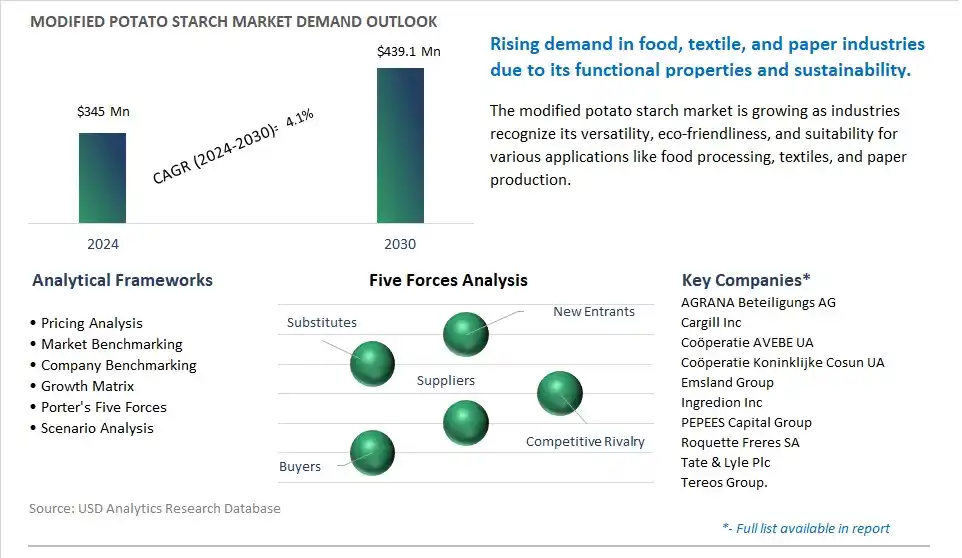
The global Modified Potato Starch Market is poised to register a 4.1% CAGR from $345 Million in 2024 to $439.1 Million in 2030.
The global Modified Potato Starch Market Study analyzes and forecasts the market size across 6 regions and 24 countries for diverse segments -By Nature (Organic, Conventional), By End-User (Bakery, Dairy and Deserts, Soups, Sauces and Dressings, Meat and Fish, Savory and Snacks, Confectionery, Pet Food, Others).
An Introduction to Global Modified Potato Starch Market in 2024
The future of modified potato starch is shaped by several key trends, including increasing demand for clean-label and plant-based ingredients in food and beverage formulations, advancements in starch modification technologies, and growing emphasis on functionality, texture, and sensory attributes. Modified potato starch is derived from potatoes and undergoes physical, chemical, or enzymatic treatments to alter its properties such as viscosity, stability, and gelling ability, making it suitable for various applications in food processing. With the rise of gluten-free, vegan, and natural food trends, there's a growing need for modified potato starch that offers improved texture, mouthfeel, and shelf stability while meeting consumer expectations for clean-label products with minimal processing and additives. Moreover, advancements in starch modification techniques, such as cross-linking, hydroxypropylation, and acid hydrolysis, are driving the development of modified potato starch with enhanced functional properties such as freeze-thaw stability, shear resistance, and heat tolerance for applications in soups, sauces, bakery products, and dairy alternatives. Additionally, the integration of modified potato starch into food formulations with other functional ingredients such as gums, proteins, and fibers is enabling the development of healthier and more indulgent products that meet the evolving needs of consumers seeking nutritious and delicious food options. Collaboration between starch processors, food manufacturers, research institutions, and regulatory agencies is essential to drive innovation, ensure ingredient safety, and address market demands in the modified potato starch industry.
Modified Potato Starch Market Competitive Landscape
The market report analyses the leading companies in the industry including AGRANA Beteiligungs AG, Cargill Inc, Coöperatie AVEBE UA, Coöperatie Koninklijke Cosun UA, Emsland Group, Ingredion Inc, PEPEES Capital Group, Roquette Freres SA, Tate & Lyle Plc, Tereos Group..
Modified Potato Starch Market Dynamics
Modified Potato Starch Market Trend: Increasing Demand for Clean Label and Natural Food Ingredients
A significant trend in the modified potato starch market is the increasing demand for clean label and natural food ingredients. As consumers become more health-conscious and ingredient-savvy, there's a growing preference for food products made with natural and recognizable ingredients. Modified potato starch, derived from potatoes and modified through physical, enzymatic, or chemical processes to improve functionality, texture, and stability, is gaining popularity as a clean label ingredient in various food and beverage applications. This trend is driven by consumer demand for minimally processed foods, free from artificial additives and preservatives, as well as the food industry's efforts to meet clean label requirements and differentiate products in the marketplace. As manufacturers reformulate their products to align with clean label trends, the demand for modified potato starch as a natural and versatile ingredient is expected to continue rising.
Modified Potato Starch Market Driver: Growth in Convenience Food and Processed Food Industries
A major driver of the modified potato starch market is the growth in convenience food and processed food industries. Modified potato starch is widely used as a thickening, binding, and stabilizing agent in a variety of convenience foods, including soups, sauces, gravies, bakery products, and ready-to-eat meals. With changing lifestyles, urbanization, and increasing demand for on-the-go meals, there's a rising need for food ingredients that enhance texture, mouthfeel, and shelf stability while meeting consumer preferences for convenience and taste. Modified potato starch offers functional benefits such as improved viscosity, freeze-thaw stability, and resistance to high temperatures, making it suitable for use in a wide range of processed food applications. As the convenience food market continues to expand globally, particularly in emerging economies, the demand for modified potato starch as a key ingredient in processed foods is expected to drive market growth.
Modified Potato Starch Market Opportunity: Expansion into Gluten-Free and Health-Conscious Food Segments
An opportunity within the modified potato starch market lies in the expansion into gluten-free and health-conscious food segments. With the growing prevalence of gluten intolerance, celiac disease, and gluten-free diet trends, there's a demand for alternative ingredients that can replace wheat-based thickeners and binders in gluten-free food products. Modified potato starch, naturally gluten-free and hypoallergenic, offers an ideal solution for formulating gluten-free bakery products, pasta, snacks, and sauces with desirable texture and sensory properties. Additionally, there's an opportunity to develop modified potato starch products with enhanced nutritional profiles, such as resistant starch variants that offer prebiotic benefits and digestive health advantages. By targeting the gluten-free and health-conscious food segments and positioning modified potato starch as a clean label, natural, and functional ingredient, companies can tap into new market opportunities and drive growth in the modified potato starch market.
Modified Potato Starch Market Share Analysis: The Conventional potato starch segment generated the highest revenue in 2024
The largest segment in the Modified Potato Starch Market is Conventional potato starch. This dominance is primarily driving demand within this sector. Conventional potato starch is widely produced and used in various food and industrial applications globally. It is obtained from non-organic potatoes through traditional extraction and modification processes. Conventional potato starch offers Diverse functional properties, including thickening, binding, gelling, and stabilizing, making it a versatile ingredient in food processing, pharmaceuticals, papermaking, textiles, and other industries. Additionally, conventional potato starch is more readily available and cost-effective compared to organic potato starch, as it is produced on a larger scale and does not require organic certification, which involves stringent production standards and higher costs. Further, the majority of consumers and industrial users prioritize factors such as price, availability, and performance when selecting starch ingredients, driving the preference for conventional potato starch in the market. Furthermore, the conventional agriculture sector dominates potato cultivation worldwide, with larger acreages dedicated to non-organic potato production, further supporting the dominance of conventional potato starch in the Modified Potato Starch Market. Over the forecast period, these factors contribute to Conventional potato starch emerging as the largest segment in the Modified Potato Starch Market.
Modified Potato Starch Market Share Analysis: The Savory and Snacks segment is poised to register the fastest growth rate (CAGR) over the forecast period to 2030
The fastest-growing segment in the Modified Potato Starch Market is Savory and Snacks. Savory and snack products, including potato chips, extruded snacks, crackers, and savory biscuits, are experiencing increasing popularity globally due to changing consumer lifestyles, growing urbanization, and the rising demand for convenient, on-the-go food options. Modified potato starch is widely used in the savory and snack industry as a functional ingredient for its ability to provide texture, crispness, and mouthfeel to snack products. Additionally, modified potato starch offers improved stability, freeze-thaw resistance, and oil binding capacity, making it an ideal ingredient for enhancing the quality and shelf life of savory and snack products. Further, the trend towards healthier and clean-label snack options has led manufacturers to seek natural and plant-based ingredients like modified potato starch to replace synthetic additives and improve the nutritional profile of their products. Furthermore, the increasing consumer demand for gluten-free, non-GMO, and allergen-free snack options further drives the adoption of modified potato starch, which meets these dietary preferences and regulatory requirements. Additionally, the growing awareness of sustainable food production practices and environmental concerns prompts manufacturers to choose modified potato starch derived from renewable and biodegradable sources. Over the forecast period, these factors contribute to Savory and Snacks emerging as the fastest-growing segment in the Modified Potato Starch Market.
Modified Potato Starch Market Report Segmentation
By Nature
Organic
Conventional
By End-User
Bakery
Dairy and Deserts
Soups
Sauces and Dressings
Meat and Fish
Savory and Snacks
Confectionery
Pet Food
Others
Regions Included
North America (US, Canada, Mexico)
Europe (Germany, UK, France, Spain, Italy, Russia, Rest of Europe)
Asia Pacific (China, India, Japan, South Korea, Australia, South East Asia, Rest of Asia)
South America (Brazil, Argentina, Rest of South America)
Middle East and Africa (Saudi Arabia, UAE, Rest of Middle East, South Africa, Egypt, Rest of Africa)
Modified Potato Starch Companies Profiled in the Market Study
AGRANA Beteiligungs AG
Cargill Inc
Coöperatie AVEBE UA
Coöperatie Koninklijke Cosun UA
Emsland Group
Ingredion Inc
PEPEES Capital Group
Roquette Freres SA
Tate & Lyle Plc
Tereos Group.
*- List Not Exhaustive
TABLE OF CONTENTS
1 Introduction to 2024 Modified Potato Starch Market
1.1 Market Overview
1.2 Quick Facts
1.3 Scope/Objective of the Study
1.4 Market Definition
1.5 Countries and Regions Covered
1.6 Units, Currency, and Conversions
1.7 Industry Value Chain
2 Research Methodology
2.1 Market Size Estimation
2.2 Sources and Research Methodology
2.3 Data Triangulation
2.4 Assumptions and Limitations
3 Executive Summary
3.1 Global Modified Potato Starch Market Size Outlook, $ Million, 2021 to 2030
3.2 Modified Potato Starch Market Outlook by Type, $ Million, 2021 to 2030
3.3 Modified Potato Starch Market Outlook by Product, $ Million, 2021 to 2030
3.4 Modified Potato Starch Market Outlook by Application, $ Million, 2021 to 2030
3.5 Modified Potato Starch Market Outlook by Key Countries, $ Million, 2021 to 2030
4 Market Dynamics
4.1 Key Driving Forces of Modified Potato Starch Industry
4.2 Key Market Trends in Modified Potato Starch Industry
4.3 Potential Opportunities in Modified Potato Starch Industry
4.4 Key Challenges in Modified Potato Starch Industry
5 Market Factor Analysis
5.1 Value Chain Analysis
5.2 Competitive Landscape
5.2.1 Global Modified Potato Starch Market Share by Company (%), 2023
5.2.2 Product Offerings by Company
5.3 Porter’s Five Forces Analysis
5.4 Pricing Analysis and Outlook
6 Growth Outlook Across Scenarios
6.1 Growth Analysis-Case Scenario Definitions
6.2 Low Growth Scenario Forecasts
6.3 Reference Growth Scenario Forecasts
6.4 High Growth Scenario Forecasts
7 Global Modified Potato Starch Market Outlook by Segments
7.1 Modified Potato Starch Market Outlook by Segments, $ Million, 2021- 2030
By Nature
Organic
Conventional
By End-User
Bakery
Dairy and Deserts
Soups
Sauces and Dressings
Meat and Fish
Savory and Snacks
Confectionery
Pet Food
Others
8 North America Modified Potato Starch Market Analysis and Outlook To 2030
8.1 Introduction to North America Modified Potato Starch Markets in 2024
8.2 North America Modified Potato Starch Market Size Outlook by Country, 2021-2030
8.2.1 United States
8.2.2 Canada
8.2.3 Mexico
8.3 North America Modified Potato Starch Market size Outlook by Segments, 2021-2030
By Nature
Organic
Conventional
By End-User
Bakery
Dairy and Deserts
Soups
Sauces and Dressings
Meat and Fish
Savory and Snacks
Confectionery
Pet Food
Others
9 Europe Modified Potato Starch Market Analysis and Outlook To 2030
9.1 Introduction to Europe Modified Potato Starch Markets in 2024
9.2 Europe Modified Potato Starch Market Size Outlook by Country, 2021-2030
9.2.1 Germany
9.2.2 France
9.2.3 Spain
9.2.4 United Kingdom
9.2.4 Italy
9.2.5 Russia
9.2.6 Norway
9.2.7 Rest of Europe
9.3 Europe Modified Potato Starch Market Size Outlook by Segments, 2021-2030
By Nature
Organic
Conventional
By End-User
Bakery
Dairy and Deserts
Soups
Sauces and Dressings
Meat and Fish
Savory and Snacks
Confectionery
Pet Food
Others
10 Asia Pacific Modified Potato Starch Market Analysis and Outlook To 2030
10.1 Introduction to Asia Pacific Modified Potato Starch Markets in 2024
10.2 Asia Pacific Modified Potato Starch Market Size Outlook by Country, 2021-2030
10.2.1 China
10.2.2 India
10.2.3 Japan
10.2.4 South Korea
10.2.5 Indonesia
10.2.6 Malaysia
10.2.7 Australia
10.2.8 Rest of Asia Pacific
10.3 Asia Pacific Modified Potato Starch Market size Outlook by Segments, 2021-2030
By Nature
Organic
Conventional
By End-User
Bakery
Dairy and Deserts
Soups
Sauces and Dressings
Meat and Fish
Savory and Snacks
Confectionery
Pet Food
Others
11 South America Modified Potato Starch Market Analysis and Outlook To 2030
11.1 Introduction to South America Modified Potato Starch Markets in 2024
11.2 South America Modified Potato Starch Market Size Outlook by Country, 2021-2030
11.2.1 Brazil
11.2.2 Argentina
11.2.3 Rest of South America
11.3 South America Modified Potato Starch Market size Outlook by Segments, 2021-2030
By Nature
Organic
Conventional
By End-User
Bakery
Dairy and Deserts
Soups
Sauces and Dressings
Meat and Fish
Savory and Snacks
Confectionery
Pet Food
Others
12 Middle East and Africa Modified Potato Starch Market Analysis and Outlook To 2030
12.1 Introduction to Middle East and Africa Modified Potato Starch Markets in 2024
12.2 Middle East and Africa Modified Potato Starch Market Size Outlook by Country, 2021-2030
12.2.1 Saudi Arabia
12.2.2 UAE
12.2.3 Oman
12.2.4 Rest of Middle East
12.2.5 Egypt
12.2.6 Nigeria
12.2.7 South Africa
12.2.8 Rest of Africa
12.3 Middle East and Africa Modified Potato Starch Market size Outlook by Segments, 2021-2030
By Nature
Organic
Conventional
By End-User
Bakery
Dairy and Deserts
Soups
Sauces and Dressings
Meat and Fish
Savory and Snacks
Confectionery
Pet Food
Others
13 Company Profiles
13.1 Company Snapshot
13.2 SWOT Profiles
13.3 Products and Services
13.4 Recent Developments
13.5 Financial Profile
AGRANA Beteiligungs AG
Cargill Inc
Coöperatie AVEBE UA
Coöperatie Koninklijke Cosun UA
Emsland Group
Ingredion Inc
PEPEES Capital Group
Roquette Freres SA
Tate & Lyle Plc
Tereos Group.
14 Appendix
14.1 Customization Offerings
14.2 Subscription Services
14.3 Related Reports
14.4 Publisher Expertise
By Nature
Organic
Conventional
By End-User
Bakery
Dairy and Deserts
Soups
Sauces and Dressings
Meat and Fish
Savory and Snacks
Confectionery
Pet Food
Others
Countries Analyzed
North America (US, Canada, Mexico)
Europe (Germany, UK, France, Spain, Italy, Russia, Rest of Europe)
Asia Pacific (China, India, Japan, South Korea, Australia, South East Asia, Rest of Asia)
South America (Brazil, Argentina, Rest of South America)
Middle East and Africa (Saudi Arabia, UAE, Rest of Middle East, South Africa, Egypt, Rest of Africa)
