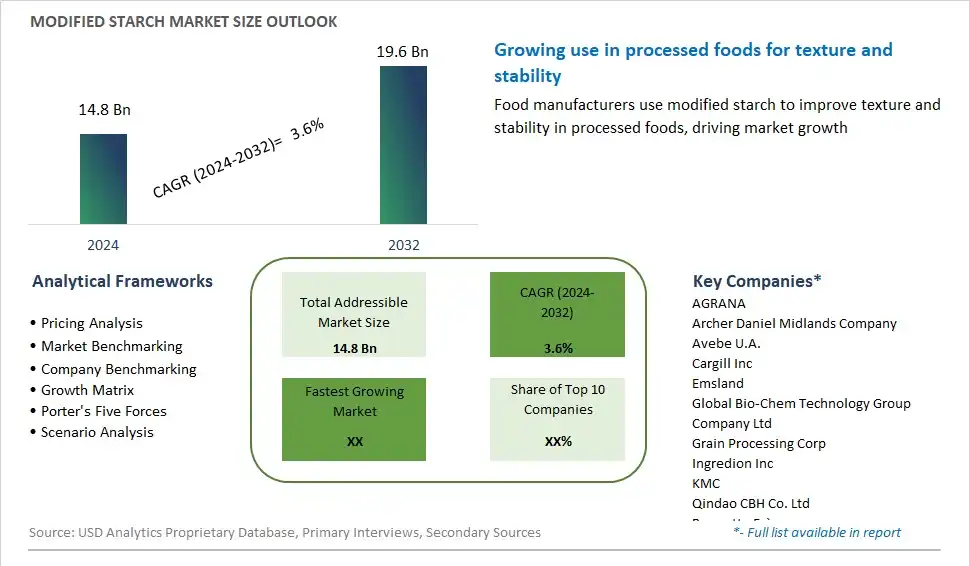
Global Modified Starch Market Size is valued at $14.8 Billion in 2024 and is forecast to register a growth rate (CAGR) of 3.6% to reach $19.6 Billion by 2032.
The global Modified Starch Market Comprehensive Study analyzes and forecasts the market size across 6 regions and 24 countries for diverse segments -By Product (Starch Esters & Ethers, Resistant, Cationic, Pre-Gelatinized, Others), By Material (Corn, Cassava, Wheat, Potato, Others), By Function (Stabilizers, Thickeners, Emulsifiers, Binders, Others), By End-User (Food & Beverage, Animal Feed, Paper, Pharmaceuticals, Textiles, Others)
An Introduction to Modified Starch Market
Modified starch refers to starch derivatives that have been chemically or physically altered to enhance their functional properties for various food and industrial applications in 2024. Common modifications include hydrolysis, oxidation, esterification, and cross-linking, which can improve characteristics such as viscosity, stability, texture, and freeze-thaw stability. Modified starches find widespread use in food products such as soups, sauces, gravies, baked goods, and dairy desserts, where they serve as thickeners, stabilizers, and texture modifiers. In the industrial sector, modified starches are utilized in adhesives, paper manufacturing, textiles, and pharmaceuticals, where they provide binding, coating, and controlled release properties. With advancements in starch modification technology and increasing demand for clean label and natural ingredients, the market for modified starches is witnessing innovations in enzyme-assisted modification, non-GMO alternatives, and functional blends that cater to diverse application needs while meeting consumer preferences for clean label and sustainable ingredients.
Modified Starch Competitive Landscape
The market report analyses the leading companies in the industry including AGRANA, Archer Daniel Midlands Company, Avebe U.A., Cargill Inc, Emsland, Global Bio-Chem Technology Group Company Ltd, Grain Processing Corp, Ingredion Inc, KMC, Qindao CBH Co. Ltd, Roquette Frères, Royal Ingredients Group, SMS Corp, SPAC Starch Products Ltd, Tate & Lyle Plc, Tereos, and Others.
Modified Starch Market Dynamics
Modified Starch Market Trend: Increased Demand for Clean Label and Natural Ingredients
The market trend for modified starch is witnessing an increased demand for clean label and natural ingredients in various industries, including food and beverage, pharmaceuticals, and personal care. As consumers become more health-conscious and scrutinize product labels, there's a growing preference for modified starches derived from natural sources such as corn, tapioca, and potato starch, rather than chemically modified variants. This trend is driven by the desire for transparency, authenticity, and minimally processed foods, leading manufacturers to reformulate products with modified starches that meet clean label criteria while maintaining functionality and performance. Additionally, the clean label movement extends beyond food to other sectors, such as cosmetics and pharmaceuticals, where modified starches are used as thickeners, stabilizers, and excipients in formulations.
Market Driver: Functional Properties and Versatility in Food Processing
A key driver propelling the market for modified starch is its functional properties and versatility in food processing, offering solutions for texture modification, viscosity control, and stability enhancement in a wide range of food products. Modified starches play a vital role in improving the sensory attributes, mouthfeel, and shelf life of food and beverage formulations, contributing to enhanced product quality and consumer acceptance. Moreover, modified starches enable manufacturers to achieve specific functional requirements such as freeze-thaw stability, acid resistance, and heat tolerance, making them indispensable ingredients in applications ranging from soups and sauces to bakery and dairy products. As the food industry continues to innovate and diversify, the demand for modified starches as functional ingredients to meet formulation challenges and consumer preferences remains strong, driving market growth and innovation.
Market Opportunity: Expansion into Health and Wellness Applications
An opportunity within the modified starch market lies in the expansion into health and wellness applications to capitalize on the growing demand for functional and nutritional ingredients. With increasing consumer awareness of the link between diet and health, there's a rising interest in products formulated with ingredients that offer added health benefits. Modified starches can be tailored to incorporate functional properties such as resistant starch, prebiotic fibers, and low glycemic index characteristics, making them suitable for use in health-focused food and beverage products. For example, modified resistant starches can be utilized in formulations targeting digestive health, weight management, and blood sugar control, while modified tapioca or rice starches can serve as alternatives for gluten-free and allergen-free products. By leveraging the nutritional attributes and functional versatility of modified starches, manufacturers can develop innovative products that appeal to health-conscious consumers and capitalize on opportunities in the burgeoning health and wellness market segment.
Modified Starch Market Share Analysis: Starch Esters & Ethers held the dominant market share in 2024
Within the modified starch market, the Starch Esters & Ethers segment is the largest, owing to several critical factors. Starch esters and ethers offer a wide range of functional properties and applications across various industries, including food and beverages, pharmaceuticals, and textiles. These modified starches are prized for their versatility, providing functionalities such as thickening, stabilizing, gelling, and binding, essential for improving texture, shelf life, and sensory attributes of end products. Additionally, starch esters and ethers exhibit enhanced resistance to shear, heat, and acid, making them suitable for a broad range of processing conditions. Further, the growing demand for clean label and natural ingredients in consumer products drives the preference for modified starches derived from renewable sources like starch. As industries continue to innovate and expand their product offerings, the Starch Esters & Ethers segment remains at the forefront, driving growth and innovation in the modified starch market.
Modified Starch Market Share Analysis: Cassava market is poised to register the fastest growth rae over the forecast period to 2032
In the modified starch market, the Cassava segment stands out as the fastest-growing, propelled by several pivotal factors. Cassava, a starchy root crop, offers numerous advantages such as high starch content, low production costs, and resilience to diverse climatic conditions, making it an attractive raw material for modified starch production. Additionally, the increasing demand for gluten-free and non-GMO ingredients in food and beverage formulations drives the popularity of cassava-derived modified starches as natural and sustainable alternatives to traditional sources like corn and wheat. Further, technological advancements in cassava processing and starch modification techniques have led to the development of high-quality and functional starch derivatives, catering to the evolving needs of various industries including food, pharmaceuticals, and textiles. Furthermore, the abundant availability of cassava in regions such as Africa, Asia, and Latin America further fuels its growth as a preferred raw material for modified starch production. As industries prioritize sustainability and innovation, the Cassava segment is poised to continue its rapid expansion, driving growth and transformation in the modified starch market.
Modified Starch Market Share Analysis: Thickeners held the dominant market share in 2024
Within the modified starch market, the Thickeners segment is the largest, driven by several pivotal factors. Thickeners play a critical role in a wide range of industries, including food and beverages, pharmaceuticals, and personal care, by imparting viscosity and texture to various formulations. Modified starches are prized for their superior thickening properties, providing manufacturers with a cost-effective and versatile solution for achieving desired product consistencies. Additionally, the growing demand for convenience foods, sauces, soups, and desserts fuels the adoption of modified starch thickeners as essential ingredients in food formulations. Further, technological advancements in starch modification processes have led to the development of highly functional and stable thickening agents, further enhancing their applicability and competitiveness in the market. Furthermore, the increasing awareness among consumers regarding the benefits of modified starches in terms of texture enhancement, shelf stability, and clean label formulations drives the demand for thickener products, solidifying the dominance of the Thickeners segment in the modified starch market. As industries continue to innovate and diversify their product offerings, thickeners derived from modified starches remain indispensable, driving growth and innovation in the market.
Modified Starch Market Segmentation
By Product
Starch Esters & Ethers
Resistant
Cationic
Pre-Gelatinized
Others
By Material
Corn
Cassava
Wheat
Potato
Others
By Function
Stabilizers
Thickeners
Emulsifiers
Binders
Others
By End-User
Food & Beverage
Animal Feed
Paper
Pharmaceuticals
Textiles
Others
Countries Analyzed
North America (US, Canada, Mexico)
Europe (Germany, UK, France, Spain, Italy, Russia, Rest of Europe)
Asia Pacific (China, India, Japan, South Korea, Australia, South East Asia, Rest of Asia)
South America (Brazil, Argentina, Rest of South America)
Middle East and Africa (Saudi Arabia, UAE, Rest of Middle East, South Africa, Egypt, Rest of Africa)
Modified Starch Companies Profiled in the Study
AGRANA
Archer Daniel Midlands Company
Avebe U.A.
Cargill Inc
Emsland
Global Bio-Chem Technology Group Company Ltd
Grain Processing Corp
Ingredion Inc
KMC
Qindao CBH Co. Ltd
Roquette Frères
Royal Ingredients Group
SMS Corp
SPAC Starch Products Ltd
Tate & Lyle Plc
Tereos
*- List Not Exhaustive
Chapter 1. TABLE OF CONTENTS
Chapter 2. Introduction to Modified Starch Market
2.1. Market Overview
2.2. Key Statistics and Report Highlights
2.3. Scope of the Comprehensive Study
2.3.1. Market Definition
2.3.2 Countries and Regions Covered
2.3.3 Research Objective
2.3.4 Units, Currency, and Conversions
2.3.5 Industry Value Chain
2.4. Key Market Segments
2.5. Key Companies
2.6. Study Period
Chapter 3. Strategic Analysis Review
3.1. Modified Starch Pricing Analysis and Forecast
3.2. Porter’s Five Forces
3.3. Market Ecosystem
3.4. SWOT Analysis
3.5. Regulatory Scenario
3.3. Effects of Inflation, Russia-Ukraine War, moderating economic growth, and other macroeconomic factors
Chapter 4. Competitive Landscape
4.1. Market Share Analysis
4.1.1. Global Modified Starch Market Share by Company, 2023
4.1.2. Product Offerings of Leading Modified Starch Companies
4.2. Market Entropy
4.2.1. New Product Launches in the Industry
4.2.2. Mergers, Acquisitions, Joint ventures, and Partnerships
4.3. Key Strategies and Best Practices
Chapter 5. Global Market Projections: Best, Reference, and Low Case Scenarios
5.1. Growth Analysis- Case Scenario Definitions
5.2. Low Growth Case Scenario Forecasts
5.3. Reference Growth Case Scenario Forecasts
5.4. High Growth Case Scenario Forecasts
Chapter 6. Market Dynamics
6.1. Modified Starch Market Drivers
6.2. Modified Starch Market Challenges
6.6. Modified Starch Market Opportunities
6.4. Modified Starch Market Trends
Chapter 7. Global Modified Starch Market Outlook Trends
7.1. Global Modified Starch Revenue (USD Million) and CAGR (%) by Type (2021-2032)
7.2. Global Modified Starch Revenue (USD Million) and CAGR (%) by Application (2021-2032)
7.3. Global Modified Starch Revenue (USD Million) and CAGR (%) by Product (2021-2032)
By Product
Starch Esters & Ethers
Resistant
Cationic
Pre-Gelatinized
Others
By Material
Corn
Cassava
Wheat
Potato
Others
By Function
Stabilizers
Thickeners
Emulsifiers
Binders
Others
By End-User
Food & Beverage
Animal Feed
Paper
Pharmaceuticals
Textiles
Others
Chapter 8. Global Modified Starch Regional Analysis and Outlook
8.1. Global Modified Starch Revenue (USD Million) By Regions (2021- 2032)
8.2. North America Modified Starch Revenue (USD Million) by Country (2021-2032)
8.2.1. United States Modified Starch Regional Analysis and Outlook
8.2.2. Canada Modified Starch Regional Analysis and Outlook
8.2.3. Mexico Modified Starch Regional Analysis and Outlook
8.3. Europe Modified Starch Revenue (USD Million), by Country (2021-2032)
8.3.1. Germany Modified Starch Regional Analysis and Outlook
8.3.2. France Modified Starch Regional Analysis and Outlook
8.3.3. United Kingdom Modified Starch Regional Analysis and Outlook
8.3.4. Spain Modified Starch Regional Analysis and Outlook
8.3.5. Italy Modified Starch Regional Analysis and Outlook
8.3.6. Russia Modified Starch Regional Analysis and Outlook
8.3.7. Rest of Europe Modified Starch Regional Analysis and Outlook
8.4. Asia Pacific Modified Starch Revenue (USD Million) by Country (2021-2032)
8.4.1. China Modified Starch Regional Analysis and Outlook
8.4.2. Japan Modified Starch Regional Analysis and Outlook
8.4.3. India Modified Starch Regional Analysis and Outlook
8.4.4. South Korea Modified Starch Regional Analysis and Outlook
8.4.5. Australia Modified Starch Regional Analysis and Outlook
8.4.6. South East Asia Modified Starch Regional Analysis and Outlook
8.4.7. Rest of Asia Pacific Modified Starch Regional Analysis and Outlook
8.5. South America Modified Starch Revenue (USD Million), by Country (2021-2032)
8.5.1. Brazil Modified Starch Regional Analysis and Outlook
8.5.2. Argentina Modified Starch Regional Analysis and Outlook
8.5.3. Rest of South America Modified Starch Regional Analysis and Outlook
8.6. Middle East and Africa Modified Starch Revenue (USD Million) by Country (2021-2032)
8.6.1. Middle East Modified Starch Regional Analysis and Outlook
8.6.2. Africa Modified Starch Regional Analysis and Outlook
Chapter 9. North America Modified Starch Analysis and Outlook
9.1. North America Modified Starch Revenue (USD Million) by Segments (2021-2032)
9.1.1. North America Modified Starch Revenue (USD Million) by Type (2021-2032)
9.1.2. North America Modified Starch Revenue (USD Million) by Application (2021-2032)
9.1.3. North America Modified Starch Revenue (USD Million) by Product (2021-2032)
By Product
Starch Esters & Ethers
Resistant
Cationic
Pre-Gelatinized
Others
By Material
Corn
Cassava
Wheat
Potato
Others
By Function
Stabilizers
Thickeners
Emulsifiers
Binders
Others
By End-User
Food & Beverage
Animal Feed
Paper
Pharmaceuticals
Textiles
Others
Chapter 10. Europe Modified Starch Analysis and Outlook
10.1. Europe Modified Starch Revenue (USD Million), by Segments (USD Million) (2021-2032)
10.1.1. Europe Modified Starch Revenue (USD Million) by Type (2021-2032)
10.1.2. Europe Modified Starch Revenue (USD Million) by Application (2021-2032)
10.1.3. Europe Modified Starch Revenue (USD Million) by Product (2021-2032)
By Product
Starch Esters & Ethers
Resistant
Cationic
Pre-Gelatinized
Others
By Material
Corn
Cassava
Wheat
Potato
Others
By Function
Stabilizers
Thickeners
Emulsifiers
Binders
Others
By End-User
Food & Beverage
Animal Feed
Paper
Pharmaceuticals
Textiles
Others
Chapter 11. Asia Pacific Modified Starch Analysis and Outlook
11.1. Asia Pacific Modified Starch Revenue (USD Million), and Revenue (USD Million) by Segments (2021-2032)
11.1.1. Asia Pacific Modified Starch Revenue (USD Million) by Type (2021-2032)
11.1.2. Asia Pacific Modified Starch Revenue (USD Million) by Application (2021-2032)
11.1.3. Asia Pacific Modified Starch Revenue (USD Million) by Product (2021-2032)
By Product
Starch Esters & Ethers
Resistant
Cationic
Pre-Gelatinized
Others
By Material
Corn
Cassava
Wheat
Potato
Others
By Function
Stabilizers
Thickeners
Emulsifiers
Binders
Others
By End-User
Food & Beverage
Animal Feed
Paper
Pharmaceuticals
Textiles
Others
Chapter 12. South America Modified Starch Analysis and Outlook
12.1. South America Modified Starch Revenue (USD Million), by Segments (2021-2032)
12.1.1. South America Modified Starch Revenue (USD Million) by Type (2021-2032)
12.1.2. South America Modified Starch Revenue (USD Million) by Application (2021-2032)
12.1.3. South America Modified Starch Revenue (USD Million) by Product (2021-2032)
By Product
Starch Esters & Ethers
Resistant
Cationic
Pre-Gelatinized
Others
By Material
Corn
Cassava
Wheat
Potato
Others
By Function
Stabilizers
Thickeners
Emulsifiers
Binders
Others
By End-User
Food & Beverage
Animal Feed
Paper
Pharmaceuticals
Textiles
Others
Chapter 13. Middle East and Africa Modified Starch Analysis and Outlook
13.1. Middle East and Africa Modified Starch Revenue (USD Million), by Segments (2021-2032)
13.1.1. Middle East and Africa Modified Starch Revenue (USD Million) by Type (2021-2032)
13.1.2. Middle East and Africa Modified Starch Revenue (USD Million) by Application (2021-2032)
13.1.3. Middle East and Africa Modified Starch Revenue (USD Million) by Product (2021-2032)
By Product
Starch Esters & Ethers
Resistant
Cationic
Pre-Gelatinized
Others
By Material
Corn
Cassava
Wheat
Potato
Others
By Function
Stabilizers
Thickeners
Emulsifiers
Binders
Others
By End-User
Food & Beverage
Animal Feed
Paper
Pharmaceuticals
Textiles
Others
Chapter 14. Modified Starch Company Profiles
14.1 Business Overview
14.2 Product Profiles
14.3 SWOT Profiles
14.5 Recent Developments
14.6 Financial Profile
List of Companies
AGRANA
Archer Daniel Midlands Company
Avebe U.A.
Cargill Inc
Emsland
Global Bio-Chem Technology Group Company Ltd
Grain Processing Corp
Ingredion Inc
KMC
Qindao CBH Co. Ltd
Roquette Frères
Royal Ingredients Group
SMS Corp
SPAC Starch Products Ltd
Tate & Lyle Plc
Tereos
15. Methodology and Data Sources
15.1 Customization Offerings
15.2 Subscription Services
15.3 Related Reports
15.4 Publisher Expertise
LIST OF TABLES
Table 1 Market Segmentation Analysis
Table 2 Global Modified Starch Market Share of Leading Companies, 2023
Table 3 Product Offerings of Leading Companies
Table 4 Low Growth Scenario Forecasts
Table 5 Reference Case Growth Scenario
Table 6 High Growth Case Scenario
Table 7 Global Modified Starch Revenue (USD Million) And CAGR (%) By Type (2021-2032)
Table 8 Global Modified Starch Revenue (USD Million) And CAGR (%) By Application (2021-2032)
Table 9 Global Modified Starch Revenue (USD Million) And CAGR (%) By Product (2021-2032)
Table 10 Global Modified Starch Market Revenue (USD Million) By Regions (2021-2032)
Table 11 Global Modified Starch Market Share (%) By Regions (2021-2032)
Table 12 North America Modified Starch Revenue (USD Million) By Country (2021-2032)
Table 13 Europe Modified Starch Revenue (USD Million) By Country (2021-2032)
Table 14 Asia Pacific Modified Starch Revenue (USD Million) By Country (2021-2032)
Table 15 South America Modified Starch Revenue (USD Million) By Country (2021-2032)
Table 16 Middle East and Africa Modified Starch Revenue (USD Million) By Region (2021-2032)
Table 17 North America Modified Starch Revenue (USD Million) By Type (2021-2032)
Table 18 North America Modified Starch Revenue (USD Million) By Application (2021-2032)
Table 19 North America Modified Starch Revenue (USD Million) By Product (2021-2032)
Table 20 Europe Modified Starch Revenue (USD Million) By Type (2021-2032)
Table 21 Europe Modified Starch Revenue (USD Million) By Application (2021-2032)
Table 22 Europe Modified Starch Revenue (USD Million) By Product (2021-2032)
Table 23 Asia Pacific Modified Starch Revenue (USD Million) By Type (2021-2032)
Table 24 Asia Pacific Modified Starch Revenue (USD Million) By Application (2021-2032)
Table 25 Asia Pacific Modified Starch Revenue (USD Million) By Product (2021-2032)
Table 26 South America Modified Starch Revenue (USD Million) By Type (2021-2032)
Table 27 South America Modified Starch Revenue (USD Million) By Application (2021-2032)
Table 28 South America Modified Starch Revenue (USD Million) By Product (2021-2032)
Table 29 Middle East and Africa Modified Starch Revenue (USD Million) By Type (2021-2032)
Table 30 Middle East and Africa Modified Starch Revenue (USD Million) By Application (2021-2032)
Table 31 Middle East and Africa Modified Starch Revenue (USD Million) By Product (2021-2032)
LIST OF FIGURES
Figure 1. Market Scope
Figure 2. Pricing Forecasts Per Unit, 2023- 2032
Figure 3. Porter’s Five Forces
Figure 4. Global Modified Starch Market Revenue (USD Million) By Regions (2021-2032)
Figure 5. Global Modified Starch Market Share (%) By Regions (2023)
Figure 6. North America Modified Starch Revenue (USD Million) By Country (2021-2032)
Figure 7. United States Modified Starch Revenue (USD Million) By Country (2021-2032)
Figure 8. Canada Modified Starch Revenue (USD Million) By Country (2021-2032)
Figure 9. Mexico Modified Starch Revenue (USD Million) By Country (2021-2032)
Figure 10. Europe Modified Starch Revenue (USD Million) By Country (2021-2032)
Figure 11. Germany Modified Starch Revenue (USD Million) By Country (2021-2032)
Figure 12. France Modified Starch Revenue (USD Million) By Country (2021-2032)
Figure 13. United Kingdom Modified Starch Revenue (USD Million) By Country (2021-2032)
Figure 14. Spain Modified Starch Revenue (USD Million) By Country (2021-2032)
Figure 15. Italy Modified Starch Revenue (USD Million) By Country (2021-2032)
Figure 16. Russia Modified Starch Revenue (USD Million) By Country (2021-2032)
Figure 17. Rest of Europe Modified Starch Revenue (USD Million) By Country (2021-2032)
Figure 11. Asia Pacific Modified Starch Revenue (USD Million) By Country (2021-2032)
Figure 12. China Modified Starch Revenue (USD Million) By Country (2021-2032)
Figure 13. Japan Modified Starch Revenue (USD Million) By Country (2021-2032)
Figure 14. India Modified Starch Revenue (USD Million) By Country (2021-2032)
Figure 15. South Korea Modified Starch Revenue (USD Million) By Country (2021-2032)
Figure 16. Australia Modified Starch Revenue (USD Million) By Country (2021-2032)
Figure 17. South East Asia Modified Starch Revenue (USD Million) By Country (2021-2032)
Figure 18. South America Modified Starch Revenue (USD Million) By Country (2021-2032)
Figure 19. Brazil Modified Starch Revenue (USD Million) By Country (2021-2032)
Figure 20. Argentina Modified Starch Revenue (USD Million) By Country (2021-2032)
Figure 21. Rest of Asia Pacific Modified Starch Revenue (USD Million) By Country (2021-2032)
Figure 22. Middle East and Africa Modified Starch Revenue (USD Million) By Region (2021-2032)
Figure 23. Saudi Arabia Modified Starch Revenue (USD Million) By Region (2021-2032)
Figure 24. The UAE Modified Starch Revenue (USD Million) By Region (2021-2032)
Figure 25. Rest of Middle East Modified Starch Revenue (USD Million) By Region (2021-2032)
Figure 26. South Africa Modified Starch Revenue (USD Million) By Region (2021-2032)
Figure 27. Africa Modified Starch Revenue (USD Million) By Region (2021-2032)
Figure 28. North America Modified Starch Revenue (USD Million) By Type (2021-2032)
Figure 29. North America Modified Starch Revenue (USD Million) By Application (2021-2032)
Figure 30. North America Modified Starch Revenue (USD Million) By Product (2021-2032)
Figure 31. Europe Modified Starch Revenue (USD Million) By Type (2021-2032)
Figure 32. Europe Modified Starch Revenue (USD Million) By Application (2021-2032)
Figure 33. Europe Modified Starch Revenue (USD Million) By Product (2021-2032)
Figure 34. Asia Pacific Modified Starch Revenue (USD Million) By Type (2021-2032)
Figure 35. Asia Pacific Modified Starch Revenue (USD Million) By Application (2021-2032)
Figure 36. Asia Pacific Modified Starch Revenue (USD Million) By Product (2021-2032)
Figure 37. South America Modified Starch Revenue (USD Million) By Type (2021-2032)
Figure 38. South America Modified Starch Revenue (USD Million) By Application (2021-2032)
Figure 39. South America Modified Starch Revenue (USD Million) By Product (2021-2032)
Figure 40. Middle East and Africa Modified Starch Revenue (USD Million) By Type (2021-2032)
Figure 41. Middle East and Africa Modified Starch Revenue (USD Million) By Application (2021-2032)
Figure 42. Middle East and Africa Modified Starch Revenue (USD Million) By Product (2021-2032)
By Product
Starch Esters & Ethers
Resistant
Cationic
Pre-Gelatinized
Others
By Material
Corn
Cassava
Wheat
Potato
Others
By Function
Stabilizers
Thickeners
Emulsifiers
Binders
Others
By End-User
Food & Beverage
Animal Feed
Paper
Pharmaceuticals
Textiles
Others
Countries Analyzed
North America (US, Canada, Mexico)
Europe (Germany, UK, France, Spain, Italy, Russia, Rest of Europe)
Asia Pacific (China, India, Japan, South Korea, Australia, South East Asia, Rest of Asia)
South America (Brazil, Argentina, Rest of South America)
Middle East and Africa (Saudi Arabia, UAE, Rest of Middle East, South Africa, Egypt, Rest of Africa)
