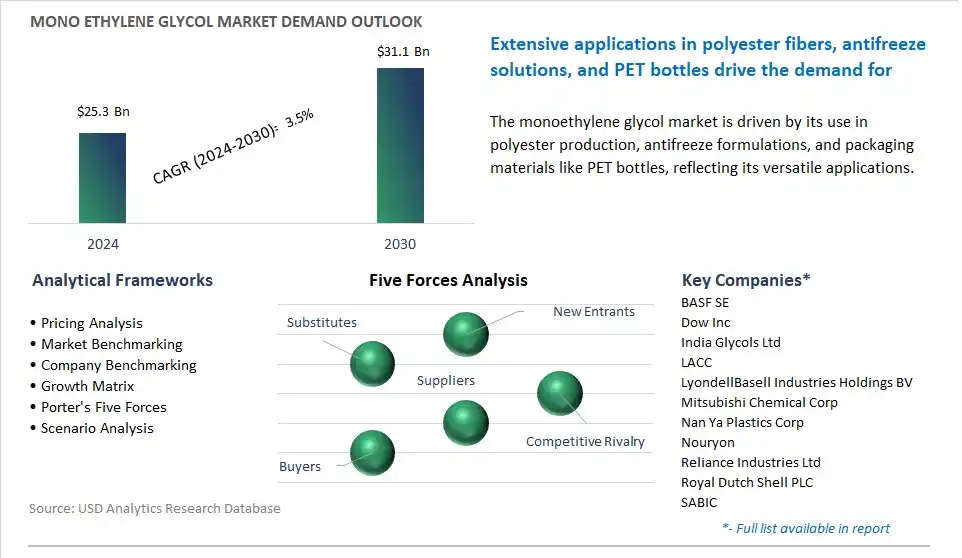
The global Mono Ethylene Glycol Market is poised to register a 3.5% CAGR from $25.3 Billion in 2024 to $31.1 Billion in 2030.
The global Mono Ethylene Glycol Market Study analyzes and forecasts the market size across 6 regions and 24 countries for diverse segments -By Application (Polyester Fiber, PET Bottle, PET Film, Antifreeze, Industrial), By End-User (Textile, Packaging, Plastic, Automotive, Others).
An Introduction to Global Mono Ethylene Glycol Market in 2024
The future of monoethylene glycol (MEG) is shaped by several key trends, including increasing demand for polymer raw materials, advancements in MEG production technologies, and growing emphasis on sustainability, product quality, and regulatory compliance. MEG is a versatile chemical compound used primarily as a raw material in the production of polyester fibers, resins, and antifreeze solutions, offering properties such as high solubility, low volatility, and thermal stability. With the rise of urbanization, population growth, and consumer demand for textiles, packaging, and automotive products, there's a growing need for MEG that offers consistent quality, purity, and supply reliability while minimizing environmental impact and energy consumption in manufacturing processes. Moreover, advancements in MEG production, such as bio-based routes, catalytic processes, and recycling technologies, are driving the development of sustainable and cost-effective methods for producing MEG from renewable feedstocks and waste streams, reducing reliance on fossil resources and mitigating carbon emissions. Additionally, the integration of MEG into downstream applications such as polyester production, coolant formulations, and gas dehydration is enabling the development of innovative products with enhanced performance, durability, and environmental compatibility, meeting the evolving needs of end-users and regulatory requirements. Collaboration between MEG producers, polymer manufacturers, research institutions, and sustainability advocates is essential to drive innovation, ensure product integrity, and address market demands in the monoethylene glycol industry.
Mono Ethylene Glycol Market Competitive Landscape
The market report analyses the leading companies in the industry including BASF SE, Dow Inc, India Glycols Ltd, LACC, LyondellBasell Industries Holdings BV, Mitsubishi Chemical Corp, Nan Ya Plastics Corp, Nouryon, Reliance Industries Ltd, Royal Dutch Shell PLC, SABIC, Solventis.
Mono Ethylene Glycol Market Dynamics
Mono Ethylene Glycol Market Trend: Growing Demand for Sustainable Packaging Solutions
A significant trend in the monoethylene glycol (MEG) market is the growing demand for sustainable packaging solutions. MEG, a key raw material in the production of polyethylene terephthalate (PET) resin, is extensively used in the manufacturing of plastic bottles, containers, and packaging materials for beverages, food products, personal care items, and household chemicals. With increasing consumer awareness of environmental issues such as plastic pollution and marine litter, there's a shift towards sustainable packaging alternatives that offer recyclability, biodegradability, and reduced environmental impact. This trend is driving the adoption of recycled PET (rPET), which utilizes MEG derived from post-consumer PET bottles, as well as bio-based MEG sourced from renewable feedstocks such as sugarcane or corn. As companies in the packaging industry commit to sustainability goals and seek to meet consumer preferences for eco-friendly packaging solutions, the demand for MEG as a crucial component of sustainable PET resin is expected to continue rising.
Mono Ethylene Glycol Market Driver: Growth in Textile and Polyester Fiber Industries
A major driver of the monoethylene glycol market is the growth in textile and polyester fiber industries. MEG is a fundamental building block in the production of polyester fibers, which are widely used in textile manufacturing for clothing, upholstery, carpets, and industrial applications. With increasing urbanization, rising disposable incomes, and changing fashion trends, there's a growing demand for polyester fibers as a versatile and cost-effective alternative to natural fibers such as cotton and wool. Additionally, the expansion of the textile industry in emerging economies, coupled with technological advancements in fiber spinning and fabric production, drives the consumption of MEG for polyester fiber manufacturing. As the textile and apparel sectors continue to grow globally, particularly in Asia-Pacific and Latin America, the demand for MEG as a key ingredient in polyester fibers is expected to remain robust.
Mono Ethylene Glycol Market Opportunity: Expansion into Antifreeze and Coolant Applications
An opportunity within the monoethylene glycol market lies in the expansion into antifreeze and coolant applications. MEG is widely used as a primary ingredient in automotive antifreeze and engine coolant formulations, where it functions as a heat transfer fluid, corrosion inhibitor, and freezing point depressant. With the increasing number of vehicles on the road, advancements in engine technology, and stricter regulations governing vehicle emissions and fuel efficiency, there's a growing need for high-quality antifreeze and coolant products that provide efficient thermal management and engine protection. MEG-based antifreeze formulations offer superior performance characteristics such as low viscosity, high boiling point, and excellent thermal stability, making them ideal for use in modern automotive engines. By leveraging its properties as an effective coolant agent and corrosion inhibitor, MEG manufacturers can explore opportunities to expand their presence in the automotive aftermarket and industrial cooling systems, thereby diversifying their product portfolio and capturing additional market share in the antifreeze and coolant segment.
Mono Ethylene Glycol (MEG) Market Share Analysis: The Polyester Fiber segment generated the highest revenue in 2024
The largest segment in the Mono Ethylene Glycol (MEG) Market is Polyester Fiber. This dominance is primarily driving demand within this sector. Polyester fiber production consumes the majority of monoethylene glycol globally, accounting for a significant share of its total consumption. Monoethylene glycol is a key raw material in the production of polyester fibers, which are widely used in textiles, apparel, home furnishings, automotive interiors, and industrial applications. Polyester fibers offer potential advantages such as durability, versatility, wrinkle resistance, and ease of care, making them popular in various end-use sectors. Additionally, the growing population, rising disposable incomes, changing consumer lifestyles, and increasing demand for textile and apparel products drive the demand for polyester fibers worldwide. Further, advancements in manufacturing technologies and product innovations have led to the development of high-performance and eco-friendly polyester fibers, further boosting their adoption in diverse applications. Furthermore, the versatility of polyester fibers enables their use in blending with other natural and synthetic fibers to achieve desired properties and performance characteristics, expanding their application scope across different industries. Over the forecast period, these factors contribute to Polyester Fiber emerging as the largest segment in the Mono Ethylene Glycol (MEG) Market.
Mono Ethylene Glycol (MEG) Market Share Analysis: The Packaging segment is poised to register the fastest growth rate (CAGR) over the forecast period to 2030
The fastest-growing segment in the Mono Ethylene Glycol (MEG) Market is Packaging. Packaging applications, including bottles, containers, films, and other forms of packaging materials, are experiencing increasing demand globally due to the growing e-commerce industry, rising consumer spending on packaged goods, and expanding food and beverage markets. Monoethylene glycol is a crucial component in the production of polyethylene terephthalate (PET), which is widely used in packaging applications, particularly in the manufacturing of PET bottles and containers for beverages, food products, personal care items, and household chemicals. PET offers potential advantages such as lightweight, transparency, shatter resistance, and recyclability, making it a preferred material for packaging solutions. Additionally, the shift towards sustainable and eco-friendly packaging materials drives the demand for PET packaging, as PET bottles are widely recyclable and contribute to reducing carbon footprint compared to traditional packaging materials such as glass and metal. Further, advancements in PET processing technologies, bottle design innovations, and labeling techniques further enhance the appeal and functionality of PET packaging, driving its adoption across various end-user industries. Furthermore, the increasing awareness of food safety, hygiene, and product protection drives the demand for high-quality packaging materials, supporting the growth of the Packaging segment in the Mono Ethylene Glycol (MEG) Market. Over the forecast period, these factors contribute to Packaging emerging as the fastest-growing segment in the Mono Ethylene Glycol (MEG) Market.
Mono Ethylene Glycol Market Report Segmentation
By Application
Polyester Fiber
PET Bottle
PET Film
Antifreeze
Industrial
By End-User
Textile
Packaging
Plastic
Automotive
Others
Regions Included
North America (US, Canada, Mexico)
Europe (Germany, UK, France, Spain, Italy, Russia, Rest of Europe)
Asia Pacific (China, India, Japan, South Korea, Australia, South East Asia, Rest of Asia)
South America (Brazil, Argentina, Rest of South America)
Middle East and Africa (Saudi Arabia, UAE, Rest of Middle East, South Africa, Egypt, Rest of Africa)
Mono Ethylene Glycol Companies Profiled in the Market Study
BASF SE
Dow Inc
India Glycols Ltd
LACC
LyondellBasell Industries Holdings BV
Mitsubishi Chemical Corp
Nan Ya Plastics Corp
Nouryon
Reliance Industries Ltd
Royal Dutch Shell PLC
SABIC
Solventis
*- List Not Exhaustive
TABLE OF CONTENTS
1 Introduction to 2024 Mono Ethylene Glycol Market
1.1 Market Overview
1.2 Quick Facts
1.3 Scope/Objective of the Study
1.4 Market Definition
1.5 Countries and Regions Covered
1.6 Units, Currency, and Conversions
1.7 Industry Value Chain
2 Research Methodology
2.1 Market Size Estimation
2.2 Sources and Research Methodology
2.3 Data Triangulation
2.4 Assumptions and Limitations
3 Executive Summary
3.1 Global Mono Ethylene Glycol Market Size Outlook, $ Million, 2021 to 2030
3.2 Mono Ethylene Glycol Market Outlook by Type, $ Million, 2021 to 2030
3.3 Mono Ethylene Glycol Market Outlook by Product, $ Million, 2021 to 2030
3.4 Mono Ethylene Glycol Market Outlook by Application, $ Million, 2021 to 2030
3.5 Mono Ethylene Glycol Market Outlook by Key Countries, $ Million, 2021 to 2030
4 Market Dynamics
4.1 Key Driving Forces of Mono Ethylene Glycol Industry
4.2 Key Market Trends in Mono Ethylene Glycol Industry
4.3 Potential Opportunities in Mono Ethylene Glycol Industry
4.4 Key Challenges in Mono Ethylene Glycol Industry
5 Market Factor Analysis
5.1 Value Chain Analysis
5.2 Competitive Landscape
5.2.1 Global Mono Ethylene Glycol Market Share by Company (%), 2023
5.2.2 Product Offerings by Company
5.3 Porter’s Five Forces Analysis
5.4 Pricing Analysis and Outlook
6 Growth Outlook Across Scenarios
6.1 Growth Analysis-Case Scenario Definitions
6.2 Low Growth Scenario Forecasts
6.3 Reference Growth Scenario Forecasts
6.4 High Growth Scenario Forecasts
7 Global Mono Ethylene Glycol Market Outlook by Segments
7.1 Mono Ethylene Glycol Market Outlook by Segments, $ Million, 2021- 2030
By Application
Polyester Fiber
PET Bottle
PET Film
Antifreeze
Industrial
By End-User
Textile
Packaging
Plastic
Automotive
Others
8 North America Mono Ethylene Glycol Market Analysis and Outlook To 2030
8.1 Introduction to North America Mono Ethylene Glycol Markets in 2024
8.2 North America Mono Ethylene Glycol Market Size Outlook by Country, 2021-2030
8.2.1 United States
8.2.2 Canada
8.2.3 Mexico
8.3 North America Mono Ethylene Glycol Market size Outlook by Segments, 2021-2030
By Application
Polyester Fiber
PET Bottle
PET Film
Antifreeze
Industrial
By End-User
Textile
Packaging
Plastic
Automotive
Others
9 Europe Mono Ethylene Glycol Market Analysis and Outlook To 2030
9.1 Introduction to Europe Mono Ethylene Glycol Markets in 2024
9.2 Europe Mono Ethylene Glycol Market Size Outlook by Country, 2021-2030
9.2.1 Germany
9.2.2 France
9.2.3 Spain
9.2.4 United Kingdom
9.2.4 Italy
9.2.5 Russia
9.2.6 Norway
9.2.7 Rest of Europe
9.3 Europe Mono Ethylene Glycol Market Size Outlook by Segments, 2021-2030
By Application
Polyester Fiber
PET Bottle
PET Film
Antifreeze
Industrial
By End-User
Textile
Packaging
Plastic
Automotive
Others
10 Asia Pacific Mono Ethylene Glycol Market Analysis and Outlook To 2030
10.1 Introduction to Asia Pacific Mono Ethylene Glycol Markets in 2024
10.2 Asia Pacific Mono Ethylene Glycol Market Size Outlook by Country, 2021-2030
10.2.1 China
10.2.2 India
10.2.3 Japan
10.2.4 South Korea
10.2.5 Indonesia
10.2.6 Malaysia
10.2.7 Australia
10.2.8 Rest of Asia Pacific
10.3 Asia Pacific Mono Ethylene Glycol Market size Outlook by Segments, 2021-2030
By Application
Polyester Fiber
PET Bottle
PET Film
Antifreeze
Industrial
By End-User
Textile
Packaging
Plastic
Automotive
Others
11 South America Mono Ethylene Glycol Market Analysis and Outlook To 2030
11.1 Introduction to South America Mono Ethylene Glycol Markets in 2024
11.2 South America Mono Ethylene Glycol Market Size Outlook by Country, 2021-2030
11.2.1 Brazil
11.2.2 Argentina
11.2.3 Rest of South America
11.3 South America Mono Ethylene Glycol Market size Outlook by Segments, 2021-2030
By Application
Polyester Fiber
PET Bottle
PET Film
Antifreeze
Industrial
By End-User
Textile
Packaging
Plastic
Automotive
Others
12 Middle East and Africa Mono Ethylene Glycol Market Analysis and Outlook To 2030
12.1 Introduction to Middle East and Africa Mono Ethylene Glycol Markets in 2024
12.2 Middle East and Africa Mono Ethylene Glycol Market Size Outlook by Country, 2021-2030
12.2.1 Saudi Arabia
12.2.2 UAE
12.2.3 Oman
12.2.4 Rest of Middle East
12.2.5 Egypt
12.2.6 Nigeria
12.2.7 South Africa
12.2.8 Rest of Africa
12.3 Middle East and Africa Mono Ethylene Glycol Market size Outlook by Segments, 2021-2030
By Application
Polyester Fiber
PET Bottle
PET Film
Antifreeze
Industrial
By End-User
Textile
Packaging
Plastic
Automotive
Others
13 Company Profiles
13.1 Company Snapshot
13.2 SWOT Profiles
13.3 Products and Services
13.4 Recent Developments
13.5 Financial Profile
BASF SE
Dow Inc
India Glycols Ltd
LACC
LyondellBasell Industries Holdings BV
Mitsubishi Chemical Corp
Nan Ya Plastics Corp
Nouryon
Reliance Industries Ltd
Royal Dutch Shell PLC
SABIC
Solventis
14 Appendix
14.1 Customization Offerings
14.2 Subscription Services
14.3 Related Reports
14.4 Publisher Expertise
By Application
Polyester Fiber
PET Bottle
PET Film
Antifreeze
Industrial
By End-User
Textile
Packaging
Plastic
Automotive
Others
Countries Analyzed
North America (US, Canada, Mexico)
Europe (Germany, UK, France, Spain, Italy, Russia, Rest of Europe)
Asia Pacific (China, India, Japan, South Korea, Australia, South East Asia, Rest of Asia)
South America (Brazil, Argentina, Rest of South America)
Middle East and Africa (Saudi Arabia, UAE, Rest of Middle East, South Africa, Egypt, Rest of Africa)
