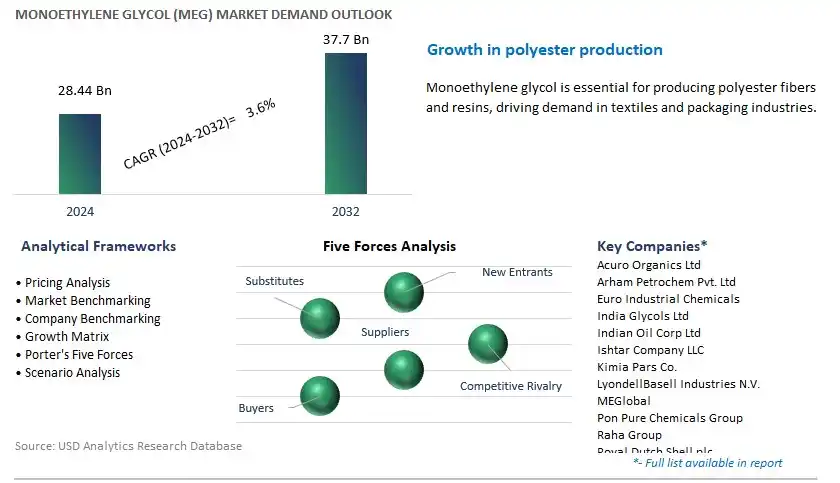
Global Monoethylene Glycol (MEG) Market Size is valued at $28.44 Billion in 2024 and is forecast to register a growth rate (CAGR) of 3.6% to reach $37.7 Billion by 2032.
The global Monoethylene Glycol (MEG) Market Study analyzes and forecasts the market size across 6 regions and 24 countries for diverse segments -By Application (PET, Polyester Fibers, Antifreeze, Others), By End-User (Packaging, Textile, Automotive, Plastics, Others).
An Introduction to Monoethylene Glycol (MEG) Market in 2024
Monoethylene glycol (MEG) plays a vital role in the production of polyester fibers, resins, and antifreeze solutions, serving diverse industries including textiles, packaging, automotive, and HVAC systems. In 2024, the market for monoethylene glycol remains strong, driven by its extensive use as a raw material in the manufacture of polyethylene terephthalate (PET) and other polyester products. MEG is produced through the ethylene oxide hydration process, resulting in a versatile chemical compound with excellent solvent properties, thermal stability, and low volatility. The demand for MEG is closely tied to the growth of end-user industries such as beverage packaging, textile manufacturing, and automotive production, reflecting its importance in modern manufacturing supply chains. Market trends include the adoption of bio-based MEG derived from renewable feedstocks and technological advancements aimed at enhancing process efficiency, product quality, and sustainability.
Monoethylene Glycol (MEG) Market Competitive Landscape
The market report analyses the leading companies in the industry including Acuro Organics Ltd, Arham Petrochem Pvt. Ltd, Euro Industrial Chemicals, India Glycols Ltd, Indian Oil Corp Ltd, Ishtar Company LLC, Kimia Pars Co., LyondellBasell Industries N.V., MEGlobal, Pon Pure Chemicals Group, Raha Group, Royal Dutch Shell plc, SABIC, UPM Biochemicals, and others.
Monoethylene Glycol (MEG) Market Dynamics
Market Trend: Shift Towards Sustainable and Bio-based Feedstocks
A prominent market trend for monoethylene glycol (MEG) is the industry's shift towards sustainable and bio-based feedstocks in response to environmental concerns and regulatory pressures. With increasing emphasis on reducing carbon footprint and dependence on fossil fuels, there's a growing interest in producing MEG from renewable sources such as biomass and bioethanol. Manufacturers are investing in research and development to develop innovative processes for bio-based MEG production, aiming to offer eco-friendly alternatives to conventional petrochemical-derived MEG. This trend is driven by the need for sustainable solutions that align with corporate sustainability goals, regulatory requirements, and consumer preferences for environmentally friendly products.
Market Driver: Growing Demand from Polyester Fiber and PET Resin Industries
A key market driver for monoethylene glycol is the growing demand from the polyester fiber and polyethylene terephthalate (PET) resin industries for the production of textiles, packaging materials, and beverage bottles. As global population growth and urbanization drive the demand for clothing, packaging, and consumer goods, there's a corresponding increase in the consumption of polyester fibers and PET resins, which are major end-uses for MEG. MEG serves as a critical raw material in the production of polyester fibers through the polyesterification process and PET resins through the polymerization of ethylene glycol with terephthalic acid. The drive for urbanization, lifestyle changes, and consumer convenience fuels the demand for polyester-based products, thereby boosting the consumption of MEG as a key component in their manufacturing processes.
Market Opportunity: Expansion into Emerging Applications and Green Chemistry Initiatives
A potential opportunity for monoethylene glycol producers lies in expanding into emerging applications and green chemistry initiatives that offer sustainable solutions and value-added products. Opportunities exist for developing MEG-based derivatives such as ethylene glycol ethers, antifreeze solutions, and biodegradable polymers for specialty applications in industries such as automotive, construction, and personal care. Additionally, there's an opportunity to collaborate with industry partners and research institutions to explore novel applications of MEG in green chemistry initiatives such as carbon capture and utilization, renewable energy storage, and sustainable materials development. By leveraging its versatile chemistry and properties, MEG manufacturers can diversify their product portfolio, penetrate new markets, and capture opportunities for growth and innovation in the evolving landscape of sustainable chemistry.
Monoethylene Glycol (MEG) Market Share Analysis: PET (Polyethylene Terephthalate) segment generated the highest revenue in 2024
The largest segment in the Monoethylene Glycol (MEG) Market is the PET (Polyethylene Terephthalate) application segment. PET is a polymer widely used in the packaging industry for the production of bottles, containers, and other packaging materials. MEG serves as a key raw material in the production of PET resin, where it undergoes polymerization to form PET. The demand for PET is consistently high due to its versatility, transparency, lightweight nature, and excellent barrier properties, making it suitable for packaging various beverages, foods, pharmaceuticals, and personal care products. The PET industry accounts for a significant portion of the global Monoethylene Glycol market due to the extensive use of PET in the packaging sector, driving the demand for MEG as a raw material. Additionally, the growing demand for PET bottles and containers, particularly in emerging economies with expanding consumer markets, further contributes to the dominance of the PET application segment in the Monoethylene Glycol market.
Monoethylene Glycol (MEG) Market Share Analysis: Automotive is poised to register the fastest CAGR over the forecast period
The Automotive End-User Segment is the fastest-growing segment in the Monoethylene Glycol (MEG) Market. MEG is extensively utilized in the automotive industry for the production of antifreeze and engine coolant solutions. These solutions play a critical role in maintaining optimal operating temperatures within vehicle engines, preventing overheating, and safeguarding engine components from corrosion and freezing in cold climates. With the automotive industry experiencing technological advancements, stricter emission regulations, and the growing adoption of electric vehicles (EVs) and hybrid vehicles, the demand for MEG-based antifreeze solutions is witnessing a significant surge. Additionally, the increasing production of automotive components, such as plastic parts, polyester-based upholstery, and textiles used in vehicle interiors, further drives the demand for MEG in the automotive sector. As automotive manufacturers prioritize sustainability and eco-friendly solutions, MEG-based antifreeze formulations are gaining traction due to their non-toxic nature and compatibility with modern vehicle systems. The robust growth of the Automotive End-User Segment in the Monoethylene Glycol Market is expected to continue, fuelled by ongoing innovations in automotive technology and the rising global demand for automobiles.
Monoethylene Glycol (MEG) Market
By Application
PET
Polyester Fibers
Antifreeze
Others
By End-User
Packaging
Textile
Automotive
Plastics
Others
Countries Analyzed
North America (US, Canada, Mexico)
Europe (Germany, UK, France, Spain, Italy, Russia, Rest of Europe)
Asia Pacific (China, India, Japan, South Korea, Australia, South East Asia, Rest of Asia)
South America (Brazil, Argentina, Rest of South America)
Middle East and Africa (Saudi Arabia, UAE, Rest of Middle East, South Africa, Egypt, Rest of Africa)
Monoethylene Glycol Companies Profiled in the Study
Acuro Organics Ltd
Arham Petrochem Pvt. Ltd
Euro Industrial Chemicals
India Glycols Ltd
Indian Oil Corp Ltd
Ishtar Company LLC
Kimia Pars Co.
LyondellBasell Industries N.V.
MEGlobal
Pon Pure Chemicals Group
Raha Group
Royal Dutch Shell plc
SABIC
UPM Biochemicals
*- List Not Exhaustive
TABLE OF CONTENTS
1 Introduction to 2024 Monoethylene Glycol Market
1.1 Market Overview
1.2 Quick Facts
1.3 Scope/Objective of the Study
1.4 Market Definition
1.5 Countries and Regions Covered
1.6 Units, Currency, and Conversions
1.7 Industry Value Chain
2 Research Methodology
2.1 Market Size Estimation
2.2 Sources and Research Methodology
2.3 Data Triangulation
2.4 Assumptions and Limitations
3 Executive Summary
3.1 Global Monoethylene Glycol Market Size Outlook, $ Million, 2021 to 2032
3.2 Monoethylene Glycol Market Outlook by Type, $ Million, 2021 to 2032
3.3 Monoethylene Glycol Market Outlook by Product, $ Million, 2021 to 2032
3.4 Monoethylene Glycol Market Outlook by Application, $ Million, 2021 to 2032
3.5 Monoethylene Glycol Market Outlook by Key Countries, $ Million, 2021 to 2032
4 Market Dynamics
4.1 Key Driving Forces of Monoethylene Glycol Industry
4.2 Key Market Trends in Monoethylene Glycol Industry
4.3 Potential Opportunities in Monoethylene Glycol Industry
4.4 Key Challenges in Monoethylene Glycol Industry
5 Market Factor Analysis
5.1 Value Chain Analysis
5.2 Competitive Landscape
5.2.1 Global Monoethylene Glycol Market Share by Company (%), 2023
5.2.2 Product Offerings by Company
5.3 Porter’s Five Forces Analysis
5.4 Pricing Analysis and Outlook
6 Growth Outlook Across Scenarios
6.1 Growth Analysis-Case Scenario Definitions
6.2 Low Growth Scenario Forecasts
6.3 Reference Growth Scenario Forecasts
6.4 High Growth Scenario Forecasts
7 Global Monoethylene Glycol Market Outlook by Segments
7.1 Monoethylene Glycol Market Outlook by Segments, $ Million, 2021- 2032
By Application
PET
Polyester Fibers
Antifreeze
Others
By End-User
Packaging
Textile
Automotive
Plastics
Others
8 North America Monoethylene Glycol Market Analysis and Outlook To 2032
8.1 Introduction to North America Monoethylene Glycol Markets in 2024
8.2 North America Monoethylene Glycol Market Size Outlook by Country, 2021-2032
8.2.1 United States
8.2.2 Canada
8.2.3 Mexico
8.3 North America Monoethylene Glycol Market size Outlook by Segments, 2021-2032
By Application
PET
Polyester Fibers
Antifreeze
Others
By End-User
Packaging
Textile
Automotive
Plastics
Others
9 Europe Monoethylene Glycol Market Analysis and Outlook To 2032
9.1 Introduction to Europe Monoethylene Glycol Markets in 2024
9.2 Europe Monoethylene Glycol Market Size Outlook by Country, 2021-2032
9.2.1 Germany
9.2.2 France
9.2.3 Spain
9.2.4 United Kingdom
9.2.4 Italy
9.2.5 Russia
9.2.6 Norway
9.2.7 Rest of Europe
9.3 Europe Monoethylene Glycol Market Size Outlook by Segments, 2021-2032
By Application
PET
Polyester Fibers
Antifreeze
Others
By End-User
Packaging
Textile
Automotive
Plastics
Others
10 Asia Pacific Monoethylene Glycol Market Analysis and Outlook To 2032
10.1 Introduction to Asia Pacific Monoethylene Glycol Markets in 2024
10.2 Asia Pacific Monoethylene Glycol Market Size Outlook by Country, 2021-2032
10.2.1 China
10.2.2 India
10.2.3 Japan
10.2.4 South Korea
10.2.5 Indonesia
10.2.6 Malaysia
10.2.7 Australia
10.2.8 Rest of Asia Pacific
10.3 Asia Pacific Monoethylene Glycol Market size Outlook by Segments, 2021-2032
By Application
PET
Polyester Fibers
Antifreeze
Others
By End-User
Packaging
Textile
Automotive
Plastics
Others
11 South America Monoethylene Glycol Market Analysis and Outlook To 2032
11.1 Introduction to South America Monoethylene Glycol Markets in 2024
11.2 South America Monoethylene Glycol Market Size Outlook by Country, 2021-2032
11.2.1 Brazil
11.2.2 Argentina
11.2.3 Rest of South America
11.3 South America Monoethylene Glycol Market size Outlook by Segments, 2021-2032
By Application
PET
Polyester Fibers
Antifreeze
Others
By End-User
Packaging
Textile
Automotive
Plastics
Others
12 Middle East and Africa Monoethylene Glycol Market Analysis and Outlook To 2032
12.1 Introduction to Middle East and Africa Monoethylene Glycol Markets in 2024
12.2 Middle East and Africa Monoethylene Glycol Market Size Outlook by Country, 2021-2032
12.2.1 Saudi Arabia
12.2.2 UAE
12.2.3 Oman
12.2.4 Rest of Middle East
12.2.5 Egypt
12.2.6 Nigeria
12.2.7 South Africa
12.2.8 Rest of Africa
12.3 Middle East and Africa Monoethylene Glycol Market size Outlook by Segments, 2021-2032
By Application
PET
Polyester Fibers
Antifreeze
Others
By End-User
Packaging
Textile
Automotive
Plastics
Others
13 Company Profiles
13.1 Company Snapshot
13.2 SWOT Profiles
13.3 Products and Services
13.4 Recent Developments
13.5 Financial Profile
Acuro Organics Ltd
Arham Petrochem Pvt. Ltd
Euro Industrial Chemicals
India Glycols Ltd
Indian Oil Corp Ltd
Ishtar Company LLC
Kimia Pars Co.
LyondellBasell Industries N.V.
MEGlobal
Pon Pure Chemicals Group
Raha Group
Royal Dutch Shell plc
SABIC
UPM Biochemicals
14 Appendix
14.1 Customization Offerings
14.2 Subscription Services
14.3 Related Reports
14.4 Publisher Expertise
By Application
PET
Polyester Fibers
Antifreeze
Others
By End-User
Packaging
Textile
Automotive
Plastics
Others
Countries Analyzed
North America (US, Canada, Mexico)
Europe (Germany, UK, France, Spain, Italy, Russia, Rest of Europe)
Asia Pacific (China, India, Japan, South Korea, Australia, South East Asia, Rest of Asia)
South America (Brazil, Argentina, Rest of South America)
Middle East and Africa (Saudi Arabia, UAE, Rest of Middle East, South Africa, Egypt, Rest of Africa)
