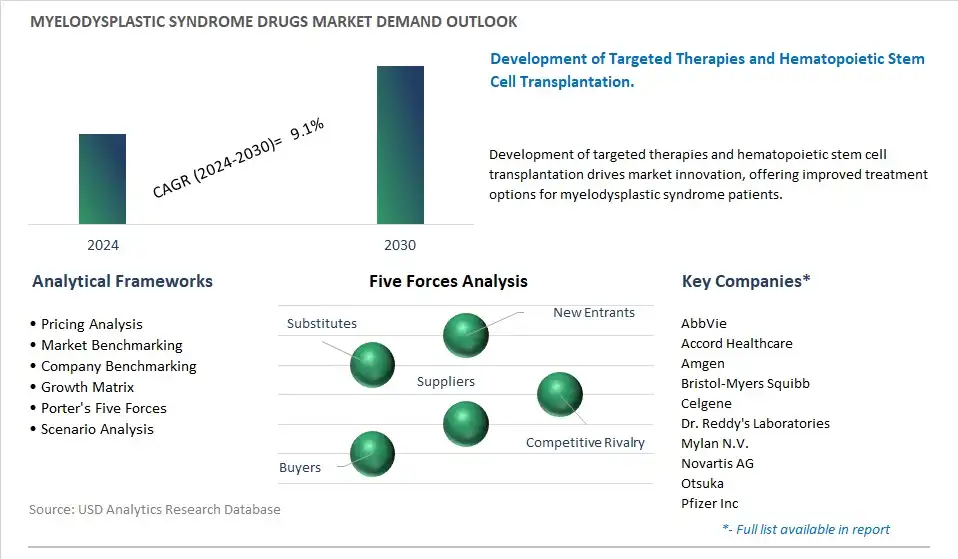
Myelodysplastic Syndrome Drugs Market is estimated to increase at a growth rate of 9.1% CAGR over the forecast period from 2024 to 2030.
The global Myelodysplastic Syndrome Drugs Marketstudy analyzes and forecasts the market size across 6 regions and 24 countries for diverse segments including By Therapeutic Class (Hypomethylating Agents, Immunomodulatory Drugs, Anti-Anemics), By Type Of Syndrome (Refractory Cytopenia With Multilineage Dysplasia, Refractory Anemia, Refractory Anemia With Excess Blasts, Refractory Anemia With Ringed Sideroblasts), By Route of Administration (Oral, Parenteral), By Application (Original, Generics), By End-user (Hospitals, Clinics, Ambulatory Surgical Centers).
An introduction to Myelodysplastic Syndrome Drugs Market in 2024
Addressing the heterogeneous group of hematopoietic stem cell disorders characterized by ineffective blood cell production and increased risk of leukemia progression, the Myelodysplastic Syndrome Drugs market offers therapeutic options aimed at managing cytopenias, reducing disease progression, and improving overall survival in patients with myelodysplastic syndromes (MDS). Treatment modalities include hypomethylating agents, immunomodulatory drugs, and supportive care measures such as blood transfusions and growth factors. The market's growth is driven by the increasing incidence of MDS, the aging population, and advancements in molecular diagnostics enabling risk stratification and personalized treatment approaches for MDS patients.
Myelodysplastic Syndrome Drugs Market Trend: Shift towards Personalized Therapies
A significant trend in the myelodysplastic syndrome (MDS) drugs market is the shift towards personalized therapies. With advancements in understanding the molecular and genetic drivers of MDS, there's a growing recognition of the heterogeneity within this disease spectrum. This trend has led to the development of targeted therapies aimed at specific genetic mutations or dysregulated pathways implicated in MDS pathogenesis. By tailoring treatment approaches to individual patient characteristics, such as cytogenetic abnormalities and mutational profiles, pharmaceutical companies are striving to improve treatment outcomes and reduce adverse effects associated with traditional, one-size-fits-all approaches. This trend towards personalized medicine in MDS therapeutics is driving innovation and market growth in the sector.
Myelodysplastic Syndrome Drugs Market Driver: Aging Population and Rising Incidence of MDS
The primary driver propelling the myelodysplastic syndrome drugs market is the aging population and the associated rise in the incidence of MDS. Myelodysplastic syndromes are a group of hematologic disorders characterized by ineffective hematopoiesis and an increased risk of progression to acute myeloid leukemia (AML). As the global population ages and life expectancy increases, there's a corresponding increase in the number of new cases of MDS diagnosed each year, particularly among older adults. Additionally, improvements in diagnostic techniques and disease awareness have contributed to earlier detection and diagnosis of MDS, further driving the demand for effective therapeutic interventions. This driver underscores the urgent need for innovative treatments that can delay disease progression, improve quality of life, and prolong survival for patients living with MDS, thus fueling market growth and research efforts in the field.
Myelodysplastic Syndrome Drugs Market Opportunity: Development of Disease-Modifying Therapies and Combination Regimens
An exciting opportunity in the myelodysplastic syndrome drugs market lies in the development of disease-modifying therapies and combination regimens. While current treatments for MDS focus on supportive care measures, such as blood transfusions and growth factors, and disease-modifying agents, such as hypomethylating agents and immunomodulatory drugs, there's a significant unmet need for therapies that address the underlying pathophysiology of the disease and modify its course. Potential approaches include targeted therapies aimed at specific genetic mutations, novel agents targeting dysregulated signaling pathways, and immune-based therapies to enhance antitumor immune responses. Additionally, there's an opportunity to explore combination regimens that synergistically target multiple pathways implicated in MDS pathogenesis, potentially improving treatment outcomes and overcoming resistance mechanisms. By investing in research and development initiatives focused on disease-modifying therapies and combination approaches, pharmaceutical companies can capitalize on this opportunity to address unmet medical needs and drive innovation in the myelodysplastic syndrome drugs market.
Myelodysplastic Syndrome Drugs Market Market Segmentation
By Therapeutic Class
Hypomethylating Agents
Immunomodulatory Drugs
Anti-Anemics
By Type Of Syndrome
Refractory Cytopenia With Multilineage Dysplasia
Refractory Anemia
Refractory Anemia With Excess Blasts
Refractory Anemia With Ringed Sideroblasts
By Route Of Administration
Oral
Parenteral
By Applications
Original
Generics
By End-User
Hospitals
Clinics
Ambulatory Surgical Centers
Geographical Analysis
North America (United States, Canada, Mexico)
Europe (Germany, France, United Kingdom, Spain, Italy, Rest of Europe)
Asia Pacific (China, India, Japan, South Korea, Rest of Asia Pacific)
South America (Brazil, Argentina, Rest of South America)
Middle East and Africa (Saudi Arabia, UAE, Rest of Middle East, South Africa, Egypt, Rest of Africa)
Myelodysplastic Syndrome Drugs Market Companies
AbbVie
Accord Healthcare
Amgen
Bristol-Myers Squibb
Celgene
Dr. Reddy's Laboratories
Mylan N.V.
Novartis AG
Otsuka
Pfizer Inc
Sandoz Inc
Takeda
Reasons to Buy the Myelodysplastic Syndrome Drugs Market Study
• Deepen your industry insights and navigate uncertainties for strategy formulation, CAPEX, and Operational decisions
• Gain access to detailed insights on the Myelodysplastic Syndrome Drugs Market, encompassing current market size, growth trends, and forecasts till 2030.
• Access detailed competitor analysis, enabling competitive advantage through a thorough understanding of market players, strategies, and potential differentiation opportunities
• Stay ahead of the curve with insights on technological advancements, innovations, and upcoming trends
• Identify lucrative investment avenues and expansion opportunities within the Myelodysplastic Syndrome Drugs Market industry, guided by robust, data-backed analysis.
• Understand regional and global markets through country-wise analysis, regional market potential, regulatory nuances, and dynamics
• Execute strategies with confidence and speed through information, analytics, and insights on the industry value chain
• Corporate leaders, strategists, financial experts, shareholders, asset managers, and governmental representatives can make long-term planning scenarios and build an integrated and timely understanding of market dynamics
• Benefit from tailored solutions and expert consultation based on report insights, providing personalized strategies aligned with specific business needs.
TABLE OF CONTENTS
1 Introduction to 2024 Myelodysplastic Syndrome Drugs Market
1.1 Market Overview
1.2 Quick Facts
1.3 Scope/Objective of the Study
1.4 Market Definition
1.5 Countries and Regions Analyzed
1.6 Units, Currency, and Conversions
1.7 Industry Value Chain
2 Research Methodology
2.1 Market Size Estimation
2.2 Sources and Research Methodology
2.3 Data Triangulation
2.4 Assumptions and Limitations
3 Executive Summary
3.1 Global Myelodysplastic Syndrome Drugs Market Size Outlook, $ Million, 2021 to 2030
3.2 Myelodysplastic Syndrome Drugs Market Outlook by Type, $ Million, 2021 to 2030
3.3 Myelodysplastic Syndrome Drugs Market Outlook by Product, $ Million, 2021 to 2030
3.4 Myelodysplastic Syndrome Drugs Market Outlook by Application, $ Million, 2021 to 2030
3.5 Myelodysplastic Syndrome Drugs Market Outlook by Key Countries, $ Million, 2021 to 2030
4 Market Dynamics
4.1 Key Driving Forces of Myelodysplastic Syndrome Drugs Industry
4.2 Key Market Trends in Myelodysplastic Syndrome Drugs Industry
4.3 Potential Opportunities in Myelodysplastic Syndrome Drugs Industry
4.4 Key Challenges in Myelodysplastic Syndrome Drugs Industry
5 Market Factor Analysis
5.1 Value Chain Analysis
5.2 Competitive Landscape
5.2.1 Global Myelodysplastic Syndrome Drugs Market Share by Company (%), 2023
5.2.2 Product Offerings by Company
5.3 Porter’s Five Forces Analysis
5.4 Pricing Analysis and Outlook
6 Growth Outlook Across Scenarios
6.1 Growth Analysis-Case Scenario Definitions
6.2 Low Growth Scenario Forecasts
6.3 Reference Growth Scenario Forecasts
6.4 High Growth Scenario Forecasts
7 Global Myelodysplastic Syndrome Drugs Market Outlook by Segments
7.1 Myelodysplastic Syndrome Drugs Market Outlook by Segments, $ Million, 2021- 2030
By Therapeutic Class
Hypomethylating Agents
Immunomodulatory Drugs
Anti-Anemics
By Type Of Syndrome
Refractory Cytopenia With Multilineage Dysplasia
Refractory Anemia
Refractory Anemia With Excess Blasts
Refractory Anemia With Ringed Sideroblasts
By Route Of Administration
Oral
Parenteral
By Applications
Original
Generics
By End-User
Hospitals
Clinics
Ambulatory Surgical Centers
8 North America Myelodysplastic Syndrome Drugs Market Analysis and Outlook To 2030
8.1 Introduction to North America Myelodysplastic Syndrome Drugs Markets in 2024
8.2 North America Myelodysplastic Syndrome Drugs Market Size Outlook by Country, 2021-2030
8.2.1 United States
8.2.2 Canada
8.2.3 Mexico
8.3 North America Myelodysplastic Syndrome Drugs Market size Outlook by Segments, 2021-2030
By Therapeutic Class
Hypomethylating Agents
Immunomodulatory Drugs
Anti-Anemics
By Type Of Syndrome
Refractory Cytopenia With Multilineage Dysplasia
Refractory Anemia
Refractory Anemia With Excess Blasts
Refractory Anemia With Ringed Sideroblasts
By Route Of Administration
Oral
Parenteral
By Applications
Original
Generics
By End-User
Hospitals
Clinics
Ambulatory Surgical Centers
9 Europe Myelodysplastic Syndrome Drugs Market Analysis and Outlook To 2030
9.1 Introduction to Europe Myelodysplastic Syndrome Drugs Markets in 2024
9.2 Europe Myelodysplastic Syndrome Drugs Market Size Outlook by Country, 2021-2030
9.2.1 Germany
9.2.2 France
9.2.3 Spain
9.2.4 United Kingdom
9.2.4 Italy
9.2.5 Russia
9.2.6 Norway
9.2.7 Rest of Europe
9.3 Europe Myelodysplastic Syndrome Drugs Market Size Outlook by Segments, 2021-2030
By Therapeutic Class
Hypomethylating Agents
Immunomodulatory Drugs
Anti-Anemics
By Type Of Syndrome
Refractory Cytopenia With Multilineage Dysplasia
Refractory Anemia
Refractory Anemia With Excess Blasts
Refractory Anemia With Ringed Sideroblasts
By Route Of Administration
Oral
Parenteral
By Applications
Original
Generics
By End-User
Hospitals
Clinics
Ambulatory Surgical Centers
10 Asia Pacific Myelodysplastic Syndrome Drugs Market Analysis and Outlook To 2030
10.1 Introduction to Asia Pacific Myelodysplastic Syndrome Drugs Markets in 2024
10.2 Asia Pacific Myelodysplastic Syndrome Drugs Market Size Outlook by Country, 2021-2030
10.2.1 China
10.2.2 India
10.2.3 Japan
10.2.4 South Korea
10.2.5 Indonesia
10.2.6 Malaysia
10.2.7 Australia
10.2.8 Rest of Asia Pacific
10.3 Asia Pacific Myelodysplastic Syndrome Drugs Market size Outlook by Segments, 2021-2030
By Therapeutic Class
Hypomethylating Agents
Immunomodulatory Drugs
Anti-Anemics
By Type Of Syndrome
Refractory Cytopenia With Multilineage Dysplasia
Refractory Anemia
Refractory Anemia With Excess Blasts
Refractory Anemia With Ringed Sideroblasts
By Route Of Administration
Oral
Parenteral
By Applications
Original
Generics
By End-User
Hospitals
Clinics
Ambulatory Surgical Centers
11 South America Myelodysplastic Syndrome Drugs Market Analysis and Outlook To 2030
11.1 Introduction to South America Myelodysplastic Syndrome Drugs Markets in 2024
11.2 South America Myelodysplastic Syndrome Drugs Market Size Outlook by Country, 2021-2030
11.2.1 Brazil
11.2.2 Argentina
11.2.3 Rest of South America
11.3 South America Myelodysplastic Syndrome Drugs Market size Outlook by Segments, 2021-2030
By Therapeutic Class
Hypomethylating Agents
Immunomodulatory Drugs
Anti-Anemics
By Type Of Syndrome
Refractory Cytopenia With Multilineage Dysplasia
Refractory Anemia
Refractory Anemia With Excess Blasts
Refractory Anemia With Ringed Sideroblasts
By Route Of Administration
Oral
Parenteral
By Applications
Original
Generics
By End-User
Hospitals
Clinics
Ambulatory Surgical Centers
12 Middle East and Africa Myelodysplastic Syndrome Drugs Market Analysis and Outlook To 2030
12.1 Introduction to Middle East and Africa Myelodysplastic Syndrome Drugs Markets in 2024
12.2 Middle East and Africa Myelodysplastic Syndrome Drugs Market Size Outlook by Country, 2021-2030
12.2.1 Saudi Arabia
12.2.2 UAE
12.2.3 Oman
12.2.4 Rest of Middle East
12.2.5 Egypt
12.2.6 Nigeria
12.2.7 South Africa
12.2.8 Rest of Africa
12.3 Middle East and Africa Myelodysplastic Syndrome Drugs Market size Outlook by Segments, 2021-2030
By Therapeutic Class
Hypomethylating Agents
Immunomodulatory Drugs
Anti-Anemics
By Type Of Syndrome
Refractory Cytopenia With Multilineage Dysplasia
Refractory Anemia
Refractory Anemia With Excess Blasts
Refractory Anemia With Ringed Sideroblasts
By Route Of Administration
Oral
Parenteral
By Applications
Original
Generics
By End-User
Hospitals
Clinics
Ambulatory Surgical Centers
13 Company Profiles
13.1 Company Snapshot
13.2 SWOT Profiles
13.3 Products and Services
13.4 Recent Developments
13.5 Financial Profile
List of Companies
AbbVie
Accord Healthcare
Amgen
Bristol-Myers Squibb
Celgene
Dr. Reddy's Laboratories
Mylan N.V.
Novartis AG
Otsuka
Pfizer Inc
Sandoz Inc
Takeda
14 Appendix
14.1 Customization Offerings
14.2 Subscription Services
14.3 Related Reports
14.4 Publisher Expertise
By Therapeutic Class
Hypomethylating Agents
Immunomodulatory Drugs
Anti-Anemics
By Type Of Syndrome
Refractory Cytopenia With Multilineage Dysplasia
Refractory Anemia
Refractory Anemia With Excess Blasts
Refractory Anemia With Ringed Sideroblasts
By Route Of Administration
Oral
Parenteral
By Applications
Original
Generics
By End-User
Hospitals
Clinics
Ambulatory Surgical Centers
