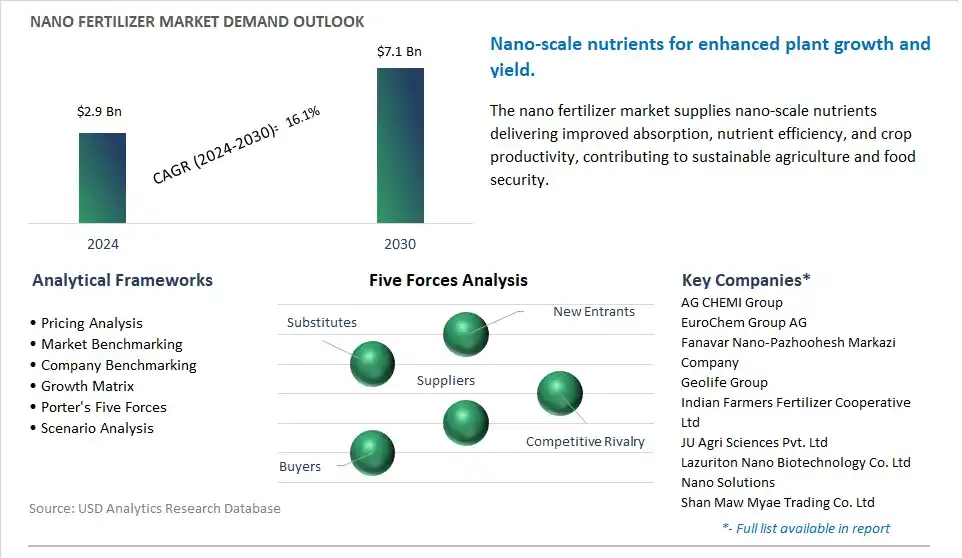
The global Nano Fertilizer Market is poised to register a 16.1% CAGR from $2.9 Billion in 2024 to $7.1 Billion in 2030.
The global Nano Fertilizer Market Study analyzes and forecasts the market size across 6 regions and 24 countries for diverse segments -By Raw Material (Nitrogen, Silver, Carbon, Zinc, Others), By Application (Spray, Soil), By Application (Cereals & Grains, Oilseeds & Pulses, Fruits & Vegetables, Others).
An Introduction to Global Nano Fertilizer Market in 2024
The future of nano-fertilizers is characterized by their potential to revolutionize agriculture by improving nutrient uptake efficiency, crop yields, and environmental sustainability. Key trends include the development of nano-sized nutrient carriers and delivery systems that enable targeted and controlled release of fertilizers, minimizing nutrient loss through leaching, volatilization, and runoff. Manufacturers are also exploring the use of nanomaterials such as nanoparticles, nanoclays, and nanocomposites to enhance soil fertility, water retention, and nutrient availability, thereby reducing the need for excessive fertilizer application and mitigating environmental pollution. Additionally, there's a growing interest in nano-enabled sensors and precision agriculture technologies that can monitor soil health, plant growth, and nutrient status in real-time, enabling optimized fertilization strategies and resource management practices. Furthermore, nano-fertilizers offer opportunities to address the challenges of nutrient deficiencies, soil degradation, and water scarcity in a changing climate, contributing to sustainable intensification of agricultural production and food security. As research continues to advance our understanding of nano-fertilizer interactions with soil, plants, and ecosystems, collaboration among scientists, policymakers, and agricultural stakeholders will be crucial to ensure the responsible and effective deployment of nano-enabled solutions, shaping the future of farming practices and sustainable agriculture.
Nano Fertilizer Market Competitive Landscape
The market report analyses the leading companies in the industry including AG CHEMI Group, EuroChem Group AG, Fanavar Nano-Pazhoohesh Markazi Company, Geolife Group, Indian Farmers Fertilizer Cooperative Ltd, JU Agri Sciences Pvt. Ltd, Lazuriton Nano Biotechnology Co. Ltd, Nano Solutions, Shan Maw Myae Trading Co. Ltd, Tropical Agrosystem India (P) Ltd.
Nano Fertilizer Market Dynamics
Nano Fertilizer Market Trend: Increasing Focus on Sustainable Agriculture Practices
One of the most prominent trends in the nano fertilizer market is the increasing focus on sustainable agriculture practices. Nano fertilizers, formulated using nanotechnology, offer several advantages over traditional fertilizers, including improved nutrient uptake efficiency, reduced environmental impact, and enhanced crop yields. With growing concerns about soil degradation, water pollution, and the need to feed a growing global population, there's a rising demand for innovative agricultural solutions that promote sustainable farming practices. Nano fertilizers, with their potential to optimize nutrient delivery and minimize fertilizer runoff, are gaining traction among farmers, agricultural organizations, and policymakers seeking to improve agricultural productivity while minimizing environmental harm.
Nano Fertilizer Market Driver: Need for Increased Agricultural Productivity and Food Security
A significant driver propelling the nano fertilizer market is the pressing need to increase agricultural productivity and ensure food security in the face of population growth, climate change, and resource constraints. Nano fertilizers offer a promising solution to address these challenges by delivering nutrients more efficiently to crops, optimizing nutrient utilization, and improving crop resilience to environmental stresses such as drought, salinity, and pests. As farmers strive to maximize yields and optimize resource use, nano fertilizers are being recognized as valuable tools to enhance soil fertility, crop health, and overall agricultural productivity. This need for innovative agricultural inputs to sustainably increase food production drives the demand for nano fertilizers in both developed and developing regions.
Nano Fertilizer Market Opportunity: Tailoring Nano Fertilizers for Specific Crop Requirements
An exciting opportunity within the nano fertilizer market lies in tailoring nano fertilizers to meet the specific nutrient requirements of different crops and growing conditions. Nanotechnology allows for precise control over particle size, composition, and nutrient release kinetics, enabling the customization of fertilizers to match the nutritional needs of various crops at different growth stages. By developing nano fertilizers that deliver targeted nutrient formulations, manufacturers can offer farmers solutions that maximize crop yields, improve nutrient use efficiency, and minimize environmental impact. This opportunity for customization and specialization in nano fertilizer formulations presents a potential avenue for market differentiation and expansion, as farmers increasingly seek tailored solutions to optimize their agricultural practices and achieve sustainable productivity gains.
Nano Fertilizer Market Share Analysis: Nitrogen generated the highest revenue in 2024
The largest segment in the Nano Fertilizer Market is the Nitrogen raw material segment. The market growth is driven by nitrogen is one of the essential nutrients required for plant growth and development. It plays a crucial role in various physiological processes, including photosynthesis, protein synthesis, and chlorophyll formation. Nano fertilizers incorporating nitrogen nanoparticles offer potential advantages over conventional nitrogen fertilizers, such as improved nutrient uptake efficiency, reduced nutrient losses through leaching and volatilization, and enhanced crop productivity. Nanostructured nitrogen carriers facilitate the controlled release and targeted delivery of nitrogen to plant roots, ensuring optimal nutrient availability and utilization throughout the growing season. Further, nitrogen deficiency is a common challenge in agricultural systems worldwide, leading to reduced crop yields, poor quality, and environmental degradation. Nano fertilizers provide a sustainable solution for addressing nitrogen deficiencies and improving soil fertility without exacerbating environmental pollution or contributing to greenhouse gas emissions. Nanostructured nitrogen formulations enable precise nutrient management and optimization, minimizing the risk of over-fertilization and nutrient runoff while maximizing crop yields and resource use efficiency. In addition, advancements in nanotechnology have led to the development of innovative nitrogen delivery systems, such as nitrogen-doped nanoparticles, nitrogen nanocarriers, and nitrogen nanocomposites, with enhanced physicochemical properties and performance characteristics. Nano-enabled nitrogen fertilizers offer opportunities for improving nutrient availability, uptake kinetics, and crop responses under diverse soil and climatic conditions, contributing to the resilience and sustainability of agricultural production systems. Further, regulatory initiatives promoting sustainable agriculture, eco-friendly inputs, and precision nutrient management drive the adoption of Nano fertilizers as part of integrated nutrient management strategies. Nano-enabled nitrogen fertilizers are increasingly recognized for their potential to enhance crop nutrition, soil health, and environmental sustainability while reducing the environmental footprint of agriculture. Additionally, collaborations and partnerships between research institutions, fertilizer manufacturers, and agricultural stakeholders facilitate the development, commercialization, and adoption of Nano fertilizers tailored to the specific needs and challenges of modern agriculture. Over the forecast period, the combination of nitrogen's essential role in plant nutrition, the benefits of nanostructured delivery systems, and the growing demand for sustainable agriculture position the Nitrogen raw material segment as the largest in the Nano Fertilizer Market.
Nano Fertilizer Market Share Analysis: Spray application segment is poised to register the fastest growth rate (CAGR) over the forecast period to 2030
The fastest-growing segment in the Nano Fertilizer Market is the Spray application segment. spray application methods offer potential advantages over traditional soil application methods in terms of efficiency, precision, and effectiveness in delivering nutrients to plants. Nano fertilizers formulated for spray application can be atomized into fine droplets, ensuring uniform coverage and distribution of nutrients over the plant foliage and root surface. This targeted delivery system enhances nutrient uptake by plants, leading to improved nutrient use efficiency and crop productivity. Further, spray application of Nano fertilizers enables foliar feeding, a process by which nutrients are absorbed directly through the leaves and stems of plants, bypassing the soil medium. Foliar uptake of nutrients allows for rapid nutrient assimilation and translocation within the plant, particularly during critical growth stages or under conditions of soil nutrient deficiencies or imbalances. Nanostructured formulations enhance the bioavailability and mobility of nutrients within plant tissues, promoting physiological processes such as photosynthesis, flowering, and fruit set. In addition, spray application methods offer flexibility and convenience in nutrient management and application scheduling, allowing farmers to respond quickly to changing crop needs, environmental conditions, and pest pressures. Nano fertilizers designed for spray application can be easily integrated into existing crop management practices and equipment, minimizing disruption to farming operations and optimizing resource use efficiency. Further, spray application technologies, such as aerial spraying, ground-based sprayers, and precision sprayers, enable targeted delivery of Nano fertilizers to specific areas of the field or crop canopy, reducing waste and environmental impact. Additionally, advancements in nanotechnology have led to the development of innovative nanostructured delivery systems and formulations tailored for spray application, such as nanoemulsions, nanosuspensions, and nanoparticle coatings. These Nano-enabled sprayable fertilizers offer enhanced stability, compatibility, and performance characteristics, allowing for efficient nutrient delivery and uptake by plants. Over the forecast period, the combination of the efficiency, precision, flexibility, and effectiveness of spray application methods, along with the technological advancements in Nano-enabled formulations, positions the Spray application segment as the fastest-growing in the Nano Fertilizer Market.
Nano Fertilizer Market Share Analysis: Fruits & Vegetables segment is poised to register the fastest growth rate (CAGR) over the forecast period to 2030
The fastest-growing segment in the Nano Fertilizer Market is the Fruits & Vegetables application segment. fruits and vegetables are high-value crops that require precise nutrient management to achieve optimal yields, quality, and marketability. Nano fertilizers offer unique advantages in meeting the specific nutritional needs of fruits and vegetables by delivering nutrients directly to plant roots, foliage, and fruiting structures with enhanced efficiency and effectiveness. Nanostructured formulations enable targeted nutrient uptake, assimilation, and utilization by fruit and vegetable crops, resulting in improved growth, development, and yield outcomes. Further, the increasing global demand for fresh, nutritious, and safe fruits and vegetables has driven the adoption of advanced agricultural technologies, including Nano-enabled fertilizers, to enhance productivity, sustainability, and profitability in horticultural production systems. Nano fertilizers tailored for fruits and vegetables address critical challenges such as nutrient deficiencies, environmental stressors, and pest pressures, supporting optimal plant growth, fruit set, and quality attributes. In addition, fruits and vegetables are often grown under intensive cropping systems, greenhouse conditions, or controlled environments where nutrient availability, uptake kinetics, and nutrient use efficiency are crucial for maximizing crop performance and resource use efficiency. Nano fertilizers provide solutions for improving nutrient uptake, utilization, and translocation within fruit and vegetable plants, leading to higher yields, better fruit quality, and reduced nutrient losses to the environment. Further, consumer preferences for organic, sustainably produced fruits and vegetables drive the demand for eco-friendly and precision nutrient management practices, including the use of Nano-enabled fertilizers. Nano fertilizers offer opportunities for reducing chemical inputs, minimizing environmental impacts, and promoting soil health and biodiversity in fruit and vegetable production systems. Additionally, collaborations and partnerships between agricultural researchers, horticultural producers, and Nano fertilizer manufacturers facilitate the development, validation, and adoption of tailored nutrient management strategies and products for fruits and vegetables. Over the forecast period, the combination of the importance of fruits and vegetables in global food systems, the unique nutritional requirements of these crops, and the benefits of Nano-enabled fertilizers for precision nutrient management position the Fruits & Vegetables application segment as the fastest-growing in the Nano Fertilizer Market.
Nano Fertilizer Market Report Segmentation
By Raw Material
Nitrogen
Silver
Carbon
Zinc
Others
By Application
Spray
Soil
By Application
Cereals & Grains
Oilseeds & Pulses
Fruits & Vegetables
Others
Regions Included
North America (US, Canada, Mexico)
Europe (Germany, UK, France, Spain, Italy, Russia, Rest of Europe)
Asia Pacific (China, India, Japan, South Korea, Australia, South East Asia, Rest of Asia)
South America (Brazil, Argentina, Rest of South America)
Middle East and Africa (Saudi Arabia, UAE, Rest of Middle East, South Africa, Egypt, Rest of Africa)
Nano Fertilizer Companies Profiled in the Market Study
AG CHEMI Group
EuroChem Group AG
Fanavar Nano-Pazhoohesh Markazi Company
Geolife Group
Indian Farmers Fertilizer Cooperative Ltd
JU Agri Sciences Pvt. Ltd
Lazuriton Nano Biotechnology Co. Ltd
Nano Solutions
Shan Maw Myae Trading Co. Ltd
Tropical Agrosystem India (P) Ltd
*- List Not Exhaustive
TABLE OF CONTENTS
1 Introduction to 2024 Nano Fertilizer Market
1.1 Market Overview
1.2 Quick Facts
1.3 Scope/Objective of the Study
1.4 Market Definition
1.5 Countries and Regions Covered
1.6 Units, Currency, and Conversions
1.7 Industry Value Chain
2 Research Methodology
2.1 Market Size Estimation
2.2 Sources and Research Methodology
2.3 Data Triangulation
2.4 Assumptions and Limitations
3 Executive Summary
3.1 Global Nano Fertilizer Market Size Outlook, $ Million, 2021 to 2030
3.2 Nano Fertilizer Market Outlook by Type, $ Million, 2021 to 2030
3.3 Nano Fertilizer Market Outlook by Product, $ Million, 2021 to 2030
3.4 Nano Fertilizer Market Outlook by Application, $ Million, 2021 to 2030
3.5 Nano Fertilizer Market Outlook by Key Countries, $ Million, 2021 to 2030
4 Market Dynamics
4.1 Key Driving Forces of Nano Fertilizer Industry
4.2 Key Market Trends in Nano Fertilizer Industry
4.3 Potential Opportunities in Nano Fertilizer Industry
4.4 Key Challenges in Nano Fertilizer Industry
5 Market Factor Analysis
5.1 Value Chain Analysis
5.2 Competitive Landscape
5.2.1 Global Nano Fertilizer Market Share by Company (%), 2023
5.2.2 Product Offerings by Company
5.3 Porter’s Five Forces Analysis
5.4 Pricing Analysis and Outlook
6 Growth Outlook Across Scenarios
6.1 Growth Analysis-Case Scenario Definitions
6.2 Low Growth Scenario Forecasts
6.3 Reference Growth Scenario Forecasts
6.4 High Growth Scenario Forecasts
7 Global Nano Fertilizer Market Outlook by Segments
7.1 Nano Fertilizer Market Outlook by Segments, $ Million, 2021- 2030
By Raw Material
Nitrogen
Silver
Carbon
Zinc
Others
By Application
Spray
Soil
By Application
Cereals & Grains
Oilseeds & Pulses
Fruits & Vegetables
Others
8 North America Nano Fertilizer Market Analysis and Outlook To 2030
8.1 Introduction to North America Nano Fertilizer Markets in 2024
8.2 North America Nano Fertilizer Market Size Outlook by Country, 2021-2030
8.2.1 United States
8.2.2 Canada
8.2.3 Mexico
8.3 North America Nano Fertilizer Market size Outlook by Segments, 2021-2030
By Raw Material
Nitrogen
Silver
Carbon
Zinc
Others
By Application
Spray
Soil
By Application
Cereals & Grains
Oilseeds & Pulses
Fruits & Vegetables
Others
9 Europe Nano Fertilizer Market Analysis and Outlook To 2030
9.1 Introduction to Europe Nano Fertilizer Markets in 2024
9.2 Europe Nano Fertilizer Market Size Outlook by Country, 2021-2030
9.2.1 Germany
9.2.2 France
9.2.3 Spain
9.2.4 United Kingdom
9.2.4 Italy
9.2.5 Russia
9.2.6 Norway
9.2.7 Rest of Europe
9.3 Europe Nano Fertilizer Market Size Outlook by Segments, 2021-2030
By Raw Material
Nitrogen
Silver
Carbon
Zinc
Others
By Application
Spray
Soil
By Application
Cereals & Grains
Oilseeds & Pulses
Fruits & Vegetables
Others
10 Asia Pacific Nano Fertilizer Market Analysis and Outlook To 2030
10.1 Introduction to Asia Pacific Nano Fertilizer Markets in 2024
10.2 Asia Pacific Nano Fertilizer Market Size Outlook by Country, 2021-2030
10.2.1 China
10.2.2 India
10.2.3 Japan
10.2.4 South Korea
10.2.5 Indonesia
10.2.6 Malaysia
10.2.7 Australia
10.2.8 Rest of Asia Pacific
10.3 Asia Pacific Nano Fertilizer Market size Outlook by Segments, 2021-2030
By Raw Material
Nitrogen
Silver
Carbon
Zinc
Others
By Application
Spray
Soil
By Application
Cereals & Grains
Oilseeds & Pulses
Fruits & Vegetables
Others
11 South America Nano Fertilizer Market Analysis and Outlook To 2030
11.1 Introduction to South America Nano Fertilizer Markets in 2024
11.2 South America Nano Fertilizer Market Size Outlook by Country, 2021-2030
11.2.1 Brazil
11.2.2 Argentina
11.2.3 Rest of South America
11.3 South America Nano Fertilizer Market size Outlook by Segments, 2021-2030
By Raw Material
Nitrogen
Silver
Carbon
Zinc
Others
By Application
Spray
Soil
By Application
Cereals & Grains
Oilseeds & Pulses
Fruits & Vegetables
Others
12 Middle East and Africa Nano Fertilizer Market Analysis and Outlook To 2030
12.1 Introduction to Middle East and Africa Nano Fertilizer Markets in 2024
12.2 Middle East and Africa Nano Fertilizer Market Size Outlook by Country, 2021-2030
12.2.1 Saudi Arabia
12.2.2 UAE
12.2.3 Oman
12.2.4 Rest of Middle East
12.2.5 Egypt
12.2.6 Nigeria
12.2.7 South Africa
12.2.8 Rest of Africa
12.3 Middle East and Africa Nano Fertilizer Market size Outlook by Segments, 2021-2030
By Raw Material
Nitrogen
Silver
Carbon
Zinc
Others
By Application
Spray
Soil
By Application
Cereals & Grains
Oilseeds & Pulses
Fruits & Vegetables
Others
13 Company Profiles
13.1 Company Snapshot
13.2 SWOT Profiles
13.3 Products and Services
13.4 Recent Developments
13.5 Financial Profile
AG CHEMI Group
EuroChem Group AG
Fanavar Nano-Pazhoohesh Markazi Company
Geolife Group
Indian Farmers Fertilizer Cooperative Ltd
JU Agri Sciences Pvt. Ltd
Lazuriton Nano Biotechnology Co. Ltd
Nano Solutions
Shan Maw Myae Trading Co. Ltd
Tropical Agrosystem India (P) Ltd
14 Appendix
14.1 Customization Offerings
14.2 Subscription Services
14.3 Related Reports
14.4 Publisher Expertise
