
The global Nanochemicals Market Study analyzes and forecasts the market size across 6 regions and 24 countries for diverse segments -By Type (Metallic, Ceramic, Polymer, Others), By Application (Semiconductors & electronics, Pharmaceuticals, Food & Agriculture, Energy, Textiles, Others).
The future of nanochemicals is defined by their transformative potential across various industries, from electronics and healthcare to energy and environmental remediation. Key trends include the development of nano-sized chemical compounds and formulations with enhanced properties such as catalytic activity, optical performance, and surface reactivity, enabling novel applications in catalysis, sensors, drug delivery, and water treatment. Manufacturers are also exploring innovative synthesis and fabrication techniques to produce nanochemicals with precise control over size, shape, and composition, unlocking new functionalities and performance advantages. Additionally, there's a growing interest in green nanochemistry approaches that minimize waste generation, energy consumption, and environmental impact throughout the chemical manufacturing process. Furthermore, as regulations and public awareness of nanomaterial safety continue to evolve, there's a concerted effort to characterize the toxicological profiles and environmental fate of nanochemicals, ensuring their safe and responsible use in commercial products and industrial processes. As research and development efforts expand the frontier of nanochemicals and their applications, collaboration between academia, industry, and regulatory agencies will be essential to realize the full potential of nanotechnology in addressing global challenges and driving innovation in chemistry and materials science.
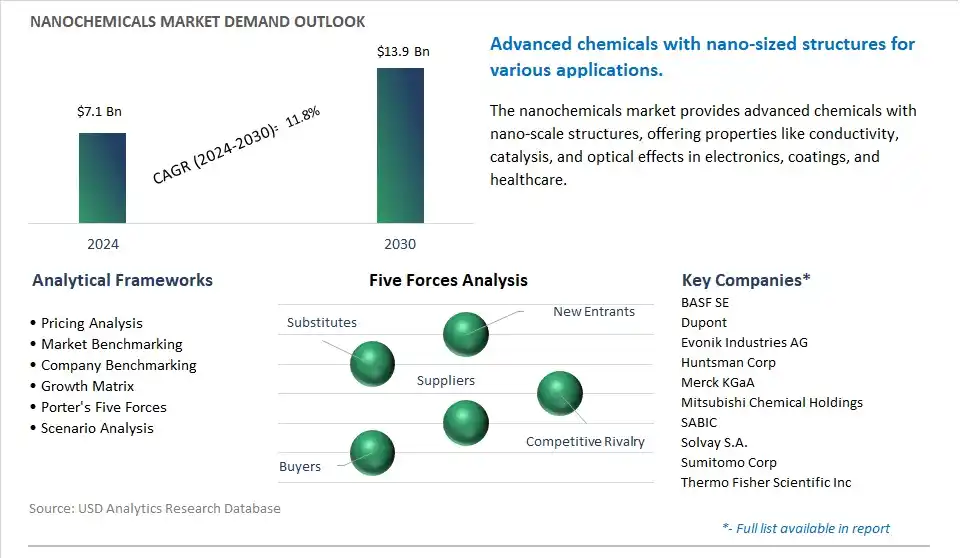
The market report analyses the leading companies in the industry including BASF SE, Dupont, Evonik Industries AG, Huntsman Corp, Merck KGaA, Mitsubishi Chemical Holdings, SABIC, Solvay S.A., Sumitomo Corp, Thermo Fisher Scientific Inc.
One of the most prominent trends in the nanochemicals market is the growing demand for high-performance materials across various industries. Nanochemicals, engineered at the nanoscale, offer unique properties and functionalities that traditional chemicals cannot match. With advancements in nanotechnology and materials science, there's increasing interest in nanochemicals for applications ranging from electronics and energy storage to healthcare and environmental remediation. Industries are leveraging nanochemicals to enhance product performance, durability, and efficiency, driving the adoption of these advanced materials as key components in manufacturing processes and product formulations.
A significant driver propelling the nanochemicals market is technological advancements and ongoing innovation in nanotechnology research and development. Breakthroughs in nanomaterial synthesis, characterization, and manipulation enable the production of nanochemicals with precisely controlled properties, tailored for specific applications and performance requirements. Furthermore, advancements in scalable manufacturing techniques and cost-effective production methods make nanochemicals more accessible to industries seeking to incorporate them into their products and processes. This continuous innovation in nanotechnology drives the expansion of the nanochemicals market by unlocking new possibilities for enhancing material properties and addressing complex challenges across diverse industries.
An exciting opportunity within the nanochemicals market lies in integrating nanochemicals into sustainable solutions to address global challenges such as climate change, resource depletion, and pollution. Nanochemicals offer potential for improving the efficiency of renewable energy technologies, reducing environmental impact in manufacturing processes, and enhancing the effectiveness of environmental remediation efforts. By leveraging the unique properties of nanochemicals, industries can develop sustainable solutions that promote energy efficiency, waste reduction, and environmental stewardship. This opportunity to integrate nanochemicals into sustainable technologies and practices not only addresses pressing environmental concerns but also drives market growth by offering innovative solutions that meet the needs of a changing world.
The largest segment in the Nanochemicals Market is the Polymer type segment. The market growth is driven by polymers are versatile materials with wide-ranging applications in various industries, including healthcare, electronics, automotive, packaging, and construction. Nanochemicals derived from polymers offer numerous advantages such as improved mechanical properties, enhanced functionality, and tailored performance characteristics compared to conventional polymer materials. Nanostructured polymers exhibit unique properties at the nanoscale, including high surface area, tunable surface chemistry, and controlled morphology, which make them highly desirable for advanced applications requiring precision engineering and tailored material properties. Further, the demand for nanochemicals derived from polymers is driven by their versatility, adaptability, and compatibility with existing manufacturing processes and product formulations. Nanostructured polymers can be incorporated into existing polymer matrices or used as standalone materials to impart desired functionalities such as strength, durability, conductivity, thermal stability, and barrier properties. In addition, advancements in polymer nanotechnology have led to the development of novel synthesis methods, processing techniques, and functionalization strategies for producing nanostructured polymer materials with controlled size, shape, and composition. Nanochemicals derived from polymers offer opportunities for innovation and differentiation in product development, enabling manufacturers to create value-added materials with enhanced performance characteristics and competitive advantages in the marketplace. Further, the increasing demand for high-performance materials, sustainable solutions, and functional additives across diverse industries drives the adoption of nanochemicals derived from polymers as key components in advanced product formulations and manufacturing processes. Additionally, regulatory initiatives promoting the use of eco-friendly and safe materials in consumer products, along with technological advancements in polymer nanotechnology, support the growth of the Polymer type segment in the Nanochemicals Market. Over the forecast period, the combination of the versatility, functionality, and market demand for nanochemicals derived from polymers positions the Polymer type segment as the largest in the Nanochemicals Market.
The fastest-growing segment in the Nanochemicals Market is the Semiconductors & Electronics application segment. The semiconductor and electronics industry is characterized by rapid technological advancements, increasing demand for miniaturization, and the need for high-performance materials to meet evolving consumer preferences and industry requirements. Nanochemicals play a critical role in enabling the development of next-generation electronic devices, such as smartphones, tablets, wearables, and IoT devices, by providing innovative materials with enhanced properties and functionalities. Nanochemicals tailored for semiconductor and electronics applications offer advantages such as improved conductivity, thermal stability, dielectric properties, and mechanical strength, enabling the fabrication of smaller, faster, and more energy-efficient electronic components and systems. Further, the growing adoption of nanomaterials and nanostructures in semiconductor manufacturing processes, such as lithography, deposition, etching, and patterning, drives the demand for nanochemicals as key building blocks for creating advanced semiconductor devices and integrated circuits. Nanochemicals enable precise control over material properties, device performance, and manufacturing processes, leading to higher yields, improved device reliability, and reduced production costs in semiconductor fabrication facilities. In addition, emerging technologies and applications, such as nanoelectronics, quantum computing, flexible electronics, and optoelectronics, require novel materials and nanochemicals with tailored properties and functionalities to enable breakthrough innovations and address complex challenges in device design, performance optimization, and scalability. Nanochemicals offer opportunities for enhancing device performance, functionality, and reliability in emerging semiconductor applications, driving the adoption of Nano-enabled solutions across the semiconductor and electronics value chain. Further, collaborations and partnerships between semiconductor manufacturers, nanomaterial suppliers, research institutions, and government agencies facilitate technology transfer, knowledge exchange, and commercialization of nanochemicals for semiconductor and electronics applications. Additionally, regulatory initiatives promoting the safe and responsible development of nanomaterials in electronics manufacturing support the growth of the Semiconductors & Electronics application segment in the Nanochemicals Market. Over the forecast period, the combination of technological innovation, market demand, and industry collaborations positions the Semiconductors & Electronics application segment as the fastest-growing in the Nanochemicals Market.
By Type
Metallic
Ceramic
Polymer
Others
By Application
Semiconductors & electronics
Pharmaceuticals
Food & Agriculture
Energy
Textiles
Others
Regions Included
North America (US, Canada, Mexico)
Europe (Germany, UK, France, Spain, Italy, Russia, Rest of Europe)
Asia Pacific (China, India, Japan, South Korea, Australia, South East Asia, Rest of Asia)
South America (Brazil, Argentina, Rest of South America)
Middle East and Africa (Saudi Arabia, UAE, Rest of Middle East, South Africa, Egypt, Rest of Africa)
BASF SE
Dupont
Evonik Industries AG
Huntsman Corp
Merck KGaA
Mitsubishi Chemical Holdings
SABIC
Solvay S.A.
Sumitomo Corp
Thermo Fisher Scientific Inc
*- List Not Exhaustive
TABLE OF CONTENTS
1 Introduction to 2024 Nanochemicals Market
1.1 Market Overview
1.2 Quick Facts
1.3 Scope/Objective of the Study
1.4 Market Definition
1.5 Countries and Regions Covered
1.6 Units, Currency, and Conversions
1.7 Industry Value Chain
2 Research Methodology
2.1 Market Size Estimation
2.2 Sources and Research Methodology
2.3 Data Triangulation
2.4 Assumptions and Limitations
3 Executive Summary
3.1 Global Nanochemicals Market Size Outlook, $ Million, 2021 to 2030
3.2 Nanochemicals Market Outlook by Type, $ Million, 2021 to 2030
3.3 Nanochemicals Market Outlook by Product, $ Million, 2021 to 2030
3.4 Nanochemicals Market Outlook by Application, $ Million, 2021 to 2030
3.5 Nanochemicals Market Outlook by Key Countries, $ Million, 2021 to 2030
4 Market Dynamics
4.1 Key Driving Forces of Nanochemicals Industry
4.2 Key Market Trends in Nanochemicals Industry
4.3 Potential Opportunities in Nanochemicals Industry
4.4 Key Challenges in Nanochemicals Industry
5 Market Factor Analysis
5.1 Value Chain Analysis
5.2 Competitive Landscape
5.2.1 Global Nanochemicals Market Share by Company (%), 2023
5.2.2 Product Offerings by Company
5.3 Porter’s Five Forces Analysis
5.4 Pricing Analysis and Outlook
6 Growth Outlook Across Scenarios
6.1 Growth Analysis-Case Scenario Definitions
6.2 Low Growth Scenario Forecasts
6.3 Reference Growth Scenario Forecasts
6.4 High Growth Scenario Forecasts
7 Global Nanochemicals Market Outlook by Segments
7.1 Nanochemicals Market Outlook by Segments, $ Million, 2021- 2030
By Type
Metallic
Ceramic
Polymer
Others
By Application
Semiconductors & electronics
Pharmaceuticals
Food & Agriculture
Energy
Textiles
Others
8 North America Nanochemicals Market Analysis and Outlook To 2030
8.1 Introduction to North America Nanochemicals Markets in 2024
8.2 North America Nanochemicals Market Size Outlook by Country, 2021-2030
8.2.1 United States
8.2.2 Canada
8.2.3 Mexico
8.3 North America Nanochemicals Market size Outlook by Segments, 2021-2030
By Type
Metallic
Ceramic
Polymer
Others
By Application
Semiconductors & electronics
Pharmaceuticals
Food & Agriculture
Energy
Textiles
Others
9 Europe Nanochemicals Market Analysis and Outlook To 2030
9.1 Introduction to Europe Nanochemicals Markets in 2024
9.2 Europe Nanochemicals Market Size Outlook by Country, 2021-2030
9.2.1 Germany
9.2.2 France
9.2.3 Spain
9.2.4 United Kingdom
9.2.4 Italy
9.2.5 Russia
9.2.6 Norway
9.2.7 Rest of Europe
9.3 Europe Nanochemicals Market Size Outlook by Segments, 2021-2030
By Type
Metallic
Ceramic
Polymer
Others
By Application
Semiconductors & electronics
Pharmaceuticals
Food & Agriculture
Energy
Textiles
Others
10 Asia Pacific Nanochemicals Market Analysis and Outlook To 2030
10.1 Introduction to Asia Pacific Nanochemicals Markets in 2024
10.2 Asia Pacific Nanochemicals Market Size Outlook by Country, 2021-2030
10.2.1 China
10.2.2 India
10.2.3 Japan
10.2.4 South Korea
10.2.5 Indonesia
10.2.6 Malaysia
10.2.7 Australia
10.2.8 Rest of Asia Pacific
10.3 Asia Pacific Nanochemicals Market size Outlook by Segments, 2021-2030
By Type
Metallic
Ceramic
Polymer
Others
By Application
Semiconductors & electronics
Pharmaceuticals
Food & Agriculture
Energy
Textiles
Others
11 South America Nanochemicals Market Analysis and Outlook To 2030
11.1 Introduction to South America Nanochemicals Markets in 2024
11.2 South America Nanochemicals Market Size Outlook by Country, 2021-2030
11.2.1 Brazil
11.2.2 Argentina
11.2.3 Rest of South America
11.3 South America Nanochemicals Market size Outlook by Segments, 2021-2030
By Type
Metallic
Ceramic
Polymer
Others
By Application
Semiconductors & electronics
Pharmaceuticals
Food & Agriculture
Energy
Textiles
Others
12 Middle East and Africa Nanochemicals Market Analysis and Outlook To 2030
12.1 Introduction to Middle East and Africa Nanochemicals Markets in 2024
12.2 Middle East and Africa Nanochemicals Market Size Outlook by Country, 2021-2030
12.2.1 Saudi Arabia
12.2.2 UAE
12.2.3 Oman
12.2.4 Rest of Middle East
12.2.5 Egypt
12.2.6 Nigeria
12.2.7 South Africa
12.2.8 Rest of Africa
12.3 Middle East and Africa Nanochemicals Market size Outlook by Segments, 2021-2030
By Type
Metallic
Ceramic
Polymer
Others
By Application
Semiconductors & electronics
Pharmaceuticals
Food & Agriculture
Energy
Textiles
Others
13 Company Profiles
13.1 Company Snapshot
13.2 SWOT Profiles
13.3 Products and Services
13.4 Recent Developments
13.5 Financial Profile
BASF SE
Dupont
Evonik Industries AG
Huntsman Corp
Merck KGaA
Mitsubishi Chemical Holdings
SABIC
Solvay S.A.
Sumitomo Corp
Thermo Fisher Scientific Inc
14 Appendix
14.1 Customization Offerings
14.2 Subscription Services
14.3 Related Reports
14.4 Publisher Expertise
By Type
Metallic
Ceramic
Polymer
Others
By Application
Semiconductors & electronics
Pharmaceuticals
Food & Agriculture
Energy
Textiles
Others
Countries Analyzed
North America (US, Canada, Mexico)
Europe (Germany, UK, France, Spain, Italy, Russia, Rest of Europe)
Asia Pacific (China, India, Japan, South Korea, Australia, South East Asia, Rest of Asia)
South America (Brazil, Argentina, Rest of South America)
Middle East and Africa (Saudi Arabia, UAE, Rest of Middle East, South Africa, Egypt, Rest of Africa)
Global Nanochemicals is forecast to reach $13.9 Billion in 2030 from $7.1 Billion in 2024, registering a CAGR of 11.8%
Emerging Markets across Asia Pacific, Europe, and Americas present robust growth prospects.
BASF SE, Dupont, Evonik Industries AG, Huntsman Corp, Merck KGaA, Mitsubishi Chemical Holdings, SABIC, Solvay S.A., Sumitomo Corp, Thermo Fisher Scientific Inc
Base Year- 2023; Estimated Year- 2024; Historic Period- 2018-2023; Forecast period- 2024 to 2030; Currency: Revenue (USD); Volume