
The global Nanoclays Market Study analyzes and forecasts the market size across 6 regions and 24 countries for diverse segments -By Product (Montmorillonite, Kaolinite, Smectite, Others), By Application (Water Treatment, Food and Beverage, Automotive, Biomedical, Paints and Coatings, Others).
The future of nanoclays is shaped by their versatile properties and applications across diverse industries such as packaging, automotive, construction, and pharmaceuticals. Key trends include the development of nanoclay-based composites and nanocomposites with enhanced mechanical, thermal, and barrier properties, enabling lightweighting, durability, and sustainability in various products and materials. Manufacturers are also exploring surface modification techniques to tailor the interfacial interactions between nanoclays and polymer matrices, optimizing dispersion, compatibility, and performance in composite materials. Additionally, there's a growing interest in nanoclay-based additives and fillers that offer flame retardant, UV-blocking, and antimicrobial functionalities, addressing the multifaceted requirements of modern materials and applications. Furthermore, nanoclays are being investigated for their potential as drug delivery carriers, wound healing agents, and tissue engineering scaffolds in biomedical applications, leveraging their biocompatibility and tunable physicochemical properties. As research continues to unravel the structure-property relationships and processing-structure-performance correlations of nanoclays, their integration into commercial products and industrial processes is expected to accelerate, driving innovation and sustainability across various sectors and shaping the future of materials science and engineering.
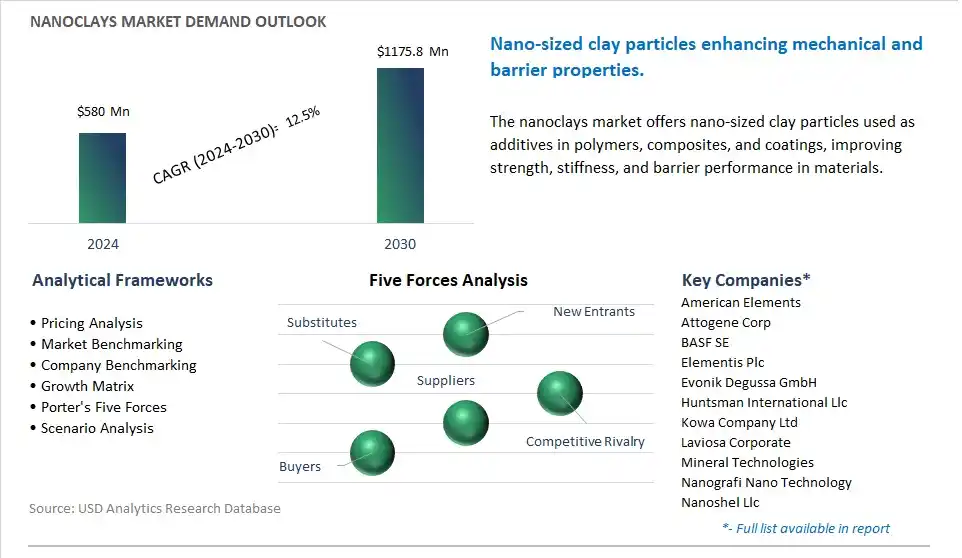
The market report analyses the leading companies in the industry including American Elements, Attogene Corp, BASF SE, Elementis Plc, Evonik Degussa GmbH, Huntsman International Llc, Kowa Company Ltd, Laviosa Corporate, Mineral Technologies, Nanografi Nano Technology, Nanoshel Llc, SABIC, Southern Clay Products Inc, Sun Chemicals, The Dow Chemical Company.
One of the most prominent trends in the nanoclays market is the increasing demand for lightweight and high-performance materials across various industries. Nanoclays, consisting of layered silicate nanoparticles, offer unique properties such as high strength, stiffness, and barrier properties when incorporated into polymer matrices. With industries such as automotive, aerospace, packaging, and construction seeking to reduce weight, improve durability, and enhance performance of their products, there's a growing interest in nanoclays as additives to enhance the properties of composite materials. The trend is driving the adoption of nanoclays as key components in the development of advanced materials for a wide range of applications.
A significant driver propelling the nanoclays market is the need for materials with enhanced mechanical properties and barrier performance. Nanoclays, when dispersed in polymer matrices, act as reinforcing agents, improving tensile strength, modulus, and impact resistance of the resulting nanocomposites. Additionally, nanoclays create tortuous paths within the polymer matrix, effectively blocking the passage of gases and liquids, thus enhancing barrier properties such as gas permeability and moisture resistance. With industries increasingly demanding materials with superior mechanical strength and barrier performance, nanoclays are emerging as indispensable additives in the development of lightweight, durable, and high-performance composite materials.
An exciting opportunity within the nanoclays market lies in its expansion into biomedical and pharmaceutical applications. Nanoclays, with their biocompatibility, tunable surface chemistry, and ability to encapsulate active ingredients, hold promise for various biomedical and pharmaceutical applications. They can be used in drug delivery systems to improve drug solubility, stability, and targeted delivery, as well as in tissue engineering scaffolds to enhance mechanical properties and promote cell adhesion and growth. By leveraging the unique properties of nanoclays, manufacturers can develop innovative solutions for drug delivery, medical implants, wound healing, and regenerative medicine, tapping into a lucrative market segment focused on improving healthcare outcomes and patient well-being. This expansion into biomedical and pharmaceutical applications presents a promising opportunity for growth and diversification within the nanoclays market.
The largest segment in the Nanoclays Market is the Montmorillonite product segment. Montmorillonite holds this position. Montmorillonite is one of the most widely used and extensively studied types of nanoclays due to its unique properties, such as high surface area, cation exchange capacity, and swelling behavior. These properties make Montmorillonite highly versatile and suitable for various applications across industries, including construction, cosmetics, pharmaceuticals, packaging, automotive, and agriculture. Further, Montmorillonite nanoclays are characterized by their layered structure, consisting of stacked silicate layers with intercalated water molecules and exchangeable cations. This layered structure imparts desirable properties to Montmorillonite nanoclays, such as reinforcement, barrier properties, rheological control, and adsorption capacity, making them valuable additives in composite materials, polymer nanocomposites, coatings, adhesives, and rheological modifiers. In addition, Montmorillonite nanoclays offer advantages such as cost-effectiveness, availability, and compatibility with existing manufacturing processes and product formulations. Montmorillonite-based nanoclays can be easily incorporated into polymer matrices, aqueous dispersions, and solvent-based systems to improve material properties, enhance performance characteristics, and enable new functionalities in end products. Further, Montmorillonite nanoclays exhibit excellent compatibility with organic and inorganic matrices, allowing for synergistic effects and tailored material properties in nanocomposite formulations. Additionally, the widespread use of Montmorillonite nanoclays in commercial products and industrial applications contributes to their dominance in the Nanoclays Market. Manufacturers, researchers, and end-users recognize the benefits of Montmorillonite nanoclays in enhancing product performance, durability, and sustainability, driving their continued demand and market leadership. Over the forecast period, the combination of unique properties, versatility, and widespread applications positions the Montmorillonite product segment as the largest in the Nanoclays Market.
The fastest-growing segment in the Nanoclays Market is the Paints and Coatings application segment. nanoclays offer unique properties that make them highly desirable additives in paints and coatings formulations. Nanoclays, such as montmorillonite, kaolinite, and smectite, can act as rheology modifiers, reinforcing agents, barrier materials, and functional additives, imparting various benefits to paints and coatings, such as improved mechanical strength, scratch resistance, barrier properties, UV stability, and corrosion resistance. Further, the paints and coatings industry is experiencing increasing demand for high-performance, environmentally friendly, and sustainable coatings solutions to meet regulatory requirements, consumer preferences, and industry standards. Nanoclays enable the development of eco-friendly coatings formulations with reduced VOC emissions, improved durability, and enhanced performance characteristics, addressing the need for advanced coatings solutions in architectural, automotive, marine, aerospace, and industrial applications. In addition, advancements in nanotechnology and materials science have led to the development of innovative nanoclay-based coatings technologies, such as nanostructured coatings, nanocomposite coatings, and self-healing coatings, with superior properties and functionalities compared to conventional coatings systems. Nanoclay-based coatings offer opportunities for enhancing surface properties, appearance, and functionality, leading to increased adoption in diverse end-use sectors. Further, growing awareness of the benefits of nanoclay-based coatings, such as improved adhesion, weatherability, and chemical resistance, drives their demand among manufacturers, contractors, and end-users seeking high-performance coatings solutions for challenging environments and applications. Additionally, collaborations and partnerships between nanoclay suppliers, coatings manufacturers, research institutions, and end-users facilitate technology transfer, product development, and market penetration of nanoclay-based coatings solutions. Regulatory support for sustainable coatings technologies, coupled with the development of novel nanoclay formulations and application methods, further accelerates the growth of the Paints and Coatings application segment in the Nanoclays Market. Over the forecast period, the combination of unique properties, market demand, and technological advancements positions the Paints and Coatings application segment as the fastest-growing in the Nanoclays Market.
By Product
Montmorillonite
Kaolinite
Smectite
Others
By Application
Water Treatment
Food and Beverage
Automotive
Biomedical
Paints and Coatings
Others
Regions Included
North America (US, Canada, Mexico)
Europe (Germany, UK, France, Spain, Italy, Russia, Rest of Europe)
Asia Pacific (China, India, Japan, South Korea, Australia, South East Asia, Rest of Asia)
South America (Brazil, Argentina, Rest of South America)
Middle East and Africa (Saudi Arabia, UAE, Rest of Middle East, South Africa, Egypt, Rest of Africa)
American Elements
Attogene Corp
BASF SE
Elementis Plc
Evonik Degussa GmbH
Huntsman International Llc
Kowa Company Ltd
Laviosa Corporate
Mineral Technologies
Nanografi Nano Technology
Nanoshel Llc
SABIC
Southern Clay Products Inc
Sun Chemicals
The Dow Chemical Company
*- List Not Exhaustive
TABLE OF CONTENTS
1 Introduction to 2024 Nanoclays Market
1.1 Market Overview
1.2 Quick Facts
1.3 Scope/Objective of the Study
1.4 Market Definition
1.5 Countries and Regions Covered
1.6 Units, Currency, and Conversions
1.7 Industry Value Chain
2 Research Methodology
2.1 Market Size Estimation
2.2 Sources and Research Methodology
2.3 Data Triangulation
2.4 Assumptions and Limitations
3 Executive Summary
3.1 Global Nanoclays Market Size Outlook, $ Million, 2021 to 2030
3.2 Nanoclays Market Outlook by Type, $ Million, 2021 to 2030
3.3 Nanoclays Market Outlook by Product, $ Million, 2021 to 2030
3.4 Nanoclays Market Outlook by Application, $ Million, 2021 to 2030
3.5 Nanoclays Market Outlook by Key Countries, $ Million, 2021 to 2030
4 Market Dynamics
4.1 Key Driving Forces of Nanoclays Industry
4.2 Key Market Trends in Nanoclays Industry
4.3 Potential Opportunities in Nanoclays Industry
4.4 Key Challenges in Nanoclays Industry
5 Market Factor Analysis
5.1 Value Chain Analysis
5.2 Competitive Landscape
5.2.1 Global Nanoclays Market Share by Company (%), 2023
5.2.2 Product Offerings by Company
5.3 Porter’s Five Forces Analysis
5.4 Pricing Analysis and Outlook
6 Growth Outlook Across Scenarios
6.1 Growth Analysis-Case Scenario Definitions
6.2 Low Growth Scenario Forecasts
6.3 Reference Growth Scenario Forecasts
6.4 High Growth Scenario Forecasts
7 Global Nanoclays Market Outlook by Segments
7.1 Nanoclays Market Outlook by Segments, $ Million, 2021- 2030
By Product
Montmorillonite
Kaolinite
Smectite
Others
By Application
Water Treatment
Food and Beverage
Automotive
Biomedical
Paints and Coatings
Others
8 North America Nanoclays Market Analysis and Outlook To 2030
8.1 Introduction to North America Nanoclays Markets in 2024
8.2 North America Nanoclays Market Size Outlook by Country, 2021-2030
8.2.1 United States
8.2.2 Canada
8.2.3 Mexico
8.3 North America Nanoclays Market size Outlook by Segments, 2021-2030
By Product
Montmorillonite
Kaolinite
Smectite
Others
By Application
Water Treatment
Food and Beverage
Automotive
Biomedical
Paints and Coatings
Others
9 Europe Nanoclays Market Analysis and Outlook To 2030
9.1 Introduction to Europe Nanoclays Markets in 2024
9.2 Europe Nanoclays Market Size Outlook by Country, 2021-2030
9.2.1 Germany
9.2.2 France
9.2.3 Spain
9.2.4 United Kingdom
9.2.4 Italy
9.2.5 Russia
9.2.6 Norway
9.2.7 Rest of Europe
9.3 Europe Nanoclays Market Size Outlook by Segments, 2021-2030
By Product
Montmorillonite
Kaolinite
Smectite
Others
By Application
Water Treatment
Food and Beverage
Automotive
Biomedical
Paints and Coatings
Others
10 Asia Pacific Nanoclays Market Analysis and Outlook To 2030
10.1 Introduction to Asia Pacific Nanoclays Markets in 2024
10.2 Asia Pacific Nanoclays Market Size Outlook by Country, 2021-2030
10.2.1 China
10.2.2 India
10.2.3 Japan
10.2.4 South Korea
10.2.5 Indonesia
10.2.6 Malaysia
10.2.7 Australia
10.2.8 Rest of Asia Pacific
10.3 Asia Pacific Nanoclays Market size Outlook by Segments, 2021-2030
By Product
Montmorillonite
Kaolinite
Smectite
Others
By Application
Water Treatment
Food and Beverage
Automotive
Biomedical
Paints and Coatings
Others
11 South America Nanoclays Market Analysis and Outlook To 2030
11.1 Introduction to South America Nanoclays Markets in 2024
11.2 South America Nanoclays Market Size Outlook by Country, 2021-2030
11.2.1 Brazil
11.2.2 Argentina
11.2.3 Rest of South America
11.3 South America Nanoclays Market size Outlook by Segments, 2021-2030
By Product
Montmorillonite
Kaolinite
Smectite
Others
By Application
Water Treatment
Food and Beverage
Automotive
Biomedical
Paints and Coatings
Others
12 Middle East and Africa Nanoclays Market Analysis and Outlook To 2030
12.1 Introduction to Middle East and Africa Nanoclays Markets in 2024
12.2 Middle East and Africa Nanoclays Market Size Outlook by Country, 2021-2030
12.2.1 Saudi Arabia
12.2.2 UAE
12.2.3 Oman
12.2.4 Rest of Middle East
12.2.5 Egypt
12.2.6 Nigeria
12.2.7 South Africa
12.2.8 Rest of Africa
12.3 Middle East and Africa Nanoclays Market size Outlook by Segments, 2021-2030
By Product
Montmorillonite
Kaolinite
Smectite
Others
By Application
Water Treatment
Food and Beverage
Automotive
Biomedical
Paints and Coatings
Others
13 Company Profiles
13.1 Company Snapshot
13.2 SWOT Profiles
13.3 Products and Services
13.4 Recent Developments
13.5 Financial Profile
American Elements
Attogene Corp
BASF SE
Elementis Plc
Evonik Degussa GmbH
Huntsman International Llc
Kowa Company Ltd
Laviosa Corporate
Mineral Technologies
Nanografi Nano Technology
Nanoshel Llc
SABIC
Southern Clay Products Inc
Sun Chemicals
The Dow Chemical Company
14 Appendix
14.1 Customization Offerings
14.2 Subscription Services
14.3 Related Reports
14.4 Publisher Expertise
By Product
Montmorillonite
Kaolinite
Smectite
Others
By Application
Water Treatment
Food and Beverage
Automotive
Biomedical
Paints and Coatings
Others
Countries Analyzed
North America (US, Canada, Mexico)
Europe (Germany, UK, France, Spain, Italy, Russia, Rest of Europe)
Asia Pacific (China, India, Japan, South Korea, Australia, South East Asia, Rest of Asia)
South America (Brazil, Argentina, Rest of South America)
Middle East and Africa (Saudi Arabia, UAE, Rest of Middle East, South Africa, Egypt, Rest of Africa)
Global Nanoclays is forecast to reach $1175.8 Million in 2030 from $580 Million in 2024, registering a CAGR of 12.5%
Emerging Markets across Asia Pacific, Europe, and Americas present robust growth prospects.
American Elements, Attogene Corp, BASF SE, Elementis Plc, Evonik Degussa GmbH, Huntsman International Llc, Kowa Company Ltd, Laviosa Corporate, Mineral Technologies, Nanografi Nano Technology, Nanoshel Llc, SABIC, Southern Clay Products Inc, Sun Chemicals, The Dow Chemical Company
Base Year- 2023; Estimated Year- 2024; Historic Period- 2018-2023; Forecast period- 2024 to 2030; Currency: Revenue (USD); Volume