
The global Nanofibers Market Study analyzes and forecasts the market size across 6 regions and 24 countries for diverse segments -By Product (Carbon Nanofiber, Composite Nanofiber, Metal and Metal Oxide Nanofiber, Polymeric Nanofiber, Carbohydrate-based Nanofiber, Ceramic Nanofiber), By Application (Water and Air Filtration, Automotive, Textiles, Medical, Electronics, Energy Storage, Others).
The future of nanofibers is characterized by their exceptional properties and versatile applications in fields ranging from textiles and filtration to biomedicine and electronics. Key trends include the development of nanofiber materials with precise control over morphology, composition, and functionality, enabling tailored solutions for specific performance requirements. Manufacturers are exploring advanced electrospinning techniques, template-assisted synthesis, and self-assembly methods to produce nanofibers with ultrafine diameters, high surface area, and unique surface chemistry. Additionally, there's a growing interest in functionalized nanofibers that offer functionalities such as antimicrobial properties, catalytic activity, and stimuli responsiveness, opening up new opportunities for innovative applications in areas such as wound dressing, drug delivery, and environmental remediation. Furthermore, nanofibers are being integrated into composite materials and hybrid structures to enhance mechanical strength, durability, and multifunctionality in diverse engineered products and systems. As research continues to push the boundaries of nanofiber science and technology, collaboration among academia, industry, and government agencies will be crucial to accelerate the commercialization and widespread adoption of nanofiber-based solutions, shaping the future of advanced materials and enabling transformative innovations in various sectors.
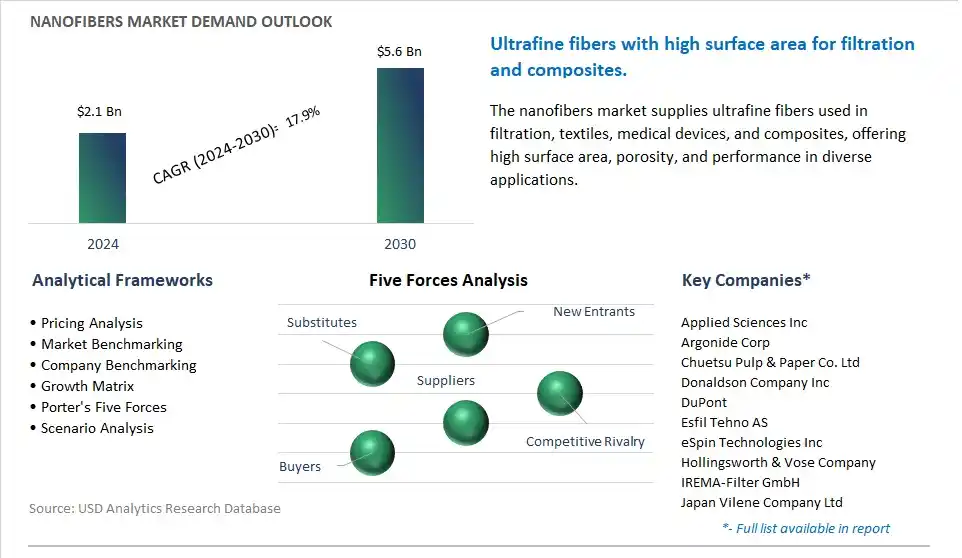
The market report analyses the leading companies in the industry including Applied Sciences Inc, Argonide Corp, Chuetsu Pulp & Paper Co. Ltd, Donaldson Company Inc, DuPont, Esfil Tehno AS, eSpin Technologies Inc, Hollingsworth & Vose Company, IREMA-Filter GmbH, Japan Vilene Company Ltd, LIME, Merck KgAA, Nanofiber Solutions, Nanoval GmbH & Co. KG, Nippon Paper Industries Co. Ltd, Pardam SRO, Sappi Ltd, Teijin Ltd, Toray Industries Inc.
One of the most prominent trends in the nanofibers market is the growing demand for advanced filtration and protective textiles across various industries. Nanofibers, with their extremely small diameters and high surface area-to-volume ratio, offer exceptional filtration efficiency and barrier properties. As concerns about air and water quality, as well as personal and environmental protection, continue to rise, there's an increasing need for filtration materials capable of capturing ultrafine particles, pathogens, and pollutants. Nanofibers are being extensively utilized in air and water filtration systems, as well as in protective clothing and masks, driving the market's growth as industries seek innovative solutions to address emerging health and environmental challenges.
A significant driver propelling the nanofibers market is the continuous advancements in nanotechnology and material science, enabling the development of nanofibers with tailored properties and functionalities. With ongoing research and innovation, manufacturers can engineer nanofibers with precise control over fiber morphology, porosity, surface chemistry, and mechanical properties. These advancements allow for the customization of nanofibers to meet specific application requirements, whether it be in air and water filtration, biomedical devices, tissue engineering, or energy storage. The ability to design nanofibers with enhanced performance characteristics drives the adoption of nanofiber-based solutions across a wide range of industries, stimulating market growth and driving further innovation.
An exciting opportunity within the nanofibers market lies in its expansion into biomedical and tissue engineering applications. Nanofibers, particularly those made from biocompatible polymers, exhibit properties that closely mimic the extracellular matrix found in natural tissues. This makes them ideal scaffolds for tissue regeneration and wound healing applications. Additionally, nanofibers can be functionalized with bioactive molecules, growth factors, and drugs to promote cell adhesion, proliferation, and differentiation, further enhancing their potential in regenerative medicine. By leveraging nanofibers in biomedical applications such as tissue engineering, wound dressings, drug delivery systems, and medical implants, manufacturers can tap into a rapidly growing market segment focused on improving healthcare outcomes and enhancing patient quality of life. This expansion into biomedical and tissue engineering applications presents a promising opportunity for growth and diversification within the nanofibers market.
The largest segment in the Nanofibers Market is the Polymeric Nanofiber segment. This segment holds this position. polymeric nanofibers are among the most extensively researched and commercially developed types of nanofibers due to their versatility, tunability, and wide range of applications. Polymeric nanofibers can be produced from various synthetic and natural polymers, such as polyethylene, polypropylene, polycaprolactone, polylactic acid, cellulose, and gelatin, offering flexibility in material selection and performance optimization for specific applications. Further, polymeric nanofibers exhibit unique properties such as high surface area-to-volume ratio, high porosity, controllable pore size distribution, and excellent mechanical properties, making them suitable for diverse applications in filtration, tissue engineering, drug delivery, protective textiles, sensors, energy storage, and electronics. The versatility and tailorable properties of polymeric nanofibers enable their use in addressing various technological challenges and market needs across industries. In addition, advancements in nanotechnology, electrospinning techniques, and polymer chemistry have led to the development of scalable and cost-effective methods for producing polymeric nanofibers with controlled morphology, composition, and functionality. Electrospinning, in particular, is a widely used technique for manufacturing polymeric nanofibers on a large scale, offering precise control over fiber diameter, alignment, and orientation, as well as the incorporation of functional additives and nanoparticles into the polymer matrix. Further, polymeric nanofibers can be functionalized, surface-modified, or blended with other materials to enhance their properties and enable specific functionalities, such as antibacterial, conductive, or biocompatible properties. The wide range of applications and the ability to tailor properties to meet specific requirements make polymeric nanofibers a preferred choice for manufacturers, researchers, and end-users in various industries. Additionally, the growing demand for advanced materials with unique properties, improved performance, and enhanced functionality drive the adoption of polymeric nanofibers in emerging applications and markets, further consolidating their position as the largest segment in the Nanofibers Market. Over the forecast period, the combination of versatility, tunability, and wide-ranging applications positions the Polymeric Nanofiber segment as the largest in the Nanofibers Market.
The fastest-growing segment in the Nanofibers Market is the Medical application segment. nanofibers offer unique properties that make them highly suitable for various medical applications, including tissue engineering, wound healing, drug delivery, and medical textiles. Nanofibers possess characteristics such as high surface area-to-volume ratio, tunable porosity, and biocompatibility, which are essential for biomedical applications requiring precise control over material properties and interactions with biological systems. Further, the increasing prevalence of chronic diseases, surgical procedures, and wound management challenges drives the demand for advanced medical materials and technologies capable of improving patient outcomes, reducing healthcare costs, and enhancing quality of life. Nanofibers enable the development of novel medical devices, implants, scaffolds, dressings, and drug delivery systems with superior performance characteristics, such as enhanced biocompatibility, tissue regeneration, and controlled release of therapeutics. In addition, advancements in nanofiber fabrication techniques, surface modification methods, and biofunctionalization strategies have expanded the capabilities and applications of nanofibers in medical settings. Electrospinning, melt blowing, and phase separation are among the commonly used techniques for producing medical-grade nanofibers with tailored properties and functionalities, such as controlled drug release kinetics, antimicrobial activity, and cellular interaction capabilities. Further, the versatility and adaptability of nanofibers allow for customization and optimization of material properties to meet specific requirements and challenges in medical applications, such as wound dressings for chronic wounds, tissue scaffolds for regenerative medicine, and drug delivery systems for targeted therapies. Additionally, regulatory approvals, clinical validations, and commercialization efforts support the adoption of nanofiber-based medical products and solutions in healthcare settings, driving market growth and expansion opportunities. The growing recognition of nanofibers as enabling technologies for addressing unmet medical needs, improving patient care, and advancing medical research further accelerates the growth of the Medical application segment in the Nanofibers Market. Over the forecast period, the combination of unique properties, market demand, and technological advancements positions the Medical application segment as the fastest-growing in the Nanofibers Market.
By Product
Carbon Nanofiber
Composite Nanofiber
Metal and Metal Oxide Nanofiber
Polymeric Nanofiber
Carbohydrate-based Nanofiber
Ceramic Nanofiber
By Application
Water and Air Filtration
Automotive
Textiles
Medical
Electronics
Energy Storage
Others
Regions Included
North America (US, Canada, Mexico)
Europe (Germany, UK, France, Spain, Italy, Russia, Rest of Europe)
Asia Pacific (China, India, Japan, South Korea, Australia, South East Asia, Rest of Asia)
South America (Brazil, Argentina, Rest of South America)
Middle East and Africa (Saudi Arabia, UAE, Rest of Middle East, South Africa, Egypt, Rest of Africa)
Applied Sciences Inc
Argonide Corp
Chuetsu Pulp & Paper Co. Ltd
Donaldson Company Inc
DuPont
Esfil Tehno AS
eSpin Technologies Inc
Hollingsworth & Vose Company
IREMA-Filter GmbH
Japan Vilene Company Ltd
LIME
Merck KgAA
Nanofiber Solutions
Nanoval GmbH & Co. KG
Nippon Paper Industries Co. Ltd
Pardam SRO
Sappi Ltd
Teijin Ltd
Toray Industries Inc
*- List Not Exhaustive
TABLE OF CONTENTS
1 Introduction to 2024 Nanofibers Market
1.1 Market Overview
1.2 Quick Facts
1.3 Scope/Objective of the Study
1.4 Market Definition
1.5 Countries and Regions Covered
1.6 Units, Currency, and Conversions
1.7 Industry Value Chain
2 Research Methodology
2.1 Market Size Estimation
2.2 Sources and Research Methodology
2.3 Data Triangulation
2.4 Assumptions and Limitations
3 Executive Summary
3.1 Global Nanofibers Market Size Outlook, $ Million, 2021 to 2030
3.2 Nanofibers Market Outlook by Type, $ Million, 2021 to 2030
3.3 Nanofibers Market Outlook by Product, $ Million, 2021 to 2030
3.4 Nanofibers Market Outlook by Application, $ Million, 2021 to 2030
3.5 Nanofibers Market Outlook by Key Countries, $ Million, 2021 to 2030
4 Market Dynamics
4.1 Key Driving Forces of Nanofibers Industry
4.2 Key Market Trends in Nanofibers Industry
4.3 Potential Opportunities in Nanofibers Industry
4.4 Key Challenges in Nanofibers Industry
5 Market Factor Analysis
5.1 Value Chain Analysis
5.2 Competitive Landscape
5.2.1 Global Nanofibers Market Share by Company (%), 2023
5.2.2 Product Offerings by Company
5.3 Porter’s Five Forces Analysis
5.4 Pricing Analysis and Outlook
6 Growth Outlook Across Scenarios
6.1 Growth Analysis-Case Scenario Definitions
6.2 Low Growth Scenario Forecasts
6.3 Reference Growth Scenario Forecasts
6.4 High Growth Scenario Forecasts
7 Global Nanofibers Market Outlook by Segments
7.1 Nanofibers Market Outlook by Segments, $ Million, 2021- 2030
By Product
Carbon Nanofiber
Composite Nanofiber
Metal and Metal Oxide Nanofiber
Polymeric Nanofiber
Carbohydrate-based Nanofiber
Ceramic Nanofiber
By Application
Water and Air Filtration
Automotive
Textiles
Medical
Electronics
Energy Storage
Others
8 North America Nanofibers Market Analysis and Outlook To 2030
8.1 Introduction to North America Nanofibers Markets in 2024
8.2 North America Nanofibers Market Size Outlook by Country, 2021-2030
8.2.1 United States
8.2.2 Canada
8.2.3 Mexico
8.3 North America Nanofibers Market size Outlook by Segments, 2021-2030
By Product
Carbon Nanofiber
Composite Nanofiber
Metal and Metal Oxide Nanofiber
Polymeric Nanofiber
Carbohydrate-based Nanofiber
Ceramic Nanofiber
By Application
Water and Air Filtration
Automotive
Textiles
Medical
Electronics
Energy Storage
Others
9 Europe Nanofibers Market Analysis and Outlook To 2030
9.1 Introduction to Europe Nanofibers Markets in 2024
9.2 Europe Nanofibers Market Size Outlook by Country, 2021-2030
9.2.1 Germany
9.2.2 France
9.2.3 Spain
9.2.4 United Kingdom
9.2.4 Italy
9.2.5 Russia
9.2.6 Norway
9.2.7 Rest of Europe
9.3 Europe Nanofibers Market Size Outlook by Segments, 2021-2030
By Product
Carbon Nanofiber
Composite Nanofiber
Metal and Metal Oxide Nanofiber
Polymeric Nanofiber
Carbohydrate-based Nanofiber
Ceramic Nanofiber
By Application
Water and Air Filtration
Automotive
Textiles
Medical
Electronics
Energy Storage
Others
10 Asia Pacific Nanofibers Market Analysis and Outlook To 2030
10.1 Introduction to Asia Pacific Nanofibers Markets in 2024
10.2 Asia Pacific Nanofibers Market Size Outlook by Country, 2021-2030
10.2.1 China
10.2.2 India
10.2.3 Japan
10.2.4 South Korea
10.2.5 Indonesia
10.2.6 Malaysia
10.2.7 Australia
10.2.8 Rest of Asia Pacific
10.3 Asia Pacific Nanofibers Market size Outlook by Segments, 2021-2030
By Product
Carbon Nanofiber
Composite Nanofiber
Metal and Metal Oxide Nanofiber
Polymeric Nanofiber
Carbohydrate-based Nanofiber
Ceramic Nanofiber
By Application
Water and Air Filtration
Automotive
Textiles
Medical
Electronics
Energy Storage
Others
11 South America Nanofibers Market Analysis and Outlook To 2030
11.1 Introduction to South America Nanofibers Markets in 2024
11.2 South America Nanofibers Market Size Outlook by Country, 2021-2030
11.2.1 Brazil
11.2.2 Argentina
11.2.3 Rest of South America
11.3 South America Nanofibers Market size Outlook by Segments, 2021-2030
By Product
Carbon Nanofiber
Composite Nanofiber
Metal and Metal Oxide Nanofiber
Polymeric Nanofiber
Carbohydrate-based Nanofiber
Ceramic Nanofiber
By Application
Water and Air Filtration
Automotive
Textiles
Medical
Electronics
Energy Storage
Others
12 Middle East and Africa Nanofibers Market Analysis and Outlook To 2030
12.1 Introduction to Middle East and Africa Nanofibers Markets in 2024
12.2 Middle East and Africa Nanofibers Market Size Outlook by Country, 2021-2030
12.2.1 Saudi Arabia
12.2.2 UAE
12.2.3 Oman
12.2.4 Rest of Middle East
12.2.5 Egypt
12.2.6 Nigeria
12.2.7 South Africa
12.2.8 Rest of Africa
12.3 Middle East and Africa Nanofibers Market size Outlook by Segments, 2021-2030
By Product
Carbon Nanofiber
Composite Nanofiber
Metal and Metal Oxide Nanofiber
Polymeric Nanofiber
Carbohydrate-based Nanofiber
Ceramic Nanofiber
By Application
Water and Air Filtration
Automotive
Textiles
Medical
Electronics
Energy Storage
Others
13 Company Profiles
13.1 Company Snapshot
13.2 SWOT Profiles
13.3 Products and Services
13.4 Recent Developments
13.5 Financial Profile
Applied Sciences Inc
Argonide Corp
Chuetsu Pulp & Paper Co. Ltd
Donaldson Company Inc
DuPont
Esfil Tehno AS
eSpin Technologies Inc
Hollingsworth & Vose Company
IREMA-Filter GmbH
Japan Vilene Company Ltd
LIME
Merck KgAA
Nanofiber Solutions
Nanoval GmbH & Co. KG
Nippon Paper Industries Co. Ltd
Pardam SRO
Sappi Ltd
Teijin Ltd
Toray Industries Inc
14 Appendix
14.1 Customization Offerings
14.2 Subscription Services
14.3 Related Reports
14.4 Publisher Expertise
By Product
Carbon Nanofiber
Composite Nanofiber
Metal and Metal Oxide Nanofiber
Polymeric Nanofiber
Carbohydrate-based Nanofiber
Ceramic Nanofiber
By Application
Water and Air Filtration
Automotive
Textiles
Medical
Electronics
Energy Storage
Others
Countries Analyzed
North America (US, Canada, Mexico)
Europe (Germany, UK, France, Spain, Italy, Russia, Rest of Europe)
Asia Pacific (China, India, Japan, South Korea, Australia, South East Asia, Rest of Asia)
South America (Brazil, Argentina, Rest of South America)
Middle East and Africa (Saudi Arabia, UAE, Rest of Middle East, South Africa, Egypt, Rest of Africa)
Global Nanofibers is forecast to reach $5.6 Billion in 2030 from $2.1 Billion in 2024, registering a CAGR of 17.9%
Emerging Markets across Asia Pacific, Europe, and Americas present robust growth prospects.
Applied Sciences Inc, Argonide Corp, Chuetsu Pulp & Paper Co. Ltd, Donaldson Company Inc, DuPont, Esfil Tehno AS, eSpin Technologies Inc, Hollingsworth & Vose Company, IREMA-Filter GmbH, Japan Vilene Company Ltd, LIME, Merck KgAA, Nanofiber Solutions, Nanoval GmbH & Co. KG, Nippon Paper Industries Co. Ltd, Pardam SRO, Sappi Ltd, Teijin Ltd, Toray Industries Inc
Base Year- 2023; Estimated Year- 2024; Historic Period- 2018-2023; Forecast period- 2024 to 2030; Currency: Revenue (USD); Volume