
The global Nanofillers Market Study analyzes and forecasts the market size across 6 regions and 24 countries for diverse segments -By Type (Organic, Inorganic), By Application (Plastics, Concrete, Paints & Coatings, Films & Rubber, Adhesives & Sealants).
The future of nanofillers is defined by their ability to reinforce, modify, and functionalize polymer matrices in a wide range of composite materials and products. Key trends include the development of nanofiller materials with tailored shapes, sizes, and surface chemistries to impart specific mechanical, thermal, electrical, and barrier properties to polymer composites. Manufacturers are exploring various nanofiller types such as nanoparticles, nanotubes, nanoclays, and graphene derivatives, optimizing dispersion, interfacial adhesion, and compatibility with polymer matrices to maximize performance enhancements. Additionally, there's a growing interest in hybrid nanofiller systems and nanocomposite architectures that combine multiple nanoscale constituents to achieve synergistic effects and multifunctionality in engineered materials. Furthermore, nanofillers are being incorporated into diverse industrial applications including automotive components, aerospace structures, electronics packaging, and sporting goods, where lightweighting, durability, and performance optimization are critical. As research advances our understanding of nanofiller-polymer interactions and processing-structure-property relationships, nanofillers are expected to play an increasingly important role in enabling next-generation materials and technologies, driving innovation and competitiveness across various sectors and shaping the future of advanced manufacturing and materials science.
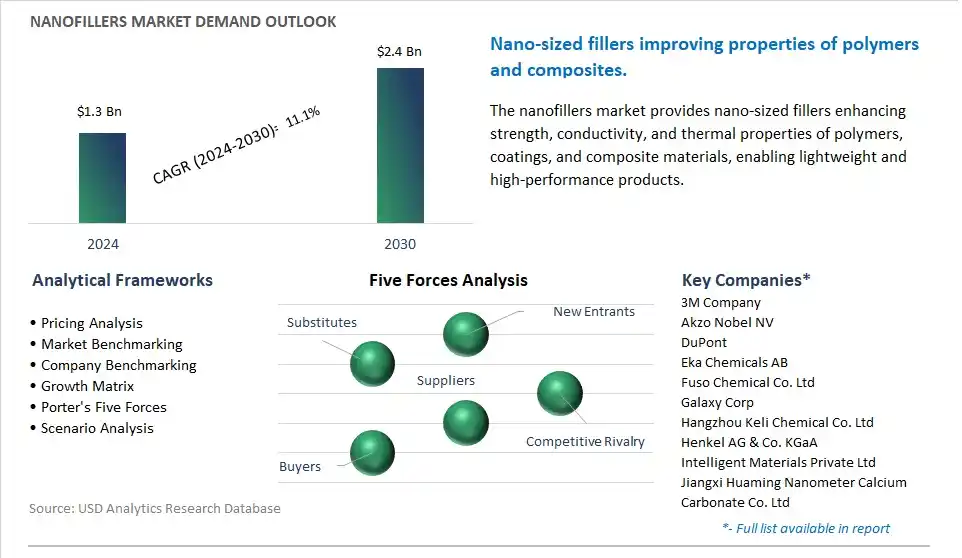
The market report analyses the leading companies in the industry including 3M Company, Akzo Nobel NV, DuPont, Eka Chemicals AB, Fuso Chemical Co. Ltd, Galaxy Corp, Hangzhou Keli Chemical Co. Ltd, Henkel AG & Co. KGaA, Intelligent Materials Private Ltd, Jiangxi Huaming Nanometer Calcium Carbonate Co. Ltd, Nanomaterials Technology Pte Ltd, Nanostructured & Amorphous Materials Inc, Reade Advanced Materials, Shanghai Yaohua Nanotech, Toyota Central R&D Labs Inc.
One of the most prominent trends in the nanofillers market is the increasing demand for lightweight and high-strength materials across various industries. Nanofillers, such as nanoparticles and nanotubes, are being extensively utilized to reinforce polymer matrices, enhancing their mechanical properties while maintaining low weight. With industries such as automotive, aerospace, and sports equipment seeking to reduce fuel consumption, improve energy efficiency, and enhance performance, there's a growing interest in nanofillers as additives to develop advanced composite materials. The trend is driving the adoption of nanofillers as key components in the manufacturing of lightweight structures with superior strength and durability.
A significant driver propelling the nanofillers market is the need for materials with improved performance characteristics and cost-effective solutions. Nanofillers offer the potential to significantly enhance the mechanical, thermal, and barrier properties of polymer composites, ceramics, and coatings, allowing manufacturers to develop materials with superior performance at competitive costs. Additionally, nanofillers enable the reduction of material usage while maintaining or even improving functionality, leading to cost savings in production processes. With industries seeking innovative solutions to meet stringent performance requirements and cost constraints, nanofillers are increasingly being integrated into various materials and applications, driving market growth.
An exciting opportunity within the nanofillers market lies in their integration into sustainable and eco-friendly materials to address environmental concerns and regulatory requirements. Nanofillers can be utilized to enhance the properties of biodegradable polymers, natural fibers, and recyclable materials, making them more durable, lightweight, and functional. By incorporating nanofillers into sustainable materials, manufacturers can develop eco-friendly solutions that reduce environmental impact, promote resource efficiency, and meet evolving sustainability standards. This opportunity to integrate nanofillers into sustainable materials presents a potential avenue for growth and differentiation within the market as industries increasingly prioritize environmental sustainability and seek greener alternatives for their products and processes.
The largest segment in the Nanofillers Market is the Inorganic type segment. The market growth is driven by inorganic nanofillers, such as metal oxides (e. g. , silica, alumina, titanium dioxide), clays (e. g. , montmorillonite, kaolinite), and metal nanoparticles (e. g. , silver, gold, iron oxide), offer a wide range of desirable properties, including high aspect ratio, surface area, mechanical strength, thermal stability, and chemical inertness. These properties make inorganic nanofillers highly versatile and suitable for various applications across industries, including plastics, rubber, coatings, adhesives, composites, and electronics. Further, inorganic nanofillers exhibit excellent compatibility with polymer matrices and other host materials, allowing for effective dispersion, interfacial bonding, and property enhancement in composite materials. Inorganic nanofillers can reinforce polymer matrices, improve mechanical properties (e. g. , strength, stiffness, toughness), enhance thermal and barrier properties, impart flame retardancy, and provide functionalities such as UV protection, antimicrobial activity, and electrical conductivity. In addition, advancements in nanotechnology, materials science, and manufacturing processes have led to the development of scalable and cost-effective methods for producing inorganic nanofillers with controlled morphology, size, composition, and surface properties. Techniques such as sol-gel synthesis, chemical vapor deposition, and hydrothermal processing enable precise control over the structure and properties of inorganic nanofillers, facilitating their integration into commercial products and industrial processes. Further, inorganic nanofillers are widely available, cost-effective, and compatible with existing manufacturing infrastructure, making them attractive options for product formulation and material optimization. Additionally, regulatory approvals, industry standards, and customer requirements drive the demand for inorganic nanofillers as performance additives in advanced materials and applications. The broad applicability, versatile properties, and established market presence of inorganic nanofillers position the Inorganic type segment as the largest in the Nanofillers Market.
The fastest-growing segment in the Nanofillers Market is the Plastics application segment. nanofillers offer unique properties that make them highly desirable additives in plastic formulations. Nanofillers, such as nanoparticles (e. g. , silica, clay, carbon nanotubes) and nanofibers, can significantly enhance the mechanical, thermal, barrier, and electrical properties of plastics, leading to improved performance characteristics and expanded application possibilities. Further, the plastics industry is experiencing increasing demand for high-performance, lightweight, and multifunctional materials to meet evolving market trends, regulatory requirements, and customer preferences across various end-use sectors, including automotive, packaging, electronics, construction, and consumer goods. Nanofillers enable the development of advanced plastic composites, nanocomposites, and nanocomposite foams with superior properties and functionalities, such as enhanced strength, stiffness, impact resistance, heat resistance, flame retardancy, UV stability, and barrier properties. In addition, advancements in nanomaterials synthesis, dispersion techniques, and processing technologies have facilitated the integration of nanofillers into plastic matrices on a large scale, enabling the production of nanocomposite materials with tailored properties and performance characteristics. Nanofillers can be incorporated into plastics using various compounding methods, such as melt blending, solution mixing, masterbatching, and in-situ polymerization, allowing for precise control over filler loading, dispersion, and distribution in the polymer matrix. Further, the versatility and adaptability of nanofillers enable their use in a wide range of plastic applications, including automotive components, packaging films, electrical insulators, construction materials, and consumer products, driving market growth and adoption across industries. Additionally, regulatory support for lightweighting initiatives, sustainability goals, and performance improvements in plastic materials encourages the use of nanofillers as eco-friendly alternatives to conventional additives and reinforcements. The increasing demand for lightweight, durable, and high-performance plastics in various applications, coupled with the unique properties and functionalities offered by nanofillers, fuels the growth of the Plastics application segment in the Nanofillers Market. Over the forecast period, the combination of market demand, technological advancements, and material innovation positions the Plastics application segment as the fastest-growing in the Nanofillers Market.
By Type
Organic
Inorganic
By Application
Plastics
Concrete
Paints & Coatings
Films & Rubber
Adhesives & Sealants
Regions Included
North America (US, Canada, Mexico)
Europe (Germany, UK, France, Spain, Italy, Russia, Rest of Europe)
Asia Pacific (China, India, Japan, South Korea, Australia, South East Asia, Rest of Asia)
South America (Brazil, Argentina, Rest of South America)
Middle East and Africa (Saudi Arabia, UAE, Rest of Middle East, South Africa, Egypt, Rest of Africa)
3M Company
Akzo Nobel NV
DuPont
Eka Chemicals AB
Fuso Chemical Co. Ltd
Galaxy Corp
Hangzhou Keli Chemical Co. Ltd
Henkel AG & Co. KGaA
Intelligent Materials Private Ltd
Jiangxi Huaming Nanometer Calcium Carbonate Co. Ltd
Nanomaterials Technology Pte Ltd
Nanostructured & Amorphous Materials Inc
Reade Advanced Materials
Shanghai Yaohua Nanotech
Toyota Central R&D Labs Inc
*- List Not Exhaustive
TABLE OF CONTENTS
1 Introduction to 2024 Nanofillers Market
1.1 Market Overview
1.2 Quick Facts
1.3 Scope/Objective of the Study
1.4 Market Definition
1.5 Countries and Regions Covered
1.6 Units, Currency, and Conversions
1.7 Industry Value Chain
2 Research Methodology
2.1 Market Size Estimation
2.2 Sources and Research Methodology
2.3 Data Triangulation
2.4 Assumptions and Limitations
3 Executive Summary
3.1 Global Nanofillers Market Size Outlook, $ Million, 2021 to 2030
3.2 Nanofillers Market Outlook by Type, $ Million, 2021 to 2030
3.3 Nanofillers Market Outlook by Product, $ Million, 2021 to 2030
3.4 Nanofillers Market Outlook by Application, $ Million, 2021 to 2030
3.5 Nanofillers Market Outlook by Key Countries, $ Million, 2021 to 2030
4 Market Dynamics
4.1 Key Driving Forces of Nanofillers Industry
4.2 Key Market Trends in Nanofillers Industry
4.3 Potential Opportunities in Nanofillers Industry
4.4 Key Challenges in Nanofillers Industry
5 Market Factor Analysis
5.1 Value Chain Analysis
5.2 Competitive Landscape
5.2.1 Global Nanofillers Market Share by Company (%), 2023
5.2.2 Product Offerings by Company
5.3 Porter’s Five Forces Analysis
5.4 Pricing Analysis and Outlook
6 Growth Outlook Across Scenarios
6.1 Growth Analysis-Case Scenario Definitions
6.2 Low Growth Scenario Forecasts
6.3 Reference Growth Scenario Forecasts
6.4 High Growth Scenario Forecasts
7 Global Nanofillers Market Outlook by Segments
7.1 Nanofillers Market Outlook by Segments, $ Million, 2021- 2030
By Type
Organic
Inorganic
By Application
Plastics
Concrete
Paints & Coatings
Films & Rubber
Adhesives & Sealants
8 North America Nanofillers Market Analysis and Outlook To 2030
8.1 Introduction to North America Nanofillers Markets in 2024
8.2 North America Nanofillers Market Size Outlook by Country, 2021-2030
8.2.1 United States
8.2.2 Canada
8.2.3 Mexico
8.3 North America Nanofillers Market size Outlook by Segments, 2021-2030
By Type
Organic
Inorganic
By Application
Plastics
Concrete
Paints & Coatings
Films & Rubber
Adhesives & Sealants
9 Europe Nanofillers Market Analysis and Outlook To 2030
9.1 Introduction to Europe Nanofillers Markets in 2024
9.2 Europe Nanofillers Market Size Outlook by Country, 2021-2030
9.2.1 Germany
9.2.2 France
9.2.3 Spain
9.2.4 United Kingdom
9.2.4 Italy
9.2.5 Russia
9.2.6 Norway
9.2.7 Rest of Europe
9.3 Europe Nanofillers Market Size Outlook by Segments, 2021-2030
By Type
Organic
Inorganic
By Application
Plastics
Concrete
Paints & Coatings
Films & Rubber
Adhesives & Sealants
10 Asia Pacific Nanofillers Market Analysis and Outlook To 2030
10.1 Introduction to Asia Pacific Nanofillers Markets in 2024
10.2 Asia Pacific Nanofillers Market Size Outlook by Country, 2021-2030
10.2.1 China
10.2.2 India
10.2.3 Japan
10.2.4 South Korea
10.2.5 Indonesia
10.2.6 Malaysia
10.2.7 Australia
10.2.8 Rest of Asia Pacific
10.3 Asia Pacific Nanofillers Market size Outlook by Segments, 2021-2030
By Type
Organic
Inorganic
By Application
Plastics
Concrete
Paints & Coatings
Films & Rubber
Adhesives & Sealants
11 South America Nanofillers Market Analysis and Outlook To 2030
11.1 Introduction to South America Nanofillers Markets in 2024
11.2 South America Nanofillers Market Size Outlook by Country, 2021-2030
11.2.1 Brazil
11.2.2 Argentina
11.2.3 Rest of South America
11.3 South America Nanofillers Market size Outlook by Segments, 2021-2030
By Type
Organic
Inorganic
By Application
Plastics
Concrete
Paints & Coatings
Films & Rubber
Adhesives & Sealants
12 Middle East and Africa Nanofillers Market Analysis and Outlook To 2030
12.1 Introduction to Middle East and Africa Nanofillers Markets in 2024
12.2 Middle East and Africa Nanofillers Market Size Outlook by Country, 2021-2030
12.2.1 Saudi Arabia
12.2.2 UAE
12.2.3 Oman
12.2.4 Rest of Middle East
12.2.5 Egypt
12.2.6 Nigeria
12.2.7 South Africa
12.2.8 Rest of Africa
12.3 Middle East and Africa Nanofillers Market size Outlook by Segments, 2021-2030
By Type
Organic
Inorganic
By Application
Plastics
Concrete
Paints & Coatings
Films & Rubber
Adhesives & Sealants
13 Company Profiles
13.1 Company Snapshot
13.2 SWOT Profiles
13.3 Products and Services
13.4 Recent Developments
13.5 Financial Profile
3M Company
Akzo Nobel NV
DuPont
Eka Chemicals AB
Fuso Chemical Co. Ltd
Galaxy Corp
Hangzhou Keli Chemical Co. Ltd
Henkel AG & Co. KGaA
Intelligent Materials Private Ltd
Jiangxi Huaming Nanometer Calcium Carbonate Co. Ltd
Nanomaterials Technology Pte Ltd
Nanostructured & Amorphous Materials Inc
Reade Advanced Materials
Shanghai Yaohua Nanotech
Toyota Central R&D Labs Inc
14 Appendix
14.1 Customization Offerings
14.2 Subscription Services
14.3 Related Reports
14.4 Publisher Expertise
By Type
Organic
Inorganic
By Application
Plastics
Concrete
Paints & Coatings
Films & Rubber
Adhesives & Sealants
Countries Analyzed
North America (US, Canada, Mexico)
Europe (Germany, UK, France, Spain, Italy, Russia, Rest of Europe)
Asia Pacific (China, India, Japan, South Korea, Australia, South East Asia, Rest of Asia)
South America (Brazil, Argentina, Rest of South America)
Middle East and Africa (Saudi Arabia, UAE, Rest of Middle East, South Africa, Egypt, Rest of Africa)
Global Nanofillers is forecast to reach $2.4 Billion in 2030 from $1.3 Billion in 2024, registering a CAGR of 11.1%
Emerging Markets across Asia Pacific, Europe, and Americas present robust growth prospects.
3M Company, Akzo Nobel NV, DuPont, Eka Chemicals AB, Fuso Chemical Co. Ltd, Galaxy Corp, Hangzhou Keli Chemical Co. Ltd, Henkel AG & Co. KGaA, Intelligent Materials Private Ltd, Jiangxi Huaming Nanometer Calcium Carbonate Co. Ltd, Nanomaterials Technology Pte Ltd, Nanostructured & Amorphous Materials Inc, Reade Advanced Materials, Shanghai Yaohua Nanotech, Toyota Central R&D Labs Inc
Base Year- 2023; Estimated Year- 2024; Historic Period- 2018-2023; Forecast period- 2024 to 2030; Currency: Revenue (USD); Volume