
The global Naphthalene Market Study analyzes and forecasts the market size across 6 regions and 24 countries for diverse segments -By Source (Coal Tar, Petroleum), By Application (Phthalic Anhydride, Naphthalene Sulfonates, Low-Volatility Solvents, Moth Repellent, Pesticides, Others).
The future of naphthalene is influenced by several key trends, including increasing demand for raw materials in the production of chemicals, plastics, and construction materials, advancements in naphthalene extraction and purification technologies, and growing emphasis on sustainability, resource efficiency, and regulatory compliance. Naphthalene is a polycyclic aromatic hydrocarbon commonly used as a precursor in the synthesis of various chemicals such as phthalic anhydride, naphthalene sulfonate, and naphthalene diols, as well as a moth repellent and deodorizer. With the rise of petrochemical feedstock diversification, circular economy principles, and environmental concerns over traditional fossil-based chemicals, there's a growing need for naphthalene that offers sustainable sourcing, cleaner production processes, and reduced environmental footprint. Moreover, advancements in naphthalene recovery from coal tar, petroleum fractions, and biomass pyrolysis by-products are driving the development of efficient and cost-effective methods for obtaining high-purity naphthalene with minimal impurities and environmental impact. Additionally, the integration of naphthalene into innovative applications such as organic semiconductors, graphene synthesis, and carbon nanomaterial production is expanding its market potential and contributing to the advancement of emerging technologies in electronics, energy storage, and environmental remediation. Collaboration between naphthalene producers, chemical manufacturers, research institutions, and regulatory agencies is essential to drive innovation, ensure product quality, and address market demands in the naphthalene industry.
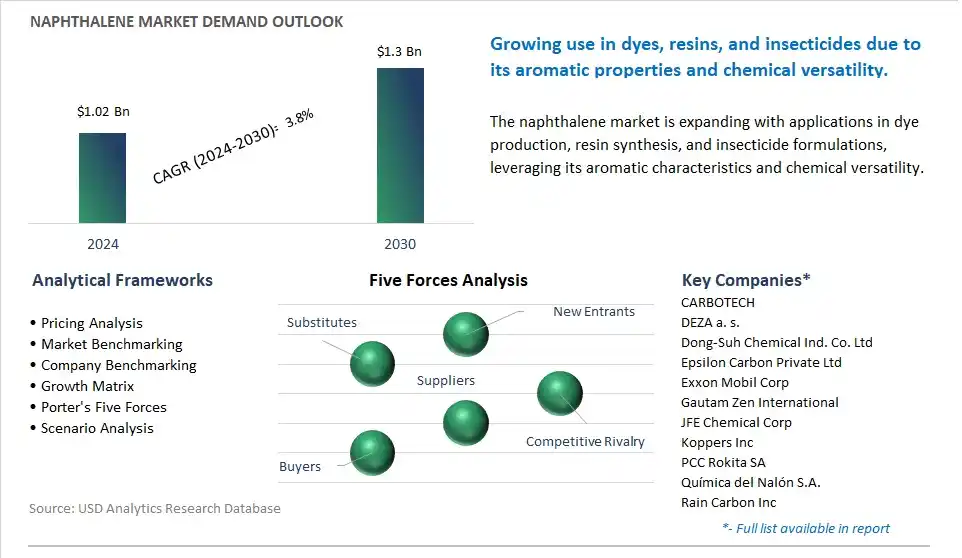
The market report analyses the leading companies in the industry including CARBOTECH, DEZA a. s., Dong-Suh Chemical Ind. Co. Ltd, Epsilon Carbon Private Ltd, Exxon Mobil Corp, Gautam Zen International, JFE Chemical Corp, Koppers Inc, PCC Rokita SA, Química del Nalón S.A., Rain Carbon Inc, Tulstar Products Inc .
A significant trend in the naphthalene market is the shift towards sustainable and bio-based chemicals. Naphthalene, a versatile aromatic hydrocarbon, is traditionally derived from coal tar or petroleum sources. However, there's a growing interest in developing bio-based routes for naphthalene production using renewable feedstocks such as biomass or waste materials. This trend is driven by increasing environmental concerns, regulatory pressure to reduce carbon emissions, and consumer demand for eco-friendly products. Bio-based naphthalene offers advantages such as lower environmental impact, reduced dependence on fossil fuels, and potential cost savings. As industries seek sustainable alternatives to conventional chemical feedstocks, the demand for bio-based naphthalene is expected to rise, driving innovation and investment in green chemistry technologies.
A major driver of the naphthalene market is the growing demand in chemical manufacturing and industrial applications. Naphthalene serves as a precursor for the production of various chemicals and intermediates used in industries such as dyes, plastics, pesticides, and pharmaceuticals. Its versatile properties make it a valuable raw material for synthesizing compounds such as phthalic anhydride, naphthalene sulfonates, and naphthols, which find applications in a wide range of sectors. The expanding chemical industry, particularly in emerging economies, drives the demand for naphthalene as a key building block in manufacturing processes. Additionally, naphthalene's use in industrial applications such as mothball production, concrete admixtures, and corrosion inhibitors further contributes to market growth. As industrial production and chemical processing activities increase globally, the demand for naphthalene as a foundational chemical feedstock is expected to remain robust.
An opportunity within the naphthalene market lies in the exploration of niche applications and high-value products. While naphthalene has well-established uses in large-scale chemical manufacturing, there's potential to explore niche markets and develop high-value products with unique properties. For example, naphthalene derivatives such as beta-naphthol and alpha-naphthylamine have applications in specialty chemicals, agrochemicals, and pharmaceuticals, offering opportunities for value-added product development. Additionally, naphthalene-based compounds exhibit interesting properties in areas such as organic electronics, advanced materials, and nanotechnology. By leveraging its chemical versatility and adapting to emerging market demands, manufacturers can diversify their product portfolios, capture niche market segments, and create added value. Investing in research and development, market intelligence, and strategic partnerships offers an opportunity to identify new applications and capitalize on evolving market trends in the dynamic landscape of naphthalene derivatives and specialty chemicals.
The largest segment in the Naphthalene Market is Coal Tar. This dominance stems from historical factors and the prevalence of coal tar as a traditional source of naphthalene. Coal tar, a byproduct of coal carbonization, contains significant amounts of naphthalene, making it a primary source for naphthalene production. Coal tar distillation processes extract naphthalene along with other aromatic compounds, creating a steady supply of naphthalene for various industrial applications. Despite advancements in petroleum refining technologies, coal tar remains a major source of naphthalene due to its cost-effectiveness and established infrastructure. However, it's worth noting that the demand for petroleum-derived naphthalene has been steadily increasing due to factors such as environmental regulations, sustainability concerns, and the shift towards cleaner energy sources. Nevertheless, the Coal Tar segment continues to dominate the Naphthalene Market, driven by its historical significance and widespread availability.
The fastest-growing segment in the Naphthalene Market is Naphthalene Sulfonates. This growth is fueled by the increasing demand for naphthalene sulfonates as dispersants and surfactants in various industries, including construction, agriculture, textiles, and detergents. Naphthalene sulfonates are widely utilized as concrete admixtures to improve the workability, strength, and durability of concrete mixes. Additionally, they find applications in agricultural formulations as dispersants and wetting agents to enhance the efficiency of pesticides and fertilizers. Further, naphthalene sulfonates are used in the production of synthetic detergents and soaps, where they act as surfactants to improve the solubility and emulsification of grease and dirt. With ongoing infrastructure development projects, agricultural activities, and increasing demand for cleaning products globally, the demand for naphthalene sulfonates is expected to continue growing, driving the expansion of the Naphthalene Sulfonates segment in the Naphthalene Market.
By Source
Coal Tar
Petroleum
By Application
Phthalic Anhydride
Naphthalene Sulfonates
Low-Volatility Solvents
Moth Repellent
Pesticides
Others
Regions Included
North America (US, Canada, Mexico)
Europe (Germany, UK, France, Spain, Italy, Russia, Rest of Europe)
Asia Pacific (China, India, Japan, South Korea, Australia, South East Asia, Rest of Asia)
South America (Brazil, Argentina, Rest of South America)
Middle East and Africa (Saudi Arabia, UAE, Rest of Middle East, South Africa, Egypt, Rest of Africa)
CARBOTECH
DEZA a. s.
Dong-Suh Chemical Ind. Co. Ltd
Epsilon Carbon Private Ltd
Exxon Mobil Corp
Gautam Zen International
JFE Chemical Corp
Koppers Inc
PCC Rokita SA
Química del Nalón S.A.
Rain Carbon Inc
Tulstar Products Inc
*- List Not Exhaustive
TABLE OF CONTENTS
1 Introduction to 2024 Naphthalene Market
1.1 Market Overview
1.2 Quick Facts
1.3 Scope/Objective of the Study
1.4 Market Definition
1.5 Countries and Regions Covered
1.6 Units, Currency, and Conversions
1.7 Industry Value Chain
2 Research Methodology
2.1 Market Size Estimation
2.2 Sources and Research Methodology
2.3 Data Triangulation
2.4 Assumptions and Limitations
3 Executive Summary
3.1 Global Naphthalene Market Size Outlook, $ Million, 2021 to 2030
3.2 Naphthalene Market Outlook by Type, $ Million, 2021 to 2030
3.3 Naphthalene Market Outlook by Product, $ Million, 2021 to 2030
3.4 Naphthalene Market Outlook by Application, $ Million, 2021 to 2030
3.5 Naphthalene Market Outlook by Key Countries, $ Million, 2021 to 2030
4 Market Dynamics
4.1 Key Driving Forces of Naphthalene Industry
4.2 Key Market Trends in Naphthalene Industry
4.3 Potential Opportunities in Naphthalene Industry
4.4 Key Challenges in Naphthalene Industry
5 Market Factor Analysis
5.1 Value Chain Analysis
5.2 Competitive Landscape
5.2.1 Global Naphthalene Market Share by Company (%), 2023
5.2.2 Product Offerings by Company
5.3 Porter’s Five Forces Analysis
5.4 Pricing Analysis and Outlook
6 Growth Outlook Across Scenarios
6.1 Growth Analysis-Case Scenario Definitions
6.2 Low Growth Scenario Forecasts
6.3 Reference Growth Scenario Forecasts
6.4 High Growth Scenario Forecasts
7 Global Naphthalene Market Outlook by Segments
7.1 Naphthalene Market Outlook by Segments, $ Million, 2021- 2030
By Source
Coal Tar
Petroleum
By Application
Phthalic Anhydride
Naphthalene Sulfonates
Low-Volatility Solvents
Moth Repellent
Pesticides
Others
8 North America Naphthalene Market Analysis and Outlook To 2030
8.1 Introduction to North America Naphthalene Markets in 2024
8.2 North America Naphthalene Market Size Outlook by Country, 2021-2030
8.2.1 United States
8.2.2 Canada
8.2.3 Mexico
8.3 North America Naphthalene Market size Outlook by Segments, 2021-2030
By Source
Coal Tar
Petroleum
By Application
Phthalic Anhydride
Naphthalene Sulfonates
Low-Volatility Solvents
Moth Repellent
Pesticides
Others
9 Europe Naphthalene Market Analysis and Outlook To 2030
9.1 Introduction to Europe Naphthalene Markets in 2024
9.2 Europe Naphthalene Market Size Outlook by Country, 2021-2030
9.2.1 Germany
9.2.2 France
9.2.3 Spain
9.2.4 United Kingdom
9.2.4 Italy
9.2.5 Russia
9.2.6 Norway
9.2.7 Rest of Europe
9.3 Europe Naphthalene Market Size Outlook by Segments, 2021-2030
By Source
Coal Tar
Petroleum
By Application
Phthalic Anhydride
Naphthalene Sulfonates
Low-Volatility Solvents
Moth Repellent
Pesticides
Others
10 Asia Pacific Naphthalene Market Analysis and Outlook To 2030
10.1 Introduction to Asia Pacific Naphthalene Markets in 2024
10.2 Asia Pacific Naphthalene Market Size Outlook by Country, 2021-2030
10.2.1 China
10.2.2 India
10.2.3 Japan
10.2.4 South Korea
10.2.5 Indonesia
10.2.6 Malaysia
10.2.7 Australia
10.2.8 Rest of Asia Pacific
10.3 Asia Pacific Naphthalene Market size Outlook by Segments, 2021-2030
By Source
Coal Tar
Petroleum
By Application
Phthalic Anhydride
Naphthalene Sulfonates
Low-Volatility Solvents
Moth Repellent
Pesticides
Others
11 South America Naphthalene Market Analysis and Outlook To 2030
11.1 Introduction to South America Naphthalene Markets in 2024
11.2 South America Naphthalene Market Size Outlook by Country, 2021-2030
11.2.1 Brazil
11.2.2 Argentina
11.2.3 Rest of South America
11.3 South America Naphthalene Market size Outlook by Segments, 2021-2030
By Source
Coal Tar
Petroleum
By Application
Phthalic Anhydride
Naphthalene Sulfonates
Low-Volatility Solvents
Moth Repellent
Pesticides
Others
12 Middle East and Africa Naphthalene Market Analysis and Outlook To 2030
12.1 Introduction to Middle East and Africa Naphthalene Markets in 2024
12.2 Middle East and Africa Naphthalene Market Size Outlook by Country, 2021-2030
12.2.1 Saudi Arabia
12.2.2 UAE
12.2.3 Oman
12.2.4 Rest of Middle East
12.2.5 Egypt
12.2.6 Nigeria
12.2.7 South Africa
12.2.8 Rest of Africa
12.3 Middle East and Africa Naphthalene Market size Outlook by Segments, 2021-2030
By Source
Coal Tar
Petroleum
By Application
Phthalic Anhydride
Naphthalene Sulfonates
Low-Volatility Solvents
Moth Repellent
Pesticides
Others
13 Company Profiles
13.1 Company Snapshot
13.2 SWOT Profiles
13.3 Products and Services
13.4 Recent Developments
13.5 Financial Profile
CARBOTECH
DEZA a. s.
Dong-Suh Chemical Ind. Co. Ltd
Epsilon Carbon Private Ltd
Exxon Mobil Corp
Gautam Zen International
JFE Chemical Corp
Koppers Inc
PCC Rokita SA
Química del Nalón S.A.
Rain Carbon Inc
Tulstar Products Inc
14 Appendix
14.1 Customization Offerings
14.2 Subscription Services
14.3 Related Reports
14.4 Publisher Expertise
By Source
Coal Tar
Petroleum
By Application
Phthalic Anhydride
Naphthalene Sulfonates
Low-Volatility Solvents
Moth Repellent
Pesticides
Others
Countries Analyzed
North America (US, Canada, Mexico)
Europe (Germany, UK, France, Spain, Italy, Russia, Rest of Europe)
Asia Pacific (China, India, Japan, South Korea, Australia, South East Asia, Rest of Asia)
South America (Brazil, Argentina, Rest of South America)
Middle East and Africa (Saudi Arabia, UAE, Rest of Middle East, South Africa, Egypt, Rest of Africa)
Global Naphthalene is forecast to reach $1.3 Billion in 2030 from $1.02 Billion in 2024, registering a CAGR of 3.8%
Emerging Markets across Asia Pacific, Europe, and Americas present robust growth prospects.
CARBOTECH, DEZA a. s., Dong-Suh Chemical Ind. Co. Ltd, Epsilon Carbon Private Ltd, Exxon Mobil Corp, Gautam Zen International, JFE Chemical Corp, Koppers Inc, PCC Rokita SA, QuÃmica del Nalón S.A., Rain Carbon Inc, Tulstar Products Inc
Base Year- 2023; Estimated Year- 2024; Historic Period- 2018-2023; Forecast period- 2024 to 2030; Currency: Revenue (USD); Volume