
The global Natural Colorant and Flavor Market Study analyzes and forecasts the market size across 6 regions and 24 countries for diverse segments -By Type (Animal-derived Pigment, Plant-derived Pigments, Chlorophyll, Polyphenols, Others), By Application (Beverages, Bakery, Confectionery, Dairy & frozen, Meat products, Others).
The future of natural colorants and flavors is shaped by several key trends, including increasing consumer demand for clean-label and organic products, advancements in natural extraction and formulation techniques, and growing emphasis on health, wellness, and sensory experience. Natural colorants and flavors are derived from plant sources such as fruits, vegetables, herbs, and spices, offering vibrant hues and aromatic profiles for use in food, beverage, cosmetics, and pharmaceutical applications. With the rise of health-consciousness, dietary restrictions, and clean-label preferences, there's a growing need for natural colorants and flavors that provide authentic sensory experiences, nutritional benefits, and traceability while replacing synthetic additives and artificial ingredients. Moreover, advancements in extraction methods such as supercritical fluid extraction, enzyme-assisted extraction, and fermentation are driving the development of sustainable and eco-friendly processes for obtaining natural pigments and aromatic compounds from botanical sources with minimal solvent use and energy consumption. Additionally, the integration of natural colorants and flavors into product formulations such as beverages, confectionery, and personal care products is enabling the development of healthier, more appealing products that meet consumer expectations for taste, aroma, and visual appeal while supporting sustainable sourcing practices and biodiversity conservation. Collaboration between natural ingredient suppliers, food and beverage manufacturers, flavor houses, and regulatory authorities is essential to drive innovation, ensure ingredient safety, and address market demands in the natural colorant and flavor industry.
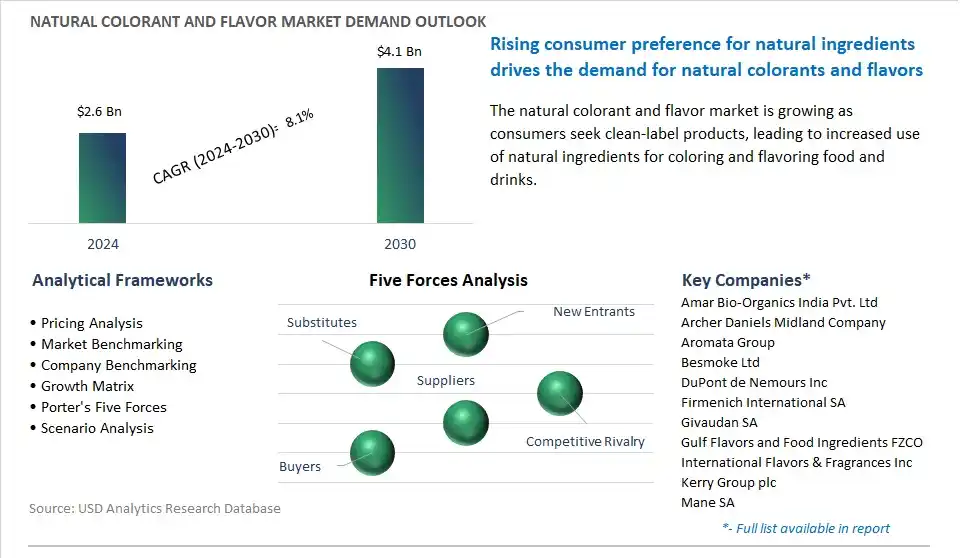
The market report analyses the leading companies in the industry including Amar Bio-Organics India Pvt. Ltd, Archer Daniels Midland Company, Aromata Group, Besmoke Ltd, DuPont de Nemours Inc, Firmenich International SA, Givaudan SA, Gulf Flavors and Food Ingredients FZCO, International Flavors & Fragrances Inc, Kerry Group plc, Mane SA, Robertet SA, Seluz Fragrances & Flavors Company, Sensient Technologies Corp, Symrise AG, Synergy Flavors Inc, T. Hasegawa Co. Ltd, Taiyo International Inc, Takasago International Corp, The Foodie Flavours Ltd.
A significant trend in the natural colorant and flavor market is the growing preference for natural and clean label products. Consumers are increasingly seeking food and beverage products made with natural ingredients, including colorants and flavors derived from plant, fruit, and vegetable sources. This trend is driven by health-conscious consumer preferences, concerns about artificial additives and synthetic chemicals, and the desire for transparency in food labeling. Manufacturers are responding to this demand by replacing artificial colorants and flavors with natural alternatives to create clean label products. As a result, there's a growing market for natural colorants and flavors in various food and beverage segments, including confectionery, beverages, dairy, and snacks. The emphasis on natural ingredients and clean label formulations is expected to continue driving the demand for natural colorants and flavors in the food industry.
A major driver of the natural colorant and flavor market is regulatory restrictions on synthetic additives and food safety concerns. Regulatory agencies worldwide are implementing stricter regulations and guidelines on the use of synthetic colorants and flavors in food and beverage products due to health and safety considerations. Concerns about adverse health effects, allergic reactions, and potential toxicity associated with artificial additives have prompted governments to impose limits or bans on certain synthetic ingredients. As a result, food manufacturers are seeking natural alternatives to synthetic colorants and flavors to comply with regulations and address consumer demand for safer and healthier products. This regulatory environment drives the adoption of natural colorants and flavors as preferred ingredients in food and beverage formulations, creating opportunities for suppliers and manufacturers to innovate and offer clean label solutions that meet regulatory requirements and consumer expectations.
An opportunity within the natural colorant and flavor market lies in expansion into functional and nutraceutical applications. Beyond traditional food and beverage products, natural colorants and flavors are increasingly being used in functional foods, dietary supplements, and nutraceuticals to enhance nutritional value, sensory appeal, and consumer acceptance. For example, natural colorants derived from fruits and vegetables are used to impart vibrant hues to health-oriented products such as nutritional bars, protein powders, and dietary supplements. Similarly, natural flavors extracted from herbs, spices, and botanicals are incorporated into functional beverages, probiotics, and fortified foods to improve taste and aroma profiles while offering health benefits. By capitalizing on the growing demand for functional and nutraceutical products, manufacturers of natural colorants and flavors can expand their market reach, diversify their product portfolios, and address emerging consumer trends in the health and wellness sector. Investing in research and development to identify novel applications and value-added formulations offers an opportunity to unlock new revenue streams and drive growth in the evolving landscape of natural ingredients.
The largest segment in the Natural Colorant and Flavor Market is Plant-derived Pigments. The market growth is driven by the widespread availability and diverse range of plant sources that contain natural pigments suitable for coloring food and beverages. Plant-derived pigments include anthocyanins, carotenoids, betalains, and chlorophyll, among others, which impart vibrant colors ranging from reds, oranges, and yellows to greens and blues. Consumers increasingly prefer plant-derived pigments over synthetic alternatives due to their natural origin, perceived health benefits, and cleaner labeling. Furthermore, plant-derived pigments offer versatility in application, enabling manufacturers to create a wide spectrum of colors while meeting consumer preferences for natural and sustainable ingredients. With growing consumer awareness of health and wellness, coupled with regulatory initiatives promoting clean-label products, the demand for plant-derived pigments is expected to continue rising, driving the growth of this segment in the Natural Colorant and Flavor Market.
The fastest-growing segment in the Natural Colorant and Flavor Market is Confectionery. This is driving demand within this sector. Confectionery products, including candies, chocolates, gums, and snacks, rely heavily on appealing colors and flavors to attract consumers. As consumers increasingly seek healthier and more natural alternatives, there is a growing demand for confectionery products formulated with natural colorants and flavors derived from plant and fruit extracts, spices, and herbs. Natural colorants provide vibrant hues to confectionery items without the use of synthetic dyes, addressing concerns related to artificial additives and food safety. Additionally, natural flavors enhance the taste and aroma of confectionery products, aligning with consumer preferences for clean-label and minimally processed foods. Manufacturers are responding to this trend by reformulating their confectionery offerings with natural ingredients, leading to a surge in demand for natural colorants and flavors in the Confectionery segment. As the demand for healthier and more natural confectionery options continues to rise, the Confectionery segment is poised for significant growth in the Natural Colorant and Flavor Market.
By Type
Animal-derived Pigment
Plant-derived Pigments
Chlorophyll
Polyphenols
Others
By Application
Beverages
Bakery
Confectionery
Dairy & frozen
Meat products
Others
Regions Included
North America (US, Canada, Mexico)
Europe (Germany, UK, France, Spain, Italy, Russia, Rest of Europe)
Asia Pacific (China, India, Japan, South Korea, Australia, South East Asia, Rest of Asia)
South America (Brazil, Argentina, Rest of South America)
Middle East and Africa (Saudi Arabia, UAE, Rest of Middle East, South Africa, Egypt, Rest of Africa)
Amar Bio-Organics India Pvt. Ltd
Archer Daniels Midland Company
Aromata Group
Besmoke Ltd
DuPont de Nemours Inc
Firmenich International SA
Givaudan SA
Gulf Flavors and Food Ingredients FZCO
International Flavors & Fragrances Inc
Kerry Group plc
Mane SA
Robertet SA
Seluz Fragrances & Flavors Company
Sensient Technologies Corp
Symrise AG
Synergy Flavors Inc
T. Hasegawa Co. Ltd
Taiyo International Inc
Takasago International Corp
The Foodie Flavours Ltd
*- List Not Exhaustive
TABLE OF CONTENTS
1 Introduction to 2024 Natural Colorant and Flavor Market
1.1 Market Overview
1.2 Quick Facts
1.3 Scope/Objective of the Study
1.4 Market Definition
1.5 Countries and Regions Covered
1.6 Units, Currency, and Conversions
1.7 Industry Value Chain
2 Research Methodology
2.1 Market Size Estimation
2.2 Sources and Research Methodology
2.3 Data Triangulation
2.4 Assumptions and Limitations
3 Executive Summary
3.1 Global Natural Colorant and Flavor Market Size Outlook, $ Million, 2021 to 2030
3.2 Natural Colorant and Flavor Market Outlook by Type, $ Million, 2021 to 2030
3.3 Natural Colorant and Flavor Market Outlook by Product, $ Million, 2021 to 2030
3.4 Natural Colorant and Flavor Market Outlook by Application, $ Million, 2021 to 2030
3.5 Natural Colorant and Flavor Market Outlook by Key Countries, $ Million, 2021 to 2030
4 Market Dynamics
4.1 Key Driving Forces of Natural Colorant and Flavor Industry
4.2 Key Market Trends in Natural Colorant and Flavor Industry
4.3 Potential Opportunities in Natural Colorant and Flavor Industry
4.4 Key Challenges in Natural Colorant and Flavor Industry
5 Market Factor Analysis
5.1 Value Chain Analysis
5.2 Competitive Landscape
5.2.1 Global Natural Colorant and Flavor Market Share by Company (%), 2023
5.2.2 Product Offerings by Company
5.3 Porter’s Five Forces Analysis
5.4 Pricing Analysis and Outlook
6 Growth Outlook Across Scenarios
6.1 Growth Analysis-Case Scenario Definitions
6.2 Low Growth Scenario Forecasts
6.3 Reference Growth Scenario Forecasts
6.4 High Growth Scenario Forecasts
7 Global Natural Colorant and Flavor Market Outlook by Segments
7.1 Natural Colorant and Flavor Market Outlook by Segments, $ Million, 2021- 2030
By Type
Animal-derived Pigment
Plant-derived Pigments
Chlorophyll
Polyphenols
Others
By Application
Beverages
Bakery
Confectionery
Dairy & frozen
Meat products
Others
8 North America Natural Colorant and Flavor Market Analysis and Outlook To 2030
8.1 Introduction to North America Natural Colorant and Flavor Markets in 2024
8.2 North America Natural Colorant and Flavor Market Size Outlook by Country, 2021-2030
8.2.1 United States
8.2.2 Canada
8.2.3 Mexico
8.3 North America Natural Colorant and Flavor Market size Outlook by Segments, 2021-2030
By Type
Animal-derived Pigment
Plant-derived Pigments
Chlorophyll
Polyphenols
Others
By Application
Beverages
Bakery
Confectionery
Dairy & frozen
Meat products
Others
9 Europe Natural Colorant and Flavor Market Analysis and Outlook To 2030
9.1 Introduction to Europe Natural Colorant and Flavor Markets in 2024
9.2 Europe Natural Colorant and Flavor Market Size Outlook by Country, 2021-2030
9.2.1 Germany
9.2.2 France
9.2.3 Spain
9.2.4 United Kingdom
9.2.4 Italy
9.2.5 Russia
9.2.6 Norway
9.2.7 Rest of Europe
9.3 Europe Natural Colorant and Flavor Market Size Outlook by Segments, 2021-2030
By Type
Animal-derived Pigment
Plant-derived Pigments
Chlorophyll
Polyphenols
Others
By Application
Beverages
Bakery
Confectionery
Dairy & frozen
Meat products
Others
10 Asia Pacific Natural Colorant and Flavor Market Analysis and Outlook To 2030
10.1 Introduction to Asia Pacific Natural Colorant and Flavor Markets in 2024
10.2 Asia Pacific Natural Colorant and Flavor Market Size Outlook by Country, 2021-2030
10.2.1 China
10.2.2 India
10.2.3 Japan
10.2.4 South Korea
10.2.5 Indonesia
10.2.6 Malaysia
10.2.7 Australia
10.2.8 Rest of Asia Pacific
10.3 Asia Pacific Natural Colorant and Flavor Market size Outlook by Segments, 2021-2030
By Type
Animal-derived Pigment
Plant-derived Pigments
Chlorophyll
Polyphenols
Others
By Application
Beverages
Bakery
Confectionery
Dairy & frozen
Meat products
Others
11 South America Natural Colorant and Flavor Market Analysis and Outlook To 2030
11.1 Introduction to South America Natural Colorant and Flavor Markets in 2024
11.2 South America Natural Colorant and Flavor Market Size Outlook by Country, 2021-2030
11.2.1 Brazil
11.2.2 Argentina
11.2.3 Rest of South America
11.3 South America Natural Colorant and Flavor Market size Outlook by Segments, 2021-2030
By Type
Animal-derived Pigment
Plant-derived Pigments
Chlorophyll
Polyphenols
Others
By Application
Beverages
Bakery
Confectionery
Dairy & frozen
Meat products
Others
12 Middle East and Africa Natural Colorant and Flavor Market Analysis and Outlook To 2030
12.1 Introduction to Middle East and Africa Natural Colorant and Flavor Markets in 2024
12.2 Middle East and Africa Natural Colorant and Flavor Market Size Outlook by Country, 2021-2030
12.2.1 Saudi Arabia
12.2.2 UAE
12.2.3 Oman
12.2.4 Rest of Middle East
12.2.5 Egypt
12.2.6 Nigeria
12.2.7 South Africa
12.2.8 Rest of Africa
12.3 Middle East and Africa Natural Colorant and Flavor Market size Outlook by Segments, 2021-2030
By Type
Animal-derived Pigment
Plant-derived Pigments
Chlorophyll
Polyphenols
Others
By Application
Beverages
Bakery
Confectionery
Dairy & frozen
Meat products
Others
13 Company Profiles
13.1 Company Snapshot
13.2 SWOT Profiles
13.3 Products and Services
13.4 Recent Developments
13.5 Financial Profile
Amar Bio-Organics India Pvt. Ltd
Archer Daniels Midland Company
Aromata Group
Besmoke Ltd
DuPont de Nemours Inc
Firmenich International SA
Givaudan SA
Gulf Flavors and Food Ingredients FZCO
International Flavors & Fragrances Inc
Kerry Group plc
Mane SA
Robertet SA
Seluz Fragrances & Flavors Company
Sensient Technologies Corp
Symrise AG
Synergy Flavors Inc
T. Hasegawa Co. Ltd
Taiyo International Inc
Takasago International Corp
The Foodie Flavours Ltd
14 Appendix
14.1 Customization Offerings
14.2 Subscription Services
14.3 Related Reports
14.4 Publisher Expertise
By Type
Animal-derived Pigment
Plant-derived Pigments
Chlorophyll
Polyphenols
Others
By Application
Beverages
Bakery
Confectionery
Dairy & frozen
Meat products
Others
Countries Analyzed
North America (US, Canada, Mexico)
Europe (Germany, UK, France, Spain, Italy, Russia, Rest of Europe)
Asia Pacific (China, India, Japan, South Korea, Australia, South East Asia, Rest of Asia)
South America (Brazil, Argentina, Rest of South America)
Middle East and Africa (Saudi Arabia, UAE, Rest of Middle East, South Africa, Egypt, Rest of Africa)
Global Natural Colorant and Flavor is forecast to reach $4.1 Billion in 2030 from $2.6 Billion in 2024, registering a CAGR of 8.1%
Emerging Markets across Asia Pacific, Europe, and Americas present robust growth prospects.
Amar Bio-Organics India Pvt. Ltd, Archer Daniels Midland Company, Aromata Group, Besmoke Ltd, DuPont de Nemours Inc, Firmenich International SA, Givaudan SA, Gulf Flavors and Food Ingredients FZCO, International Flavors & Fragrances Inc, Kerry Group plc, Mane SA, Robertet SA, Seluz Fragrances & Flavors Company, Sensient Technologies Corp, Symrise AG, Synergy Flavors Inc, T. Hasegawa Co. Ltd, Taiyo International Inc, Takasago International Corp, The Foodie Flavours Ltd
Base Year- 2023; Estimated Year- 2024; Historic Period- 2018-2023; Forecast period- 2024 to 2030; Currency: Revenue (USD); Volume