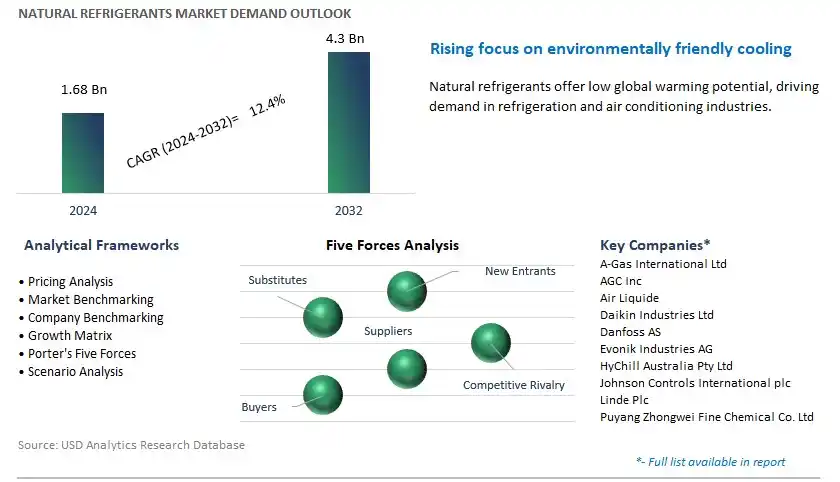
Global Natural Refrigerants Market Size is valued at $1.68 Billion in 2024 and is forecast to register a growth rate (CAGR) of 12.4% to reach $4.3 Billion by 2032.
The global Natural Refrigerants Market Study analyzes and forecasts the market size across 6 regions and 24 countries for diverse segments -By Type (Ammonia, Hydrocarbons, Carbon Dioxide), By Application (Industrial Refrigeration, Commercial Refrigeration, Domestic Refrigeration, Stationary Air-Conditioning, Mobile Air-Conditioning).
An Introduction to Natural Refrigerants Market in 2024
Natural refrigerants, such as carbon dioxide (CO2), ammonia (NH3), and hydrocarbons (e.g., propane, isobutane), offer environmentally friendly alternatives to synthetic refrigerants such as chlorofluorocarbons (CFCs) and hydrochlorofluorocarbons (HCFCs), which contribute to ozone depletion and global warming. In 2024, the market for natural refrigerants s to expand as governments worldwide implement regulations to phase out ozone-depleting substances and reduce greenhouse gas emissions from refrigeration and air conditioning systems. Natural refrigerants are characterized by their low global warming potential (GWP) and zero ozone depletion potential (ODP), making them attractive options for sustainable cooling applications. They are used in various refrigeration and air conditioning systems, including commercial refrigeration units, heat pumps, and automotive air conditioners. Market trends include the development of energy-efficient systems optimized for natural refrigerants, the adoption of natural refrigerants in new construction and retrofit projects, and advancements in safety standards and training programs to ensure proper handling and management of natural refrigerants in different applications.
Natural Refrigerants Market Competitive Landscape
The market report analyses the leading companies in the industry including A-Gas International Ltd, AGC Inc, Air Liquide, Daikin Industries Ltd, Danfoss AS, Evonik Industries AG, HyChill Australia Pty Ltd, Johnson Controls International plc, Linde Plc, Puyang Zhongwei Fine Chemical Co. Ltd, and others.
Natural Refrigerants Market Dynamics
Market Trend: Transition Towards Environmentally Friendly Cooling Solutions
A notable market trend in natural refrigerants is the transition towards environmentally friendly cooling solutions across various industries. With growing concerns about climate change and the phase-out of synthetic refrigerants like hydrochlorofluorocarbons (HCFCs) and hydrofluorocarbons (HFCs) due to their high global warming potential (GWP), there is a significant shift towards natural alternatives. Natural refrigerants such as ammonia, carbon dioxide (CO2), hydrocarbons (propane, isobutane), and water offer sustainable and energy-efficient options for refrigeration and air conditioning systems. Industries including food retail, cold chain logistics, HVAC, and automotive are increasingly adopting natural refrigerants to comply with regulatory requirements, reduce greenhouse gas emissions, and mitigate environmental impact, thereby driving market growth.
Market Driver: Regulatory Mandates and Emission Reduction Targets
A key driver for the natural refrigerants market is regulatory mandates and emission reduction targets set by governments and international organizations. Regulations such as the Montreal Protocol and the Kigali Amendment aim to phase out ozone-depleting substances and high-GWP refrigerants, leading to stricter regulations on the use and production of synthetic refrigerants. In response, industries are transitioning to natural refrigerants to comply with regulatory mandates and avoid penalties. Additionally, initiatives aimed at reducing carbon emissions and achieving sustainability goals are driving the adoption of natural refrigerants as part of broader efforts to address climate change. The need for compliance with regulatory requirements and emission reduction targets is thus propelling the demand for natural refrigerants, creating opportunities for manufacturers, suppliers, and service providers in the refrigeration and cooling industry.
Market Opportunity: Expansion in Emerging Economies and Developing Regions
A significant market opportunity for natural refrigerants lies in their expansion into emerging economies and developing regions. As these regions experience rapid urbanization, industrialization, and rising demand for refrigeration and air conditioning systems, there is a growing need for sustainable and energy-efficient cooling solutions. Natural refrigerants offer a viable alternative to synthetic refrigerants in these markets, providing cost-effective and environmentally friendly options for cooling applications. By leveraging the opportunity presented by the growing demand for natural refrigerants in emerging economies, companies can expand their market presence, establish strategic partnerships, and capitalize on the transition towards sustainable cooling technologies. Collaborations with local governments, industry associations, and technology providers can facilitate knowledge transfer, capacity building, and market development efforts, unlocking new opportunities for growth and market penetration in emerging economies.
Natural Refrigerants Market Share Analysis: Ammonia segment generated the highest revenue in 2024
Among the types in the Natural Refrigerants Market, Ammonia is the largest segment. The large revenue share is driven by ammonia a preferred refrigerant in various applications. Ammonia, also known as R-717, is a highly efficient and cost-effective refrigerant with excellent thermodynamic properties, including high heat transfer coefficient and low boiling point. It has been widely used in industrial refrigeration, cold storage, and food processing facilities for decades due to its superior performance and low environmental impact. Moreover, ammonia is non-toxic and non-flammable, making it a safe choice for large-scale refrigeration systems. Additionally, as industries and governments increasingly prioritize environmentally friendly refrigeration solutions to mitigate climate change and ozone depletion, the demand for ammonia as a natural refrigerant continues to grow. Its proven track record of reliability, efficiency, and environmental sustainability solidifies its position as the largest segment in the Natural Refrigerants Market.
Natural Refrigerants Market Share Analysis: Stationary Air-Conditioning segment generated the highest revenue in 2024
Within the Natural Refrigerants Market, the Stationary Air-Conditioning segment is experiencing rapid growth, surpassing other applications. This accelerated growth is driven by the demand for natural refrigerants in stationary air-conditioning systems. With increasing concerns over climate change and environmental sustainability, there is a growing shift towards eco-friendly refrigerants that have low global warming potential (GWP) and zero ozone depletion potential (ODP). Natural refrigerants such as hydrocarbons (e.g., propane, isobutane) and carbon dioxide are gaining traction as alternatives to synthetic refrigerants in stationary air-conditioning applications. These natural refrigerants offer superior thermodynamic properties, energy efficiency, and environmental compatibility compared to conventional options like hydrofluorocarbons (HFCs) and chlorofluorocarbons (CFCs). Moreover, regulatory initiatives and policies aimed at phasing out high-GWP refrigerants further drive the adoption of natural refrigerants in stationary air-conditioning systems. As manufacturers and consumers alike prioritize sustainable cooling solutions, the Stationary Air-Conditioning segment of the Natural Refrigerants Market is poised for significant growth, driving innovation and market expansion in the refrigeration and air-conditioning industry.
Natural Refrigerants Market
By Type
Ammonia
Hydrocarbons
Carbon Dioxide
By Application
Industrial Refrigeration
Commercial Refrigeration
Domestic Refrigeration
Stationary Air-Conditioning
Mobile Air-ConditioningCountries Analyzed
North America (US, Canada, Mexico)
Europe (Germany, UK, France, Spain, Italy, Russia, Rest of Europe)
Asia Pacific (China, India, Japan, South Korea, Australia, South East Asia, Rest of Asia)
South America (Brazil, Argentina, Rest of South America)
Middle East and Africa (Saudi Arabia, UAE, Rest of Middle East, South Africa, Egypt, Rest of Africa)
Natural Refrigerants Companies Profiled in the Study
A-Gas International Ltd
AGC Inc
Air Liquide
Daikin Industries Ltd
Danfoss AS
Evonik Industries AG
HyChill Australia Pty Ltd
Johnson Controls International plc
Linde Plc
Puyang Zhongwei Fine Chemical Co. Ltd
*- List Not Exhaustive
TABLE OF CONTENTS
1 Introduction to 2024 Natural Refrigerants Market
1.1 Market Overview
1.2 Quick Facts
1.3 Scope/Objective of the Study
1.4 Market Definition
1.5 Countries and Regions Covered
1.6 Units, Currency, and Conversions
1.7 Industry Value Chain
2 Research Methodology
2.1 Market Size Estimation
2.2 Sources and Research Methodology
2.3 Data Triangulation
2.4 Assumptions and Limitations
3 Executive Summary
3.1 Global Natural Refrigerants Market Size Outlook, $ Million, 2021 to 2032
3.2 Natural Refrigerants Market Outlook by Type, $ Million, 2021 to 2032
3.3 Natural Refrigerants Market Outlook by Product, $ Million, 2021 to 2032
3.4 Natural Refrigerants Market Outlook by Application, $ Million, 2021 to 2032
3.5 Natural Refrigerants Market Outlook by Key Countries, $ Million, 2021 to 2032
4 Market Dynamics
4.1 Key Driving Forces of Natural Refrigerants Industry
4.2 Key Market Trends in Natural Refrigerants Industry
4.3 Potential Opportunities in Natural Refrigerants Industry
4.4 Key Challenges in Natural Refrigerants Industry
5 Market Factor Analysis
5.1 Value Chain Analysis
5.2 Competitive Landscape
5.2.1 Global Natural Refrigerants Market Share by Company (%), 2023
5.2.2 Product Offerings by Company
5.3 Porter’s Five Forces Analysis
5.4 Pricing Analysis and Outlook
6 Growth Outlook Across Scenarios
6.1 Growth Analysis-Case Scenario Definitions
6.2 Low Growth Scenario Forecasts
6.3 Reference Growth Scenario Forecasts
6.4 High Growth Scenario Forecasts
7 Global Natural Refrigerants Market Outlook by Segments
7.1 Natural Refrigerants Market Outlook by Segments, $ Million, 2021- 2032
By Type
Ammonia
Hydrocarbons
Carbon Dioxide
By Application
Industrial Refrigeration
Commercial Refrigeration
Domestic Refrigeration
Stationary Air-Conditioning
Mobile Air-Conditioning
8 North America Natural Refrigerants Market Analysis and Outlook To 2032
8.1 Introduction to North America Natural Refrigerants Markets in 2024
8.2 North America Natural Refrigerants Market Size Outlook by Country, 2021-2032
8.2.1 United States
8.2.2 Canada
8.2.3 Mexico
8.3 North America Natural Refrigerants Market size Outlook by Segments, 2021-2032
By Type
Ammonia
Hydrocarbons
Carbon Dioxide
By Application
Industrial Refrigeration
Commercial Refrigeration
Domestic Refrigeration
Stationary Air-Conditioning
Mobile Air-Conditioning
9 Europe Natural Refrigerants Market Analysis and Outlook To 2032
9.1 Introduction to Europe Natural Refrigerants Markets in 2024
9.2 Europe Natural Refrigerants Market Size Outlook by Country, 2021-2032
9.2.1 Germany
9.2.2 France
9.2.3 Spain
9.2.4 United Kingdom
9.2.4 Italy
9.2.5 Russia
9.2.6 Norway
9.2.7 Rest of Europe
9.3 Europe Natural Refrigerants Market Size Outlook by Segments, 2021-2032
By Type
Ammonia
Hydrocarbons
Carbon Dioxide
By Application
Industrial Refrigeration
Commercial Refrigeration
Domestic Refrigeration
Stationary Air-Conditioning
Mobile Air-Conditioning
10 Asia Pacific Natural Refrigerants Market Analysis and Outlook To 2032
10.1 Introduction to Asia Pacific Natural Refrigerants Markets in 2024
10.2 Asia Pacific Natural Refrigerants Market Size Outlook by Country, 2021-2032
10.2.1 China
10.2.2 India
10.2.3 Japan
10.2.4 South Korea
10.2.5 Indonesia
10.2.6 Malaysia
10.2.7 Australia
10.2.8 Rest of Asia Pacific
10.3 Asia Pacific Natural Refrigerants Market size Outlook by Segments, 2021-2032
By Type
Ammonia
Hydrocarbons
Carbon Dioxide
By Application
Industrial Refrigeration
Commercial Refrigeration
Domestic Refrigeration
Stationary Air-Conditioning
Mobile Air-Conditioning
11 South America Natural Refrigerants Market Analysis and Outlook To 2032
11.1 Introduction to South America Natural Refrigerants Markets in 2024
11.2 South America Natural Refrigerants Market Size Outlook by Country, 2021-2032
11.2.1 Brazil
11.2.2 Argentina
11.2.3 Rest of South America
11.3 South America Natural Refrigerants Market size Outlook by Segments, 2021-2032
By Type
Ammonia
Hydrocarbons
Carbon Dioxide
By Application
Industrial Refrigeration
Commercial Refrigeration
Domestic Refrigeration
Stationary Air-Conditioning
Mobile Air-Conditioning
12 Middle East and Africa Natural Refrigerants Market Analysis and Outlook To 2032
12.1 Introduction to Middle East and Africa Natural Refrigerants Markets in 2024
12.2 Middle East and Africa Natural Refrigerants Market Size Outlook by Country, 2021-2032
12.2.1 Saudi Arabia
12.2.2 UAE
12.2.3 Oman
12.2.4 Rest of Middle East
12.2.5 Egypt
12.2.6 Nigeria
12.2.7 South Africa
12.2.8 Rest of Africa
12.3 Middle East and Africa Natural Refrigerants Market size Outlook by Segments, 2021-2032
By Type
Ammonia
Hydrocarbons
Carbon Dioxide
By Application
Industrial Refrigeration
Commercial Refrigeration
Domestic Refrigeration
Stationary Air-Conditioning
Mobile Air-Conditioning
13 Company Profiles
13.1 Company Snapshot
13.2 SWOT Profiles
13.3 Products and Services
13.4 Recent Developments
13.5 Financial Profile
A-Gas International Ltd
AGC Inc
Air Liquide
Daikin Industries Ltd
Danfoss AS
Evonik Industries AG
HyChill Australia Pty Ltd
Johnson Controls International plc
Linde Plc
Puyang Zhongwei Fine Chemical Co. Ltd
14 Appendix
14.1 Customization Offerings
14.2 Subscription Services
14.3 Related Reports
14.4 Publisher Expertise
By Type
Ammonia
Hydrocarbons
Carbon Dioxide
By Application
Industrial Refrigeration
Commercial Refrigeration
Domestic Refrigeration
Stationary Air-Conditioning
Mobile Air-Conditioning
Countries Analyzed
North America (US, Canada, Mexico)
Europe (Germany, UK, France, Spain, Italy, Russia, Rest of Europe)
Asia Pacific (China, India, Japan, South Korea, Australia, South East Asia, Rest of Asia)
South America (Brazil, Argentina, Rest of South America)
Middle East and Africa (Saudi Arabia, UAE, Rest of Middle East, South Africa, Egypt, Rest of Africa)
