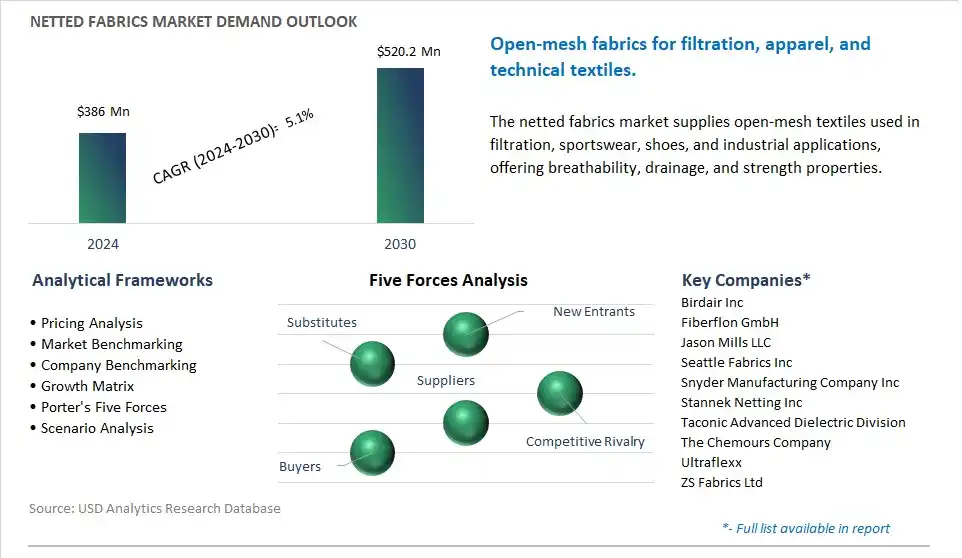
The global Netted Fabrics Market is poised to register a 5.1% CAGR from $386 Million in 2024 to $520.2 Million in 2030.
The global Netted Fabrics Market Study analyzes and forecasts the market size across 6 regions and 24 countries for diverse segments -By Material (Nylon, Polyester, Others), By Product (Tulle, Fishnet, Others), By Application (Clothing, Utility).
An Introduction to Global Netted Fabrics Market in 2024
The market for netted fabrics is experiencing significant growth driven by their versatile applications across various industries including apparel, sports and recreation, automotive, and agriculture. Key trends shaping the future of this industry include the increasing demand for lightweight, breathable, and durable fabrics for activewear, swimwear, lingerie, and technical textiles, driving the adoption of netted fabrics for their unique properties such as ventilation, moisture management, and stretchability. Additionally, advancements in knitting and weaving technologies are enabling the production of netted fabrics with customized designs, patterns, and functionalities, catering to evolving consumer preferences and market trends. With the rising popularity of sustainable and eco-friendly materials, netted fabrics made from recycled fibers, organic cotton, and biodegradable polymers are gaining traction, offering benefits such as reduced environmental impact and improved circularity. Furthermore, the growing use of netted fabrics in automotive seating, interior trims, and safety components for their lightweight, breathable, and aesthetic properties is driving market expansion, as automakers seek innovative solutions to enhance comfort, performance, and design appeal. As consumer lifestyles and preferences continue to evolve, the netted fabrics market is poised for sustained growth, offering opportunities for product innovation, market diversification, and collaboration across industries.
Netted Fabrics Market Competitive Landscape
The market report analyses the leading companies in the industry including Birdair Inc, Fiberflon GmbH, Jason Mills LLC, Seattle Fabrics Inc, Snyder Manufacturing Company Inc, Stannek Netting Inc, Taconic Advanced Dielectric Division, The Chemours Company, Ultraflexx, ZS Fabrics Ltd.
Netted Fabrics Market Dynamics
Netted Fabrics Market Trend: Increasing Demand for Lightweight and Breathable Textiles
A prominent trend in the netted fabrics market is the increasing demand for lightweight and breathable textiles across various industries. Netted fabrics, known for their open weave structure and air permeability, are experiencing growing popularity in apparel, sports equipment, automotive interiors, and outdoor furniture applications. Consumers are seeking comfortable and functional textiles that offer breathability, moisture-wicking properties, and enhanced ventilation, particularly in warm climates or during physical activities. The trend towards lightweight and breathable fabrics is driving the adoption of netted fabrics as a versatile solution for achieving comfort and performance in diverse end-use applications.
Netted Fabrics Market Driver: Growth in Active Lifestyle and Sportswear Market
A key driver propelling the netted fabrics market is the growth in the active lifestyle and sportswear segment. With increasing health consciousness and participation in sports and fitness activities, there is a rising demand for performance-oriented textiles that offer comfort, flexibility, and moisture management properties. Netted fabrics, with their ability to provide ventilation and airflow, are well-suited for activewear, sportswear, and athleisure garments, catering to the needs of consumers engaged in various physical pursuits. As the athleisure trend continues to gain momentum and sportswear becomes a mainstream fashion choice, the demand for netted fabrics in this market segment is expected to expand further.
Netted Fabrics Market Opportunity: Innovation in Technical and Functional Applications
An opportunity in the netted fabrics market lies in the innovation and development of technical and functional applications to meet evolving consumer preferences and industry requirements. Netted fabrics offer inherent properties such as flexibility, lightweight construction, and breathability, making them ideal candidates for integration into advanced textile solutions. By leveraging technological advancements in yarn engineering, fabric finishing, and additive manufacturing, manufacturers can enhance the performance attributes of netted fabrics, such as durability, UV resistance, antibacterial properties, and flame retardancy, opening up new opportunities in sectors such as protective clothing, medical textiles, automotive interiors, and architectural shading systems. This presents a pathway for differentiation and value creation in the netted fabrics market through the introduction of innovative products that address specific performance needs and market niches.
Netted Fabrics Market Share Analysis: Polyester generated the highest revenue in 2024
The largest segment in the Netted Fabrics Market is the Polyester segment. Polyester is widely used in the production of netted fabrics due to its favorable properties and versatility. Polyester offers potential advantages for netted fabric applications, including high strength, durability, abrasion resistance, and dimensional stability. Further, polyester netted fabrics exhibit excellent resistance to moisture, chemicals, and UV radiation, making them suitable for outdoor and high-performance applications such as sportswear, outdoor furniture, and automotive upholstery. Additionally, polyester is relatively easy to dye, allowing for a wide range of color options and designs in netted fabric products. The widespread availability and cost-effectiveness of polyester further contribute to its dominance in the netted fabrics market. Hence, the Polyester segment is the largest in the Netted Fabrics Market, driven by its superior properties, versatility, and extensive applications across various industries.
Netted Fabrics Market Share Analysis: Fishnet segment is poised to register the fastest growth rate (CAGR) over the forecast period to 2030
The Fishnet segment is the fastest-growing segment in the Netted Fabrics Market. Fishnet fabrics, characterized by their open and grid-like structure, are experiencing a surge in demand across various industries, including fashion, sports, and home decor. In the fashion industry, fishnet fabrics have gained popularity as stylish and versatile materials for apparel, including tops, dresses, and accessories. The unique texture and visual appeal of fishnet fabrics adds a trendy and edgy aesthetic to clothing designs, appealing to a wide range of consumers, especially millennials and Gen Z. Further, fishnet fabrics are lightweight, breathable, and stretchable, offering comfort and ease of movement, which are highly valued in activewear and athleisure markets. Additionally, fishnet fabrics are finding applications in home decor and interior design, where they are used for curtains, upholstery, and decorative accents to create modern and contemporary living spaces. The growing adoption of fishnet fabrics in diverse end-use applications, coupled with evolving fashion trends and consumer preferences, is driving the rapid growth of the Fishnet segment in the Netted Fabrics Market.
Netted Fabrics Market Share Analysis: The clothing segment is poised to register the fastest growth rate (CAGR) over the forecast period to 2030
The Clothing segment is the fastest-growing segment in the Netted Fabrics Market. Netted fabrics, characterized by their open and breathable structure, are experiencing a surge in demand in the fashion industry for clothing applications. These fabrics offer unique aesthetic appeal and versatility, making them popular choices for a wide range of apparel, including tops, dresses, skirts, and swimwear. In particular, netted fabrics such as tulle and fishnet have become increasingly fashionable, with designers incorporating them into their collections to create trendy and edgy looks. The lightweight and airy nature of netted fabrics provides comfort and freedom of movement, making them ideal for warm weather and active lifestyles. Further, the rise of athleisure and streetwear trends has further propelled the demand for netted fabrics in clothing, as consumers seek stylish yet functional garments suitable for both casual and performance-oriented activities. The growing popularity of netted fabrics in clothing applications, driven by evolving fashion trends and consumer preferences for breathable and statement-making apparel, is driving the rapid growth of the Clothing segment in the Netted Fabrics Market.
Netted Fabrics Market Report Segmentation
By Material
Nylon
Polyester
Others
By Product
Tulle
Fishnet
Others
By Application
Clothing
Utility
Regions Included
North America (US, Canada, Mexico)
Europe (Germany, UK, France, Spain, Italy, Russia, Rest of Europe)
Asia Pacific (China, India, Japan, South Korea, Australia, South East Asia, Rest of Asia)
South America (Brazil, Argentina, Rest of South America)
Middle East and Africa (Saudi Arabia, UAE, Rest of Middle East, South Africa, Egypt, Rest of Africa)
Netted Fabrics Companies Profiled in the Market Study
Birdair Inc
Fiberflon GmbH
Jason Mills LLC
Seattle Fabrics Inc
Snyder Manufacturing Company Inc
Stannek Netting Inc
Taconic Advanced Dielectric Division
The Chemours Company
Ultraflexx
ZS Fabrics Ltd
*- List Not Exhaustive
TABLE OF CONTENTS
1 Introduction to 2024 Netted Fabrics Market
1.1 Market Overview
1.2 Quick Facts
1.3 Scope/Objective of the Study
1.4 Market Definition
1.5 Countries and Regions Covered
1.6 Units, Currency, and Conversions
1.7 Industry Value Chain
2 Research Methodology
2.1 Market Size Estimation
2.2 Sources and Research Methodology
2.3 Data Triangulation
2.4 Assumptions and Limitations
3 Executive Summary
3.1 Global Netted Fabrics Market Size Outlook, $ Million, 2021 to 2030
3.2 Netted Fabrics Market Outlook by Type, $ Million, 2021 to 2030
3.3 Netted Fabrics Market Outlook by Product, $ Million, 2021 to 2030
3.4 Netted Fabrics Market Outlook by Application, $ Million, 2021 to 2030
3.5 Netted Fabrics Market Outlook by Key Countries, $ Million, 2021 to 2030
4 Market Dynamics
4.1 Key Driving Forces of Netted Fabrics Industry
4.2 Key Market Trends in Netted Fabrics Industry
4.3 Potential Opportunities in Netted Fabrics Industry
4.4 Key Challenges in Netted Fabrics Industry
5 Market Factor Analysis
5.1 Value Chain Analysis
5.2 Competitive Landscape
5.2.1 Global Netted Fabrics Market Share by Company (%), 2023
5.2.2 Product Offerings by Company
5.3 Porter’s Five Forces Analysis
5.4 Pricing Analysis and Outlook
6 Growth Outlook Across Scenarios
6.1 Growth Analysis-Case Scenario Definitions
6.2 Low Growth Scenario Forecasts
6.3 Reference Growth Scenario Forecasts
6.4 High Growth Scenario Forecasts
7 Global Netted Fabrics Market Outlook by Segments
7.1 Netted Fabrics Market Outlook by Segments, $ Million, 2021- 2030
By Material
Nylon
Polyester
Others
By Product
Tulle
Fishnet
Others
By Application
Clothing
Utility
8 North America Netted Fabrics Market Analysis and Outlook To 2030
8.1 Introduction to North America Netted Fabrics Markets in 2024
8.2 North America Netted Fabrics Market Size Outlook by Country, 2021-2030
8.2.1 United States
8.2.2 Canada
8.2.3 Mexico
8.3 North America Netted Fabrics Market size Outlook by Segments, 2021-2030
By Material
Nylon
Polyester
Others
By Product
Tulle
Fishnet
Others
By Application
Clothing
Utility
9 Europe Netted Fabrics Market Analysis and Outlook To 2030
9.1 Introduction to Europe Netted Fabrics Markets in 2024
9.2 Europe Netted Fabrics Market Size Outlook by Country, 2021-2030
9.2.1 Germany
9.2.2 France
9.2.3 Spain
9.2.4 United Kingdom
9.2.4 Italy
9.2.5 Russia
9.2.6 Norway
9.2.7 Rest of Europe
9.3 Europe Netted Fabrics Market Size Outlook by Segments, 2021-2030
By Material
Nylon
Polyester
Others
By Product
Tulle
Fishnet
Others
By Application
Clothing
Utility
10 Asia Pacific Netted Fabrics Market Analysis and Outlook To 2030
10.1 Introduction to Asia Pacific Netted Fabrics Markets in 2024
10.2 Asia Pacific Netted Fabrics Market Size Outlook by Country, 2021-2030
10.2.1 China
10.2.2 India
10.2.3 Japan
10.2.4 South Korea
10.2.5 Indonesia
10.2.6 Malaysia
10.2.7 Australia
10.2.8 Rest of Asia Pacific
10.3 Asia Pacific Netted Fabrics Market size Outlook by Segments, 2021-2030
By Material
Nylon
Polyester
Others
By Product
Tulle
Fishnet
Others
By Application
Clothing
Utility
11 South America Netted Fabrics Market Analysis and Outlook To 2030
11.1 Introduction to South America Netted Fabrics Markets in 2024
11.2 South America Netted Fabrics Market Size Outlook by Country, 2021-2030
11.2.1 Brazil
11.2.2 Argentina
11.2.3 Rest of South America
11.3 South America Netted Fabrics Market size Outlook by Segments, 2021-2030
By Material
Nylon
Polyester
Others
By Product
Tulle
Fishnet
Others
By Application
Clothing
Utility
12 Middle East and Africa Netted Fabrics Market Analysis and Outlook To 2030
12.1 Introduction to Middle East and Africa Netted Fabrics Markets in 2024
12.2 Middle East and Africa Netted Fabrics Market Size Outlook by Country, 2021-2030
12.2.1 Saudi Arabia
12.2.2 UAE
12.2.3 Oman
12.2.4 Rest of Middle East
12.2.5 Egypt
12.2.6 Nigeria
12.2.7 South Africa
12.2.8 Rest of Africa
12.3 Middle East and Africa Netted Fabrics Market size Outlook by Segments, 2021-2030
By Material
Nylon
Polyester
Others
By Product
Tulle
Fishnet
Others
By Application
Clothing
Utility
13 Company Profiles
13.1 Company Snapshot
13.2 SWOT Profiles
13.3 Products and Services
13.4 Recent Developments
13.5 Financial Profile
Birdair Inc
Fiberflon GmbH
Jason Mills LLC
Seattle Fabrics Inc
Snyder Manufacturing Company Inc
Stannek Netting Inc
Taconic Advanced Dielectric Division
The Chemours Company
Ultraflexx
ZS Fabrics Ltd
14 Appendix
14.1 Customization Offerings
14.2 Subscription Services
14.3 Related Reports
14.4 Publisher Expertise
By Material
Nylon
Polyester
Others
By Product
Tulle
Fishnet
Others
By Application
Clothing
Utility
Countries Analyzed
North America (US, Canada, Mexico)
Europe (Germany, UK, France, Spain, Italy, Russia, Rest of Europe)
Asia Pacific (China, India, Japan, South Korea, Australia, South East Asia, Rest of Asia)
South America (Brazil, Argentina, Rest of South America)
Middle East and Africa (Saudi Arabia, UAE, Rest of Middle East, South Africa, Egypt, Rest of Africa)
