
The global Neurovascular Stents Market Study analyzes and forecasts the market size across 6 regions and 24 countries for diverse segments including By Product (Carotid artery stents, Intracranial stents), By Material (Metal, Polymer), By End-User (Hospitals, Ambulatory Surgical Centers, Others).
The neurovascular stents market in 2024 is experiencing rapid growth driven by the increasing prevalence of cerebrovascular diseases such as intracranial aneurysms, ischemic strokes, and arteriovenous malformations (AVMs), as well as technological advancements in stent design, materials, and delivery systems. Neurovascular stents play a critical role in the endovascular treatment of neurovascular disorders, providing structural support, flow diversion, and vessel reconstruction to restore blood flow and prevent neurological complications. With innovations in stent technology, including flow diverters, intracranial stents, and stent-assisted coiling systems, neurovascular stents offer improved safety, efficacy, and long-term durability in endovascular interventions. Market players are investing in product development, clinical research, and physician training programs to expand the applications and improve the performance of neurovascular stents, driving further adoption and market growth in this segment.
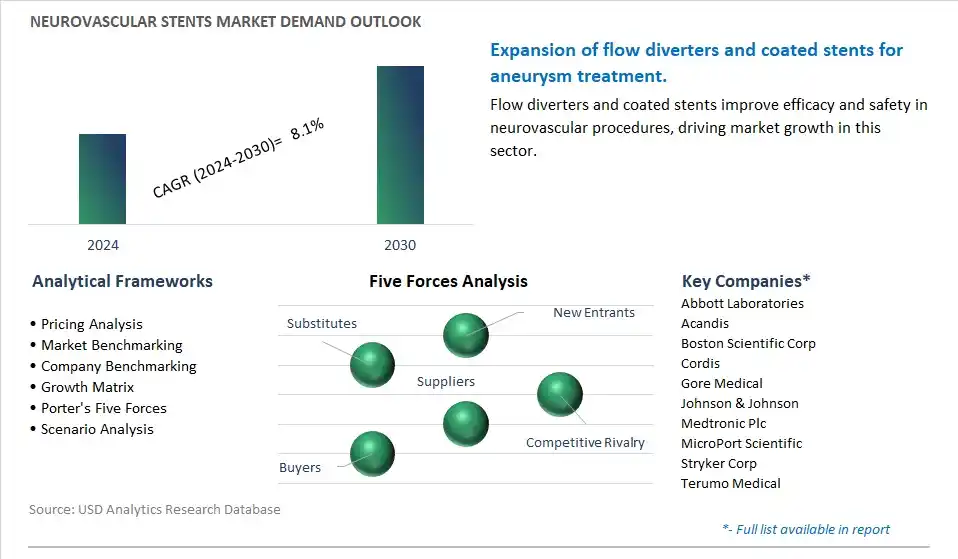
The global Neurovascular Stents Industry is highly competitive with a large number of companies focusing on niche market segments. Amidst intense competitive conditions, Neurovascular Stents Companies are investing in new product launches and strengthening distribution channels. Key companies operating in the Neurovascular Stents Industry include- Abbott Laboratories, Acandis, Boston Scientific Corp, Cordis, Gore Medical, Johnson & Johnson, Medtronic Plc, MicroPort Scientific, Stryker Corp, Terumo Medical.
In the Neurovascular Stents market, a prominent trend is the expansion of indications and treatment modalities. Neurovascular stents are medical devices used to treat intracranial aneurysms, stenosis, and other cerebrovascular diseases by providing structural support and promoting blood flow restoration in the affected vessels. Recent advancements in stent design, materials, and delivery systems have enabled the treatment of a broader range of neurovascular conditions, including complex aneurysms, vessel dissections, and acute ischemic strokes. The development of novel stent configurations, such as flow diverters, intrasaccular devices, and bifurcation stents, offers customized solutions for challenging anatomies and pathology, driving innovation and expanding treatment options in neurovascular interventions.
The primary market driver for Neurovascular Stents is the rising incidence of neurovascular diseases and stroke. Neurovascular diseases, including cerebral aneurysms, arteriovenous malformations (AVMs), and intracranial atherosclerosis, contribute to a significant proportion of cerebrovascular morbidity and mortality globally. Additionally, acute ischemic stroke, resulting from cerebral artery occlusion or embolism, represents a medical emergency requiring prompt intervention to prevent irreversible brain damage and disability. As aging populations and lifestyle-related risk factors contribute to the increasing burden of neurovascular diseases and stroke, there is a growing demand for neurovascular stents that enable safe and effective endovascular treatments, such as stent-assisted coiling, stent placement, and thrombectomy procedures.
An emerging opportunity in the Neurovascular Stents market lies in innovation in next-generation stent technologies. While existing neurovascular stents have demonstrated efficacy in treating cerebrovascular diseases, ongoing research focuses on enhancing stent performance, biocompatibility, and deliverability to optimize treatment outcomes and minimize complications. Advanced stent coatings, such as drug-eluting and bioresorbable polymers, offer potential benefits in reducing neointimal hyperplasia, preventing in-stent restenosis, and promoting vessel healing. Furthermore, the integration of imaging and sensing capabilities into stent platforms enables real-time monitoring of stent deployment, vessel patency, and endothelialization, enhancing procedural safety and postoperative management. Collaborative efforts between engineers, clinicians, and medical device manufacturers drive innovation and accelerate the development of next-generation neurovascular stents, addressing unmet clinical needs and improving patient care in cerebrovascular interventions.
Within the realm of neurovascular stents, the segment experiencing notable growth is intracranial stents. Intracranial stents are specifically designed devices used in the treatment of cerebrovascular conditions such as intracranial stenosis, aneurysms, and arteriovenous malformations. As technological advancements continue to improve the safety and efficacy of intracranial stents, their utilization in neurovascular interventions is steadily increasing. Intracranial stents made from materials like nitinol offer advantages such as flexibility, radial strength, and biocompatibility, making them particularly suitable for navigating the intricate vasculature of the brain. These stents play a crucial role in restoring blood flow, reinforcing vessel walls, and preventing the recurrence of cerebrovascular events, ultimately improving patient outcomes. With the rising incidence of cerebrovascular diseases and an aging population susceptible to stroke and other neurovascular disorders, the demand for intracranial stents is projected to escalate further. Hospitals and ambulatory surgical centers are key end-users driving the adoption of intracranial stents, as they strive to offer state-of-the-art neurointerventional procedures to their patients. This growth is also facilitated by advancements in imaging modalities and minimally invasive techniques, which enhance the precision and safety of intracranial stent placement. As the field of neurovascular intervention continues to evolve, intracranial stents are poised to remain a pivotal component, contributing to improved patient care and outcomes in neurovascular diseases.
By Product
Carotid artery stents
Intracranial stents
By Material
Metal
-Stainless steel
-Nitinol
Polymer
By End-User
Hospitals
Ambulatory Surgical Centers
Others
Geographical Analysis
North America (United States, Canada, Mexico)
Europe (Germany, France, United Kingdom, Spain, Italy, Rest of Europe)
Asia Pacific (China, India, Japan, South Korea, Rest of Asia Pacific)
South America (Brazil, Argentina, Rest of South America)
Middle East and Africa (Saudi Arabia, UAE, Rest of Middle East, South Africa, Egypt, Rest of Africa)
Abbott Laboratories
Acandis
Boston Scientific Corp
Cordis
Gore Medical
Johnson & Johnson
Medtronic Plc
MicroPort Scientific
Stryker Corp
Terumo Medical
* List not Exhaustive
• Deepen your industry insights and navigate uncertainties for strategy formulation, CAPEX, and Operational decisions
• Gain access to detailed insights on the Neurovascular Stents Market, encompassing current market size, growth trends, and forecasts till 2030.
• Access detailed competitor analysis, enabling competitive advantage through a thorough understanding of market players, strategies, and potential differentiation opportunities
• Stay ahead of the curve with insights on technological advancements, innovations, and upcoming trends
• Identify lucrative investment avenues and expansion opportunities within the Neurovascular Stents Industry, guided by robust, data-backed analysis.
• Understand regional and global markets through country-wise analysis, regional market potential, regulatory nuances, and dynamics
• Execute strategies with confidence and speed through information, analytics, and insights on the industry value chain
• Corporate leaders, strategists, financial experts, shareholders, asset managers, and governmental representatives can make long-term planning scenarios and build an integrated and timely understanding of market dynamics
• Benefit from tailored solutions and expert consultation based on report insights, providing personalized strategies aligned with specific business needs.
TABLE OF CONTENTS
1 Introduction to 2024 Neurovascular Stents Market
1.1 Market Overview
1.2 Quick Facts
1.3 Scope/Objective of the Study
1.4 Market Definition
1.5 Countries and Regions Analyzed
1.6 Units, Currency, and Conversions
1.7 Industry Value Chain
2 Research Methodology
2.1 Market Size Estimation
2.2 Sources and Research Methodology
2.3 Data Triangulation
2.4 Assumptions and Limitations
3 Executive Summary
3.1 Global Neurovascular Stents Market Size Outlook, $ Million, 2021 to 2030
3.2 Neurovascular Stents Market Outlook by Type, $ Million, 2021 to 2030
3.3 Neurovascular Stents Market Outlook by Product, $ Million, 2021 to 2030
3.4 Neurovascular Stents Market Outlook by Application, $ Million, 2021 to 2030
3.5 Neurovascular Stents Market Outlook by Key Countries, $ Million, 2021 to 2030
4 Market Dynamics
4.1 Key Driving Forces of Neurovascular Stents Industry
4.2 Key Market Trends in Neurovascular Stents Industry
4.3 Potential Opportunities in Neurovascular Stents Industry
4.4 Key Challenges in Neurovascular Stents Industry
5 Market Factor Analysis
5.1 Value Chain Analysis
5.2 Competitive Landscape
5.2.1 Global Neurovascular Stents Market Share by Company (%), 2023
5.2.2 Product Offerings by Company
5.3 Porter’s Five Forces Analysis
5.4 Pricing Analysis and Outlook
6 Growth Outlook Across Scenarios
6.1 Growth Analysis-Case Scenario Definitions
6.2 Low Growth Scenario Forecasts
6.3 Reference Growth Scenario Forecasts
6.4 High Growth Scenario Forecasts
7 Global Neurovascular Stents Market Outlook by Segments
7.1 Neurovascular Stents Market Outlook by Segments, $ Million, 2021- 2030
By Product
Carotid artery stents
Intracranial stents
By Material
Metal
-Stainless steel
-Nitinol
Polymer
By End-User
Hospitals
Ambulatory Surgical Centers
Others
8 North America Neurovascular Stents Market Analysis and Outlook To 2030
8.1 Introduction to North America Neurovascular Stents Markets in 2024
8.2 North America Neurovascular Stents Market Size Outlook by Country, 2021-2030
8.2.1 United States
8.2.2 Canada
8.2.3 Mexico
8.3 North America Neurovascular Stents Market size Outlook by Segments, 2021-2030
By Product
Carotid artery stents
Intracranial stents
By Material
Metal
-Stainless steel
-Nitinol
Polymer
By End-User
Hospitals
Ambulatory Surgical Centers
Others
9 Europe Neurovascular Stents Market Analysis and Outlook To 2030
9.1 Introduction to Europe Neurovascular Stents Markets in 2024
9.2 Europe Neurovascular Stents Market Size Outlook by Country, 2021-2030
9.2.1 Germany
9.2.2 France
9.2.3 Spain
9.2.4 United Kingdom
9.2.4 Italy
9.2.5 Russia
9.2.6 Norway
9.2.7 Rest of Europe
9.3 Europe Neurovascular Stents Market Size Outlook by Segments, 2021-2030
By Product
Carotid artery stents
Intracranial stents
By Material
Metal
-Stainless steel
-Nitinol
Polymer
By End-User
Hospitals
Ambulatory Surgical Centers
Others
10 Asia Pacific Neurovascular Stents Market Analysis and Outlook To 2030
10.1 Introduction to Asia Pacific Neurovascular Stents Markets in 2024
10.2 Asia Pacific Neurovascular Stents Market Size Outlook by Country, 2021-2030
10.2.1 China
10.2.2 India
10.2.3 Japan
10.2.4 South Korea
10.2.5 Indonesia
10.2.6 Malaysia
10.2.7 Australia
10.2.8 Rest of Asia Pacific
10.3 Asia Pacific Neurovascular Stents Market size Outlook by Segments, 2021-2030
By Product
Carotid artery stents
Intracranial stents
By Material
Metal
-Stainless steel
-Nitinol
Polymer
By End-User
Hospitals
Ambulatory Surgical Centers
Others
11 South America Neurovascular Stents Market Analysis and Outlook To 2030
11.1 Introduction to South America Neurovascular Stents Markets in 2024
11.2 South America Neurovascular Stents Market Size Outlook by Country, 2021-2030
11.2.1 Brazil
11.2.2 Argentina
11.2.3 Rest of South America
11.3 South America Neurovascular Stents Market size Outlook by Segments, 2021-2030
By Product
Carotid artery stents
Intracranial stents
By Material
Metal
-Stainless steel
-Nitinol
Polymer
By End-User
Hospitals
Ambulatory Surgical Centers
Others
12 Middle East and Africa Neurovascular Stents Market Analysis and Outlook To 2030
12.1 Introduction to Middle East and Africa Neurovascular Stents Markets in 2024
12.2 Middle East and Africa Neurovascular Stents Market Size Outlook by Country, 2021-2030
12.2.1 Saudi Arabia
12.2.2 UAE
12.2.3 Oman
12.2.4 Rest of Middle East
12.2.5 Egypt
12.2.6 Nigeria
12.2.7 South Africa
12.2.8 Rest of Africa
12.3 Middle East and Africa Neurovascular Stents Market size Outlook by Segments, 2021-2030
By Product
Carotid artery stents
Intracranial stents
By Material
Metal
-Stainless steel
-Nitinol
Polymer
By End-User
Hospitals
Ambulatory Surgical Centers
Others
13 Company Profiles
13.1 Company Snapshot
13.2 SWOT Profiles
13.3 Products and Services
13.4 Recent Developments
13.5 Financial Profile
List of Companies
Abbott Laboratories
Acandis
Boston Scientific Corp
Cordis
Gore Medical
Johnson & Johnson
Medtronic Plc
MicroPort Scientific
Stryker Corp
Terumo Medical
14 Appendix
14.1 Customization Offerings
14.2 Subscription Services
14.3 Related Reports
14.4 Publisher Expertise
By Product
Carotid artery stents
Intracranial stents
By Material
Metal
-Stainless steel
-Nitinol
Polymer
By End-User
Hospitals
Ambulatory Surgical Centers
Others
The global Neurovascular Stents Market is one of the lucrative growth markets, poised to register a 8.1% growth (CAGR) between 2024 and 2030.
Emerging Markets across Asia Pacific, Europe, and Americas present robust growth prospects.
Abbott Laboratories, Acandis, Boston Scientific Corp, Cordis, Gore Medical, Johnson & Johnson, Medtronic Plc, MicroPort Scientific, Stryker Corp, Terumo Medical
Base Year- 2023; Estimated Year- 2024; Historic Period- 2018-2023; Forecast period- 2024 to 2030; Currency: USD; Volume